
Transform your workspace with our pro office painting guide. We cover planning, choosing durable paints like Scuff-X, and detailed pricing to ensure a flawless finish.
Key Takeaways
- **Night and Weekend Work:** Probably 80% of our occupied-space jobs happen when your team's gone home. We show up Thursday at 6 PM, work through the night, and by Friday morning everything's painted, dried, and your team walks into a finished space. Nobody's disrupted. No productivity lost. No clients seeing tarps and paint cans during a meeting. Yeah, specialized scheduling runs about 1.5x normal labor rates, but compare that to losing three days of productivity or rescheduling client meetings. The math works out.
- **Smart Zoning & Phasing:** One section at a time. We isolate whatever area we're painting with 4 mil poly sheeting, zippered enclosures, containment barriers that meet ICRA standards (same protocols hospitals use during renovations). Maybe we knock out the accounting department's offices overnight, then move to marketing the next night. Rest of the office? Functions completely normally. This phased approach also lets us move furniture strategically with industrial-grade, non-abrasive coverings so nothing gets dinged up.
- **Low-Odor, Low-VOC Paints:** Every product we stock is low-VOC — Sherwin-Williams ProMar 200 Zero VOC, Benjamin Moore Eco Spec. These meet Green Seal standards and keep VOCs under 50 g/L for flat finishes. Your team won't smell a thing. No headaches, no complaints, no weird chemical taste in their morning coffee. We've got spec sheets showing exact VOC levels and GreenGuard certifications if you need them for LEED or WELL compliance.
- **Advanced Dust and Fume Containment:** HEPA air scrubbers that catch 99.97% of particles down to 0.3 microns. Negative air pressure setups with industrial fans. Strategic ventilation that actually pulls contaminants out instead of just pushing them around. Dust doesn't migrate to occupied zones. Odors get actively removed. We follow the same protocols you'd see in hospital renovations — that's how serious we're about indoor air quality.
- **Clear Communication Protocols:** Daily email updates. Clearly marked work zones with signage ("Work in Progress," "Wet Paint — seriously, don't touch"). Designated contact person for immediate concerns (you've got our project manager's cell). We hold a pre-project meeting to outline all logistical arrangements, so potential issues get caught before they become actual problems.
Key Takeaways
Office Painting Guide: Pro Tips For a Flawless Finish & Boosted Morale
A guy in Buckhead spent $8,400 on an office repaint last spring. His crew came in over a weekend, used whatever paint was on sale, and by Tuesday morning his entire team was complaining about headaches. Three people went home sick. The smell lingered for two weeks.
Could've been avoided with about $200 worth of better paint and a plan that actually made sense.
Look — look, a professional office paint job can completely transform how your team feels about coming to work, how clients perceive your business, and how well your building holds up over time. But — and this is important — you've got to get it right. A rushed or poorly planned job creates more problems than it solves: disruption that kills productivity, surprise costs that blow your budget, even health complaints from fumes. Our team of experienced **commercial painters** knows how to handle workspace transformations without bringing your business to a halt. We've spent over twenty years figuring out the details that matter — material choices, timing, air quality — so you get a finish that actually lasts and looks professional.
The Transformative Power of Professional Office Painting: Beyond Aesthetics and into Productivity
A professional paint job does way more than make your office look nice. It directly affects how your employees work, how clients perceive you, and how long your building's interior holds up. That's the real issue. Studies back this up — a clean, well-maintained space genuinely improves employee satisfaction and focus. The right colors can spark creativity, lower stress levels, and reinforce your brand just by existing in the background.
On the flip side? Peeling paint or that depressing beige from 2003 sends a message too.
It says "we don't really care about this place."
Which tanks morale and makes potential clients wonder what else you're letting slide. We've been doing this for over two decades, so we get these nuances. Our approach considers the whole picture — not just how it looks, but how it affects psychology, environment, and your bottom line.
Psychological Impact of Color in the Workplace: A Strategic Approach to Well-being
I've watched color choices tank morale and I've watched them fix it. One law firm in Midtown — they painted everything battleship gray thinking it looked "serious." Six months later, three paralegals quit citing the "depressing environment." We came in with warm neutrals and strategic blue accents in the conference rooms.
Here's the thing: blues and greens are workhorses. They just are. You want focus? Use these in main work areas, executive offices, meeting rooms. Green cuts eye strain (everyone's glued to screens anyway) while blue genuinely calms people down — lowers heart rate, sharpens thinking. There's a 2017 study in the *Journal of Environmental Psychology* claiming the right colors boost efficiency up to 15%.
Yellows bring energy. Break rooms, creative spaces, anywhere you want people brainstorming. But careful — too much yellow and people get irritated instead of inspired. I usually go with softer, buttery tones rather than pure lemon.
Reds? They amp things up — literally increase heart rate. Small doses work great for accent walls in decision-making areas where you need people alert. Grays and whites are your safe bet for that clean, sophisticated backdrop. That's the real issue. They make spaces feel bigger, reflect more light (especially semi-gloss), and they don't compete with your branding or artwork.
Our design consultants match your palette to your actual company culture, not some generic office template we pull from a catalog.
Enhancing Brand Identity and Client Perception Through Strategic Color Integration
Here's what happens when someone walks into your office: they form an opinion in about seven seconds. That's it. Seven seconds before they've decided if you're legit or not.
Your walls are talking whether you planned for it or not. Fresh paint in your brand colors? That's saying "we pay attention to details." Scuffed baseboards and that mystery stain by the conference room? Different message entirely. We worked with a tech startup in Bucktown that wanted to project innovation — we used their brand's electric blue as an accent wall in the lobby, kept everything else crisp white with charcoal trim. Their investor meetings went differently after that. People commented on it.
You can go subtle with this (accent walls that echo your logo) or bold (entire departments color-coded to different brand values). Point is, you're either using color strategically or you're leaving money on the table. Your office should feel like an extension of your marketing materials, not some beige box you rent.
Strategic Planning: The Foundation of a Successful Office Painting Project
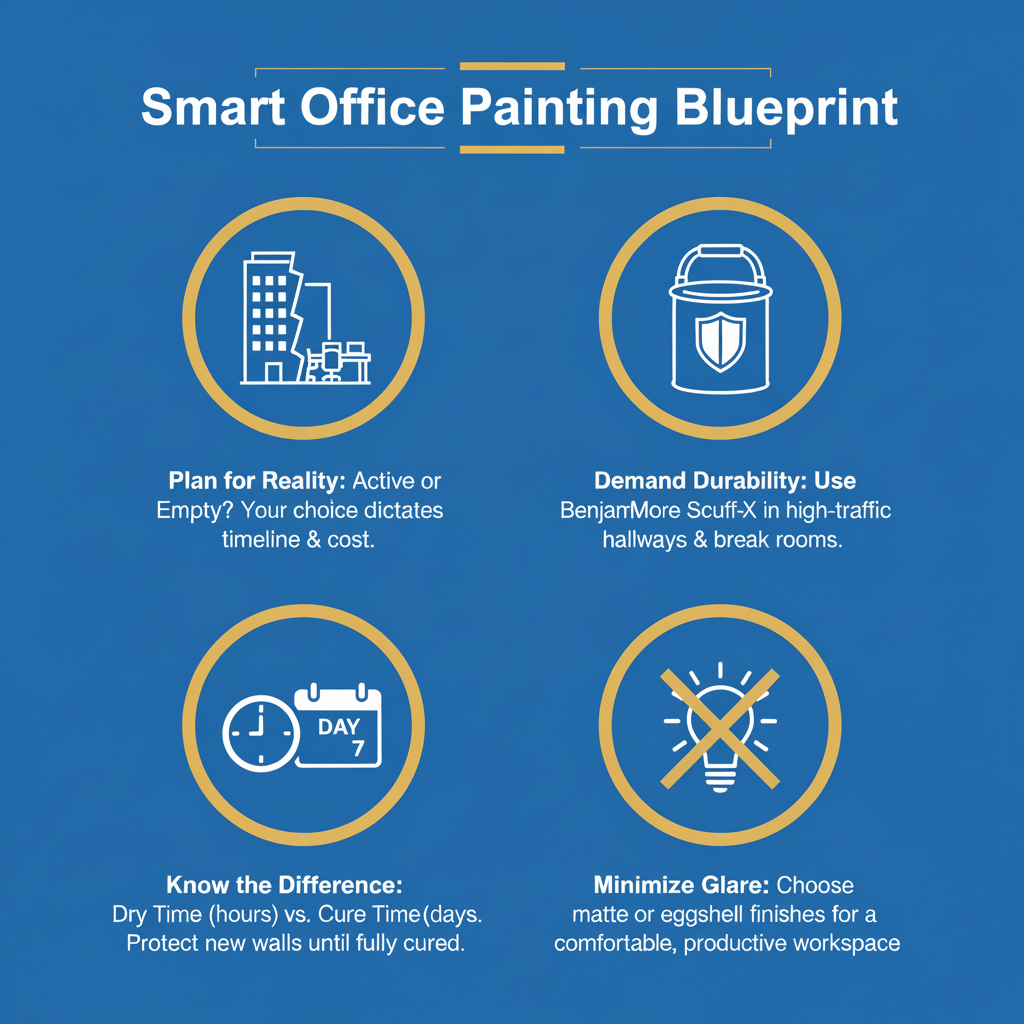
So you're ready to paint. First question you've got to answer: is this space empty or are people working in it right now? Because that decision changes literally everything — your timeline, your budget, how you approach the whole project.
We handle both. We've done hundreds of after-hours jobs where your team never even knows we were there. The planning phase covers scope definition, timeline development, material selection (including LEED-compliant options if that's your thing), budget allocation, and contingency planning. That's the real issue. For more on maximizing efficiency in commercial renovations across various sectors, explore our detailed guide on [commercial painting services](https://www.bizzfactor.com/commercial-painting-services).
Painting an Unoccupied Office: The Ideal Scenario for Efficiency
Empty space before furniture shows up? New lease situation? Everyone's already moved out for a bigger renovation?
These are the jobs where we move fastest and you pay the least.
Why? No furniture to shuffle around every night. No employees working three feet from wet paint. No equipment we're terrified of damaging. No Bob in accounting yelling because we're using a sprayer while he's on a client call. We bring in a full crew, blast through the space, and we're done 25-40% faster than occupied jobs. Maybe three days instead of five. Labor costs drop 10-15% because we're not constantly setting up and breaking down protective barriers or scheduling around your business hours.
The paint cures better too. We control airflow, temperature, everything. No compromises.
Navigating an Occupied Office: Precision, Protocol, and Professionalism as a Standard
But what if you can't just shut down for a week? That's most businesses, honestly. Painting around people who are actively working requires a completely different playbook — and you really need a crew that's done this a thousand times. Not kidding. Our OSHA-certified project managers work directly with your facility team to develop a detailed strategy.
- **Night and Weekend Work:** Probably 80% of our occupied-space jobs happen when your team's gone home. We show up Thursday at 6 PM, work through the night, and by Friday morning everything's painted, dried, and your team walks into a finished space. Nobody's disrupted. No productivity lost. No clients seeing tarps and paint cans during a meeting. Yeah, specialized scheduling runs about 1.5x normal labor rates, but compare that to losing three days of productivity or rescheduling client meetings. The math works out.
- **Smart Zoning & Phasing:** One section at a time. We isolate whatever area we're painting with 4 mil poly sheeting, zippered enclosures, containment barriers that meet ICRA standards (same protocols hospitals use during renovations). Maybe we knock out the accounting department's offices overnight, then move to marketing the next night. Rest of the office? Functions completely normally. This phased approach also lets us move furniture strategically with industrial-grade, non-abrasive coverings so nothing gets dinged up.
- **Low-Odor, Low-VOC Paints:** Every product we stock is low-VOC — Sherwin-Williams ProMar 200 Zero VOC, Benjamin Moore Eco Spec. These meet Green Seal standards and keep VOCs under 50 g/L for flat finishes. Your team won't smell a thing. No headaches, no complaints, no weird chemical taste in their morning coffee. We've got spec sheets showing exact VOC levels and GreenGuard certifications if you need them for LEED or WELL compliance.
- **Advanced Dust and Fume Containment:** HEPA air scrubbers that catch 99.97% of particles down to 0.3 microns. Negative air pressure setups with industrial fans. Strategic ventilation that actually pulls contaminants out instead of just pushing them around. Dust doesn't migrate to occupied zones. Odors get actively removed. We follow the same protocols you'd see in hospital renovations — that's how serious we're about indoor air quality.
- **Clear Communication Protocols:** Daily email updates. Clearly marked work zones with signage ("Work in Progress," "Wet Paint — seriously, don't touch"). Designated contact person for immediate concerns (you've got our project manager's cell). We hold a pre-project meeting to outline all logistical arrangements, so potential issues get caught before they become actual problems.
⚠️ The #1 Office Painting Mistake to Avoid: Confusing Dry Time with Cure Time
This drives me insane because it happens constantly.
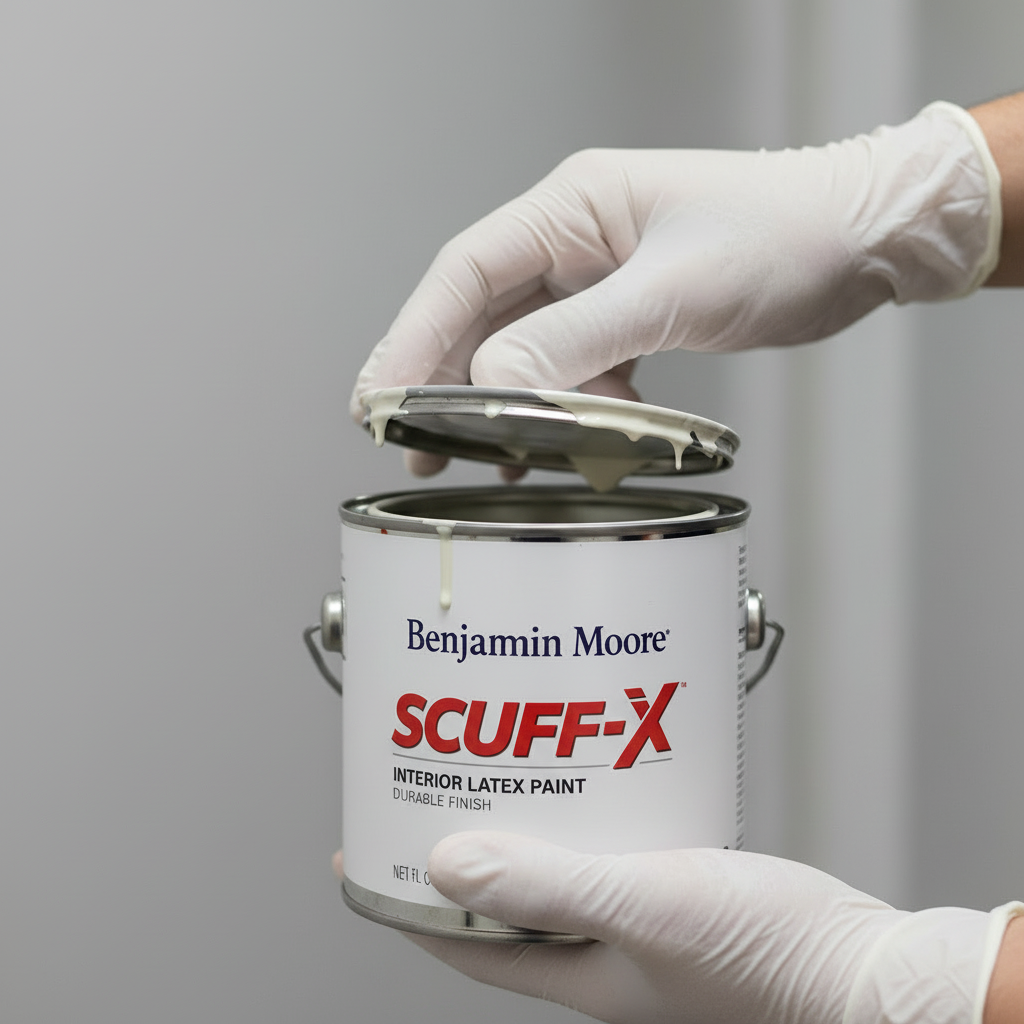
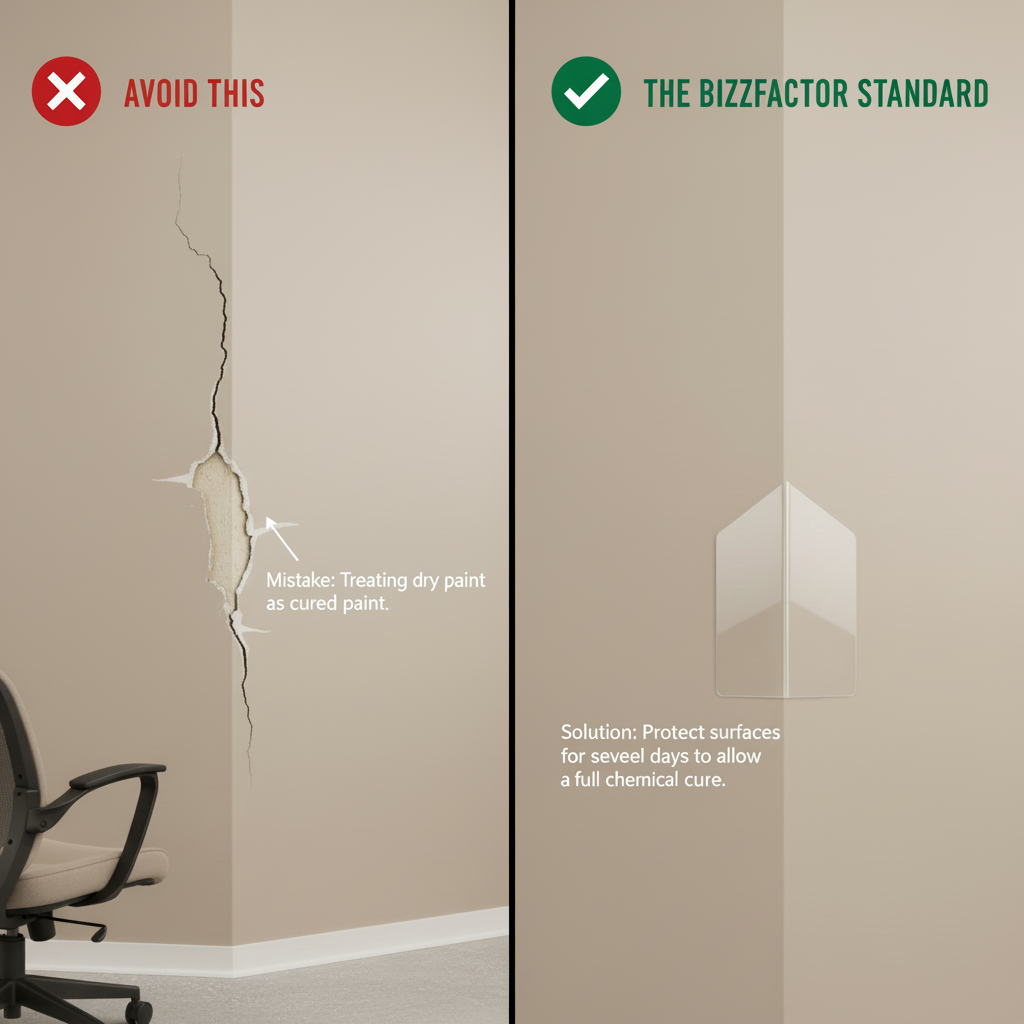
Contractor paints overnight. By morning, walls feel dry to the touch (usually 1-4 hours for latex). They look ready. Employees return to work, someone bumps a chair into the freshly painted wall, and now there's a mark that won't come out.
The paint felt dry. But it wasn't cured.
"Dry" just means the surface solvents evaporated. The paint film is still soft, porous, vulnerable. Full cure — when the paint's actually hardened into a durable finish — takes 2-4 weeks depending on humidity, temperature, ventilation, how thick you applied it. An accounting firm in River North learned this the expensive way last year — they moved furniture back in 48 hours after painting, and within a week had scuff marks on every wall that touched a desk or filing cabinet. We had to come back and do touch-ups on probably 30% of the surfaces. Cost them an extra $1,800.
Here's what actually works: coordinate your furniture return with cure time, not dry time. We typically recommend waiting at least 5-7 days before
In-Depth Look
Detailed illustration of key concepts
Visual Guide
Infographic illustration for this topic
Side-by-Side Comparison
Visual comparison of options and alternatives
Sources & References
- Interior Painting Tips: Best Practices From an Expert
- The Secrets of Pro Painters: Mastering Interior Painting ...
- Everything You Need To Know About Working With A Painter
- Painting Walls LIke a Professional Painter: Start to Finish
- What Should You Expect From House ...
- Best Interior & Exterior Paint Buying Guide - Consumer Reports
- Navigating Painting Rules for Commercial Buildings Made Simple
- Best Paint for Commercial Buildings - Miko LLC
- Building Codes, Standards, and Regulations: Frequently Asked ...
- Best Industrial Painting Brands: A 2025 Comparison Guide
Frequently Asked Questions
Need Professional Help?
Find top-rated house painters experts in your area