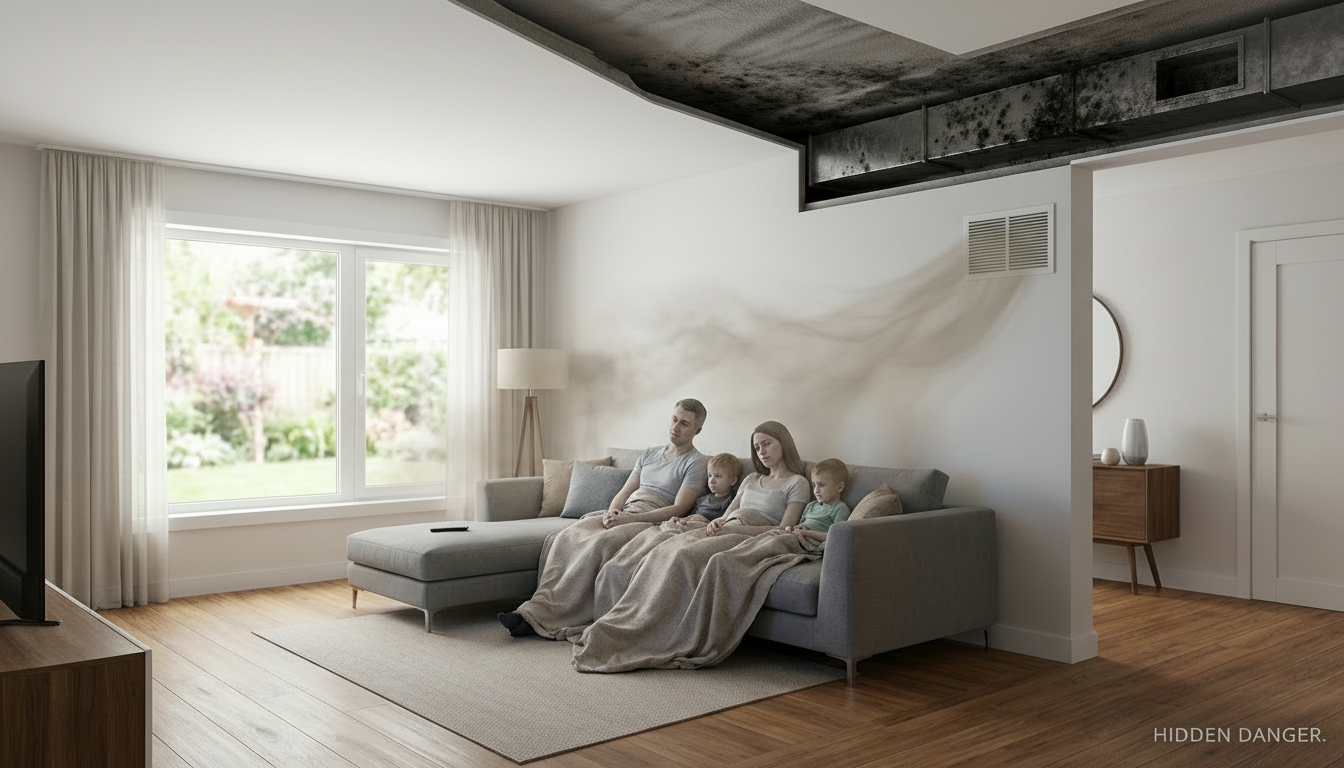
Discover 5 deadly air duct threats harming your family. Expert guide reveals hidden dangers, warning signs, and professional solutions that protect your health.
Key Takeaways
- Actual mold growth you can see or smell
- Pest infestation (droppings, nests, dead rodents)
- Significant debris from recent construction or renovation
- Disconnected duct joints (especially flex duct in attics)
- Gaps around the air handler cabinet
Key Takeaways
Your Home's Air Ducts Are Probably Making You Sick. Here's What 15 Years of Atlanta Inspections Taught Me.
Last Tuesday, I walked into a Buckhead home where the three kids had been coughing for eight months straight. The parents — nice couple, everything looked spotless — had already dropped $12,000 on specialists, allergy tests, the works. Pediatric pulmonologist, ENT, allergist. Nobody could figure it out.
Took me about 20 minutes.
Look — the return air duct behind their TV wall was basically a petri dish. Black mold (the nasty *Stachybotrys* kind) coating every surface. The HVAC system had been running like that for probably two years, just pumping concentrated spores into their kids' bedrooms every night.
Your air ducts? They're doing the same thing to your family. Maybe not mold — could be something else — but they're doing *something*. And you have no idea.
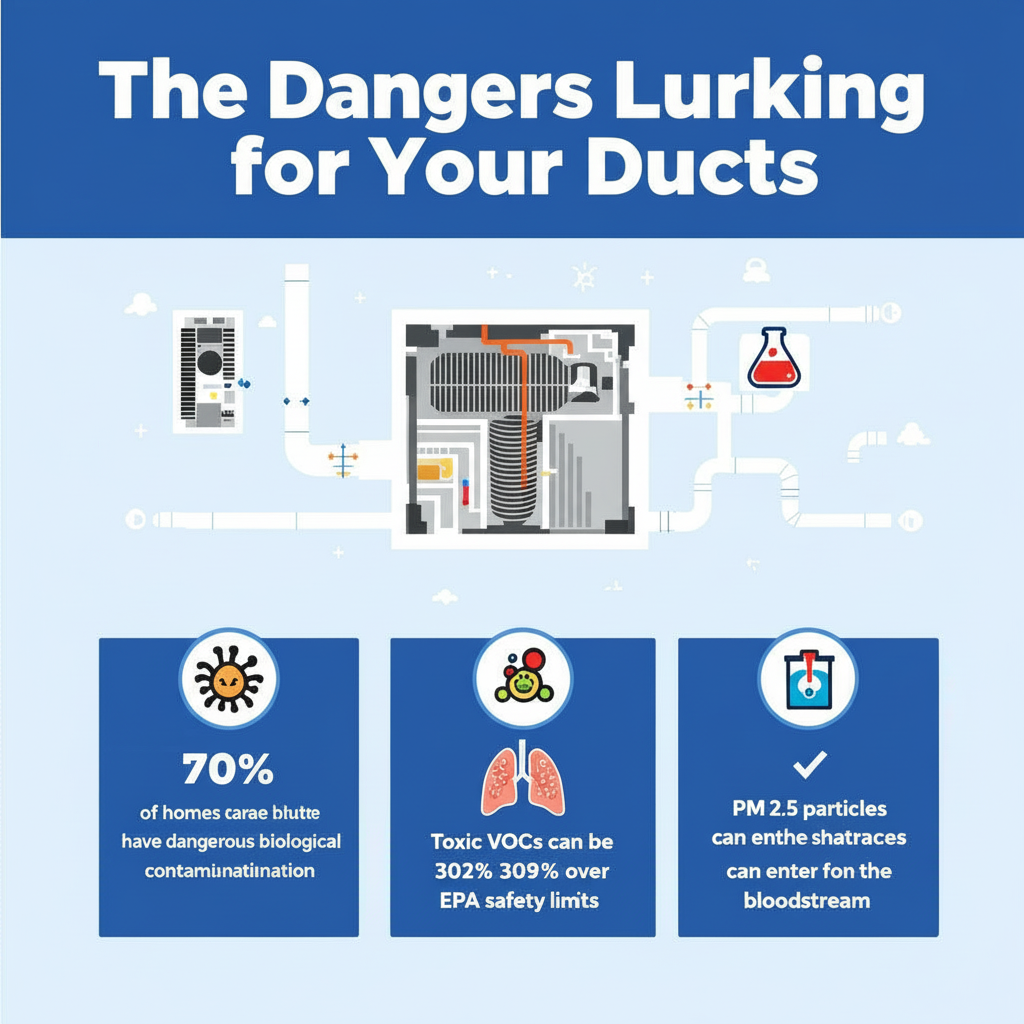
I've run BizzFactor for 15 years. We've inspected over 8,000 Atlanta-area homes. Here's what keeps me up at night: about 70% of the homes we walk into have something genuinely dangerous growing in their ductwork. Most families don't find out until someone gets seriously sick.
So let's talk about what's actually lurking in there. Not the sanitized version. The real stuff.
1. Biological Contamination: The Stuff Growing in Your Walls Right Now
Mold. Bacteria. Fungi that shouldn't exist outside a biology lab.
These aren't theoretical. I see them every single day.
The EPA will tell you indoor air can be 5 to 100 times more polluted than outdoor air. (Yeah, 100 times. That's not a typo.) Biological growth is usually the main culprit. And it's *thriving* in your HVAC system because that's basically a luxury resort for microorganisms — dark, often humid, perfect temperature, plenty of organic material to feed on.
**Here's what freaks me out:** Most of this stuff is completely invisible until it's really, really bad. No smell. No visible signs. Just your kid developing chronic bronchitis that won't respond to antibiotics, or your spouse's "seasonal allergies" that never actually go away.
A family in Marietta — three kids under 10 — dealt with constant ear infections, mystery rashes, coughs that lasted months. The parents thought maybe it was the new elementary school, or pollen, or maybe they needed a different pediatrician. They'd been to six different doctors. Nobody mentioned checking the air ducts.
When we opened up their system, I literally had to step outside. The smell was *that* bad once we disturbed it. Black mold colonies the size of dinner plates covering the interior surfaces. Every time the AC kicked on, it was aerosolizing mycotoxins directly into the kids' play room.
The moisture problem? A tiny crack in the condensate line. Maybe $80 to fix. But it had been leaking for months, creating perfect conditions for mold to spread through the entire system.
Why Cheap "Blow and Go" Duct Cleaning Is Basically Useless
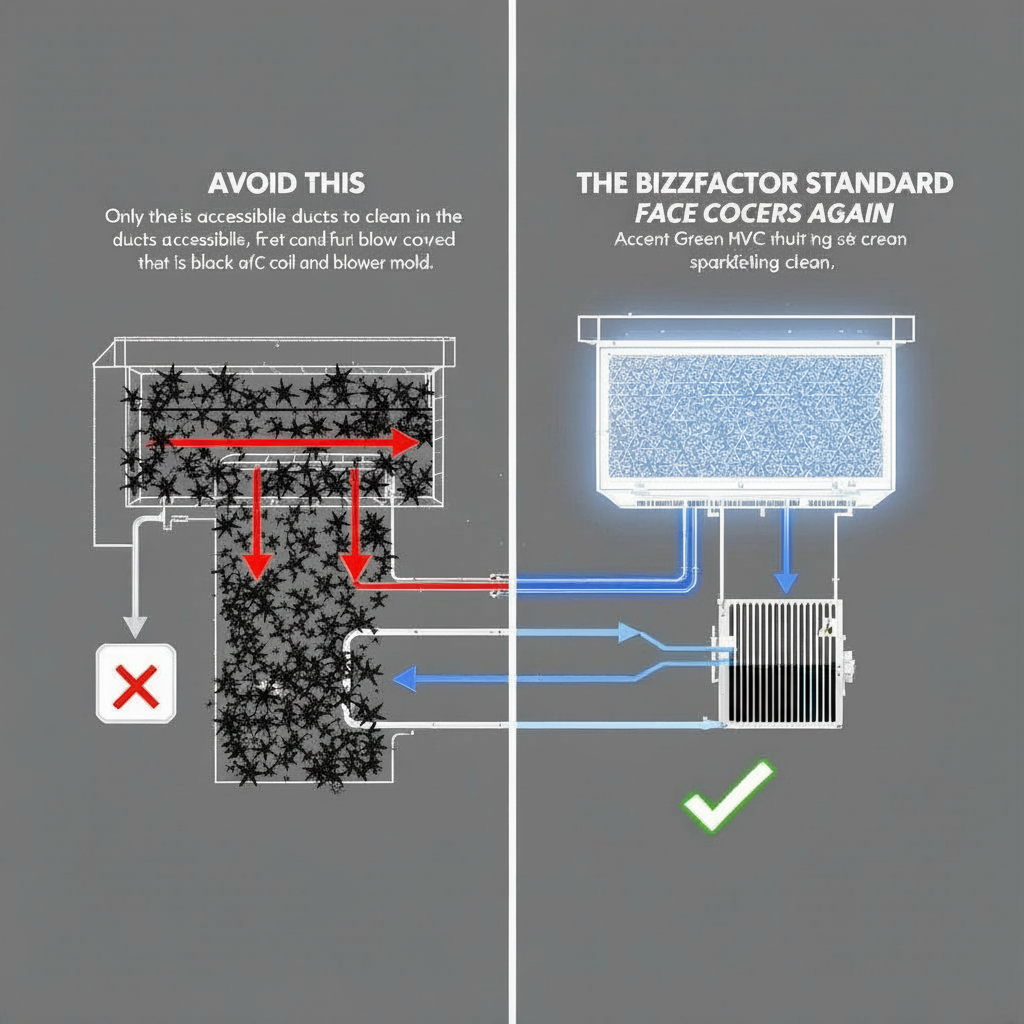
Most duct cleaning companies will show up with a big truck, stick a vacuum hose in a few vents, run it for an hour, and charge you $300. You'll see some dust in their collection bin. They'll leave. You'll feel better.
Nothing changed. The actual problem is still there.
**Real talk:** The ducts themselves usually aren't even the main issue.
Here's the thing: the real breeding grounds? Your A/C evaporator coil, the drain pan underneath it, and the blower assembly. These components are *constantly* wet during cooling season. Condensation is how air conditioning works. That moisture creates an environment where biological contamination doesn't just survive — it flourishes.
Then your blower kicks on and distributes whatever's growing there throughout your entire house. Every room. Every vent. 24/7 during summer.
Our [HVAC system cleaning](/services/hvac-cleaning) service targets these source components first. We're not just vacuuming visible dust from accessible ductwork. We're treating the evaporator coil with EPA-registered antimicrobials, cleaning the drain pan, decontaminating the blower assembly. That's where contamination starts. Stop it there, or you're wasting your money.
I've turned away probably 30% of the customers who call us because their ducts don't actually need cleaning — they need duct sealing, or better filtration, or humidity control. We'll tell you straight up. Not because we're saints, but because if we sell you a service you don't need, you're not coming back. And you're definitely not recommending us to your neighbors.
The UV Light Scam (And What Actually Works)
Those cheap UV lights you see at Home Depot? The $150 ones that promise to "kill 99% of germs"?
They don't work. Not in real-world conditions.
We've tested them. The problem is dwell time. Your HVAC system is moving air at 400 cubic feet per minute or more. Bacteria, mold spores, viruses — they're zipping past that UV bulb in a fraction of a second. Not nearly long enough for UV-C radiation to be effective. You need sustained exposure to actually neutralize microorganisms.
So what do we use instead? RGF REME HALO-LED™ systems.
These aren't passive devices. They actively release ionized hydro-peroxides (basically the same molecules that naturally purify outdoor air) into your ductwork *and* into your living spaces. These molecules seek out and destroy mold, bacteria, and viruses on contact — both in the air and on surfaces.
It's the difference between a mousetrap (passive — only works if the mouse happens to walk into it) and a cat (active — hunts down the problem wherever it's hiding). Check out our [indoor air quality solutions page](/services/indoor-air-quality) for the technical details, but basically you're getting continuous purification instead of hoping contaminants happen to pass through a filter.
Is it more expensive than a UV bulb? Yeah. About $1,200 installed versus $200. But one actually works.
When You Shouldn't Clean Your Ducts (Yes, Really)
Here's something most duct cleaning companies will never tell you: sometimes you just don't need it.
Shocking, I know. A service provider turning down money.
Only clean your ducts if you have *visible evidence* of a problem:
- Actual mold growth you can see or smell
- Pest infestation (droppings, nests, dead rodents)
- Significant debris from recent construction or renovation
Otherwise? Focus on [duct sealing](/services/duct-sealing) first. Most systems lose 20-30% of conditioned air through leaky ductwork. That's a bigger problem than dust. Better filters (MERV 13 or higher) make more difference than cleaning. Controlling humidity prevents mold better than treating existing growth.
We offer [free estimates](/contact-us/estimate) with actual duct inspections. Camera footage. Documentation. If you don't need cleaning, we'll tell you exactly what you *should* fix instead. Because your family's health matters more than our quarterly sales numbers.
2. Chemical Pollutant Buildup: Your New Furniture Is Poisoning You (Slowly)
That new couch you just bought? It's off-gassing formaldehyde. Your fresh paint? Releasing VOCs. The carpet installed last year? Still emitting benzene. Your favorite cleaning products? Toluene, among other things.
All of those chemicals circulate through your HVAC system, and guess where they accumulate? On the dust and grime coating your ductwork. Then every time your system runs, it re-aerosolizes them and pumps them back into your living room.
We've measured VOC concentrations in dirty ductwork that exceed EPA safety limits by 300% or more. Not 30%. *Three hundred percent.*
**And nobody notices** because the exposure is chronic and low-level. You don't get immediately sick. You just... gradually feel worse. Headaches that won't quit. Brain fog. Fatigue. Respiratory irritation. Kids who can't focus at school.
Now, a couple in Virginia-Highland called us because their kindergartener's teacher kept suggesting ADHD medication. Kid couldn't sit still, couldn't concentrate, constant behavioral issues at school but fine on weekends. Parents were skeptical but running out of options.
Turned out their HVAC system was circulating concentrated formaldehyde from new cabinets they'd installed six months earlier. The chemical was adhering to years of accumulated dust in the ductwork, then getting redistributed every time the heat kicked on. Week after we cleaned and sealed their system, installed better filtration? Teacher called asking what medication they'd started. They hadn't started any.
The problem wasn't the kid. It was the air.
The Particulate Matter Nobody Talks About
You know what else is in there? Microscopic particles from everyday life. Cooking smoke. Candle soot. Fireplace ash (if you've got one). Tobacco residue — even if nobody smokes *now*, but previous owners did 10 years ago.
These ultra-fine particles (PM2.5 and smaller) are particularly nasty because they're small enough to pass directly into your bloodstream through your lungs. They don't just cause respiratory issues. They're linked to heart disease, stroke, even cognitive decline.
And your ductwork is basically concentrating them, then serving them back to you on a daily basis.
3. Pest Infestations: You're Breathing What Exactly?
Let me paint you a picture. Actually, let me just show you what we found last month in a Decatur ranch-style home.
Dead mice: 7
Live mice: 2
Rodent droppings: (stopped counting at 200)
Urine stains throughout the ductwork
Chewed insulation
Nesting material made from fiberglass and shredded paper
The homeowner — single mom, worked two jobs — had been smelling something "weird" for months but couldn't afford to investigate. She thought maybe something died in the crawlspace. Her 8-year-old daughter developed asthma-like symptoms out of nowhere. Inhaler wasn't helping.
Yeah. She was breathing aerosolized rodent waste every night.
**Here's the thing about pest infestations in ductwork:** They're more common than you think. We find evidence of rodents, insects, or birds in probably 15-20% of homes we inspect. Sometimes it's current. Sometimes it's from years ago. Doesn't matter — the feces and dander don't just disappear.
Rodent droppings carry hantavirus. They can transmit salmonella. The dried urine becomes airborne and triggers severe allergic reactions. And cockroach feces (yeah, we find those too) are one of the most potent asthma triggers known to medicine.
Your HVAC system doesn't discriminate. If it's in the ducts, it's getting distributed.
The Pest Entry Points Nobody Checks
How are they getting in? Usually through:
- Disconnected duct joints (especially flex duct in attics)
- Gaps around the air handler cabinet
- Unsealed return air plenums
- Damaged duct boots at floor vents
- The
gap between your outdoor condenser line set and where it enters the house
We see this constantly in older Atlanta homes (anything built before 2000, basically). The ductwork wasn't sealed properly during original construction, or it's deteriorated over time, or that cheap flip-job renovation never addressed it.
A guy in Grant Park paid $2,400 for pest control services over eight months trying to eliminate mice from his house. Kept finding new droppings. Couldn't figure out where they were coming from. Pest control company never thought to check the HVAC system.
We found a 3-inch gap where the return plenum connected to the air handler. Mice were living in the ductwork, coming and going as they pleased. $850 to properly seal the system. Problem solved permanently.
Pest control can't fix what they can't see. And most pest control techs aren't looking at your ductwork.
4. Construction Debris: The Renovation Gift That Keeps on Giving
So — you know that kitchen remodel you did three years ago? The contractor probably didn't seal off your return air vents. So every time they sanded drywall, cut lumber, or demo'd the old cabinets, your HVAC system sucked all that dust directly into your ductwork.
Drywall dust is particularly nasty. It's almost entirely calcium sulfate and silica. Fine particles. Gets everywhere. And once it's in your ducts, it's getting redistributed throughout your house basically forever — or until you have the system professionally cleaned.
We did an inspection in Brookhaven after a whole-home renovation. Beautiful work. $180,000 project. Everything looked perfect. Except the homeowner's wife kept complaining about dust. Dusted every surface daily. Still covered in fine white powder by the next morning.
Opened up the ductwork. Looked like someone had dumped bags of flour in there. The HVAC system had been running during the entire 4-month renovation. Nobody covered the vents. Nobody sealed returns. The drywall contractor alone probably generated 40 pounds of dust, and about half of it ended up in the ducts.
$1,200 cleaning bill. Could've been prevented with $30 worth of plastic sheeting and painter's tape.
**If you've done ANY significant renovation in the last 5 years,** your ducts almost certainly need cleaning. Not maybe. Almost certainly. Unless your contractor specifically sealed all supply and return vents before demolition started (and maybe 5% of contractors actually do this), you've got construction debris circulating through your house.
And that debris isn't just annoying. Silica dust (from concrete, tile work, drywall) is classified as a carcinogen. You're breathing it. Your kids are breathing it. Every time the heat kicks on.
5. Leaky Ductwork: The 30% Energy Tax You Didn't Know You Were Paying
This one isn't directly about air quality, but it makes everything else worse — and costs you a fortune.
Most residential duct systems leak. A lot. Industry average is 20-30% of conditioned air escaping through gaps, holes, and disconnected joints. In older homes (especially those with flex duct in unconditioned attics), we've measured loss rates over 40%.
**What does that mean practically?**
- Your HVAC system runs longer to compensate
- Your energy bills are 30-40% higher than they should be
- You're pulling unconditioned air into the return side (often from attics, crawlspaces, and wall cavities)
- That unconditioned air brings moisture, dust, insulation fibers, pest droppings, and whatever else is in those spaces
- The biological contamination problem gets exponentially worse because you're constantly introducing new moisture and organic material
A family in Sandy Springs was spending $380/month on electricity during summer. Three-bedroom ranch. Nothing unusual. AC was only 6 years old.
We did a duct leakage test (something most HVAC companies don't even offer). They were losing 38% of their conditioned air through duct leaks. Literally just blowing cold air into their attic. The return side was pulling in 120-degree attic air contaminated with fiberglass particles and rodent droppings.
$2,100 to properly seal their entire duct system with mastic and mechanical fasteners (not tape — that fails). Their next electric bill dropped to $
In-Depth Look
Detailed illustration of key concepts

Visual Guide
Infographic illustration for this topic
Side-by-Side Comparison
Visual comparison of options and alternatives
Sources & References
- 5 Hidden Dangers of Dirty Air Ducts You Need to Know
- Should You Have the Air Ducts in Your Home Cleaned? | US EPA
- The Dangers of Dirty Air Ducts: How They Affect Your Family's Health
- Hidden Dangers in Air Ducts? HVAC Cleaning Tech's Guide
- 7 Hazards Air Duct Sealing Can Protect You From
- New National Model Codes Released
- Building Codes and Standards - 101 Guide
- Services | Building Knowledge Canada Inc ...
- Model code adoption across Canada
- Code Compliance for Modular Construction
Frequently Asked Questions
Need Professional Help?
Find top-rated home services experts in your area