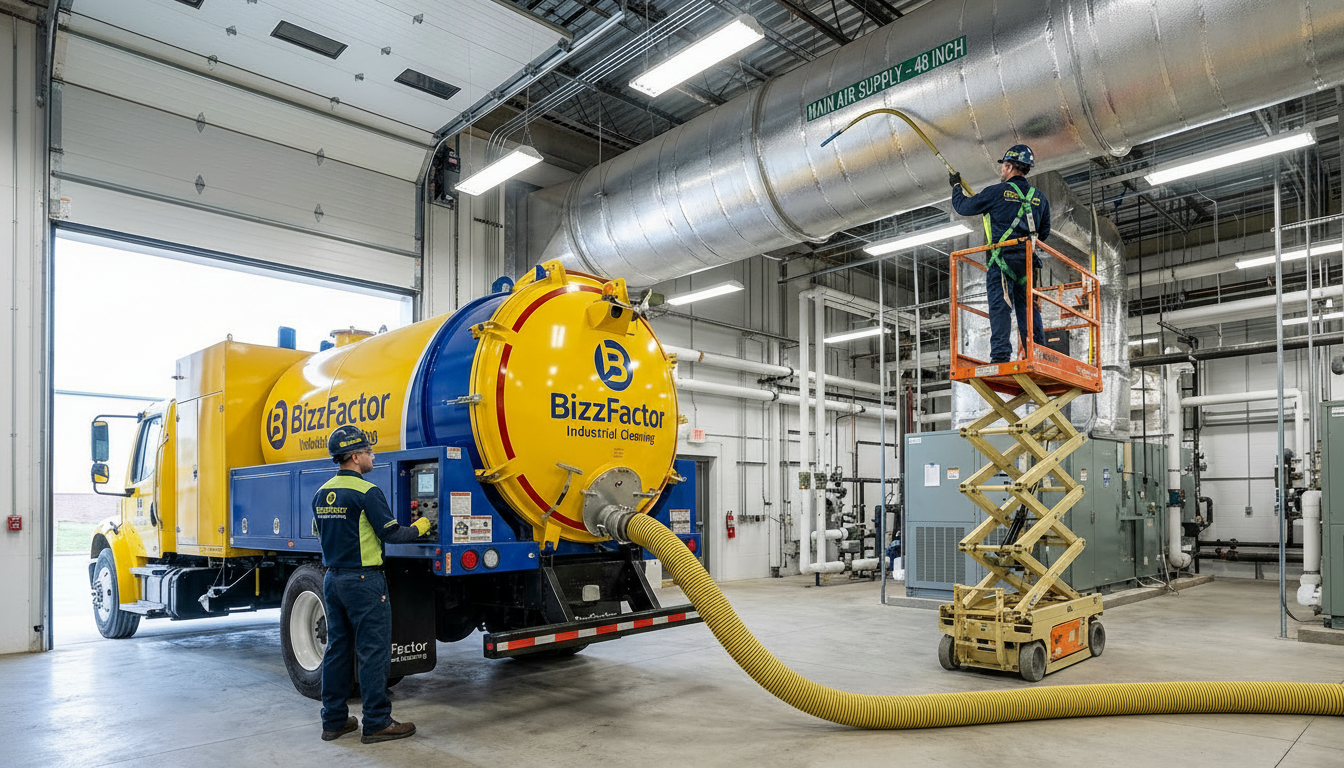
Expert commercial air duct cleaning for schools & buildings. Certified pros, specialized equipment, health code compliance. 20+ years experience.
Key Takeaways
- **Negative Air Pressure:** Creating controlled airflow that prevents contaminants from escaping into occupied spaces.
- **Mechanical Agitation:** Using rotating brushes and compressed air to dislodge stuck-on debris.
- **HEPA Filtration:** Capturing particles down to 0.3 microns before exhaust.
- **Antimicrobial Treatment:** Applied to inhibit future microbial growth on cleaned surfaces.
Key Takeaways
Commercial Air Duct Cleaning for Schools & Buildings: An Expert Guide
A guy in North Dallas once told me his school district saved $12,000 by hiring the cheapest duct cleaning bidder. Six months later? $47,000 in emergency remediation after inspectors found mold colonies behind supply registers. Some savings.
Commercial air duct cleaning for educational institutions and large buildings isn't just "residential work but bigger." I've watched contractors show up to 80,000-square-foot schools with equipment sized for ranch homes. It's like bringing a fishing rod to hunt elk. At BizzFactor, our certified techs manage large-scale HVAC systems processing over 50,000 cubic feet of air per hour. That's enough volume to completely refresh a basketball gym every few minutes.
Look — look — this guide breaks down the specific requirements, scientific methods, and compliance standards for commercial air duct cleaning in schools, hospitals, and office complexes. Places where clean air isn't a luxury — it's literally life or death.
Why Commercial Buildings Demand Specialized Duct Cleaning: It's Not Just About Size, It's About Science.
Here's where most contractors screw up: they walk into a 100,000-square-foot building thinking it's just 50 houses glued together.
It's not.
We're talking about setups that dwarf home units by factors of 10 or 15, with complex multi-zone controls and variable air volume (VAV) boxes that need specialized cleaning protocols. Skip those protocols? You're just redistributing dirt.
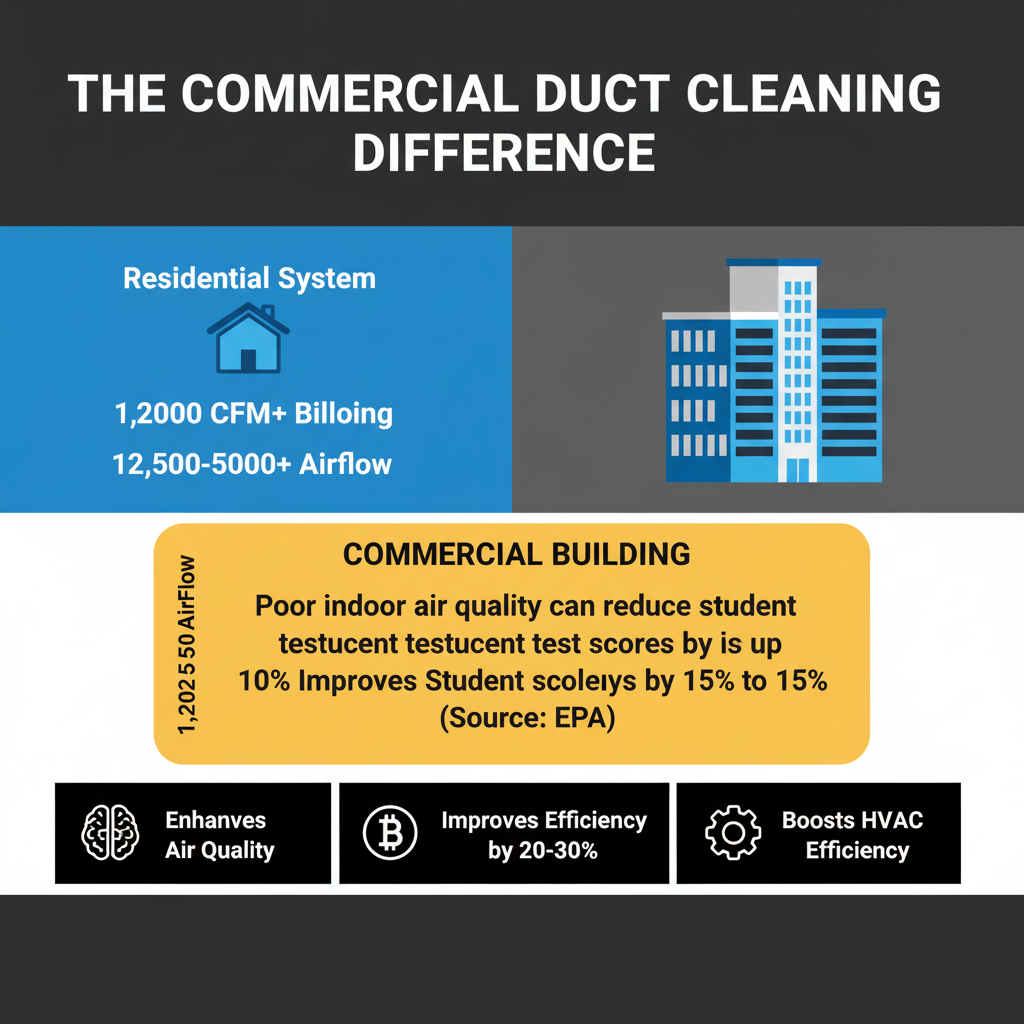
The EPA doesn't mince words on this. Poor indoor air quality can tank student test scores by up to 15%. Think about what that means for a kid's future. This isn't some minor maintenance issue — it's directly attacking educational outcomes.
We've cleaned over 200 schools in the past five years. You see patterns. An average elementary school has ductwork snaking across three floors with main trunks sometimes hitting 48 inches in diameter. Big enough to crawl through (and yeah, we've done that).
Why does it get this complicated? Let me break it down:
**Massive Airflow Requirements** — Commercial systems push anywhere from 15,000 to 50,000 CFM (cubic feet per minute). Your house? Maybe 1,200 CFM on a good day. That kind of air movement kicks up dust you didn't even know existed.
**Multi-Zone Temperature Controls** — You ever try running a library at the same temp as a gym? Different spaces need different climates. That's non-negotiable.
**Specialized Exhaust Systems** — Kitchen exhaust gets caked with grease that'll make you gag. Lab ventilation deals with chemical residues that require hazmat protocols. These aren't just dusty — they're legitimately hazardous.
I remember visiting Lincoln Elementary in Dallas after another contractor had "cleaned" the ducts. Found three inches of compacted debris in the main supply trunk. Looked like something had died in there and mummified. That's what happens when you use residential equipment on commercial jobs.
Here's the thing: for homeowners wanting to maintain clean air, our [Home Air Duct Cleaning Guide](https://bizzfactor.com/articles/home-air-duct-cleaning-guide) covers everything you need. But commercial work? Totally different ballgame.
What are the most common commercial duct cleaning errors that send shivers down our professional spines?
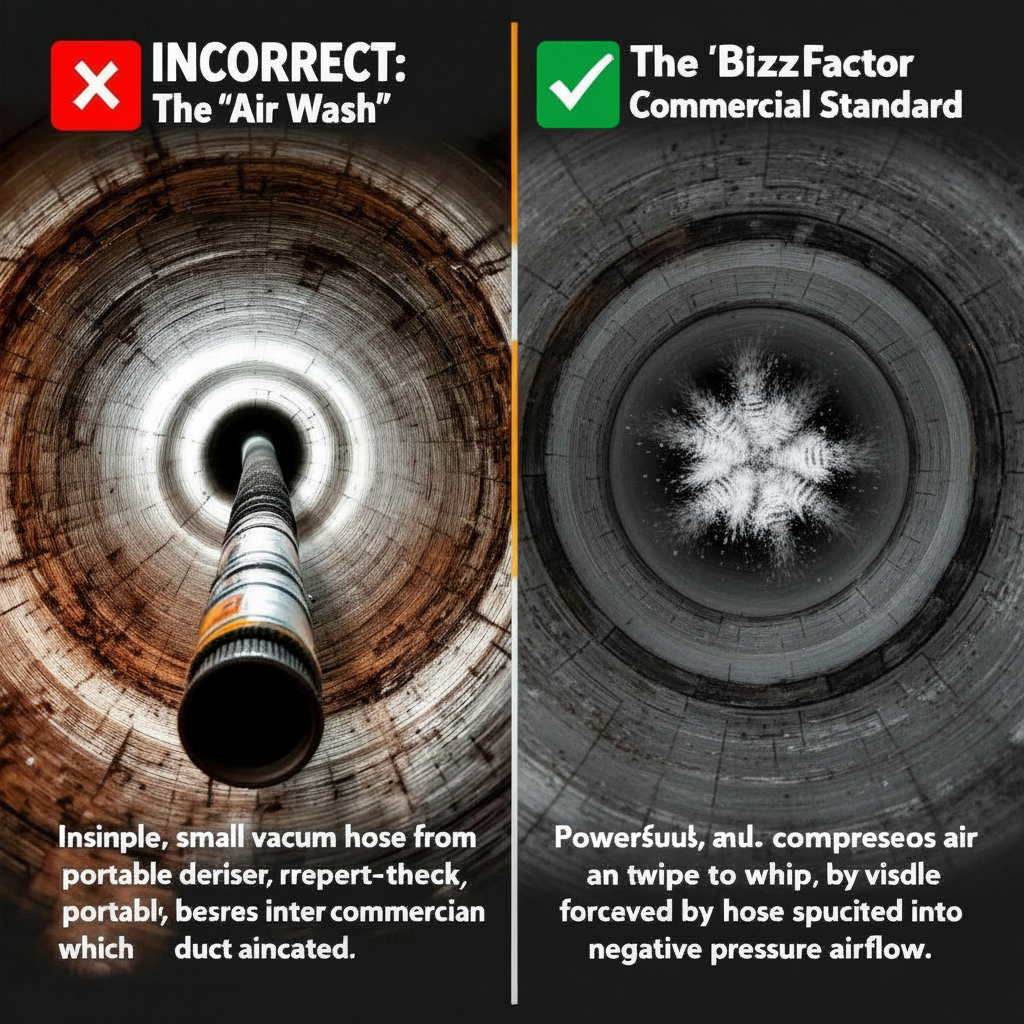
So many contractors obsess over suction power alone. And sure, suction matters. But it's maybe 40% of the equation. True professionals know you need advanced agitation tools working in sync with that suction. Without proper brushing to physically dislodge contaminants, you're basically giving the ducts an expensive air wash. Up to 60% of the crud stays put.
Don't skip the agitation step. Ever.
How frequently should commercial ductwork in these behemoth buildings be cleaned?
We don't do calendar cleaning. That's lazy. We push annual borescope inspections instead — actually looking inside with cameras to see what's happening. ASHRAE research shows contamination levels vary wildly between buildings, even in the same district. Visual evidence beats arbitrary schedules every single time.
Your maintenance budget will thank you.
The Heavy Artillery: Essential Equipment for Large-Scale Commercial Duct Cleaning
Now, you can't clean a 50,000-square-foot school with portable vacs meant for houses. Trust me, I've watched people try. Our trucks roll up carrying north of $150,000 in specialized equipment — truck-mounted systems pushing 3,000+ CFM minimum, sometimes twice that. Portable units work fine for small offices, maybe up to 10,000 square feet. Beyond that? You're wasting everyone's time.
Here's what actually works on commercial jobs:
**Truck-Mounted Vacuum Systems** pull more than 15,000 CFM on a bad day. These things could probably suck a bowling ball through a garden hose. They're loud, they're expensive, and they're absolutely necessary for buildings this size.
**Compressed Air Whips & Rotobrush Systems** get designed specifically for large-diameter ducts — we're talking 24 inches and up. They reach where hands can't. I've seen 36-inch supply trunks that hadn't been touched in 15 years. Nightmare fuel.
**Robotic Crawlers** with 4K cameras navigate spaces humans can't fit into. Some models have built-in brushes or air nozzles. It's like surgery, but for ductwork. Cost about $18,000 per unit (yeah, really).
**Plasma Cutting Tools** create clean access panels exactly where we need them. No butchering sheet metal with tin snips like some hack job.
**Antimicrobial Fogging Systems** use EPA-registered products to decontaminate surfaces after cleaning. Especially critical in schools where pathogens spread like gossip.
Real talk: Our recent project at a high school cafeteria took three full days just for the kitchen exhaust system. Had to use industrial-grade degreasers that could strip paint if you weren't careful. The National Fire Protection Association (NFPA) states that grease buildup exceeding 1/8 inch is a severe fire hazard.
One spark. That's all it takes.
Want more details on these protocols? Check out our [Commercial Kitchen Exhaust Cleaning Services](https://bizzfactor.com/articles/commercial-kitchen-exhaust-cleaning-services) article.
What's the real power disparity between residential and commercial cleaning equipment? Like, apples to oranges?
It's like comparing a Shop-Vac to an industrial dust collector. Our truck-mounted units deliver 15 times more suction than typical portable systems. That difference? It's what separates a cosmetic cleaning from genuine extraction.
You can't fake real power.
Ensuring Compliance: Navigating the Maze of Health and Safety Codes
So here's the deal with regulations — commercial air duct cleaning falls under OSHA workplace safety standards, state health department regulations, and International Building Code (IBC) ventilation guidelines. Schools face even tighter scrutiny because kids are more vulnerable to poor indoor air quality. Think asthma. Allergies. Cognitive impairment.
You can't cut corners here. It's legally mandated.
What does this actually look like when we show up to a job?
First thing: **Pre-Work Documentation.** We photograph and video everything before touching a single duct. Comprehensive evidence of initial conditions. No "he said, she said" later when someone tries to blame pre-existing damage on us.
Then we set up **Containment Barriers** to prevent cross-contamination during cleaning. We seal off work zones completely — negative air pressure systems, plastic sheeting, the whole nine yards. Last thing you need is releasing 10 years of dust into occupied classrooms.
**Respiratory Protection** is mandated for all our technicians. We're talking advanced respirators, not those cheap dust masks from Home Depot. OSHA doesn't mess around, and neither do we.
Got chemicals or biohazards? We follow documented **Hazardous Material Protocols** for handling and disposal. This gets critical in labs or medical facilities where you might encounter genuine toxins.
Finally, **Third-Party Air Testing** from independent labs verifies everything post-cleaning. We don't just tell you it's clean — we prove it with data.
FEMA guidelines explicitly require schools to maintain superior indoor air quality standards. With over two decades navigating these regulations, BizzFactor has a spotless compliance record. Every technician is background-checked and insured. We carry $2 million in liability coverage.
And we provide detailed contamination assessments before starting work. Full transparency.
What are the real consequences of taking a gamble and going for non-compliance?
Schools risking non-compliance face lawsuits, regulatory fines potentially hitting $50,000 or more, and insurance claim denials. A district in upstate New York once got slapped with $75,000 in penalties because they hired a cut-rate contractor who didn't follow proper procedures.
They thought they were saving money. Oops.
Unique, Unforeseen Challenges of School Duct Cleaning: More Than Just Classrooms
Schools throw you curveballs office buildings never will.
First off, timing's brutal. These facilities run HVAC systems 12-16 hours daily — sometimes longer if there's night programming or events. That means we're working evenings, weekends, or summer breaks. June and July are brutal for us (though the overtime's nice). Try coordinating a three-day cleaning project around final exams, graduation, and summer school schedules. It's like Tetris, but everyone's yelling at you.
But scheduling's honestly the easy part.
**Commercial Kitchens** have grease-laden exhaust systems that are borderline terrifying. I've seen buildup so thick it looked like fossilized bacon grease. Fire risk through the roof.
**Science Laboratories** mean dealing with chemical residues and volatile organic compounds that require specialized handling. One wrong move and you're evacuating the building. Containment protocols aren't optional — they're survival.
**Gymnasiums** have massive air handlers exceeding 10,000 CFM. Cleaning one is like servicing a small aircraft engine. Takes two guys and most of a day just for the air handler cabinet.
**Indoor Pools?** Chlorine vapor eats through ductwork and air handlers like acid. The corrosion's no joke — we've replaced entire sections that looked like Swiss cheese.
**Music Rooms** surprise people. Surprisingly high dust accumulation from instrument cases and sheet music. Who knew?
Here's the thing: a maintenance supervisor at Riverside Middle School in Phoenix told me they'd been getting complaints about musty smells for months. Turned out the previous contractor had completely missed a mold colony in the gym's return ducts. Cost them $8,400 to remediate properly.
Could've been prevented with proper inspection protocols.
How do you handle schools with asbestos-containing materials in older ductwork?
We bring in certified asbestos abatement specialists before touching anything. In buildings constructed before 1980, probably 40% have some asbestos-containing materials in or around ductwork. You can't just blast those with air whips and hope for the best.
Requires containment, specialized removal, and disposal at approved facilities. Not cheap, but the alternative is catastrophic health risks and legal liability.
Worth every penny.
The Science Behind Effective Commercial Duct Cleaning: It's All About Particle Removal
Indoor air quality hinges on removing particles sized 2.5-10 microns. Those are the ones that penetrate deep into lungs and cause real health problems. Standard filtration catches larger particles, but the small stuff? It recirculates endlessly unless physically extracted.
Now, nADCA (National Air Duct Cleaners Association) standards require source removal cleaning — physically extracting contaminants, not just moving them around. Their research shows that proper cleaning reduces airborne particulates by 40-60% immediately. And honestly? The effects compound over time.
Our process involves:
- **Negative Air Pressure:** Creating controlled airflow that prevents contaminants from escaping into occupied spaces.
- **Mechanical Agitation:** Using rotating brushes and compressed air to dislodge stuck-on debris.
- **HEPA Filtration:** Capturing particles down to 0.3 microns before exhaust.
- **Antimicrobial Treatment:** Applied to inhibit future microbial growth on cleaned surfaces.
Think that's overkill? Tell that to the facility manager whose building had a Legionella outbreak traced back to contaminated HVAC systems. Lost six weeks of operation for remediation.
Sixteen people hospitalized.
What's the typical debris composition in school ductwork?
From what I've seen over the years, it's usually around 35% dust and dirt, 25% paper fibers (you'd be amazed how much loose paper floats around schools), 15% textile fibers from clothing and upholstery, 10% skin cells and hair, 10% pollen and organic matter, and 5% misc
In-Depth Look
Detailed illustration of key concepts

Visual Guide
Infographic illustration for this topic
Side-by-Side Comparison
Visual comparison of options and alternatives
Sources & References
- Commercial Air Duct Cleaning Guide: Everything You Need to Know
- Ultimate Guide to Ductwork Cleaning for Better Air Quality and ...
- [PDF] DOHS Fact Sheet On HVAC Duct Cleaning - ORS
- DIY Duct Cleaning vs. Professional Services: Insights & Tips
- Indoor Air Quality Tools for Schools: Preventive Maintenance ... - EPA
- Building Codes, Standards, and Regulations: Frequently Asked ...
- Building Codes and Standards - 101 Guide | ROCKWOOL Blog
- [PDF] Building Codes Toolkit for Homeowners and Occupants - FEMA
- Navigating California Building Codes: Best Practices for Facilities ...
- ICC - International Code Council - ICC
Frequently Asked Questions
Need Professional Help?
Find top-rated air duct cleaning experts in your area