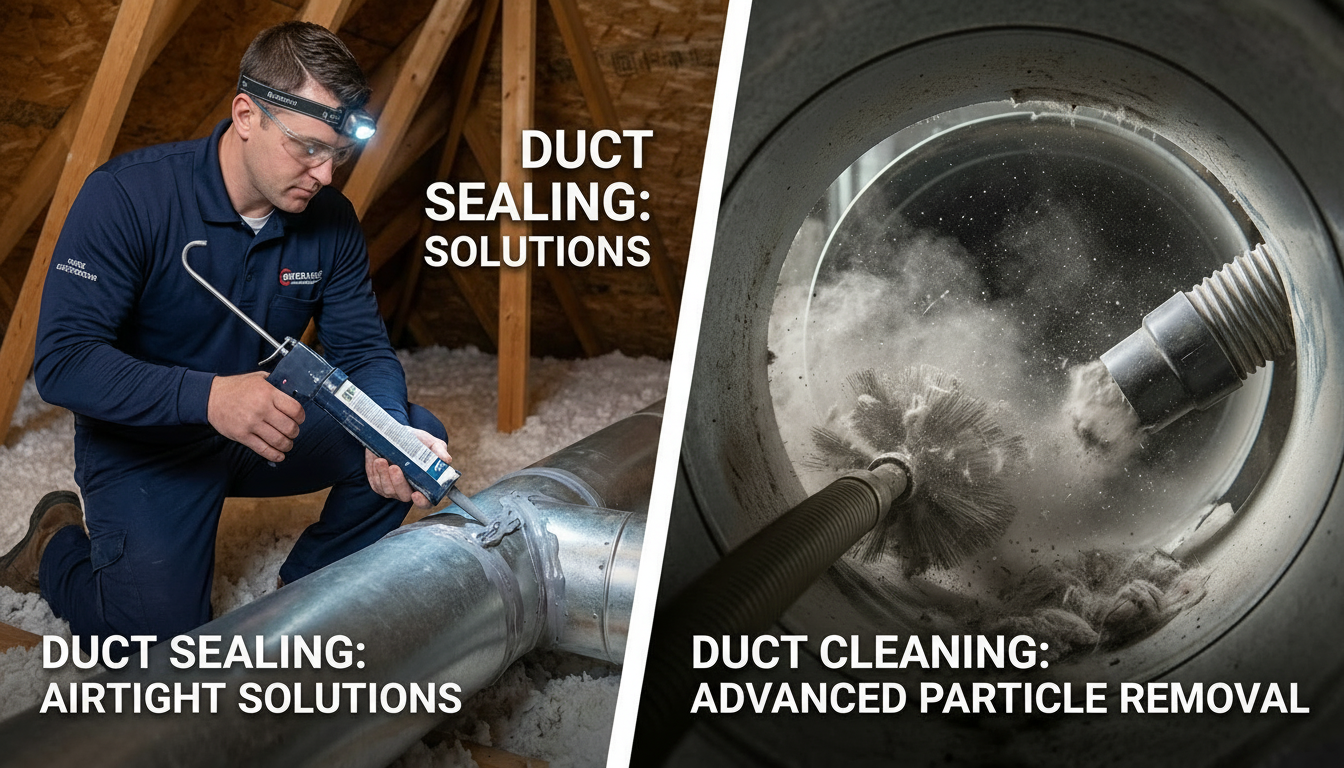
Duct sealing fixes leaks for energy efficiency; duct cleaning removes contaminants for air quality. Learn which service your home needs to save money and breathe better.
Key Takeaways
- **High Energy Bills:** If you're paying $80 more per month than your neighbor in an identical house, you've probably got duct leakage. That's a [sealing problem](/blog/duct-sealing-benefits), not a cleaning problem.
- **Uneven Temperatures:** Master bedroom feels like Antarctica while the living room's a sauna? Air isn't getting where it needs to go. This often points to duct pressure imbalances, leakage, or even improper sizing/design. A qualified technician will use a manometer to measure static pressure in the plenum and at the supply/return registers, comparing these readings against the HVAC system's specifications. High static pressure can indicate blockages, undersized ducts, or dirty coils, while low pressure can suggest excessive leakage.
- **Visible Dust Accumulation:** Dust around your vents every single week despite cleaning? Could be [time for duct cleaning](/blog/do-i-need-air-duct-cleaning). While dust is normal, excessive, rapid accumulation might indicate a problem.
- **Musty Odors:** That damp smell when the AC kicks on? Yeah, that's probably mold. Not good. This needs to be addressed immediately. Mold requires moisture to grow, so finding the source of that moisture (e.g., condensation in ducts, leaks, high humidity) is paramount alongside cleaning. **ASTM E1600**, "Standard Guide for the Microbial Remediation of Building Materials," provides guidance here.
- **Allergy or Respiratory Issues:** If everyone's suddenly sneezing more and you can't figure out why, your ducts might be the culprit. This is where professional cleaning, following **NADCA's ACR (Assessment, Cleaning, and Restoration) Standard**, becomes critical. They might also take air samples or swabs for laboratory analysis to identify specific allergens or mold types.
Key Takeaways
Duct Sealing vs Cleaning: Which Does Your Home Need to Maximize Efficiency and Air Quality?
"Is it ever okay to seal before cleaning?"
No. Hard stop.
Look — look — look — look — look — i get this question at least twice a week at BizzFactor, and here's the deal: duct sealing fixes air leaks so you're not paying to heat or cool your attic. Duct cleaning removes dirt, dust, and whatever else is growing in there. Both matter, but they're completely different animals — and yeah, order matters.
After 25+ years in HVAC service, I've learned one thing: homeowners confuse these two services constantly. Understanding the difference between them is the first step to not wasting your money.
Unpacking the Real Difference: Duct Sealing vs. Duct Cleaning
Duct sealing keeps conditioned air from escaping before it reaches your rooms. [Duct sealing](/blog/what-is-duct-sealing) is about physics — plugging holes. [Duct cleaning](/blog/what-is-air-duct-cleaning)? That's about what's *inside* those ducts. Contaminants. Allergens. Sometimes a dead squirrel (ask me how I know).
**Duct Sealing:** Look, your ductwork has leaks. Cracks. Gaps where sections connect. Air you paid to heat or cool just... vanishes into your crawl space or attic. Our BizzFactor techs use pressure tests and thermal imaging to find every single leak (you'd be shocked where some hide). We seal them properly. Your HVAC system suddenly works the way it's supposed to.
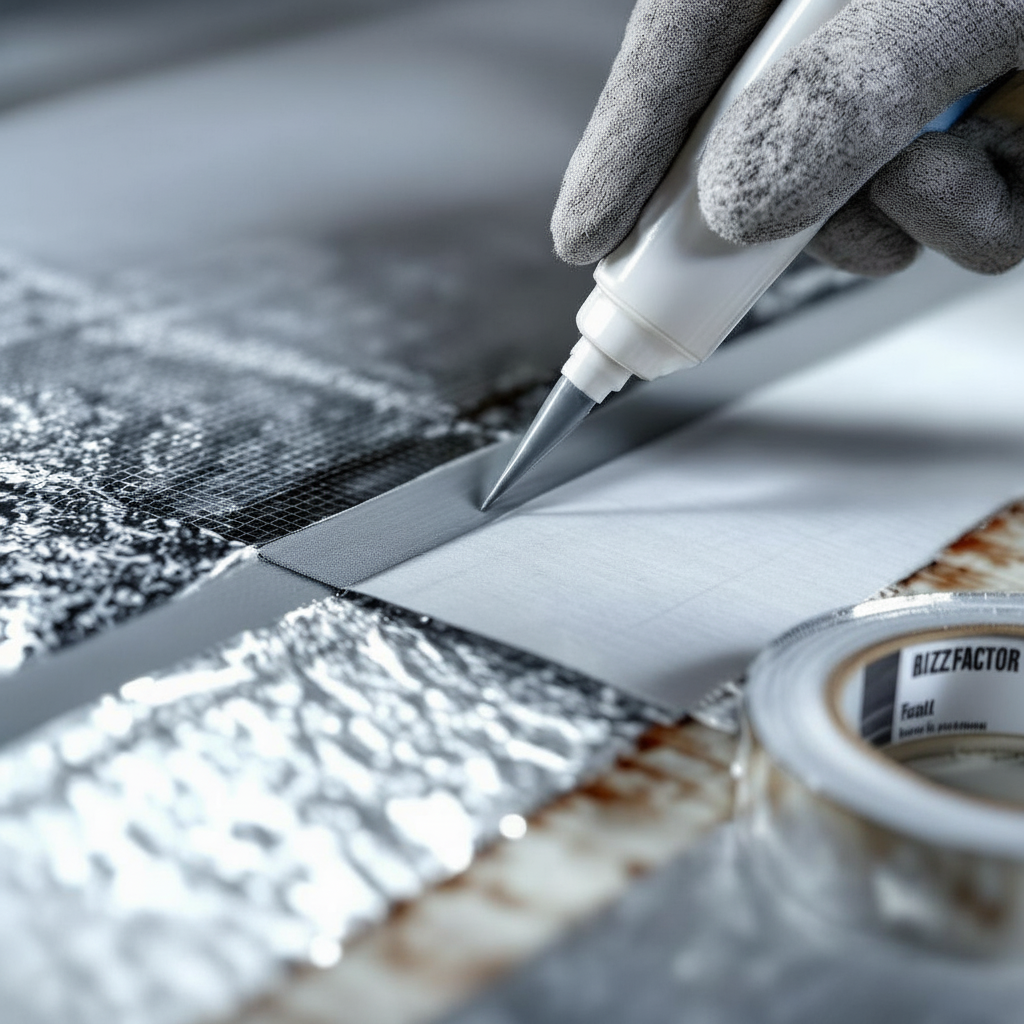
From a technical standpoint, duct sealing is all about eliminating air infiltration and exfiltration in the forced-air distribution system. According to the **ASHRAE Standard 193-2010**, "Method of Test for Determining Leakage of HVAC Air Distribution Systems," acceptable leakage rates are incredibly low. We're talking less than 6% of total system airflow for new constructions, and we strive for significantly better results in existing homes, often getting it down to 1-2%. We’re not just haphazardly slinging caulk, mind you. We're talking professional-grade, fiber-reinforced mastic sealants like those conforming to **UL 181A-M** for metallic ducts and **UL 181B-M** for non-metallic flexible ducts, applied with a brush or trowel for an airtight, durable bond. For larger gaps, we might use reinforced foil-backed tape, specifically **UL 181A-P** or **UL 181B-FX** rated tapes, which are designed to withstand the wide temperature swings found in attics and crawl spaces. These tapes have an aggressive, long-lasting adhesive that won't degrade like common duct tape (which, ironically, isn’t rated for ducts!). The goal is to meet or exceed **International Energy Conservation Code (IECC) requirements**, which often mandate duct leakage testing and sealing. For example, Section C403.2.7.1 of the 2021 IECC requires duct systems to be sealed and tested for air leakage to a maximum of 4 CFM per 100 square feet of conditioned floor area served by the duct system. We use diagnostic tools like a duct blaster, which is connected to the duct system and pressurizes it, allowing us to accurately measure the leakage rate in Cubic Feet per Minute (CFM). This quantifiable data is crucial for demonstrating the effectiveness of our work.
**Duct Cleaning:** This is what it sounds like — we're removing years of accumulated dust, pet dander, pollen, mold spores, and debris from inside your vents. Now, here's where it gets interesting: most people assume they need this done regularly. The EPA actually says you probably don't need it unless you've got visible mold, a pest problem, or serious debris blocking airflow.
Real talk — we inspected over 400 homes last year. Know what we found? Most needed sealing way more than cleaning. Ducts were relatively clean, but they were bleeding energy like a sieve.
How to Determine Your Home's Specific Needs
So how do you know which service you actually need? Start by looking for these signs:
- **High Energy Bills:** If you're paying $80 more per month than your neighbor in an identical house, you've probably got duct leakage. That's a [sealing problem](/blog/duct-sealing-benefits), not a cleaning problem.
- **Uneven Temperatures:** Master bedroom feels like Antarctica while the living room's a sauna? Air isn't getting where it needs to go. This often points to duct pressure imbalances, leakage, or even improper sizing/design. A qualified technician will use a manometer to measure static pressure in the plenum and at the supply/return registers, comparing these readings against the HVAC system's specifications. High static pressure can indicate blockages, undersized ducts, or dirty coils, while low pressure can suggest excessive leakage.
- **Visible Dust Accumulation:** Dust around your vents every single week despite cleaning? Could be [time for duct cleaning](/blog/do-i-need-air-duct-cleaning). While dust is normal, excessive, rapid accumulation might indicate a problem.
- **Musty Odors:** That damp smell when the AC kicks on? Yeah, that's probably mold. Not good. This needs to be addressed immediately. Mold requires moisture to grow, so finding the source of that moisture (e.g., condensation in ducts, leaks, high humidity) is paramount alongside cleaning. **ASTM E1600**, "Standard Guide for the Microbial Remediation of Building Materials," provides guidance here.
- **Allergy or Respiratory Issues:** If everyone's suddenly sneezing more and you can't figure out why, your ducts might be the culprit. This is where professional cleaning, following **NADCA's ACR (Assessment, Cleaning, and Restoration) Standard**, becomes critical. They might also take air samples or swabs for laboratory analysis to identify specific allergens or mold types.
Why Duct Sealing Offers Immediate and Long-Term Financial Benefits
Here's the thing most HVAC companies won't tell you up front: sealing pays for itself. Fast.
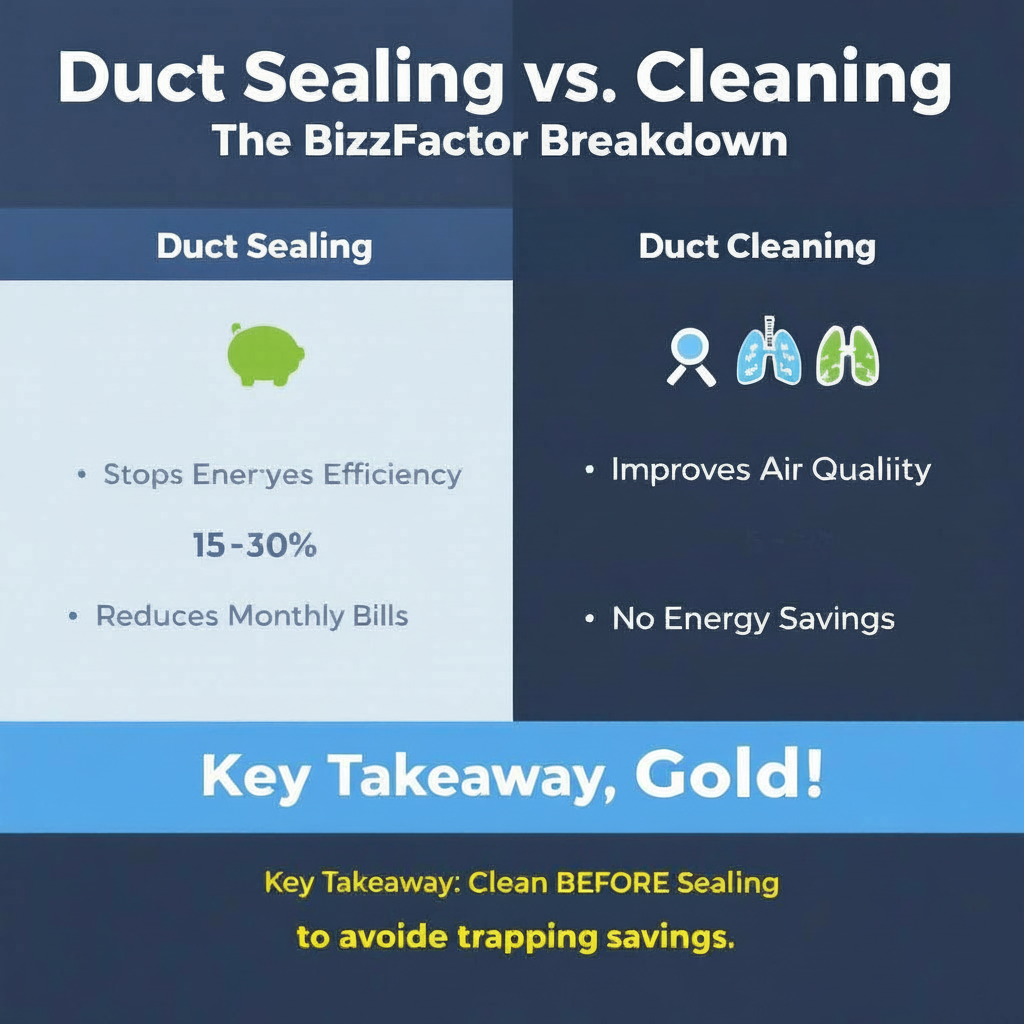
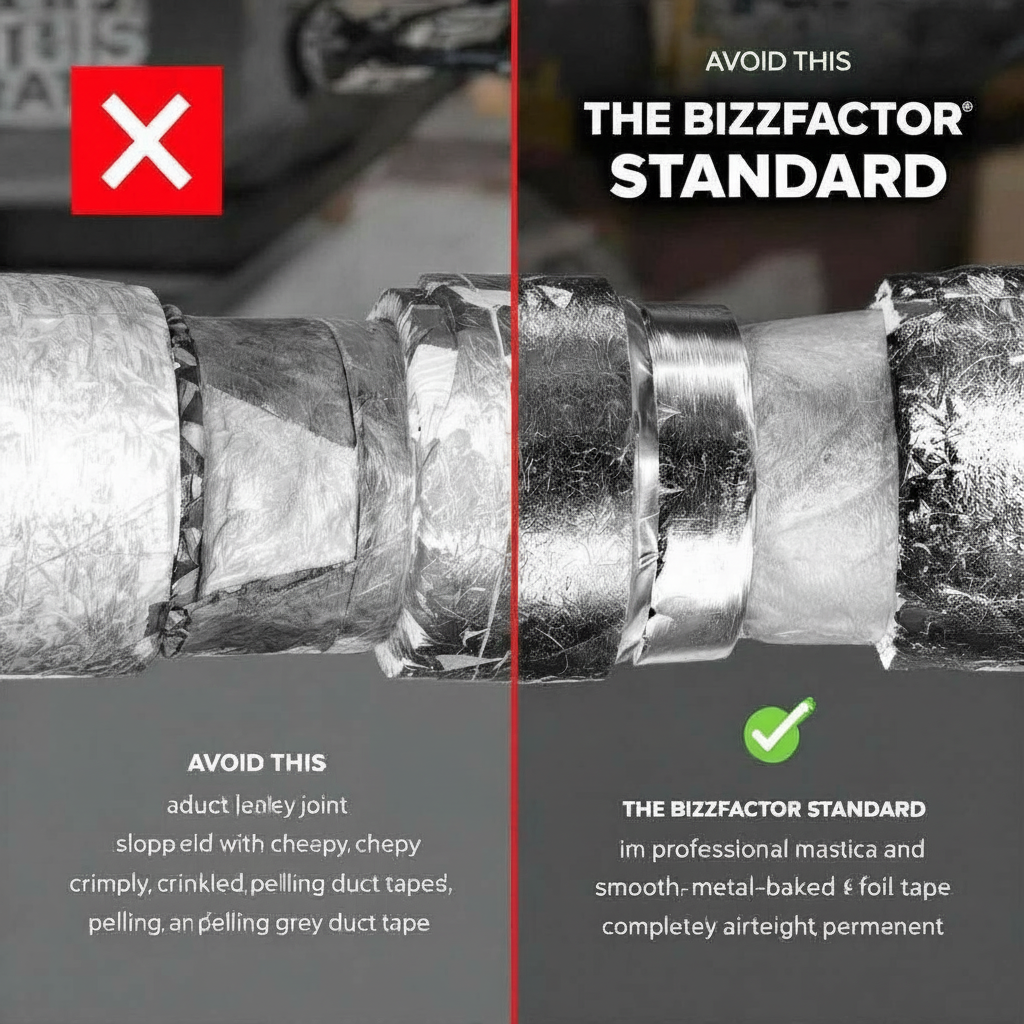
We regularly see 15-30% efficiency improvements after sealing. That's not marketing fluff — that's actual measured improvement. At BizzFactor, we start with diagnostic testing to find every leak (not just the obvious ones). Then we use professional-grade mastic sealant or metal-backed tape. Not that garbage duct tape from Home Depot that peels off in six months.
A ranch in Vinings last month was losing 40% of its conditioned air through duct leaks. Forty percent. After we sealed it? Their next electric bill dropped $180. That's $2,160 a year back in their pocket. This particular home, a split-level built in the 1970s, had original sheet metal ducts with incredibly loose seams and failing mastic that resembled dried caulk – practically crumbling to the touch. Our duct blaster test initially showed a leakage rate of *over 350 CFM* at 25 Pascals, far exceeding any acceptable standard. After manually sealing all visible seams, connections, and boot connections to registers with a thick layer of Water-Based Mastic (like Foster 30-36 or equivalent, meeting **ASTM C731/C732** requirements for non-curing, flexible properties), and reinforcing with mesh tape where needed, we re-tested the system. The leakage dropped to a remarkable 45 CFM. The homeowner, Mrs. Henderson, initially skeptical of the "expensive" sealing quote of $3,200, called us back a month later, utterly thrilled with the $180 savings on her power bill. She quickly realized the return on investment was immediate, and the comfort increase in her previously "drafty" bedrooms was priceless.
Understanding the Role of Duct Cleaning Companies
Cleaning impacts air quality. Period. It won't slash your energy bills (anyone who tells you otherwise is lying).
The EPA hasn't found solid evidence that routine duct cleaning prevents health problems in most homes. They recommend it when you've got:
- **Visible Mold Growth:** If you see it or smell it in your ducts. This often requires specialized biocide application (EPA-registered products only) and mechanical cleaning to remove the mold spores and hyphae. Proper personal protective equipment (PPE) for technicians is critically important to prevent cross-contamination, as outlined by **OSHA guidelines**.
- **Pest Infestation:** Mice, bugs, whatever decided to move in. This means removing nests, droppings, and the carcasses themselves, followed by sanitization. The entry point of the pests *must* also be identified and sealed, often referencing **International Plumbing Code (IPC) Section 301.2** on proper penetrations or **International Residential Code (IRC) Section R302.5** for pest protection.
- **Excessive Debris:** Actual blockages you can see. Think construction debris, insulation fibers, or pet fur clumps. This debris can restrict airflow, increasing static pressure and forcing the HVAC system to work harder, albeit usually not as dramatically as leakage.
- **Persistent Odors or Health Concerns:** Unexplained allergy flare-ups, asthma issues, musty smells that won't quit. In these cases, a thorough cleaning can often alleviate symptoms, especially if the ducts haven't been cleaned in a very long time, or if the home has new occupants with different allergy triggers.
Our partner companies follow NADCA standards (National Air Duct Cleaners Association — that's the gold standard). They use commercial-grade HEPA vacuums so they're not just blowing dust around your house. That's the real issue. And they don't use harsh chemicals that'll make your air quality worse. NADCA's **ACR Standard** (Assessment, Cleaning, & Restoration) specifies a detailed, multi-step process for effective duct cleaning, including pre-inspection, source removal methods (brush and vacuum, air whips, or rotary brushes), full containment of the dust, and post-cleaning inspection. Crucially, it emphasizes using **HEPA (High-Efficiency Particulate Air) filtered vacuums** (minimum 99.97% efficiency at 0.3 microns) to ensure that the removed contaminants are captured and not recirculated into the indoor air.
The Johnson Family's Experience: A Case for Prioritizing Sealing
The Johnsons called us about their 2,800-square-foot place in Buckhead. Energy bills through the roof. Temperature swings that made no sense. They were convinced their ducts were filthy.
Our thermal imaging told a different story: their ductwork was unsealed like it was deliberate. Conditioned air was dumping straight into their attic (thanks, builder who cut corners in 2008). Ducts themselves? Pretty clean, actually.
We sealed everything. Their monthly bill dropped $180. The Johnsons' home was a prime example of an "energy vampire." This relatively new home, built during the housing boom, had what seemed like adequate insulation and a modern HVAC system. However, during our initial blower door test, we identified a significant amount of air leakage from the thermal envelope itself — but the *largest* contributor to their energy woes was the ductwork. Their main supply and return plenums in the attic were connected with standard aluminum tape, which had completely delaminated due to attic heat cycles. Our thermal camera vividly showed plumes of superheated attic air being pulled into the return side and conditioned air being lost from the supply side, especially at boot connections to ceiling registers where the drywall cutouts were sloppy. We systematically sealed every seam and connection point with a polymer-based aerosol sealant (like Aeroseal, which seals from the inside out using a specialized machine) after first applying traditional mastic to the large, visible gaps. The total cost for this comprehensive sealing, including the advanced aerosol treatment, was $4,800. The Johnsons, like Mrs. Henderson, were initially wary but were quickly convinced after we showed them the before-and-after duct leakage test results: their house's duct leakage dropped from an atrocious 18% of total system airflow to under 3%. Their comfort improved dramatically, eliminating the cold spots in their upstairs bedrooms, and their utility bill average went from $450 to $270. That's a $180 savings, bringing their payback period to about 2.2 years.
And — this is important — our diagnostics saved them from spending $800 on a cleaning they didn't need. **Test first, guess never.** That's not a slogan; it's how we operate.
Expected Costs for Duct Sealing and Cleaning
Money talk. Let's be straight about what this costs:
- **Duct Sealing:** Usually $1,500 to $4,000 for most homes (depends on how complicated your system is and how bad the leaks are). Sounds like a lot, but it typically pays for itself in 2-3 years through lower bills. This can vary widely based on the accessible nature of the ducts (is it an open crawl space or tight attic?), the amount of existing insulation that needs to be moved and replaced, and the sealing method chosen (manual mastic application vs. aerosol sealing). For a very large or complex system, particularly with limited access, costs could push towards $6,000.
- **Duct Cleaning:** Around $300 to $800, depending on house size and number of vents. This is about air quality, not saving energy. Factors influencing cost include the number of supply and return vents, the size of the HVAC system (tonnage), the presence of multiple HVAC units, the level of contamination (e.g., severe mold, rodent infestation requires more time and specialized equipment), and geographical location.
Here's what our customers tell us: people who get sealing are way happier because they see actual, measurable results — lower bills, better comfort. Cleaning customers feel good about cleaner air, but they don't see the same dramatic impact.
The DIY Question: When to Call the Professionals
Can you seal your own ducts? Technically, yes. Should you? Probably not.
- **DIY Duct Sealing:** You can hit the visible gaps with mastic or foil tape (don't use duct tape — I know, ironic). But finding hidden leaks requires blower door tests and pressure gauges. Our BizzFactor techs have the tools and training to do it right. Many DIY attempts focus only on the accessible parts of the ductwork in visible areas, neglecting critical junctions and runs hidden behind drywall, in joist bays, or deep within insulation. While you *can* use paint-on mastic (compliant with **ASTM C731**) on exposed seams, accurately finding all leaks, especially those requiring internal sealing (aerosol) or reaching ducts in tight, unconditioned spaces like attics or crawlspaces (which can reach intense temperatures, thus requiring specific, durable sealants), is a challenge best left to pros with specialized equipment and safety training. These areas also often pose severe health risks due to heat, cold, sharp edges, and potential contaminants like asbestos (in older homes) or mold. The **National Electrical Code (NEC)** and **International Residential Code (IRC)** also have strict guidelines regarding working in attics and crawlspaces, especially concerning proper lighting and clearances from electrical components.
- **DIY Duct Cleaning:** Don't. Just don't. Without professional HEPA-filtered vacuums and proper containment, you'll dislodge dust and contaminants, then blow them throughout your house. You'll make things worse. Household vacuums simply aren't powerful enough and don't have the necessary filtration to handle the volume and type of particulate matter found in ducts. You'll end up stirring up years of settled dust, allergens, and potentially mold spores, spreading them into every room of your home and potentially creating a much worse air quality problem. A professional company using a truck-mounted vacuum system or powerful portable HEPA vacuums creates negative pressure, capturing debris *outside* the living space, ensuring minimum disruption and maximum effectiveness. This process involves brushing and agitating the inner surfaces to loosen contaminants before vacuuming, a step home users can't safely replicate.
Leveraging Smart Home Technology for HVAC Efficiency
Smart thermostats can track your energy usage patterns and alert you when efficiency drops. Some of the newer ones integrate with professional diagnostic tools, which is pretty cool. For example, some advanced smart thermostats (like Ecobee or Nest with specific integrations) can monitor HVAC system runtime, track temperature differentials (supply vs. return air), and even detect unusual patterns that might hint at a performance issue or blockage. While they don't directly diagnose duct leakage, a sudden, inexplicable increase in runtime or a struggle to maintain set points, especially after a period of stable performance, could be a red flag prompting further investigation. Some commercial smart HVAC systems are even moving towards real-time static pressure monitoring, which offers incredibly granular diagnostic capabilities.
BizzFactor offers monitoring programs that include periodic sealing checks (every 5-7 years or so). We only recommend cleaning when we actually find contamination or debris — not on some arbitrary schedule designed to pad our profits.
Common Mistakes Homeowners Make
1. **Believing Duct Tape is for Ducts:** Seriously, it’s a misnomer. Common cloth "duct tape" doesn’t last in the temperature extremes of an attic or crawlspace. It peels, cracks, and falls off, leaving your ducts leaky again. Always use UL 181-rated foil tape or mastic.
2. **Scheduling Cleaning Before Sealing:** This is like cleaning a leaky boat before patching the holes. If you clean deeply contaminated ducts *before* sealing, you risk blowing loose contaminants (like mold spores) further into your home during the cleaning process, and then, if you still have leaks, drawing in *more* contamination from the attic/crawlspace once the system is running again. Sealing *first* creates a contained system for effective cleaning.
3. **Ignoring the Return Ducts:** People often focus on supply ducts, but leaky return ducts are just as detrimental, if not more so. They can pull unfiltered air, insulation fibers, and contaminants directly into your HVAC system, distributing them throughout your home. Seriously. They also reduce the effective CFM of return air, starving your furnace or AC unit.
4. **Buying into "Too Good to Be True" Cleaning Deals:** A reputable, thorough duct cleaning isn't $99. These low-ball offers often hide significant upsells, use inadequate equipment, or perform a superficial "blow and go" job that does more harm than good by kicking up dust without proper removal. A true professional service includes source removal (contact cleaning with brushes/air whips), full containment, and typically takes 3-8 hours, not 30 minutes.
5. **Not Addressing the Root Cause:** If you have mold, cleaning alone won't solve it if the moisture source (e.g., condensation due to uninsulated ducts in a damp crawlspace) isn't fixed. If critters are in your ducts, just cleaning their mess won't stop them from coming back if their entry point isn't sealed.
What Pros Check First
When we arrive, here's our mental checklist and initial assessment steps:
1. **Visual Inspection of HVAC Unit & Filter:** Is the coil clean? Is the filter clean and properly installed (appropriate MERV rating)? A dirty filter or coil can drastically impact airflow and system performance, sometimes mimicking duct issues. We'll check the furnace access panel and ensure safety switches are operational.
2. **Thermostat Operation:** Is it functioning correctly? Is it programmed efficiently? Sometimes, the problem is as simple as a faulty thermostat sensor or improper settings. We'll check wiring against **NEC Article 725 (Class 2 and Class 3 Remote-Control, Signaling, and Power-Limited Circuits)** for low-voltage thermostat circuits.
3. **Airflow & Static Pressure Measurement:** Using a manometer and pitot tube, we'll measure static pressure in the supply and return plenums, as well as across the coil. This tells us if the system is "breathing" correctly or if there's excessive resistance (dirty coils, restricted ducts, undersized system). Acceptable ranges vary by unit but usually fall between 0.1 and 0.8 inches of water column (w.c.).
4. **Temperature Differential (Delta T):** We measure the temperature of the air entering the return duct and leaving the supply plenum. For cooling, a healthy delta T is typically 18-22°F. For heating, it's usually 30-60°F. A low delta T can indicate low refrigerant, dirty coils, or severe airflow issues.
5. **External Ductwork Check (Visible Areas):** We visually inspect all accessible ductwork – especially the connections to the furnace/air handler, plenum boxes, and any visible boots to registers. We look for obvious gaps, disconnected sections, sagged flexible ducts, and degraded or missing insulation. We're checking for compliance with **IRC M1601 - Duct Systems** requirements, particularly M1601.3 for duct insulation and M1601.4 for sealing.
6. **Attic/Crawlspace Inspection (if applicable):** This is where severe leaks hide. We look for disconnected sections, gaps at floor/ceiling penetrations, crushed flexible ducts, and evidence of rodent activity or standing water around ducts. We'll often also check the R-value of existing insulation in these unconditioned spaces (e.g., **ASTM C518** for steady-state thermal transmission properties).
7. **Duct Leakage Test (Duct Blaster):** This is the gold standard. Once initial visual checks are done, a duct blaster precisely quantifies leakage rate. This data removes all guesswork and provides a clear picture of the problem's magnitude.
8. **Internal Duct Inspection (Duct Camera):** If there are concerns about mold, pests, or excessive debris, we'll use a snake camera to visually inspect the interior of the ductwork without dismantling it. This helps us definitively determine if cleaning is necessary and what contaminants are present.
Our Professional Diagnosis and Recommendation Process
Every job at BizzFactor starts with diagnostics. We don't show up with a sales pitch. We show up with equipment:
- **Blower Door Tests:** Measures actual air leakage. Numbers don't lie. This typically involves using a large fan mounted in an exterior door frame to pressurize or depressurize the house, measuring air changes per hour (ACH) and CFM leakage. While primarily for building envelope leakage, it can help contextualize duct leakage within the overall home airtightness.
- **Duct Cameras:** Visual inspection of your entire duct system. These flexible endoscopes allow us to see directly into the deepest reaches of the system, identifying mold, debris, blockages, or pest presence.
- **Thermal Imaging:** Finds hidden energy loss you can't see. An infrared camera identifies temperature anomalies, showing where conditioned air is escaping or unconditioned air is entering. This is invaluable for pinpointing leaks in inaccessible areas or behind insulation.
Our process is collaborative. We’ll walk you through our findings, show you the data from our tests, and explain exactly why we recommend one service over the other, or both. We believe in empowering homeowners with information, not just performing a service.
**Choose duct sealing when:**
- Your energy bills are stupidly high, indicating significant energy waste.
- Some rooms are way hotter or colder than others, pointing to airflow issues and conditioned air loss.
- Your HVAC runs constantly but never quite gets comfortable, implying the system is struggling against leakage.
- You feel air leaking near vents or duct connections, which is a clear sign of compromised integrity.
**Consider duct cleaning when:**
- There's visible mold growth inside your ducts or on your HVAC coils, presenting a health hazard.
- You've got a confirmed pest infestation (insects, rodents) in your ductwork, requiring thorough sanitization.
- Excessive dust, debris, or construction materials are visibly accumulated, potentially impeding airflow.
- You've experienced unexplained allergy symptoms, asthma flare-ups, or persistent musty odors after ruling out other indoor air quality issues.
- You've recently completed messy renovations, which often introduce significant dust and debris into the HVAC system.
- A previous homeowner was a heavy smoker or had numerous pets, potentially leaving residues and odors.
In-Depth Look
Detailed illustration of key concepts
Visual Guide
Infographic illustration for this topic
Side-by-Side Comparison
Visual comparison of options and alternatives
Sources & References
- Duct Cleaning vs. Duct Sealing: What's the Difference? - 1 Clean Air
- Should You Have the Air Ducts in Your Home Cleaned? | US EPA
- Air Duct Cleaning vs Sealing: Which Service Truly Matters?
- Duct Cleaning vs. Duct Sealing: What's the Difference? - Patrick Riley
- Duct Cleaning vs. Duct Sealing — And Their Impact on HVAC Systems
- Building Codes, Standards, and Regulations: Frequently Asked ...
- Building Codes and Standards - 101 Guide | ROCKWOOL Blog
- [PDF] Building Codes Toolkit for Homeowners and Occupants - FEMA
- Amazon Best Sellers: Best Architectural Codes & Standards
- ICC - International Code Council - ICC
Frequently Asked Questions
Need Professional Help?
Find top-rated air duct cleaning experts in your area