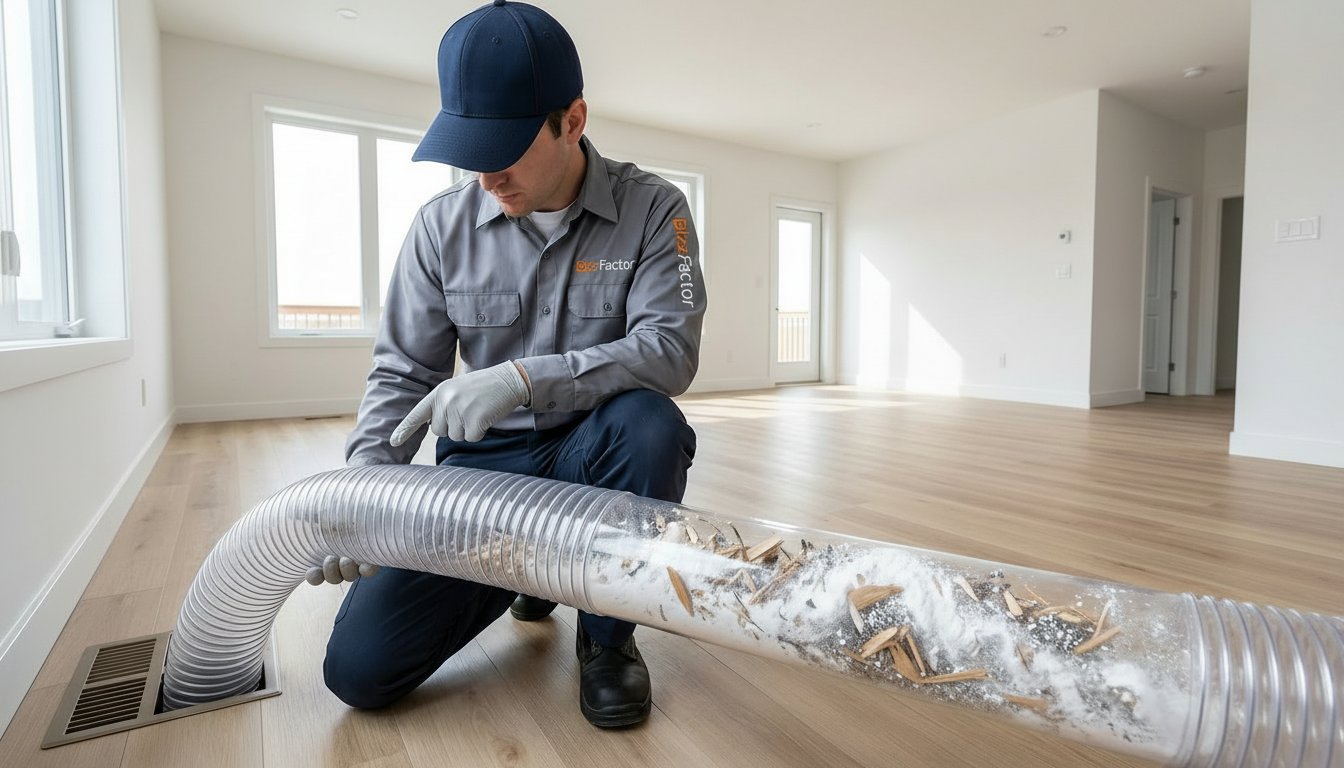
New home duct cleaning removes construction debris like drywall dust and metal shavings. Our certified pros protect your family's health and HVAC efficiency.
Key Takeaways
- Your nice furniture surfaces collect dust within *days* of cleaning, sometimes hours. You wipe it, and it's back. That film reappears like magic because there's a constant particle source pumping through your vents.
- Family members develop new or unexplained allergy symptoms, congestion, persistent coughs, skin irritation, or other respiratory irritation. Especially if they've never had them before, or if existing conditions worsen. Often it's directly tied to what they're breathing 24/7 in their own home.
- Your brand-new HVAC system seems less efficient than expected, struggling to maintain desired temperatures or requiring surprisingly frequent [HVAC maintenance](https://bizzfactor.com/hvac-maintenance), like filter changes. It shouldn't be doing that when it's new. Clogged coils and dirty blowers reduce its performance markedly.
- You detect persistent, strange chemical odors or stale, musty air when the heating or cooling system operates. That's a red flag. These are often VOCs off-gassing from trapped debris, or potential signs of moisture accumulation within the ductwork, which could lead to mold growth.
Key Takeaways
New Home Duct Cleaning: Remove Construction Debris & Improve Indoor Air Quality
A family in Kendall paid $6,200 to fix what their builder swore was "normal settling dust." Their 18-month-old had three ear infections in two months. The pediatrician kept prescribing antibiotics. Nobody thought to look at the ducts.
Your brand-new home radiates perfection, doesn't it? That fresh paint, the pristine floors – it all looks amazing. But there's usually a problem lurking inside those shiny new vents: construction debris packed into your HVAC ductwork. We're not talking about a little dust bunny. I'm talking drywall dust, sharp metal shavings, chemical residues, fiberglass insulation shards, and other particulate matter cycling through your indoor air every 12 minutes. This stuff hits your family's health and your home's efficiency directly.
Getting your ducts professionally cleaned after construction? That's not optional. It's the difference between breathing construction site air and actually living in the house you paid for.
Don't skip this step.
Seriously — it matters.
Why Does Construction Debris Contaminate New Home Ducts and Why is it Persistent?
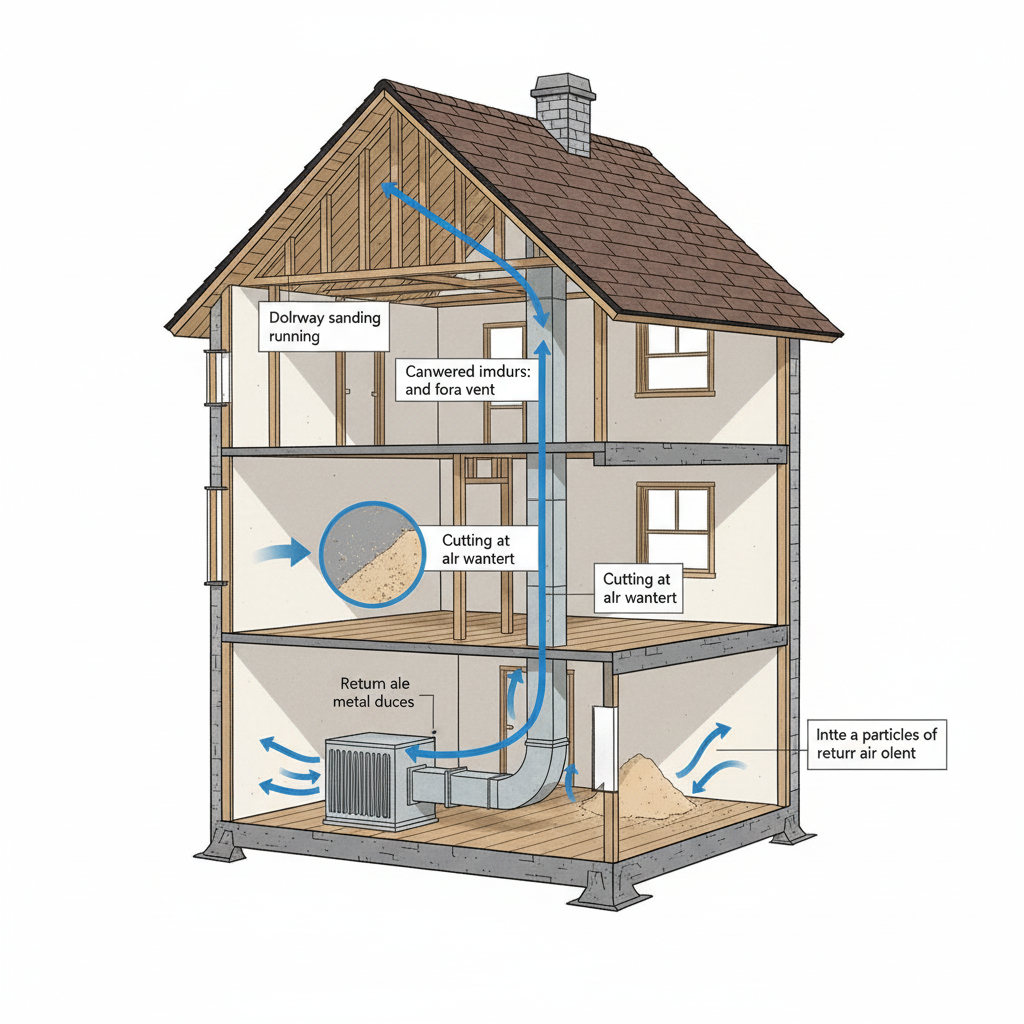
Builders run your HVAC system *during construction*. Yeah, while they're cutting drywall and sawing 2x4s. They need to control humidity and manage temperatures on the job site — makes sense from their perspective. But that system? It becomes a giant vacuum. Every return vent pulls sawdust, drywall particles (some containing crystalline silica), insulation fragments straight through.
Sealed systems?
Not really.
Covers get removed for access. Pressure differences suck fine particles through gaps you can't even see. There's no such thing as truly airtight when you've got ten different trades stomping through.
Look — look — we've cleaned over 2,000 new homes since 2003 — from sprawling estates in Coral Gables to cozy bungalows in Coconut Grove. Even the most scrupulous, detail-oriented builders with high standards can't entirely prevent this contamination. I'm talking about the $800K custom builds with dedicated site managers. Still dirty ducts. We have yet to encounter a genuinely "clean" new construction HVAC system. Not a single one. The physics of construction sites and airflow make it almost impossible.
Most new homeowners don't even know their builder left the HVAC running during framing. During drywall sanding. During painting. Why would they? Nobody tells them. But that's exactly when your ductwork becomes a debris magnet — when powerful return vents create negative pressure that sucks every airborne particle straight into the system. Once it's in there, it's staying. No standard filter catches this stuff, and normal operation just packs it deeper into horizontal runs and supply branches.
Years later? Still circulating. Still polluting your air.
And yeah, that means you're dealing with potential [HVAC repair](https://bizzfactor.com/hvac-repair) issues way sooner than you should be.
Common Contaminants Our Licensed Technicians Find in New Home Ducts
So here's what we're pulling out of these systems everybody calls "brand new." This isn't the cleaned-up story your builder wants you hearing:
1. **Drywall dust (Gypsum and Crystalline Silica):** Everybody underestimates this one. It's not "just dust." Gypsum itself? Fine, relatively harmless in small amounts. But drywall also contains crystalline silica — a known carcinogen when you're breathing it day after day. The particles are so fine they bypass your nose completely and settle deep in lung tissue. That's the real issue. One average-sized home generates maybe 50-70 pounds of airborne drywall dust during finishing. Where do you think it goes when your HVAC is running?
2. **Sharp metal shavings and fasteners:** Byproducts from duct installation, framing, electrical rough-in, you name it. These can tear standard air filters (rendering them useless), damage your blower motor bearings, and puncture evaporator coil fins. Seriously. I've seen a $1,400 coil replacement that could've been avoided with a $400 duct cleaning.
Here's the thing: 3. **Fiberglass insulation fragments and adhesive residues:** You know what fiberglass does to your skin when you touch it, right? Now picture microscopic versions floating through your lungs every time the AC kicks on. These particles break off during duct board installation, during batt insulation cutting, whenever someone's elbow brushes against exposed insulation in an attic chase. The adhesive residues from various sealants and glues? Those stick around (literally) and attract even more dust over time. They can also carry chemical traces that off-gas for months after construction wraps.
4. **Sawdust and wood particles:** From framing, cutting, finishing work. These are easily airborne and can carry mold spores if any moisture is present during construction. Gross. They also provide a food source for microbial growth if condensation occurs in the ducts.
5. **Paint fumes and VOCs (Volatile Organic Compounds) trapped:** Fresh paints, sealants, glues, composite materials — all off-gassing into your ductwork during construction. These get absorbed by accumulated debris and stick around for months. That "new house smell" everyone loves? It's mostly VOCs, and it's not doing your lungs any favors. These chemicals don't just disappear overnight.
Just last month, our team extracted three full contractor-sized bags of construction debris – that's roughly 90 gallons of junk – from the ductwork of an 1,800-square-foot new home in Kendall. The family, having lived there for only two months, was constantly battling excessive dust buildup and unexplained respiratory symptoms. Their little one had a persistent cough. After our service? Dramatic improvement in just days. It's a true story, and we see it all the time. It really opens your eyes.
Understanding the Health Risks from Contaminated New Home Ducts
Think about how your system actually works for a second. Return vents suck air from every room. That air gets forced through the blower. Drags across the evaporator coil. Then blasts through supply ducts to every bedroom, bathroom, living space. Maybe 12-15 times per hour when it's running hard in summer.
Every single pass picks up particles coating your ductwork.
Drywall dust with crystalline silica? You're breathing it. VOCs from adhesives still off-gassing two months after the painters left? You're breathing those too. Formaldehyde from composite materials, the chemical soup from fresh paint — all recirculating while you sleep, cook dinner, play with your kids.
Now, here's what scares me: crystalline silica causes silicosis — permanent lung scarring that doesn't heal. I know you're not getting construction-worker-level exposure. But it's *constant*. Day after day, month after month. Your lungs don't get weekends off. They don't reset.
A guy in Aventura ignored this for nine months after moving in. Developed a chronic cough his doctor couldn't explain. Three different medications, no improvement. We cleaned his ducts — pulled out maybe 60 pounds of compacted drywall dust — and his cough was gone in five days. Five days. His pulmonologist literally asked for our contact info.
Indoor air gets ignored until someone's wheezing. But here's what the EPA won't say in their polite reports: the air inside your house is probably 2-5 times dirtier than the air outside. When your "new home smell" is actually VOCs trapped in ductwork debris, you've got a problem that affects your [indoor air quality](https://bizzfactor.com/indoor-air-quality) in ways nobody warned you about at closing.
Don't underestimate it.
Your lungs are a sensitive instrument; treat them right.
According to EPA research (which honestly undersells the problem), contaminated indoor air ranks among the top five environmental health threats Americans face daily. Not outdoor smog in LA. Not factory emissions downwind. The air *inside your $450K dream home.*
When your brand-new HVAC system is basically a debris distribution network, you're fighting a losing battle. You can dust your furniture twice a day — it'll be back by dinner. That's the real issue. What's even the point of moving into a pristine new construction if the air you're breathing is contaminated from day one?
I've seen families notice symptoms within weeks, sometimes even *days*, of moving into their new homes. A couple in Pinecrest called us because their 4-year-old developed a chronic cough and recurrent ear infections about three weeks after they moved in. Doctors couldn't figure it out. Within 72 hours of cleaning their ducts? Kid's symptoms completely gone. The mom called me crying (happy tears). It wasn't a coincidence. The parents were ecstatic.
**Keep an eye out for these red flags:**
- Your nice furniture surfaces collect dust within *days* of cleaning, sometimes hours. You wipe it, and it's back. That film reappears like magic because there's a constant particle source pumping through your vents.
- Family members develop new or unexplained allergy symptoms, congestion, persistent coughs, skin irritation, or other respiratory irritation. Especially if they've never had them before, or if existing conditions worsen. Often it's directly tied to what they're breathing 24/7 in their own home.
- Your brand-new HVAC system seems less efficient than expected, struggling to maintain desired temperatures or requiring surprisingly frequent [HVAC maintenance](https://bizzfactor.com/hvac-maintenance), like filter changes. It shouldn't be doing that when it's new. Clogged coils and dirty blowers reduce its performance markedly.
- You detect persistent, strange chemical odors or stale, musty air when the heating or cooling system operates. That's a red flag. These are often VOCs off-gassing from trapped debris, or potential signs of moisture accumulation within the ductwork, which could lead to mold growth.
The Severity of Construction Contamination: A Case Study
A builder in Doral told us their $450K property was "construction clean." They'd even put it in writing. But when we dropped our inspection camera into the first return duct, the homeowners went silent.
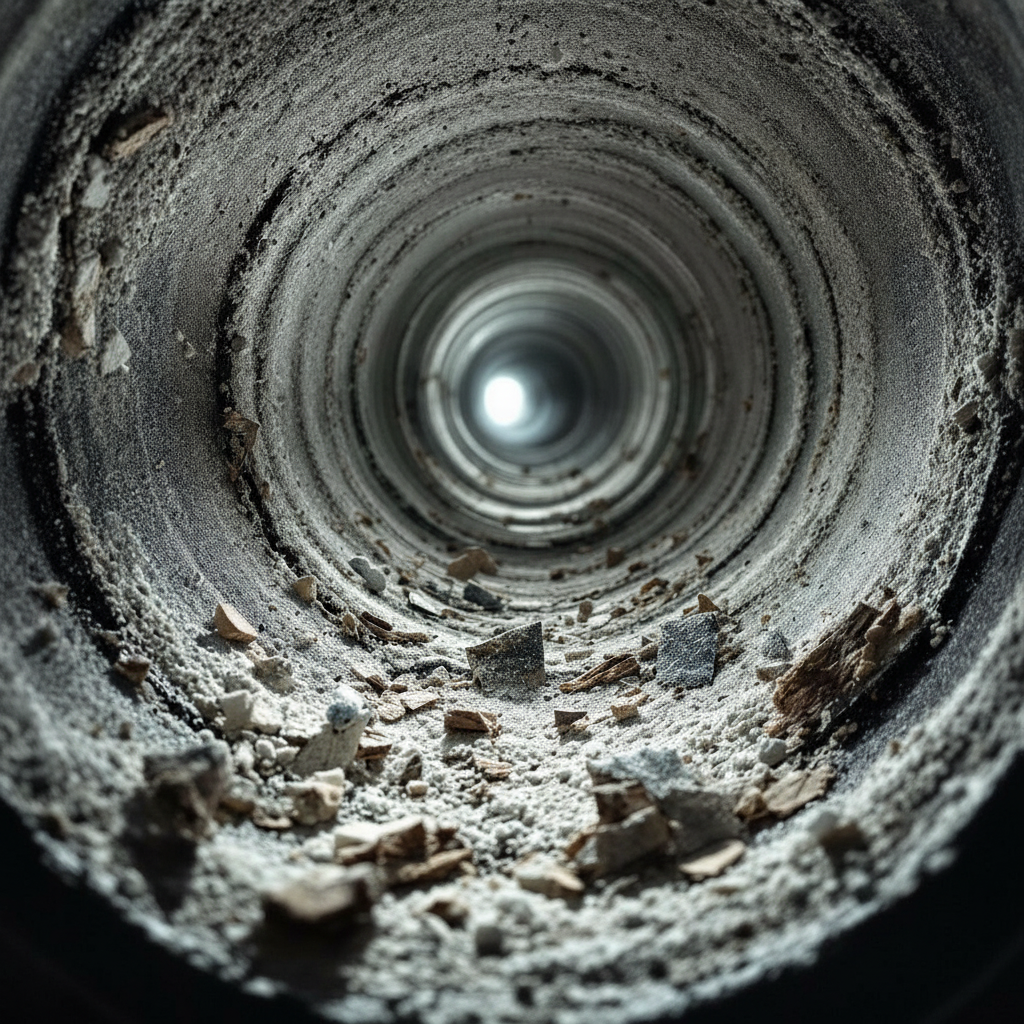
Now, two inches of packed drywall dust coating every horizontal run. Metal shavings scattered across the duct bottom like someone had dumped a hardware store in there. Fiberglass fragments stuck to the joints. This wasn't "a little residual dust" — this was full-on construction contamination that somehow passed final inspection. The homeowners had been living there eight months, spending $200+ monthly on air purifiers, vacuuming daily, wiping surfaces constantly. Nothing helped. Their 6-year-old daughter had developed chronic sinus infections. The dad joked (not really joking) that he thought Florida was just "dustier than Pennsylvania."
Now, we pulled out roughly 85 gallons of debris from their 2,100-square-foot system. Within a week? Their dust issues dropped by maybe 90%. The daughter's sinus problems cleared up. They returned two of their three air purifiers. That's the difference between treating symptoms and fixing the actual problem. The before-and-after video footage we showed them — they couldn't believe they'd been breathing that for eight months. Neither could I, honestly, and I've been doing this since 2003.
Should Homeowners Attempt DIY New Home Duct Cleaning? Risks and Limitations
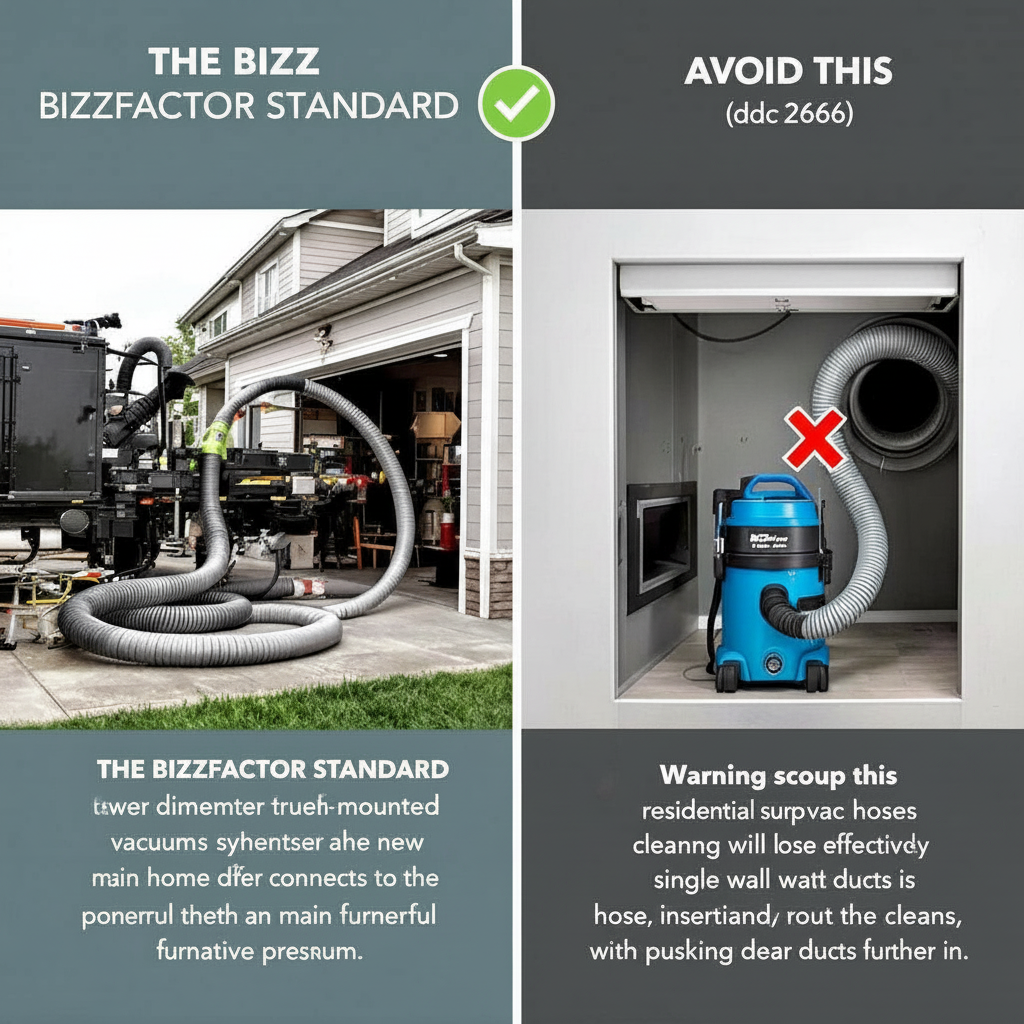
So you're thinking about tackling this yourself? I get it — you just dropped half a million on a house, and now someone's telling you to spend more money. But here's the reality: your Shop-Vac isn't going to cut it. Not even close.
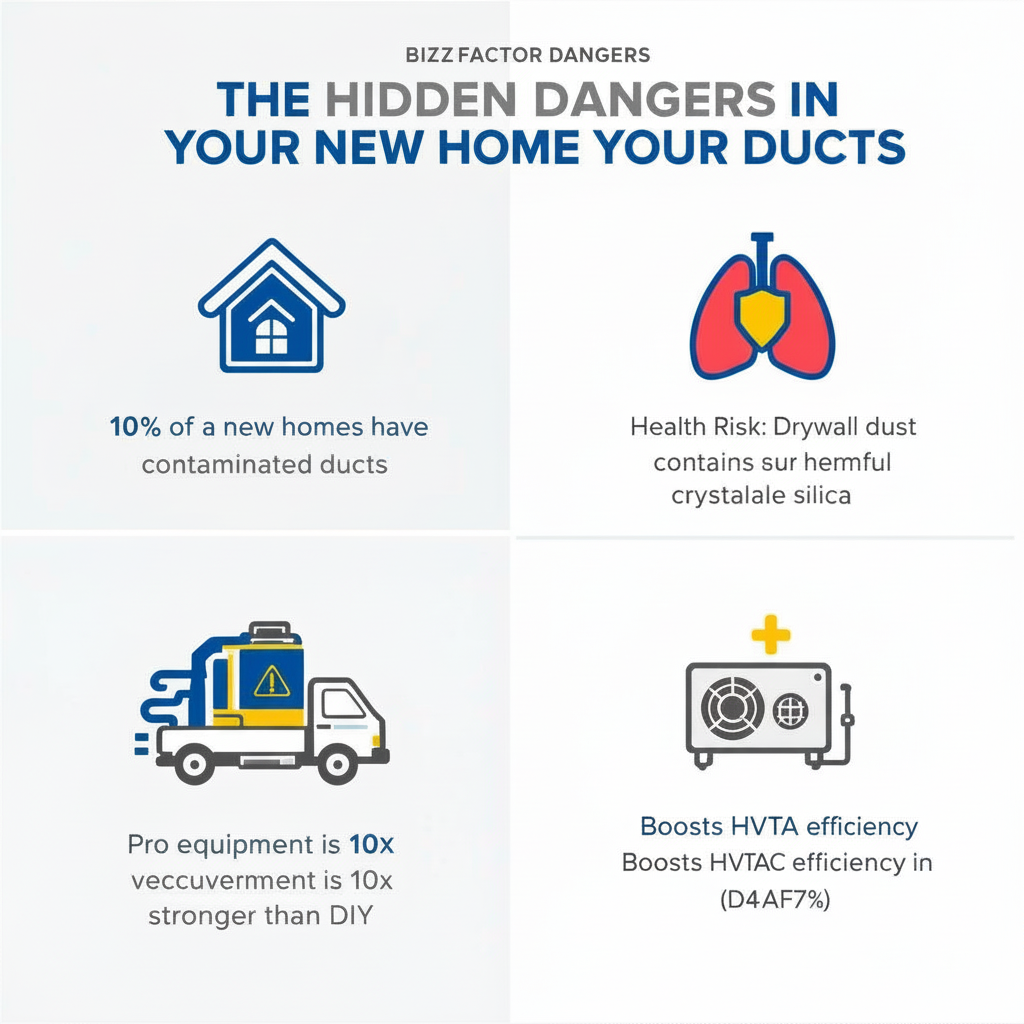
So — real post-construction cleaning demands industrial-grade equipment — truck-mounted vacuum systems pushing over 5,000 CFM (cubic feet per minute). That's a massive amount of suction. You also need speci
In-Depth Look
Detailed illustration of key concepts
Visual Guide
Infographic illustration for this topic
Side-by-Side Comparison
Visual comparison of options and alternatives
Sources & References
- Post-Construction Duct Cleaning: A Must-Have for Clean Air
- Post-Construction Duct Cleaning Services: A Comprehensive Guide
- [PDF] Should You Have the Air Ducts in Your Home Cleaned? - EPA
- Post-Construction Duct Cleaning - Air Doctor Tulsa
- Cleaning Ducts After Remodeling: A Guide by Dan's
- Building Codes, Standards, and Regulations: Frequently Asked ...
- Building Codes and Standards - 101 Guide | ROCKWOOL Blog
- [PDF] Building Codes Toolkit for Homeowners and Occupants - FEMA
- ICC - International Code Council - ICC
- Manufactured Home Construction and Safety Standards
Frequently Asked Questions
Need Professional Help?
Find top-rated air duct cleaning experts in your area