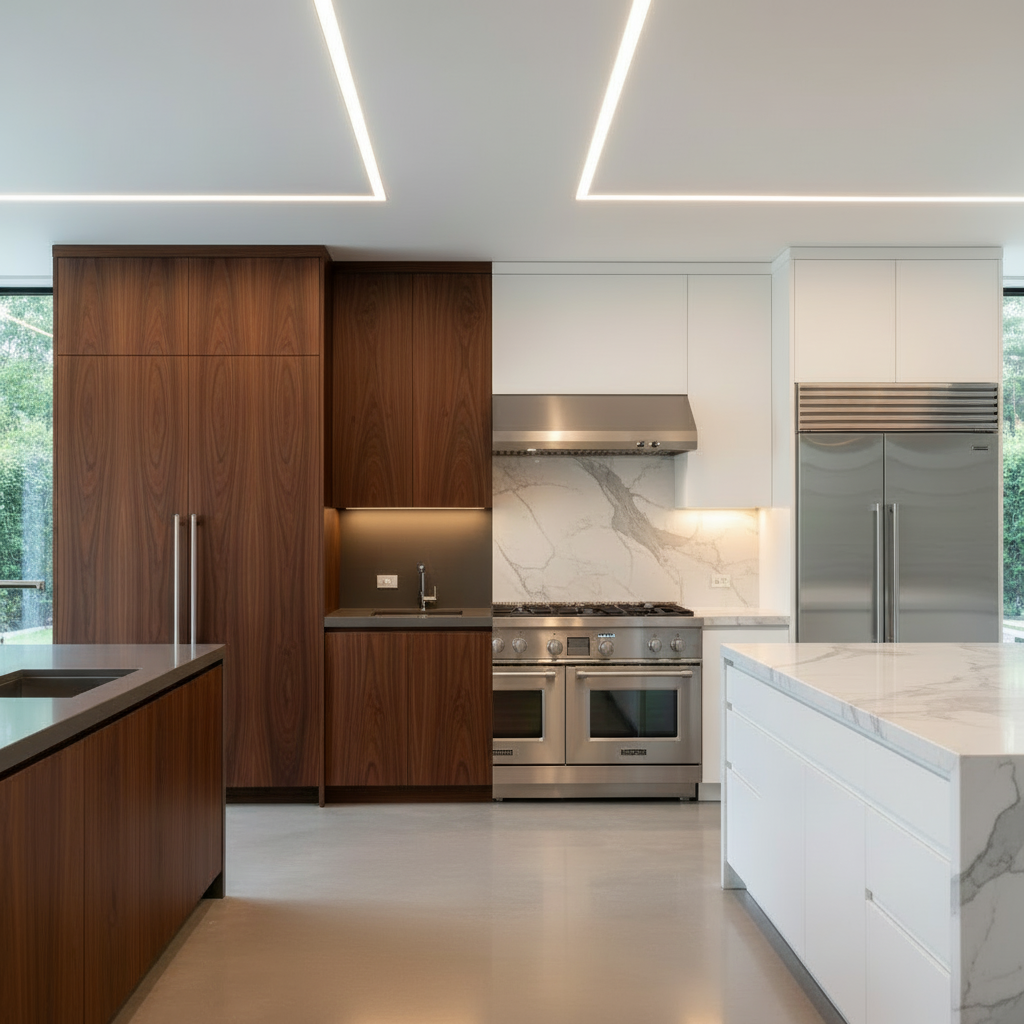
Expert 2025 guide to integrated vs freestanding appliances. Get professional insights on costs, installation, and performance from licensed contractors.
Key Takeaways
- It's one of those decisions that'll haunt your kitchen for the next decade
- I'm talking aesthetics, function, and yeah, your bank account too
- Whether you're ripping out everything or starting fresh in a new build, you need real answers
- Not the sales pitch stuff
Key Takeaways
Integrated vs. Freestanding Appliances: The Ultimate 2025 Guide for Homeowners and Professionals
Look — choosing between integrated and freestanding kitchen appliances? It's one of those decisions that'll haunt your kitchen for the next decade. I'm talking aesthetics, function, and yeah, your bank account too. Whether you're ripping out everything or starting fresh in a new build, you need real answers. Not the sales pitch stuff.
This guide breaks down what actually matters. The stuff nobody tells you until it's too late.
Built-In vs. Standalone? Here's What You're Really Choosing
Think of it this way: **Integrated appliances** (sometimes called built-in or panel-ready) hide behind cabinet panels, disappearing into your kitchen design. You walk in? Clean lines everywhere. No obvious appliances screaming for attention.
**Freestanding appliances**? They just stand there.
Out in the open.
And honestly? That's not a bad thing. They're easier to install, way easier to replace, and you've got about ten times more options when you're shopping around.
One changes how your kitchen *looks*. The other changes how you *use* it.
Integrated Appliances: When You Want Everything to Disappear
Picture a kitchen where you can't tell where the fridge ends and the cabinets begin.
That's the integrated vibe.
Why People Love Going Integrated
**The Look Is Unreal:** Everything flows together without visual breaks or mismatched finishes. A contractor in Buckhead told me he's installed probably forty integrated kitchens in the last two years alone — every single client mentioned the "clean look" as their number one reason. For open-plan homes especially, where your kitchen's basically your living room?
This matters big time.
**Makes Small Spaces Feel Bigger:** When appliances sit flush with cabinets, the whole room breathes easier. Less visual clutter. I've seen 10x10 kitchens that felt spacious just because they went integrated.
Your brain registers more space.
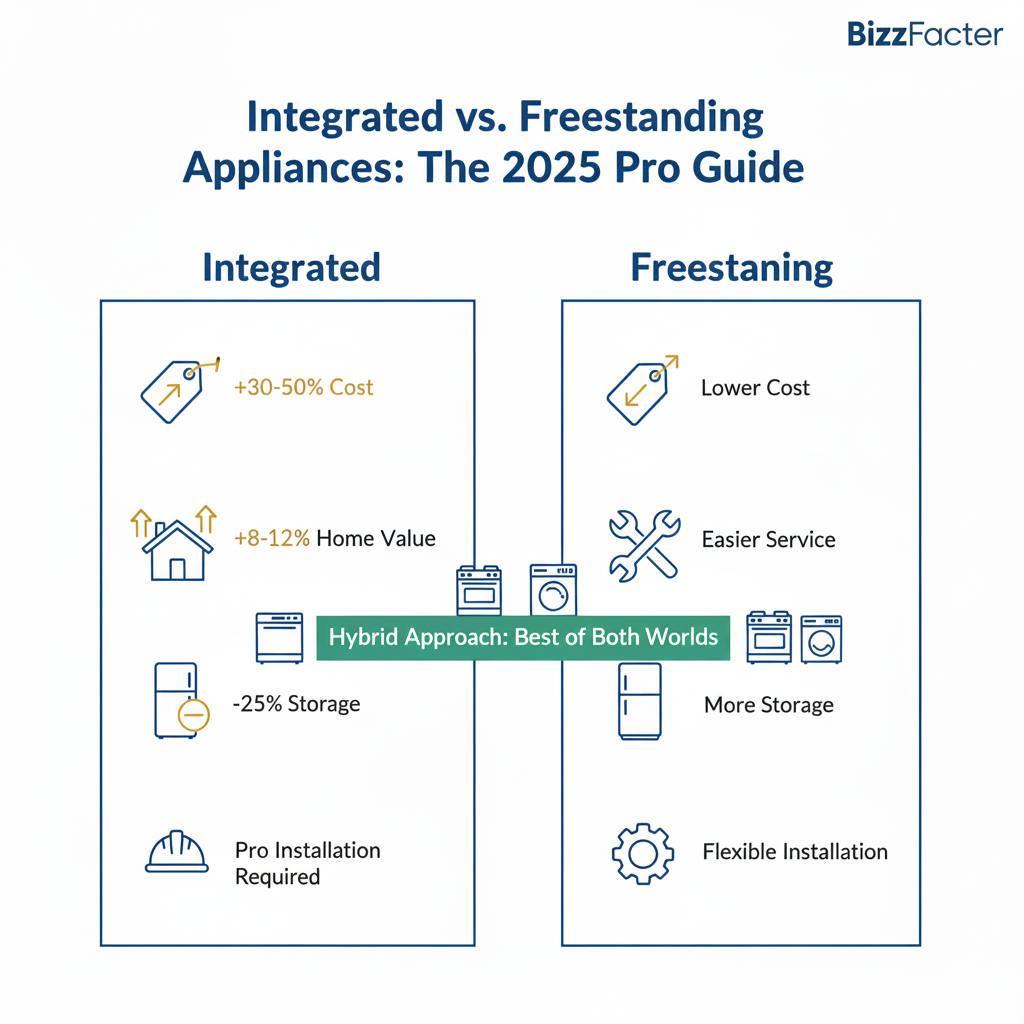
**Your Home Value Goes Up:** Real estate agents love these kitchans. They photograph well, they scream "high-end," and buyers assume the whole house is upgraded. One appraiser in Alpharetta mentioned integrated kitchens can add $8,000-$15,000 to perceived value in mid-range homes. Not guaranteed, but it happens.
**Quieter Than You'd Expect:** Here's something most people don't think about — integrated dishwashers and fridges run quieter because they're wrapped in cabinetry. Extra sound insulation. My neighbor ditched her freestanding dishwasher last spring, went integrated, and swears she can actually hear her TV now during the wash cycle. The cabinet panels act like a sound blanket, basically.
The Downsides Nobody Warns You About
**It's Expensive. Really Expensive.**
An integrated fridge that's comparable to a $1,200 freestanding model? Try $3,500. Then add custom panels ($600-$1,200), professional installation ($400-$800). You're looking at serious money up front. We're not just talking about the appliance itself; the cabinetry often needs to be specifically designed or modified to accept the integrated unit, which adds another layer of cost. Those special Blum hinges that handle the extra panel weight? $40-$65 per hinge. The mounting brackets that attach your custom door? Another $150-$300 depending on the brand. A guy in Vinings spent $2,100 just on the hardware and panels for his Bosch dishwasher — before the appliance even showed up.
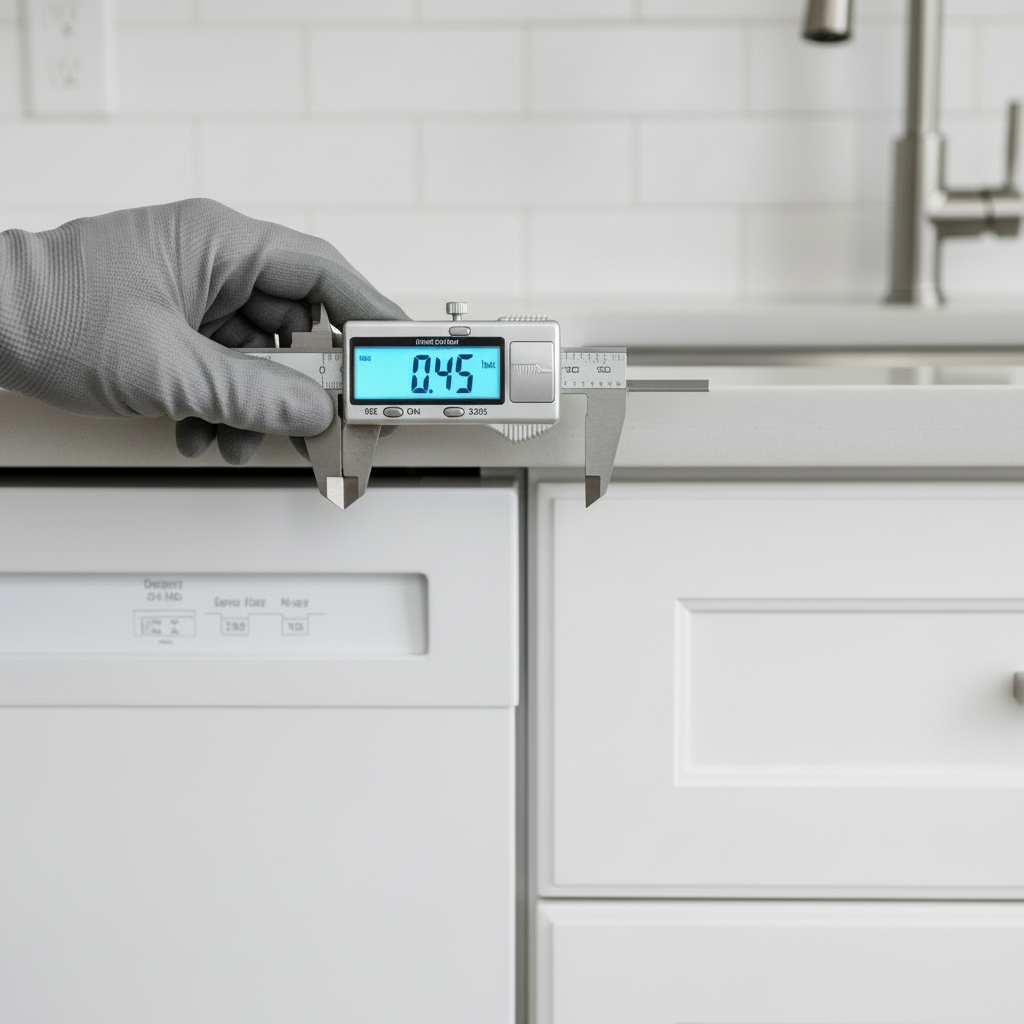
**Installation Is No Joke:** You need precision here because panel alignment has to be perfect or it looks terrible. And repairs? Total pain. I talked to an appliance tech who said he spent 90 minutes just removing custom panels to access a broken compressor.
For help finding someone who actually knows integrated systems, BizzFactor's [appliance repair professionals](/appliance-repair-services/) section is pretty solid. They get it.
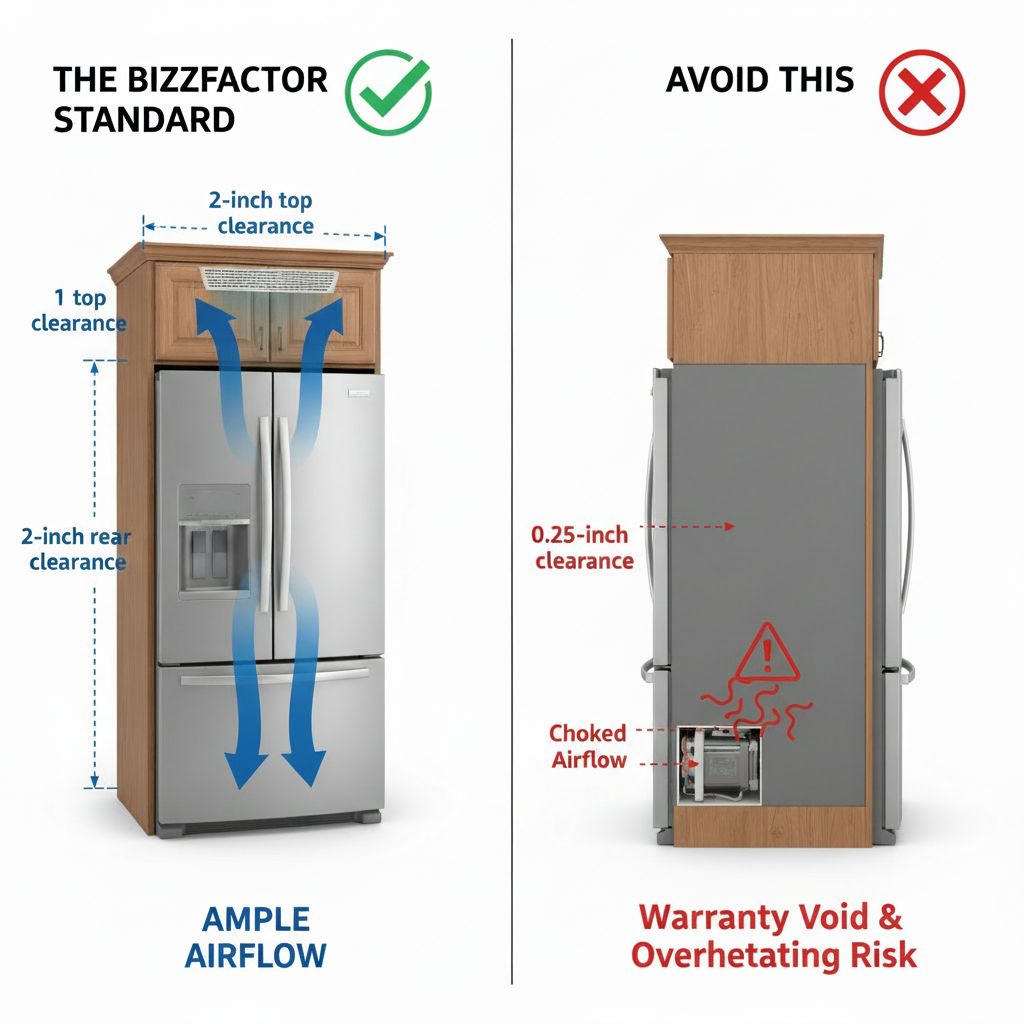
And here's the thing about ventilation — fridges especially need airflow around the compressor or they'll overheat and die early. You can't just shove these things into any old cabinet opening and call it good. That's the real issue. There's specific clearance requirements (usually listed in the manual, sometimes hidden on page 47). Screw this up and you'll void your warranty before you even stock the thing with groceries. That's the real issue. On the electrical side, your dishwasher's pulling its own dedicated 15-amp circuit. Your range? That's a 50-amp line at 240 volts, and it's not optional. I've seen homeowners try to cheap out and tap into existing circuits — don't. The National Electrical Code has strict appliance safety requirements for a reason. Same deal with dishwasher plumbing — you need either an air gap under your sink or a high loop in the drain hose. Otherwise wastewater flows back into your clean dish cycle. Yeah, gross.
**You're Locked In:** Want to change your kitchen layout in five years?
Good luck.
Look — integrated appliances basically marry you to your cabinet setup. Something breaks and you need a replacement? Better hope you can find one with the same exact footprint and mounting system, because otherwise you're rebuilding cabinets. Refrigerator columns are the worst for this — they're built around millimeter-perfect openings with brand-specific panel brackets. That's the real issue. Can't just swap a Sub-Zero for a Thermador without tearing apart the whole wall.
**Sometimes Less Storage Inside:** Check this — a 36-inch integrated fridge might actually hold less than a 36-inch freestanding model. Why? Because it has to fit within standard cabinet depths. I've seen families get burned on this during Thanksgiving. Not enough room for the turkey and all the sides.
Always check net capacity specs.
Here's what nobody tells you: the compressor and condenser coils sit in weird places on integrated units — sometimes top-mounted, sometimes on the side — because they're engineering around that flush installation. Eats into your shelf space. Then there's all the extra insulation they pack in (gotta meet those Energy Star ratings somehow). A 36-inch integrated might give you 18 cubic feet while a freestanding version gets you 22. That's an entire Thanksgiving turkey's worth of missing space. So yeah, always look at actual interior capacity numbers, not the outside measurements.
Freestanding Appliances: When You Want Flexibility and Options
Some people don't want their appliances to vanish.
They want easy access, simple replacement, and more money left in the budget.
That's freestanding.
What Works About Freestanding
**Your Wallet Will Thank You:** A quality freestanding fridge runs $800-$2,000. Comparable integrated? $3,000-$6,000. Installation's usually DIY-friendly or costs a couple hundred bucks tops.
The savings add up fast.
**Installation Takes Like an Hour:** Slide it in, plug it in, connect water if needed. Done. I helped my brother-in-law install his freestanding range last month — took us 45 minutes including lunch. Renters especially love this because there's no commitment.
Your electric range needs that 240V outlet (same plug your dryer uses, the one with three or four prongs depending on how old your house is). Gas range? You're looking at a shutoff valve and a flexible stainless connector. Dishwasher runs on its own 15-amp circuit. Pretty straightforward if the connections are already there. Any decent installer has done hundreds of these — it's not complicated stuff.
**Broke? Replace It Tomorrow:** Dishwasher dies on a Tuesday? You can have a new one in there by Thursday. No custom anything. No cabinet modifications. Just swap it out.
BizzFactor's [appliance sales directory](/appliance-sales/) has hundreds of options ready to go.
**The Selection Is Massive:** Want matte black? Retro red? Smudge-proof stainless? Commercial-grade features? You've got literally thousands of combinations available. Way more options than integrated ever offers.
Perfect for your [kitchen appliance needs](./kitchen-appliance-selection-guide/).
Freestanding manufacturers offer models that hit all the same performance benchmarks — Energy Star certification, good cleaning ratings on dishwashers, proper refrigeration efficiency — but in colors and configurations the integrated world doesn't bother with. The market's just way bigger. You want a 30-inch slide-in range with air-fry built in and a matte black finish? Twelve brands make that. Try finding it in panel-ready. Good luck.
**More Space, More Features:** Freestanding fridges pack in bigger shelves, external ice makers, door-in-door designs. Ranges offer larger oven capacities. A chef I know in Tempe insisted on a 48-inch freestanding range because she needed dual ovens with serious BTU power. Can't find that in most integrated setups — manufacturers aren't designing integrated models with the same firepower because they're focused on cabinet compatibility first, performance second.
The Trade-Offs You're Making
**It Looks... Different:** They stand out.
If you're going for that sleek, magazine-cover aesthetic, freestanding appliances can feel chunky or disjointed. It's just visually busier.
**Gaps Collect Everything:** That space between your fridge and counter? Crumb city. Dust bunnies. Stuff you dropped six months ago. Cleaning those gaps is nobody's favorite chore. And if you've got mice or roaches in your neighborhood (don't act like you don't), those gaps become highways straight into your cabinets.
**Cords and Hoses Show:** Unless you get creative, you're seeing power cords, water lines, maybe gas connections.
Little details, but they chip away at that polished look.
Your water line's gotta be code-approved flexible stainless. Gas connector needs a shutoff valve you can reach. All sitting right there where you can see 'em every time you walk past. Some folks don't care. Others obsess over it.
**Can Be Louder:** No cabinet insulation means sound travels more freely. Your mileage varies by model, but in an [open-plan kitchen design](./kitchen-layout-planning/), that hum from the fridge can carry. Worth considering. Always check the decibel rating (dB) on the appliance's spec sheet.
Your 2025 Decision Checklist: What Actually Matters
Time to get real with yourself.
**What's Your Actual Budget?** And I mean everything — not just the appliance price tag. Custom cabinets for integrated run $4,000-$12,000 depending on your kitchen size. Installation labor runs higher. Freestanding?
Way less.
Do the full math before you commit. Remember, it's not just the appliance cost. For integrated, you're paying for custom millwork, those specialized mounting kits, and probably higher labor rates because you need skilled installers who've actually done this before. A basic kitchen with integrated appliances could easily push costs up by $10,000-$20,000 compared to the same kitchen with freestanding options. I've seen it happen in Milton — twice.
**How Do You Want Your Kitchen to Feel?** Close your eyes and picture your ideal kitchen. Do appliances disappear, creating this zen minimalist space? Or are they part of the character — maybe that gorgeous retro-style range in candy apple red? Your gut knows. An integrated kitchen is often about the overall architectural statement rather than individual appliance features.
**How Long Are You Staying?** Moving in three years? Probably go freestanding. Staying for twenty? Integrated might be worth it. And think about your habits — do you like upgrading tech? My friend Sarah in Phoenix renovates her kitchen every four years. She went freestanding because she loves swapping things out.
Made total sense for her lifestyle. Integrated appliances are a commitment, not just to the aesthetic but also to the form factor. Replacing an integrated unit often means buying another integrated unit because the cabinetry is built specifically for it.
**Who's Installing This Thing?** Finding qualified installers
In-Depth Look
Detailed illustration of key concepts
Visual Guide
Infographic illustration for this topic
Side-by-Side Comparison
Visual comparison of options and alternatives
Sources & References
- 2025 Guide to Integrated Kitchen Appliances vs. Standard Models
- Built-In vs. Freestanding Appliances: What's Best for Your Kitchen?
- Integrated vs. Freestanding Appliances - Pros and Cons for Your ...
- Luxury Refrigerator Guide 2025: Built-In vs. Freestanding and What ...
- Built-In Refrigerator Ideas That Maximize Space and Style
- Building Codes, Standards, and Regulations: Frequently Asked ...
- Building Codes and Standards - 101 Guide | ROCKWOOL Blog
- [PDF] Building Codes Toolkit for Homeowners and Occupants - FEMA
- ICC - International Code Council - ICC
- [PDF] Introduction to Model Codes - eird.org
Frequently Asked Questions
Need Professional Help?
Find top-rated appliance repair experts in your area