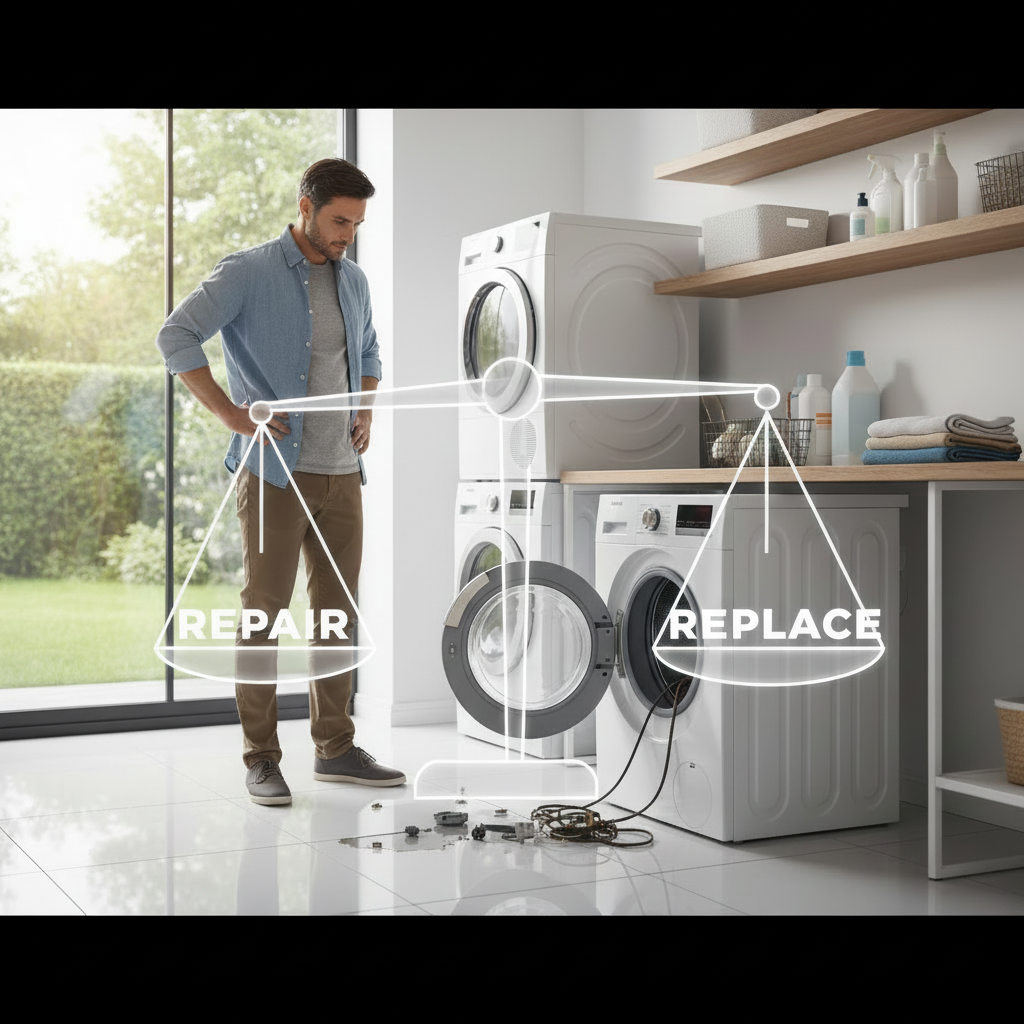
Decipher when to repair or replace home appliances with the 50% rule. Get expert advice on true costs, age, and energy efficiency for smart appliance decisions.
Key Takeaways
- **Refrigerators:** 10-15 years
- **Washing Machines:** 8-12 years
- **Dryers:** 10-14 years
- **Dishwashers:** 8-12 years
- **Range/Ovens:** 10-18 years
Key Takeaways
The 50% Rule for Home Appliances: Expert Guide to Repair vs. Replace Decisions
Your washing machine just died. Again. Should you fix it, or is it time for a new one? Making this decision, especially for major home appliances, can be complex. While the "50% rule" offers a guiding principle, a deeper dive into true costs, age, and energy efficiency is crucial for smart decision-making.
Traditionally, the 50% rule suggests replacing any appliance when the repair cost exceeds 50% of the cost of a brand-new unit. However, our certified repair technicians, with over two decades of experience at BizzFactor, know that this calculation is often oversimplified. Factors like the appliance's age, its energy efficiency, and often overlooked hidden replacement costs are critical elements that most homeowners might miss.
What Exactly Is the 50% Rule for Appliances?
So here's how most people explain it: if fixing your appliance costs more than half what you'd pay for a new one, just replace it. Seems simple enough, right? Your dishwasher needs $300 in repairs, new one's $500 — that's 60%, so supposedly you should buy new.
At BizzFactor, we use this as a starting point. But I can't tell you how many times we've watched people completely botch this math.
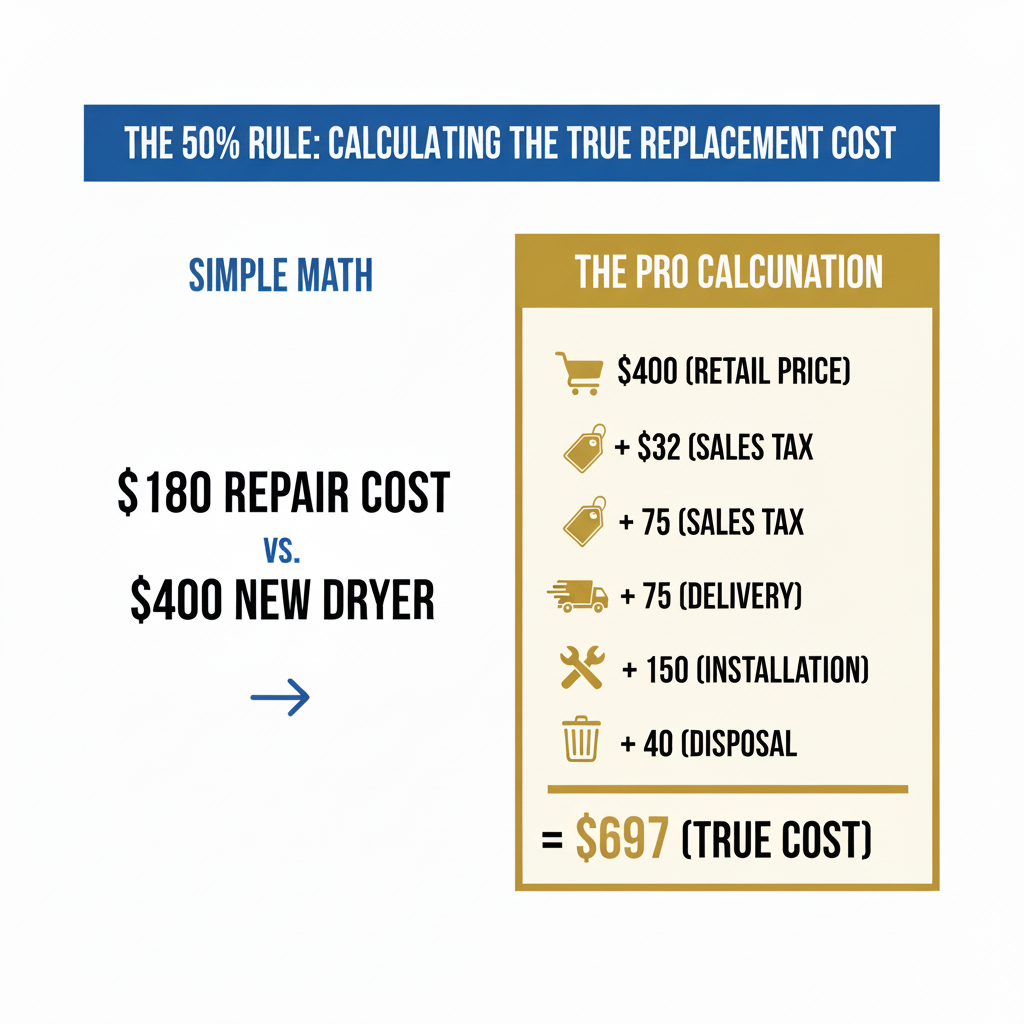
Take this one case from last month. Eight-year-old dryer, needed a $180 repair. New dryer at Home Depot? $400. Guy's thinking, "180 is only 45% of 400, easy call — I'll repair it." Makes sense until you actually walk through what replacing it *really* costs.
He forgot delivery ($75). Installation ($150 — these things don't hook themselves up). Hauling away the old unit ($40). Suddenly his "400 dollar dryer" actually costs $665 to get running in his house. That $180 repair? Now it's only 27% of his real replacement cost. Huge difference.
This is why the devil's in those details nobody thinks about.
How to Calculate the True Replacement Cost Accurately
Look, you need the actual out-the-door number. Here's what that means:
**Start with retail price** — whatever's on the tag or website.
**Add your sales tax.** Most places that's 6-10%, and on a $800 fridge that's another $50-80 you weren't planning on.
**Delivery fees.** Figure $50-100 for anything heavy. Refrigerators? Definitely on the higher end.
**Installation costs** run $75-200 depending on complexity. Gas stove hookups? Dishwasher water lines? You're probably not doing this yourself (and your homeowner's insurance thanks you for that).
**Removal charges** for your old unit. Usually $30-50. Some retailers waive this, most don't.
Then **subtract any rebates** — and yeah, these actually exist. Check [Energy Star's rebate finder](https://www.energystar.gov/rebate-finder) because utility companies sometimes kick in $50-100 for efficient models.
**Pro tip from 20 years of service calls:** When you're shopping, ask for the total out-the-door price upfront. If the salesperson seems confused by this question, that tells you something about where you're shopping. For more on budgeting this stuff, our [Appliance Maintenance Costs](https://bizzfactor.com/blog/appliance-maintenance-costs) guide breaks it down.
When Does Appliance Age Outweigh the 50% Rule?
Age changes everything. And I mean *everything*.
Our licensed technicians see this pattern constantly — appliances near the end of their lifespan don't just have one problem. They've got problems waiting in line. You fix the pump, next month it's the control board. Month after that? Something else you've never heard of gives out.
Perfect example: 13-year-old dishwasher last week needed a $220 pump repair. New unit (with all the costs we just talked about) would've been $650 total. So 220 is only 34% of 650 — repair looks like a no-brainer.
Except dishwashers typically last 8-12 years according to EPA data. This one's already living on borrowed time. We told the homeowner straight up: "Yeah, we can fix the pump. You'll probably get another 6-18 months. Maybe. But something else expensive is failing soon, and you'll be right back here making this same decision."
Sometimes the math says repair, but the calendar says replace.
Expected Appliance Lifespans
Here's what you're working with (roughly — these aren't guarantees):
- **Refrigerators:** 10-15 years
- **Washing Machines:** 8-12 years
- **Dryers:** 10-14 years
- **Dishwashers:** 8-12 years
- **Range/Ovens:** 10-18 years
- **Water Heaters:** 8-12 years
Look — at BizzFactor, our rule of thumb is this: if your appliance is under 60% of its expected life, the 50% rule works pretty well. Past two-thirds of its lifespan? Start thinking replacement even if the repair seems cheap. Those "just one more fix" situations rarely end well (ask me how I know).
The Impact of Energy Efficiency Savings
Modern appliances use *way* less electricity than their older cousins. Like, shockingly less. And nobody factors this into their decision, which drives me crazy because it's often the deciding factor when you actually run the numbers.
Today's ENERGY STAR® refrigerators use about 40% less power than models from 15 years ago. That's $150-200 back in your pocket every year in lower electric bills. Over a decade? We're talking real money.
Here's a real case we handled in Dunwoody last spring. Twelve-year-old top-loading washer needed a $310 transmission repair. New high-efficiency model would cost $750 all-in. By the 50% rule (310 is 41% of 750), repair wins.
But that new washer would save around $180 yearly on water and electricity. Five years of ownership? That's $900 in savings. Suddenly spending an extra $440 upfront ($750 minus the $310 repair) to get $900 back over five years makes the new washer the smart play.
This is why you can't just look at today's price tag.
Potential Annual Savings from New Efficient Appliances
Real-world numbers from our service data:
- **Refrigerators:** $100-250/year (ENERGY STAR® models vs. 10+ year old units)
- **Washing Machines:** $50-150/year (high-efficiency vs. traditional top-loaders)
- **Dishwashers:** $30-80/year (efficient models vs. older units)
- **Water Heaters:** $200-400/year (tankless or hybrid vs. old tank models — this one's massive)
Quick calculation we use: if your yearly energy savings would be more than 20% of the price difference between repair and replace, lean toward replacement. The long-term math works out.
When to Disregard the 50% Rule Entirely
Rules are great until they're not. We've seen plenty of situations where the 50% rule just doesn't apply, and following it blindly would be stupid (there's no nicer word for it).
**High-end built-in appliances** are the big one. You've got a Sub-Zero fridge or a Wolf range built into custom cabinetry? Replacement isn't just buying a new appliance — it's potentially $3,000-5,000 in cabinet modifications and custom installation work. A $2,000 repair on a $4,000 appliance might sound crazy until you realize replacement actually costs $9,000 with all the custom work. Yeah, fix it.
**Warranty coverage** — if it's still under warranty (manufacturer or extended plan), just repair it. This shouldn't need explaining, but apparently it does because people call us about this constantly.
**Bad timing situations** come up more than you'd think. Your fridge dies during a kitchen renovation when you're living off a microwave and a cooler? A temporary $200 repair to buy three months until your kitchen's done beats rushing into a $1,200 appliance purchase you haven't properly researched. Sometimes good enough for now is the right call.
**Sentimental value** counts too, even though it's not on any spreadsheet. That vintage O'Keefe & Merritt stove your grandmother left you? If you want to keep it running, keep it running. Not everything's about ROI.
BizzFactor's Professional Assessment Process
Here's how we actually evaluate your situation (because it's not just "repair good" or "replace good"):
**Figure out what actually failed** and why. Is this normal wear and tear after 10 years, or did something weird happen that killed a component early? Big difference.
**Check everything else while we're in there.** If your washer's transmission just died, we're looking at the drum bearings, the control board, the pump. What else is about to fail? Because if three components are near end-of-life, fixing one is just postponing the inevitable.
**Run the real numbers** on total cost of ownership. Upfront cost, energy efficiency, how long this thing will probably last, reliability ratings for the model.
**Give you our honest take** with actual reasoning behind it. We'll show you the math. Sometimes repair makes perfect sense. Sometimes it's throwing good money after bad, and we'll tell you that even though we'd make more money on the repair.
Repairs That Rarely Make Financial Sense
We've done thousands of service calls. Some repairs come up over and over, and honestly? They're almost never worth it, especially on older units.
**Compressor failures in refrigerators** — you're looking at 60-80% the cost of a new fridge just for the part and labor. And if the compressor went, other refrigeration components aren't far behind. This is a rebuild, not a repair.
**Transmission problems in top-loading washers** over 8 years old run $300-500. You're basically paying replacement money to keep an old machine limping along for another year or two. Hard to justify.
**Control boards on older appliances** can be weirdly expensive — sometimes $200-400 — because the parts are getting scarce and they're complex to replace. You're often spending more than the used value of the appliance.
General rule: if you need a major component replaced and your appliance is past 70% of its expected lifespan, just replace the whole thing. You're one repair away from needing another repair. Our [Common Appliance Problems](https://bizzfactor.com/blog/common-appliance-problems) article goes deeper on this.
The Environmental Impact of Appliance Decisions
Yeah, making new appliances uses resources. But running inefficient old ones wastes way more energy over time — it's not even close.
A 15-year-old refrigerator pulls around 1,400 kWh per year. Modern ENERGY STAR® model? About 600 kWh. That 800 kWh difference equals the CO2 from burning roughly 600 pounds of coal annually. Every single year you keep that old fridge running.
The environmental break-even point is typically 2-4 years. After that, the new efficient appliance has "paid back" its manufacturing footprint and you're net positive environmentally.
Something to think about if you care about that stuff (and honestly, you probably should).
Avoiding Common 50% Rule Mistakes
People screw this up in predictable ways. Here are the big ones:
**Mistake #1: Comparing apples to oranges.** Your high-end Samsung washer with steam cleaning and 15 cycles needs repair. You compare that to a basic $400 Whirlpool at Lowe's and think "wow, repair's 65% of replacement cost!" Yeah, but you're not actually going to buy that basic model — you're going to replace your Samsung with another similar Samsung, which costs $900. Run the comparison against what you'd *actually* buy.
**Mistake #2: Ignoring what we
In-Depth Look
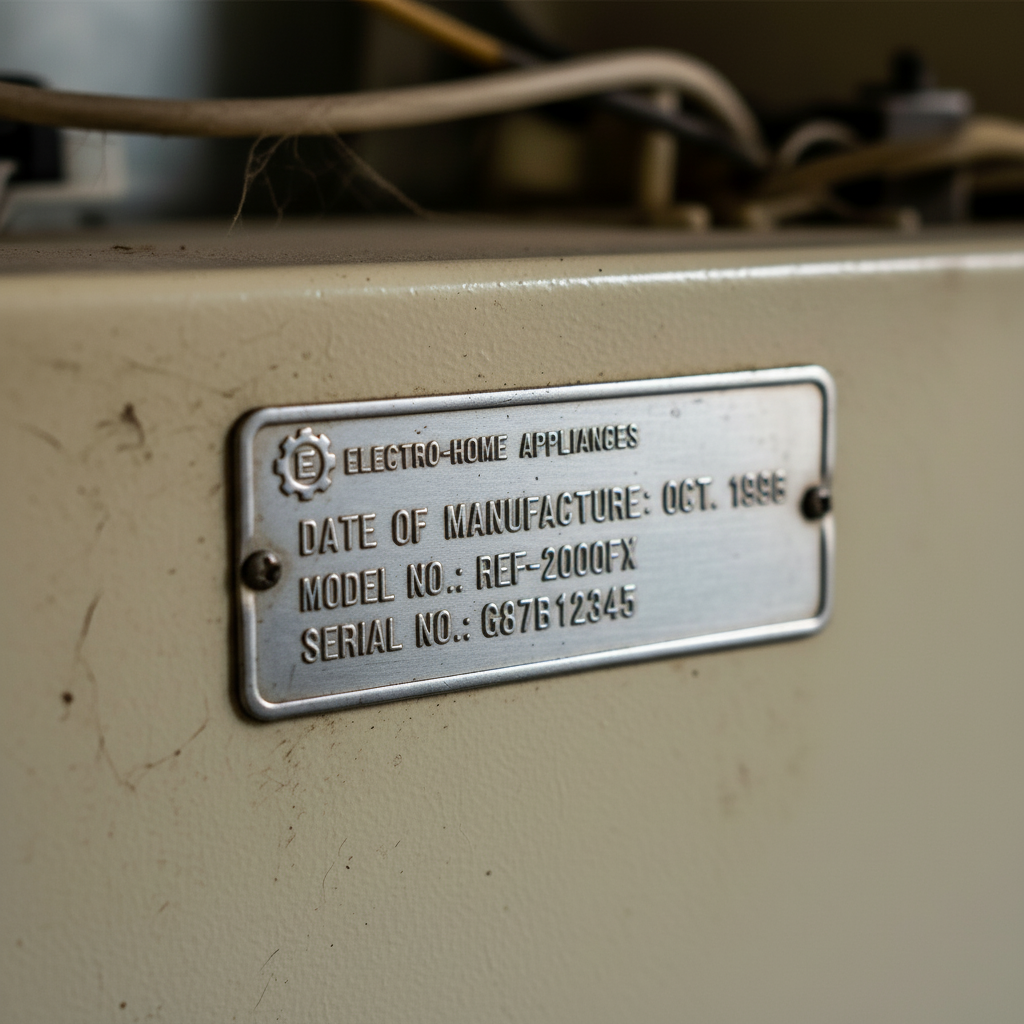
Detailed illustration of key concepts
Visual Guide
Infographic illustration for this topic
Side-by-Side Comparison
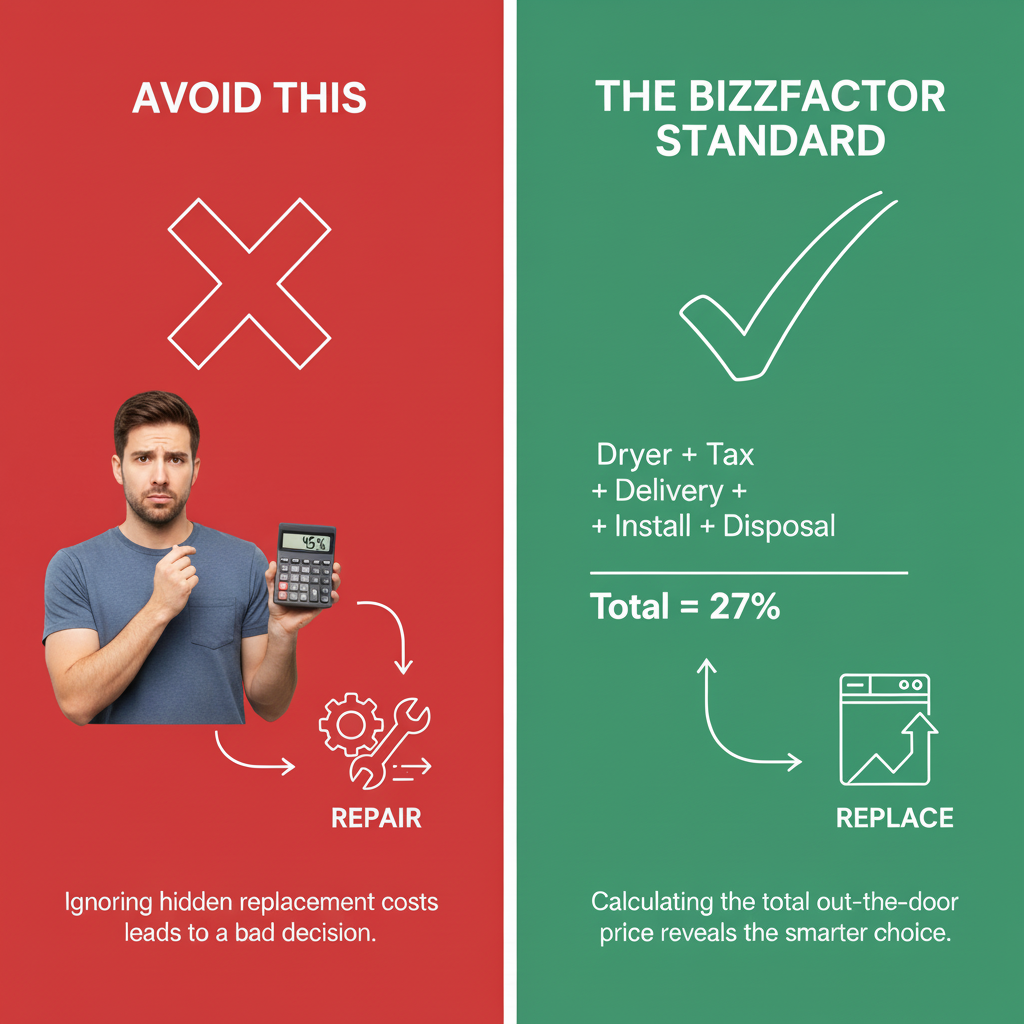
Visual comparison of options and alternatives
Sources & References
- Appliance Repair vs. Replace: A Complete Homeowner's ...
- When to Repair and When to Replace Appliances
- What Is the 50/50 Rule for Appliances? Repair or Replace?
- When to Repair or Replace Your Appliances
- When to Repair or Replace Your Appliance: A Handy Guide?
- Building Codes, Standards, and Regulations: Frequently Asked ...
- Building Codes and Standards - 101 Guide | ROCKWOOL Blog
- [PDF] Building Codes Toolkit for Homeowners and Occupants - FEMA
- 5 Reasons Building Codes Should Matter to You
- ICC - International Code Council - ICC
Frequently Asked Questions
Need Professional Help?
Find top-rated appliance repair experts in your area