Expert guide to appliance repair vs replacement decisions. Learn the 50% rule, energy savings analysis, and when to fix or replace your home appliances.
Key Takeaways
- Apply the 50% rule when repair costs exceed half of replacement price
- Factor in energy efficiency gains from newer ENERGY STAR certified models
- Professional assessment prevents costly misdiagnosis on complex appliance issues
BizzFactor Quick Guide
The BizzFactor Standard: Always get professional diagnosis before major appliance repair decisions exceeding $200
Key Takeaways
The BizzFactor Standard
3 Non-Negotiable Requirements for Elite Workmanship
Licensed & Certified Technicians Only
Qualified professionals have manufacturer training and diagnostic tools unavailable to general repair services.
Comprehensive Cost Analysis Provided
Elite services calculate total ownership costs including energy usage, not just upfront repair expenses.
Written Estimates With Warranty Details
Professional assessments include detailed repair estimates and realistic appliance longevity predictions in writing.
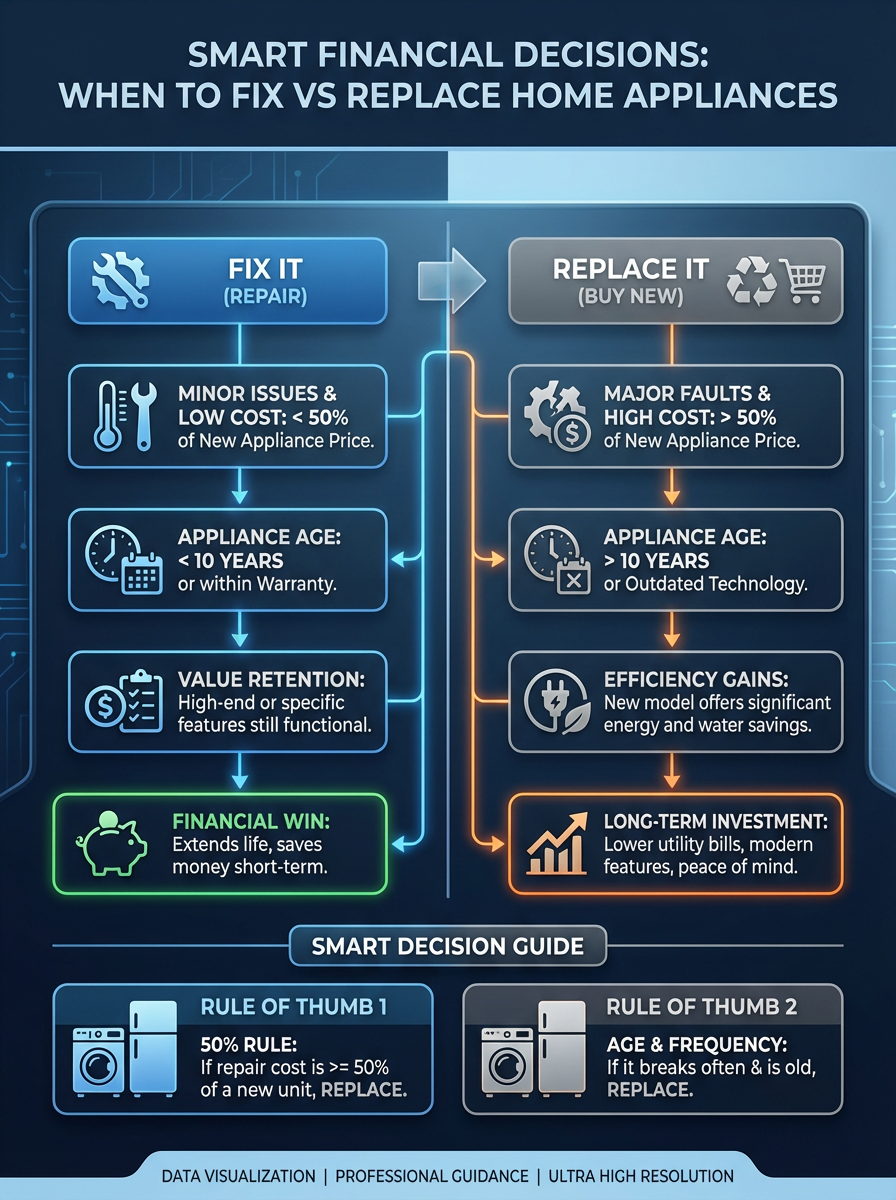
Smart Financial Decisions: When to Fix vs. Replace Home Appliances
Busted appliance?
Ugh. It's a real headache, isn't it? That moment your washing machine decides to flood the laundry room or your fridge starts humming like an angry beehive – it throws a wrench in your entire week. Suddenly, you're slammed with the big question: do you fix it, or do you bite the bullet and buy a new one?
Look — look — this isn't just about the immediate cash hit, either. We're talking about the unit's age, whether it's secretly devouring too much energy, and if it's just gonna conk out again next month. I've seen homeowners in North East Portland agonize over this decision for weeks. Getting it right can save you a ton of money and stress. This guide, packed with BizzFactor's street-smart expertise, is gonna walk you through making smart, sustainable choices for every major appliance in your home.
You'll get more bang for your buck. I promise you that.
The '50% Rule' and Appliance Lifespans: Your First Clues
You've got a quote sitting in your inbox. Maybe it's $380 to fix your dryer. You pull up your phone, check what a comparable new one costs — let's say around $700.
Do the math. That repair's hitting 54% of replacement cost.
Most contractors I've worked with won't touch anything over fifty percent. Not because they're lazy — they've just seen too many homeowners pour money into dying machines. Above that threshold? You're basically funding a very expensive Band-Aid. Below it? Okay, *maybe* repair makes sense. But — and this trips people up constantly — you can't stop there. Has this thing broken twice already this year? Did you drop $200 on it last spring? What about the warranty situation?
Because here's the kicker: most big home appliances have a pretty solid shelf life. Of course, how you use them (and how well you keep 'em clean!) makes a huge difference. But generally, you can expect these ranges:
- **Refrigerators:** 10-13 years. Newer ones have inverter compressors that adjust speed on the fly instead of just hammering on-off cycles like the old beasts. Means less wear. Some pricier models use dual evaporators — sounds fancy, but really it just means your lettuce doesn't turn to mush while your ice cream stays rock-hard. Not bad, honestly.
- **Dishwashers:** Around 9-12 years if you're lucky. Look for stainless tubs — they handle hard water way better than plastic, which gets brittle and stained over time. A lot of newer models have brushless motors that run quieter and last longer. My neighbor just hit year 13 on hers, but she's religious about cleaning the filter.
- **Washing Machines:** You're looking at 8-12 years, give or take. Front-loaders usually outlast top-loaders because they're gentler on clothes and have beefier suspension systems. Top-loaders with agitators? They clean well but beat the hell out of both your jeans and themselves.
- **Dryers:** Typically 10-13 years. They take a beating — constant heating, cooling, tumbling wet loads. Gas models often have simpler guts than electric ones, which *can* mean fewer breakdowns. But electric dryers are usually cheaper to install, so pick your poison.
- **Gas Ranges:** These bad boys last 15-20 years, sometimes longer. Built like tanks. Fewer electronics to fail. Cast-iron grates, sturdy igniters. I know a chef in Beaverton who's still using his grandmother's 35-year-old gas range. Thing's a beast.
- **Electric Ranges:** Around 13-15 years. Ceramic cooktops scratch easier but they're solid. Coil tops? Nearly bulletproof. Induction is the new hotness — heats faster, more precise, might even last longer since there's less direct heat hammering internal components.
- **Microwaves:** 7-10 years. You pay less, you get less lifespan. Makes sense. Over-the-range models tend to last longer than countertop ones — better build quality, better ventilation. Magnetron tubes usually fail first.
- **Ovens (Built-in):** 12-15 years, usually. Similar to ranges but often with fancier controls. Self-cleaning is cool but it stresses the hell out of door seals and electronics. Those pyrolytic cycles hit 900°F. Real talk: I'd skip it unless your oven's truly disgusting.
Now, here's where it gets interesting.
Here's the thing: if your appliance is hitting, say, 75% or more of its expected lifespan, it's living on borrowed time. It's significantly more likely to break down again. What does that mean for you? Well, all those little repair costs add up. Fast. And often, those cumulative costs will blow past what a shiny new model would cost, especially when you factor in new problems popping up right after you've shelled out for a repair.
We saw this with a family in Raleigh Hills; they kept fixing their 15-year-old fridge, piece by piece, until they'd spent more than a new one would've cost — and it still wasn't reliable. Don't skip this critical calculation. For a deeper dive, check out our guide on [appliance repair costs and considerations](/guides/appliance-repair-costs-considerations).
Energy Efficiency: Your Wallet's Best Friend
Okay, so picture this: I'm standing in my kitchen last spring, staring at my electricity bill, and I'm doing the math on my 2009 fridge.
Turns out the old girl was bleeding me for about $120 a year. Just sitting there, humming away, draining my bank account. Meanwhile, new ENERGY STAR models? They're pulling 20-30% less power, sometimes even more if you get one with solid insulation and a variable-speed compressor.
Run those numbers forward. You're pocketing $30-40 annually. Doesn't sound earth-shattering until you realize that's $300-400 over a decade. And that's *after* the appliance has already paid for itself in utility savings.
This is why comparing repair quotes to sticker prices is only half the story. That new [ENERGY STAR certified](https://www.energystar.gov/) fridge might run you $850 versus $650 for a basic box. But if it's saving you $35 every year? Six years in, you've broken even. Then you've got another 4-7 years of pure profit sitting in your pocket.
Free money, basically.
Now, if you're weighing options on specific appliances, we've got detailed breakdowns on [refrigerator repair vs. replacement](/guides/refrigerator-repair-vs-replacement) and [washer and dryer decisions](/guides/washer-dryer-repair-replace) that dig into the energy angle pretty deep.
A Real-World Disaster: The BizzFactor Case Study
Here's the thing: I remember this family in Portland, Oregon.
They were juggling two appliance crises at once. First, their 14-year-old refrigerator needed a hefty $450 compressor replacement – a big-ticket item. Then, their 11-year-old dishwasher threw in the towel, needing a $280 control board fix. Double whammy. It was a tough week at their house. Seriously, you could feel their stress when they called.
So we ran the numbers. That fridge had already lived to 108% of its expected lifespan — it was basically a zombie appliance. The dishwasher was at 92%. Both machines were deep in the danger zone where another breakdown was pretty much inevitable.
Here's what made the decision: the fridge's compressor was the *third* major component to die in 18 months. First the defrost timer went ($180), then the ice maker ($95), now the compressor ($450). That's the real issue. That's $725 in repairs on a machine that should've been replaced a year ago. The dishwasher? That control board replacement hit 60% of what a decent new model would cost.
Our call: replace the dishwasher immediately. Keep the fridge limping along if you must, but start shopping.
Here's the thing: guess what happened? Six months later, that refrigerator's evaporator fan motor died. Would've been another $220. They finally replaced it, kicking themselves for not pulling the trigger earlier. All those little repairs — they added up to way more than a new fridge would've cost.
That's why you can't just look at the immediate quote. You've gotta think about what's coming next.
Pro vs. DIY: Why Expert Eyes Matter
We all love to think we're handy, don't we?
Changing a lightbulb? Sure. Unclogging a simple drain? Go for it. But when your appliance is acting possessed — weird grinding noises, refusing to power on, leaking mystery fluids — you're probably out of your depth. A **[certified appliance tech](/appliance-repair/find-a-pro)** brings diagnostic equipment you don't own and training you haven't got. They've seen your exact model fail in five different ways.
That matters. A lot.
They'll figure out the actual problem instead of you guessing and buying parts that don't fix anything. A guy in Buckhead spent $380 replacing his dryer's heating element, thermostat, *and* timer before a tech diagnosed it in ten minutes: bad thermal fuse. Twelve-dollar part.
Yeah, diagnostic visits run $100-150. Nobody wants to pay that just to hear bad news. But what you're really buying is someone who can tell you the truth about whether your machine's salvageable. He's got a multimeter for motor windings, pressure gauges for refrigerant systems, and he knows which failures are warning signs of bigger catastrophes lurking underneath.
That diagnosis fee might save you from dumping $300 into something that'll die again in three months.
Find trusted [appliance repair services in your area](/appliance-repair). Worth every penny.
Warranties and Manufacturer Support: Don't Get Caught Out
If your appliance is still under its factory warranty, a professional repair usually makes sense. Especially if parts and labor are fully covered without a crazy deductible.
Same goes for extended warranties or those home protection plans – they can totally swing the decision toward repair. They *should* cover the big component costs, like a compressor or heating element.
But here's the thing – read the fine print. Carefully.
So — now, a lot of these plans have high deductibles, or they flat-out exclude certain types of failures like cosmetic damage or user error. Some only cover very specific parts, leaving you on the hook for labor. I've seen people get burned in Houston because they assumed they were covered, only to find a critical component wasn't on the list.
So if your appliance has been a problem child with repeated breakdowns, or if past repairs have been expensive, even with a warranty, maybe it's time to cut ties. Avoid that ongoing headache and those future costs.
And yes, you'll wanna check out our resource on [understanding appliance warranties](/guides/understanding-appliance-warranties) to maximize your coverage.
Market Timing & Smart Shopping: Strike When the Iron's Hot
Buying a new appliance isn't like buying milk.
You can actually save big if you time it right. The best deals? They pop up during **spring and fall clearance events**. Think Black Friday, Presidents' Day, Memorial Day, Labor Day. Those big holiday weekends. Retailers want to clear out old stock when the new models roll in, so you can often snag last year's tech for hundreds less.
Patience truly pays off here.
Nobody plans for their fridge to die just before Thanksgiving. Emergency replacements put you in a tough spot – you lose all your bargaining power, and you're pretty much
In-Depth Look
Detailed illustration of key concepts

Visual Guide
Infographic illustration for this topic
Sources & References
- The Cost of Appliance Repairs vs. Replacement Making Informed ...
- Repair or Replace? How to Decide the Fate of Your Appliances
- Repair or Replace Appliances: Cost and Lifespan Guide - Lafixit
- When to Repair vs. Replace Kitchen Appliances: Making Smart ...
- Repair vs Replace Appliances: Smart Guide for Cost & Longevity
- Building Codes and Standards - 101 Guide | ROCKWOOL Blog
- Building Codes, Standards, and Regulations: Frequently Asked ...
- [PDF] Building Codes Toolkit for Homeowners and Occupants - FEMA
- Building Standards and Codes - New York State Department of State
- ICC - International Code Council - ICC
Frequently Asked Questions
Need Professional Help?
Find top-rated appliance repair experts in your area