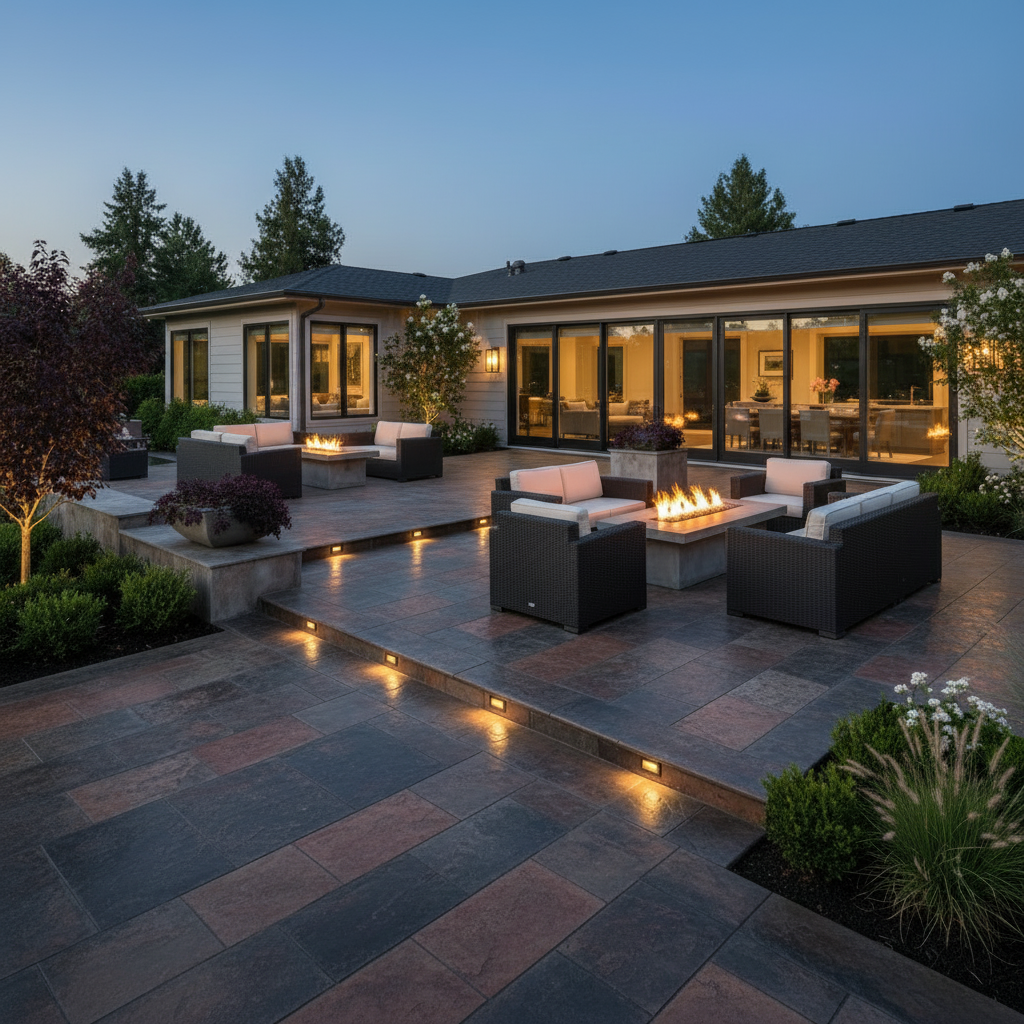
Explore decorative concrete patios: colors, stains, engraving, and essential tips for lasting beauty. Learn about design, durability, and avoiding common mistakes.
Key Takeaways
- Geometric borders
- Custom logos or insignias
- Compass roses
- Intricate Celtic knots
- Personalized company branding
Key Takeaways
Decorative Concrete Patios: Colors, Stains & Engraving Guide
A gray concrete patio is functional. But throw down some acid stain, stamp a Belgian slate pattern, and seal it right? You've got something people actually want to look at — and it'll probably add twelve grand to your home's value. Maybe more if you're in a hot market.
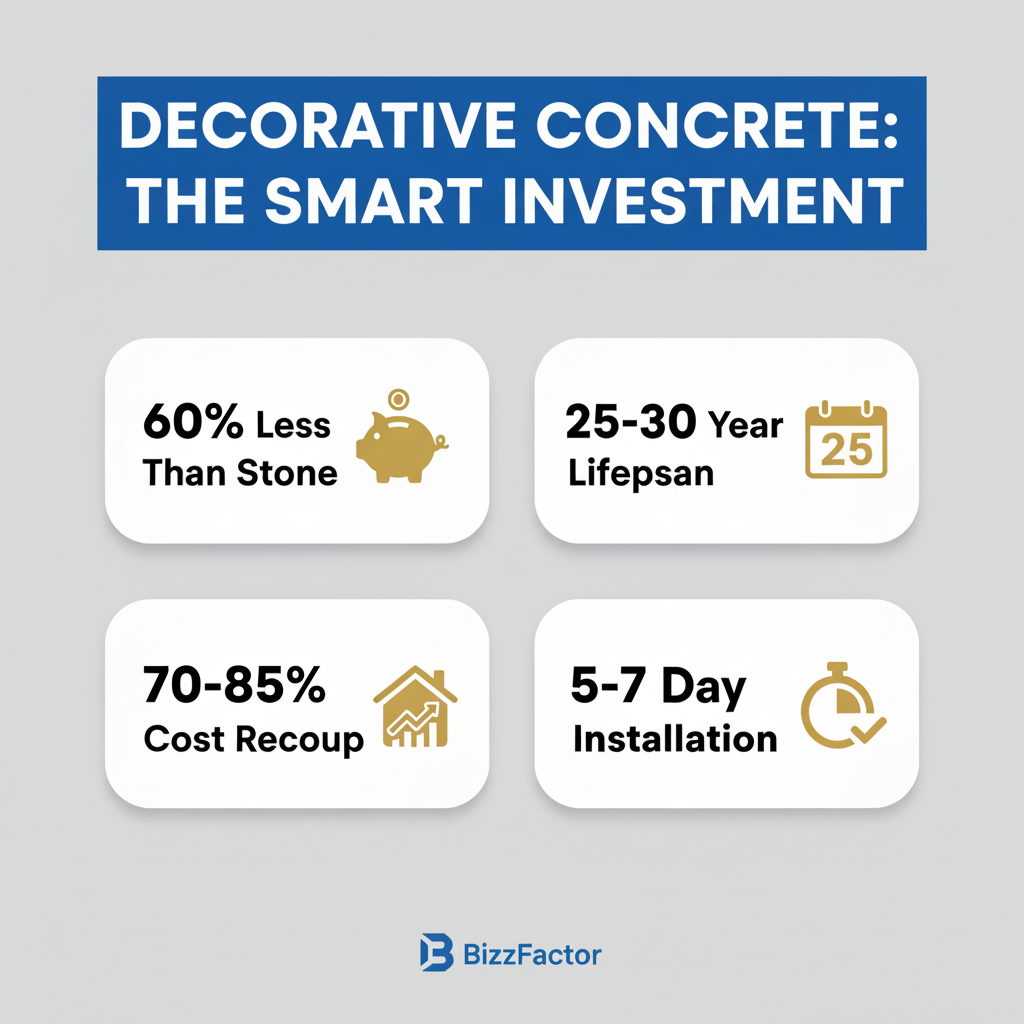
I've been doing this work for over two decades now, and decorative concrete still surprises me. The range is wild: acid stains, integral colors, stamped patterns, custom engraving. That's the real issue. Mix these techniques right and you can replicate natural stone or brick for about 60% less than the real materials. Sometimes even cheaper.
Unveiling the Appeal of Decorative Concrete Patios
The chemistry is actually kind of fascinating. Acid stains? They're literally reacting with calcium hydroxide molecules in your concrete — creating color through a chemical process, not just coating the surface. Water-based stains work totally differently. Pigment particles wedge themselves into the concrete's pores and set up shop there.
But you know what actually separates a patio that looks good for three years from one that's still gorgeous in 2050?
Surface prep.
Skip that step and I don't care how expensive your stain is. You're setting yourself up for disappointment.
We use commercial-grade products from Sherwin-Williams and Behr, the same stuff the big commercial contractors stock. (Your local big-box store version? Not quite the same formula, trust me.) Applied correctly, these create outdoor spaces that genuinely rival natural materials.
I've got clients from 2005 whose patios still look phenomenal. That's not a fluke — that's what happens when you do the boring foundational work right and don't rush the decorative stuff.
A Critical Error to Avoid: Improper Joint Placement
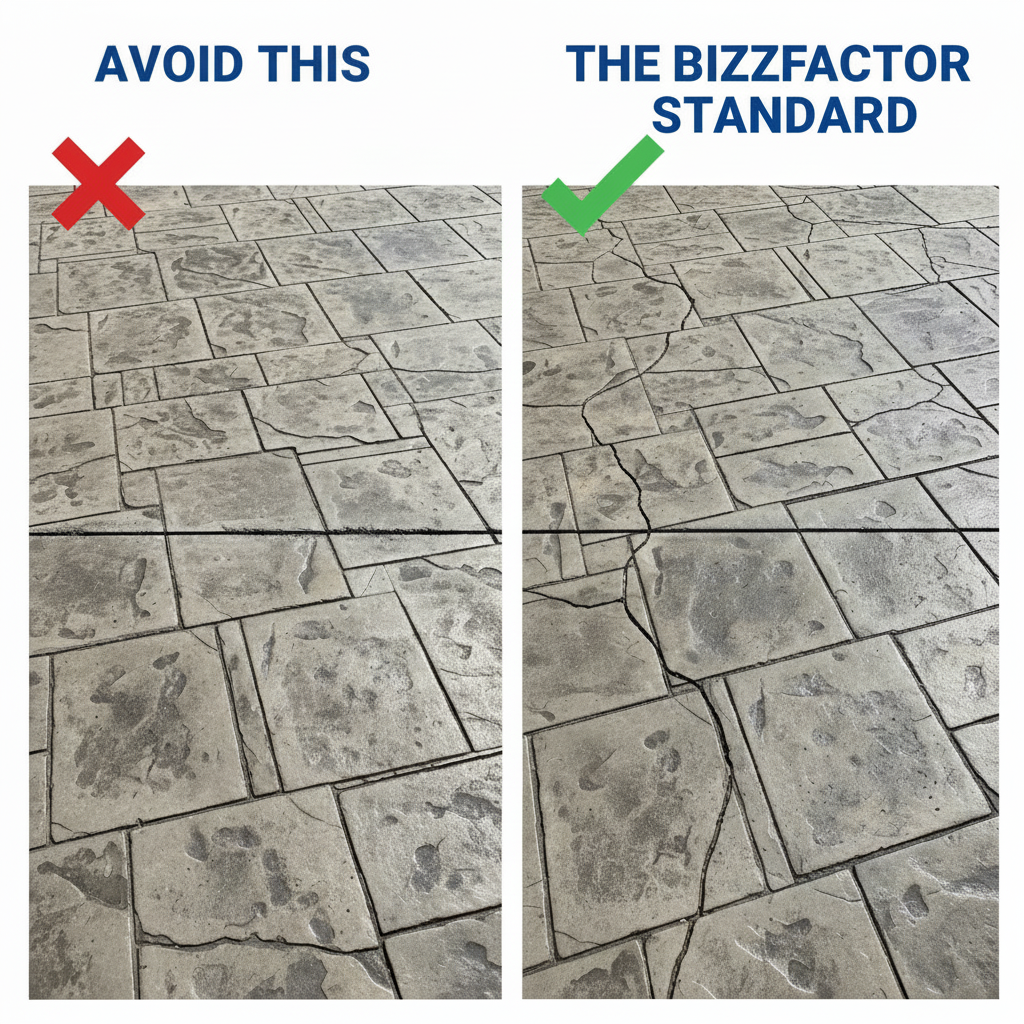
The fastest way to ruin an otherwise beautiful stamped patio? Cut your control joints straight through the pattern like you're slicing a pizza.
Look — i saw this last month in Brookhaven — contractor charged $8,400 for a "premium" slate pattern, then ran control joints perpendicular to the house in perfectly straight lines. Completely destroyed the illusion. You could spot it from the street.
**Our approach:** Control cuts follow the pattern's natural breaks. If you're stamping ashlar slate, your joints should mimic grout lines. Doing cobblestone? Joints follow the curves between "stones." This isn't rocket science, but it requires planning *before* the pour, not after.
When done right, the joints disappear. Nobody notices them. That's the entire point.
Our Professional Recommendation: Foundation First
Real talk — a gorgeous patio on a garbage foundation is just expensive future rubble.
We follow what I call the "boring stuff first" rule: proper sub-base (compacted to 95% minimum), correct rebar spacing, and drainage that actually works. Only after that structural skeleton is bulletproof do we think about colors, stamps, or engravings.
I've ripped out too many pretty patios that cracked within two years because someone rushed the foundation to get to the "fun" decorative work. Don't be that homeowner. And definitely don't hire that contractor.
Dispelling a Common Myth: The 'Wet Look'
Clients love browsing Pinterest and finding those ultra-glossy "wet look" patios. Then they ask me to replicate it.
Here's what those photos don't show: high-gloss acrylic sealers turn into ice rinks when wet. Also? Every shoe scuff, every dragged chair, every stray branch — all of it shows. Within six months, that mirror finish looks like a scratched CD.
**My recommendation:** Penetrating sealers instead. You'll lose some of the dramatic shine (not all of it, just the extreme gloss), but you gain a surface that's actually usable when it rains and won't show every imperfection. Most homeowners thank me for this advice around month three.
Demystifying Concrete Staining Options
So you've basically got two routes here, and they couldn't be more different if they tried.
**Acid-based stains** — these work through actual chemical reactions with the calcium hydroxide in your concrete. What you end up with are these beautiful, semi-unpredictable color variations. Earthy tones that look organic because they literally *are* chemistry happening in real time. The color won't fade in UV light either (huge for outdoor stuff). The catch? Your palette is limited to mostly earth tones, and you can't predict results with 100% accuracy. I've poured slabs where one section came out slightly darker than another section three feet away. Same concrete, same stain, different reaction.
**Water-based stains** are more like... think of them as super-penetrating paint. Pigment particles lodge themselves into the concrete's pores and stay there. This approach gives you way more color options — brighter tones, vibrant blues and greens, stuff you can't get with acid. And the results are way more predictable. I've probably done 200+ projects with water-based stains at this point. You can layer them, blend them, get creative.
Look — then there's **integral coloring** — where you dump pigment straight into the concrete mixer. Color goes all the way through the slab. According to EPA testing, this prevents any issues with chipping or surface wear showing gray underneath. High-traffic areas? This is your friend.
Popular Decorative Concrete Color Combinations:
**Earth Tones**: Terra cotta, sandstone, charcoal. These work if you're going for that organic outdoor vibe — they blend into landscaping without fighting it. I use these combos probably 40% of the time.
**Contemporary**: Graphite gray, slate blue, copper accents. Modern homes, clean lines, minimalist landscaping. These look killer with steel railings and glass doors.
**Traditional**: Brick red, forest green, warm brown. Classic look. Think colonial homes, established neighborhoods. These never really go out of style because they've been around forever.
Here's the thing: just wrapped a project in Sandy Springs — charcoal base with copper acid stain highlights. Customer initially balked at the $6,200 price tag. Called me three weeks later saying neighbors were stopping by to ask about it and her realtor estimated it added $12K to home value. (Did I mention she referred four neighbors? That's how you know you nailed it.)
For more inspiration, explore our [gallery of decorative concrete projects](/projects).
Advanced Engraving and Stamping Techniques
So engraving and stamping? Totally different animals.
People confuse them constantly.
**Engraving** happens *after* concrete is fully cured — we're talking 28+ days out. We use diamond-tipped equipment (usually Husqvarna tools) to cut precise patterns into hard concrete. Custom logos, geometric borders, intricate Celtic knots, compass roses. You can get detail levels that stamping can't touch. A guy in Buckhead paid $3,800 for a hand-engraved family crest in his courtyard patio. Worth every penny — that thing is genuinely art.
**Stamping** happens when concrete is still wet. We press textured mats (Butterfield Color makes the best ones) into fresh concrete to create patterns that mimic slate, flagstone, brick, wood planks, whatever. Timing is critical here — usually 2-4 hours after pour, but that window shifts based on temperature and humidity. Miss it and you're either making mush or trying to stamp rock.
We've done projects combining both techniques: stamped ashlar slate base with hand-engraved borders. Those tend to boost property values by around $10,000-$15,000 based on what appraisers tell us.
Discover more about [custom concrete designs and options](/services/custom-concrete-designs).
Common Engraving Patterns:
- Geometric borders
- Custom logos or insignias
- Compass roses
- Intricate Celtic knots
- Personalized company branding
The Professional Installation Process and Timeline
Nobody gets excited about excavation and gravel compaction. I get it. But that's literally the foundation of whether you're still enjoying this patio in 2040 or calling someone to rip it out in 2028.
We dig down 4-6 inches (sometimes deeper depending on soil conditions), then install aggregate base that we compact to spec. In flood-prone areas — and Atlanta has plenty — we add extra drainage following FEMA guidelines. Skipping this in a Zone AE area is asking for your patio to become a reflecting pool every time it storms.
Concrete placement requires specific weather. We shoot for 50-80°F with minimal wind. Our crew uses Trimble laser-guided screeds for consistent thickness and proper drainage slope (minimum 1/4 inch per foot, though we usually do 3/8 inch to be safe).
Patience matters here. Decorative treatments don't start until 24-48 hours after pour. Concrete needs strength first. Rush it and you'll mar the surface or get patchy stain penetration.
The entire process usually takes 5-7 days. Then the slab needs additional cure time before you can drag your patio furniture out there.
How This Actually Plays Out:
**Day 1** — Excavation and base prep. Dusty. Loud. This is the layer that determines whether your patio lasts three years or thirty years. Not glamorous, but critical.
**Day 2** — Pour day. Screeding, leveling, initial finishing. We're getting consistent thickness across however many square feet you're doing. Harder than it looks, especially on larger projects.
**Day 3-4** — This is when the magic happens. Staining, stamping, color work. Weather has to cooperate or we push it back a day. Can't control Mother Nature.
**Day 5-7** — Sealer application and initial curing starts. Surface looks done. It's not ready for furniture. Don't test me on this.
**Week 2** — Concrete hits full design strength. Now you can actually use it.
We don't budge on this timeline. Every single time I've had a client pressure us to compress the schedule, the results suffered. There are genuinely no shortcuts in concrete work — the chemistry doesn't care about your dinner party next weekend.
Learn more about our [concrete installation services](/services/concrete-installation).
Case Study: A Premium Patio Transformation
Last year we completed an 800-square-foot patio in Vinings that combined pretty much every technique: integral charcoal coloring, acid stain highlights, stamped European fan pattern, and a custom engraved compass rose centerpiece.
The prep work was textbook: 6-inch aggregate base, fiber-reinforced concrete at 4000 PSI, proper drainage routing. We sealed it with Behr Premium penetrating sealer.
Eighteen months later? Zero maintenance issues beyond routine cleaning with a garden hose. The homeowner reports neighbors constantly asking about it, and she's already received two quotes from other contractors trying to replicate the design next door.
Now, according to National Association of Realtors data, well-designed outdoor living spaces increase home values by 8-12%. This project hit right in that range based on her refinance appraisal — roughly $11,300 added value on a $7,200 investment.
Maintenance Best Practices and Longevity
**Regular sealing every 2-3 years is essential to protect decorative concrete from moisture ingress, d
In-Depth Look
Detailed illustration of key concepts
Visual Guide
Infographic illustration for this topic
Side-by-Side Comparison
Visual comparison of options and alternatives
Sources & References
- A Comprehensive Guide to Concrete Staining: Colors, Techniques ...
- Essential Stamped Concrete Maintenance Tips for Long-Lasting ...
- Decorative Concrete Care 101: Best Maintenance and Cleaning ...
- The Ultimate Guide to Decorative Concrete: Transform Your Space ...
- Ultimate Guide to Concrete Patios: Cost, Lifespan, & More
- Building Codes, Standards, and Regulations: Frequently Asked ...
- New Building Upgrades Codes and Regulations in Los Angeles
- Building Codes and Standards - 101 Guide | ROCKWOOL Blog
- [PDF] Building Codes Toolkit for Homeowners and Occupants - FEMA
- Construction Requirements for Retail Food Facilities | Los Angeles ...
Frequently Asked Questions
Need Professional Help?
Find top-rated home services experts in your area