
Learn 2024 AFCI breaker requirements, NEC compliance rules, and professional installation tips from certified electricians with 20+ years experience.
Key Takeaways
- The fire started behind a bedroom wall from a frayed lamp cord nobody could see
- That's the kind of thing Arc Fault Circuit Interrupters prevent
- They're not some optional upgrade your electrician's trying to upsell you on
- Since the 2024 National Electrical Code update, they're mandatory in most rooms where people actually spend time
Key Takeaways
AFCI Breaker Rules: 2024 NEC Compliance Guide (Updated for Homeowners)
A contractor in Buckhead lost a $180,000 remodel job because the homeowner's insurance wouldn't cover fire damage — turned out the electrical panel hadn't been updated since 1987. No AFCIs. The fire started behind a bedroom wall from a frayed lamp cord nobody could see.
That's the kind of thing Arc Fault Circuit Interrupters prevent. They're not some optional upgrade your electrician's trying to upsell you on. Since the 2024 National Electrical Code update, they're mandatory in most rooms where people actually spend time. And yeah, they cost more than regular breakers ($40-60 vs. $8-12), but I've seen what happens when someone skips them.
Look — look — traditional breakers? They catch the obvious stuff — overloads, dead shorts, that time you tried to run a space heater and a hair dryer on the same outlet. AFCIs are hunting for something way more subtle: the electrical equivalent of a tiny blowtorch sparking inside your walls. We're talking temperatures around 6,000°F in bursts small enough that a regular breaker won't even notice.
So how do they work? Think of it like this: the device is constantly watching how electricity flows through your wiring — checks it about 30 times every second. Normal current has a smooth rhythm. But when a wire's insulation starts breaking down, or some drywall screw is crushing a cable, or that sketchy phone charger from Amazon is shorting out? The pattern goes erratic. AFCI sees that weirdness, cuts power in roughly 1/40th of a second.
Don't skip this.
Electrical malfunctions cause around 24,000 house fires in the U.S. every year (according to the Fire Administration). That's north of $800 million in property damage. A lot of those fires? They're arc faults that smoldered for hours before anyone noticed — just sitting in a wall cavity, slowly cooking insulation and wood framing. An AFCI won't catch *everything* (nothing does), but the data's pretty clear: they massively reduce your risk in rooms where your family's actually spending time.
The Anatomy of an Arc Fault: What AFCIs Actually Detect
So electricity's jumping where it shouldn't. Two main flavors:
**Series Arc Faults:** Picture that extension cord everybody's got — the one that's been coiled in the garage for 15 years, insulation cracked, internal wires barely hanging on. Current flows, hits that damaged spot, jumps the gap. Tiny spark. Doesn't sound scary until you realize it's happening hundreds of times per second, each micro-arc heating the surrounding wire just a bit more.
Over hours (sometimes days), that heat melts insulation. Then the plastic housing. Then whatever's nearby — could be wood framing, could be a cardboard box someone shoved against the wall. Most common culprits? Old vacuum cords, cheap power strips, anything with a wire that gets yanked around regularly. They build slowly. That's what makes them dangerous.
**Parallel Arc Faults:** This is when current finds a shortcut between two different wires — hot to neutral, hot to ground. Classic example: you're hanging a picture frame, nail goes through the drywall, punctures a cable you didn't know was there. Or a mouse chews through insulation in the attic. Suddenly you've got current jumping between conductors that should never touch.
Here's the thing: these can escalate fast. Not always an instant fireball, but close. The arc superheats the metal contact point, starts melting the cable jacket, ignites nearby dust or insulation. I've pulled cables out of walls that were charred black 3 feet in both directions from a single nail puncture.
Your standard breaker trips when there's a full-on short circuit — like the toaster's heating element touching bare metal casing. Big surge, breaker pops, done. But arc faults? They're often pulling just 5-10 amps. Way under the trip threshold. A 15-amp breaker's designed to handle 20+ amps before it reacts, so these little electrical tantrums fly completely under the radar.
AFCIs are different because they're not counting amps — they're listening to the *shape* of the current. Voltage spikes. Frequency going haywire. The electrical equivalent of hearing glass break versus a door closing. Totally different game.
Where Exactly Does the 2024 NEC Demand AFCI Protection?
Your local code inspector's enforcing NEC standards (usually through IRC adoption), so this stuff's not optional. BizzFactor crews are installing AFCIs in these areas on basically every residential job now:
**All Bedroom Circuits** — Been required since 2002, but people still miss it. Bedrooms are packed with phone chargers, lamps, alarm clocks, electric blankets. Plus there's combustible stuff everywhere: mattresses, curtains, that pile of laundry your kid swears he'll fold eventually. Friend of mine in Marietta responded to a 2 AM fire from a knockoff phone charger that arced against a metal bed frame. Family got out okay. Bedroom didn't. A $40 breaker would've stopped it cold.
**Living Spaces** — Family rooms, dens, sunrooms, anywhere you're *living* instead of just storing junk. TVs, cable boxes, game consoles, stereo gear, floor lamps, laptop chargers — every cord's a potential failure point. Furniture shifts, power strips get pinched behind couches, connections wear out. One customer in Decatur had an arc fault from a power strip that'd been crushed behind a recliner for three years. Just got lucky the AFCI tripped before the carpet caught.
**Dining Rooms and Some Kitchen Circuits** — Kitchens already need GFCIs for shock protection, but certain circuits now need AFCIs too. Countertop appliances with motors and heating elements stress connections hard: coffee makers, toasters, stand mixers. They cycle constantly, wearing down internal wiring. I've seen toaster ovens arc internally every time they reach temperature — regular breaker doesn't notice, but an AFCI kills it immediately.
**Laundry Areas** — Washers and dryers vibrate. They run hot. They pull serious amps during cycles. All that mechanical stress fatigues wires over time, especially at terminals. Add humidity accelerating corrosion and you've got problems. Guy I worked with found a dryer outlet where the terminal screw vibrated loose over years — homeowner kept smelling "something electrical" but couldn't pin it down. Loose connection was arcing every single load, charring the outlet box from the inside.
**Hallway and Closet Lighting** — Sounds minor until you remember those wires run through walls you can't inspect, often near flammable storage. Light fixtures get bumped, bulbs get overtightened, sockets crack internally. I've seen closet fires start from mouse-damaged wire in an attic, arcing every time someone hit the switch. AFCI caught it before real damage happened.
**Home Offices and Rec Rooms** — This is where circuits get seriously overloaded. Computer, monitor, printer, router, modem, lamp, space heater (offices are always freezing), multiple chargers... You're easily at 8-12 amps just working at a desk. Laser printer kicks on and you're pushing 15. All those transformers create electrical noise that can hide developing arc faults. Until something fails.
**Garages and Detached Structures** — 2024 code expanded this depending on use. Garages are electrical chaos: power tools, EV chargers, refrigerators, shop lights, air compressors. Plus you're storing gasoline, paint thinner, solvents — stuff that really doesn't want to meet a spark. Not always mandatory for basic detached garages on single-family homes, but we recommend it anyway. Some insurance companies will even cut your premium for voluntary safety upgrades.
We install mostly Eaton, Siemens, and Square D breakers — they're UL-listed, warranty claims are rare (assuming proper installation, which is the real issue). For code nerds, the [NFPA publishes all the panel reports online](https://www.nfpa.org/codes-and-standards/all-codes-and-standards/list-of-codes-and-standards/detail?codeid=70) with full technical rationale behind every requirement.
The Nuisance Tripping Conundrum: Causes and BizzFactor's Solutions
Now here's where things get frustrating for homeowners. You pay for a panel upgrade, electrician installs shiny new AFCI breakers, everything's great for two days. Then the bedroom circuit starts randomly tripping. No pattern. Maybe when you turn on the vacuum. Maybe at 3 AM when nothing's running.
Homeowner calls back: "Your breakers are defective."
Usually? The breakers are fine. The problem's hidden in the existing wiring — stuff that was wrong before the AFCI got installed, but the old breaker was too dumb to notice.
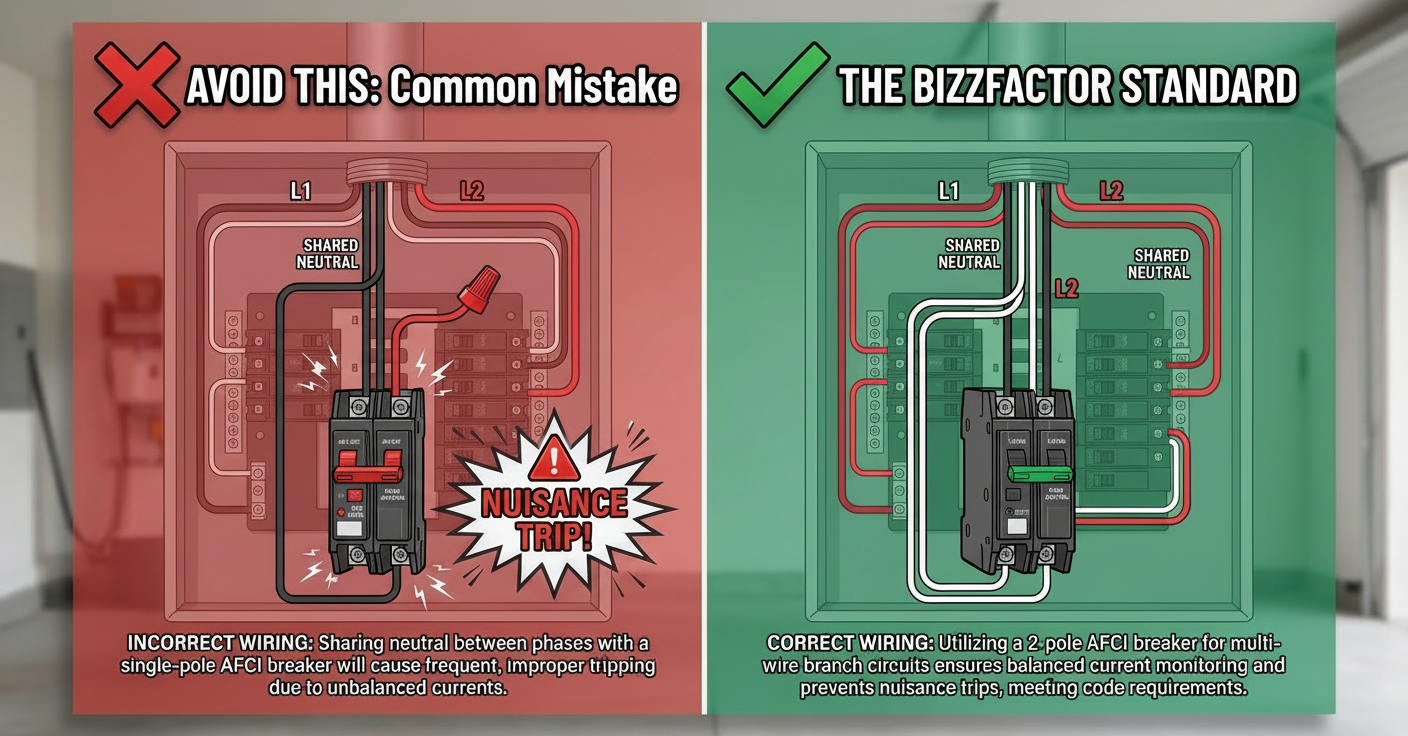
**Shared neutrals** are the biggest culprit. In older homes (pre-1990s especially), electricians commonly ran multi-wire branch circuits where two hot wires share one neutral return. Perfectly legal *if* it's done right. But if those two circuits are now on separate AFCIs, the neutral current doesn't balance correctly, and both breakers see it as electrical noise. False positive. Trips constantly.
**Backstab connections** are another nightmare. Those push-in wire terminals on outlets and switches? They're notorious for working loose over 10-15 years. Creates a high-resistance connection that sparks intermittently under load. Old breaker didn't care. AFCI absolutely sees that as an arc fault (because it *is*), trips the circuit.
Our crews test for shared neutrals before installing AFCIs — takes maybe 10 extra minutes with a multimeter. If we find one, we either separate the neutrals properly or install a dual-function breaker that's designed to handle it. We also pull every outlet and switch on the circuit, check for backstabs, re-terminate anything sketchy with proper screw terminals.
Last month we did a house in Roswell — 1985 construction, owner wanted the panel upgraded to sell the property. Inspector flagged missing AFCIs. Previous electrician had quoted $1,200 just for the breakers, warned the owner about "probable nuisance tripping because your wiring's old." We spent an extra hour testing and found shared neutrals on three circuits, plus seven outlets with loose backstabs. Fixed everything, installed the AFCIs. Zero nuisance trips. Customer saved probably $400 in callback headaches.
In-Depth Look
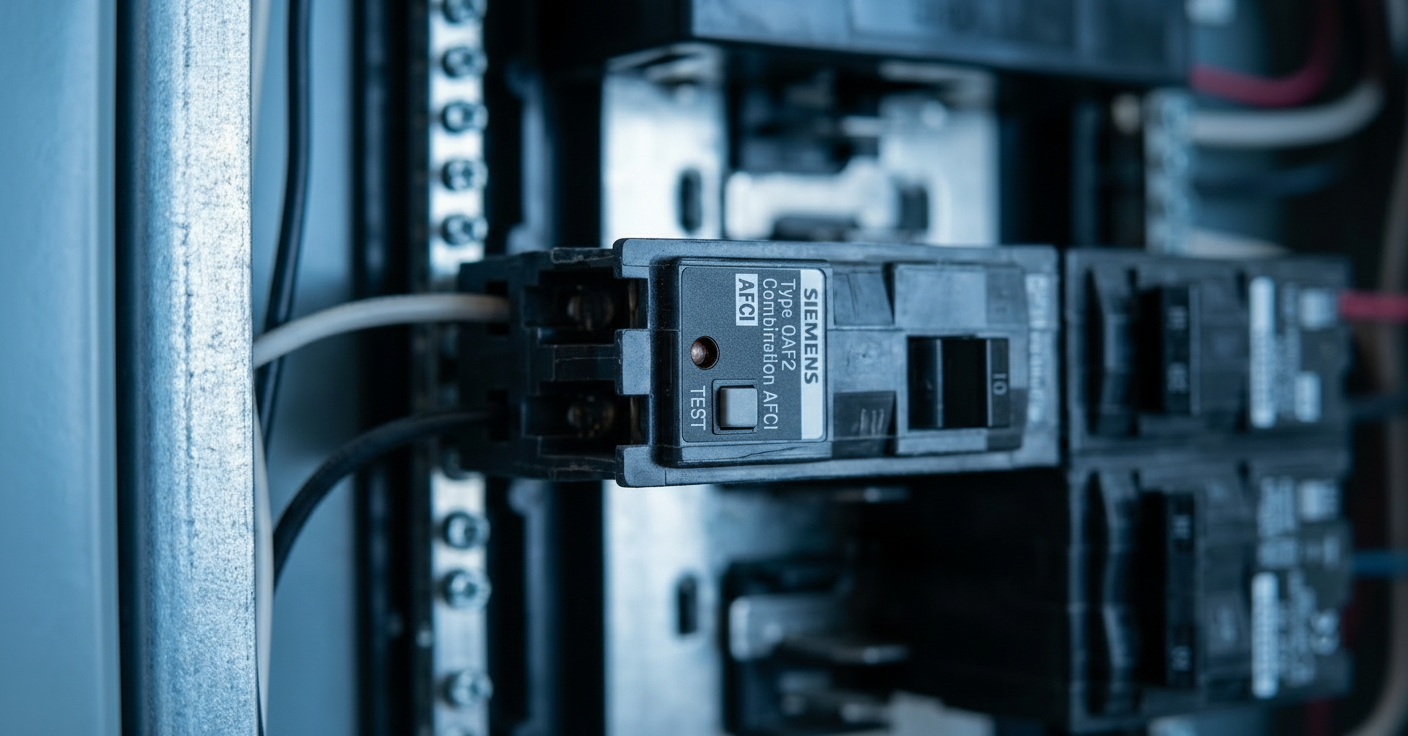
Detailed illustration of key concepts
Visual Guide
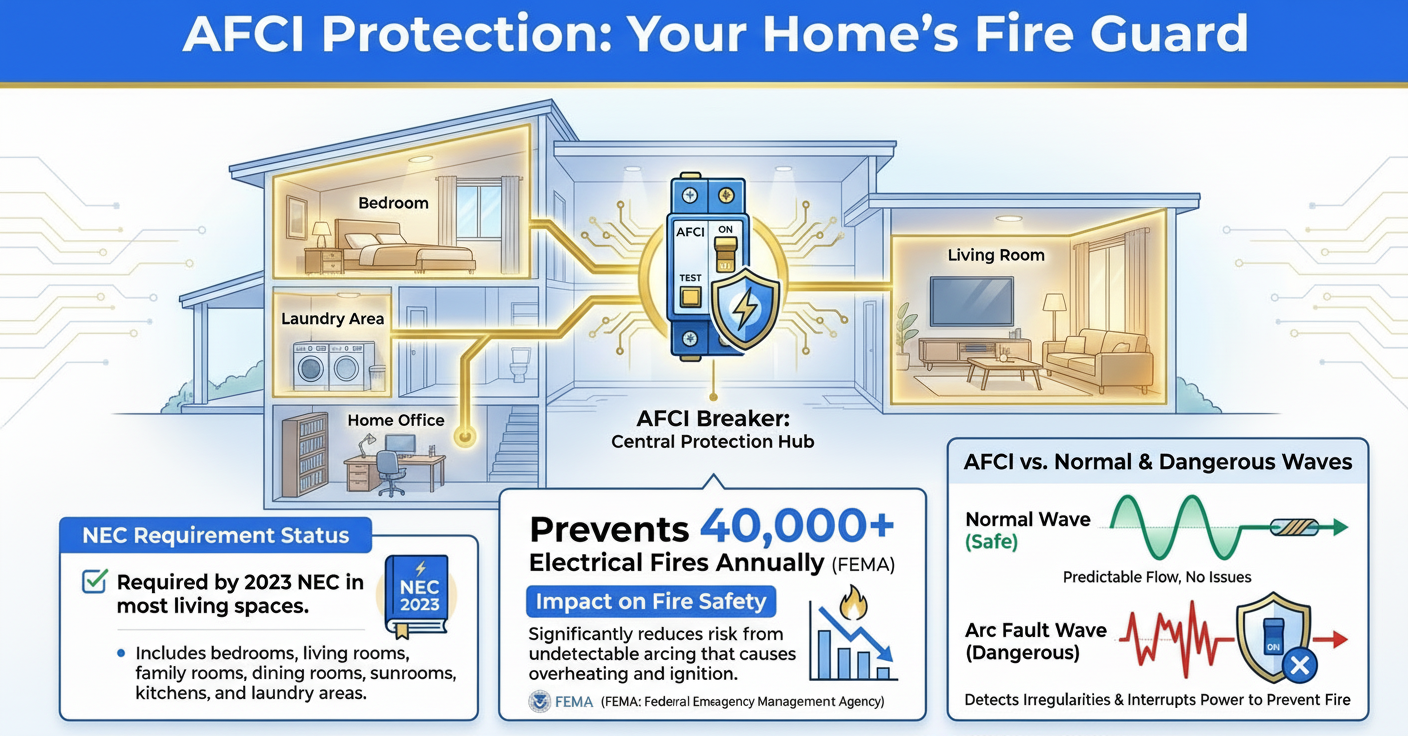
Infographic illustration for this topic
Side-by-Side Comparison
Visual comparison of options and alternatives
Sources & References
- [PDF] Homeowner's Guide to Preventing Electrical Fires - AFCI Safety
- GFCI and AFCI, based on the 2023 NEC - Mike Holt
- Home Safety Devices - Renovate Your Home to Code
- What you need to know about AFCI and GFCI requirements - Eaton
- Essential Electrical Panel Safety Standards Codes NEC Guidelines
- Building Codes, Standards, and Regulations: Frequently Asked ...
- Building Codes and Standards - 101 Guide | ROCKWOOL Blog
- [PDF] Building Codes Toolkit for Homeowners and Occupants - FEMA
- Amazon Best Sellers: Best Architectural Codes & Standards
- ICC - International Code Council - ICC
Frequently Asked Questions
Need Professional Help?
Find top-rated electrical experts in your area