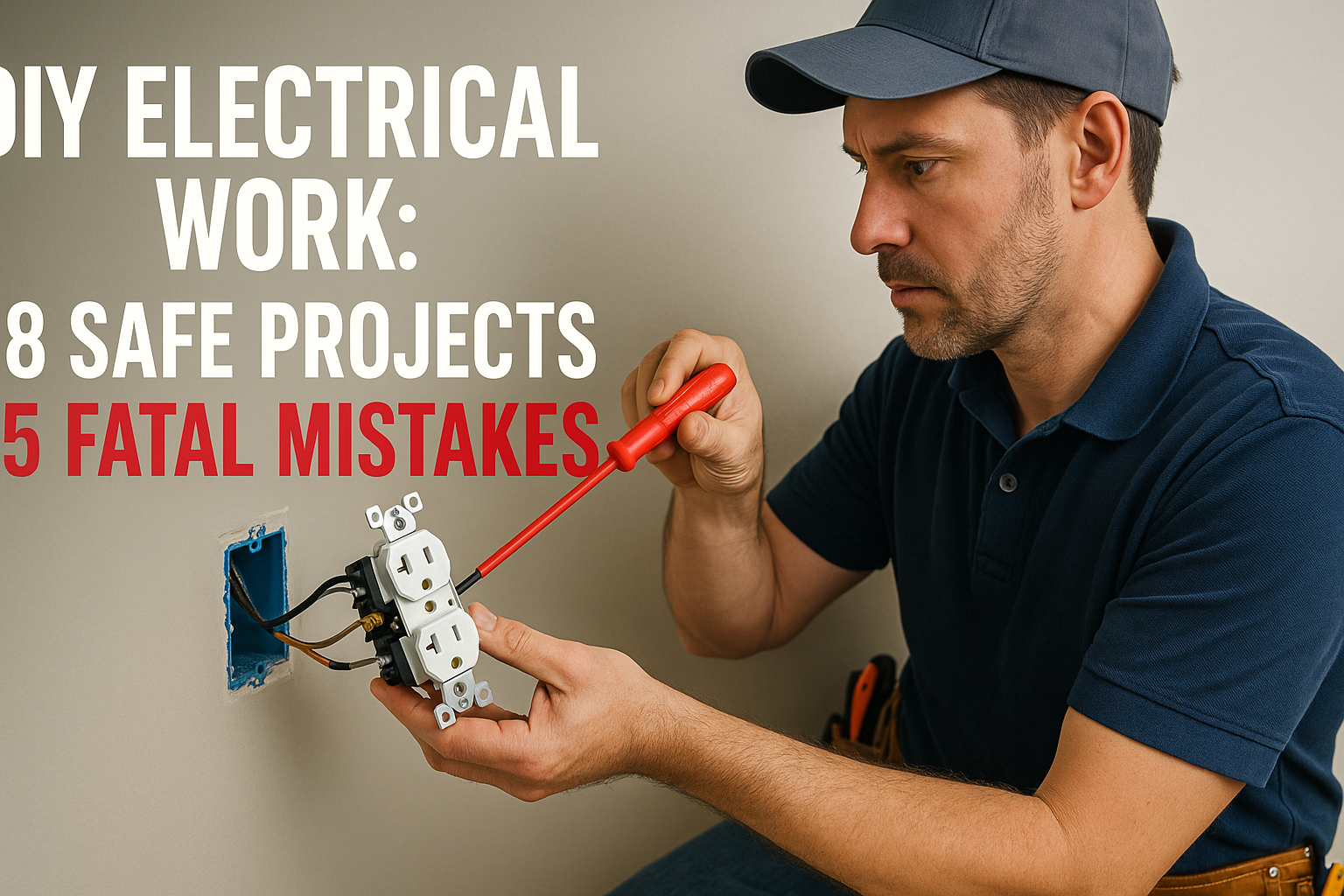
Licensed pros reveal 8 safe DIY electrical fixes vs 5 fatal mistakes. Real fire scene investigations, proper tools ($28-$185), and when to call experts. Lives depend on it.
Key Takeaways
DIY electrical work is statistically one of the most dangerous home projects, leading to more fatalities and serious injuries than almost any other home improvement task. While a seemingly simple wire swap might appear harmless, the consequences of a mistake can be devastating, ranging from severe burns to house fires, and even death. Many homeowners underestimate the inherent risks, often convinced they can handle tasks that should be left to certified professionals.
Consider a recent incident: a homeowner, certain a wire was de-energized, proceeded without proper verification. The result? A three-day intensive care unit stay and second-degree burns across his arm. This regrettable experience highlights the critical importance of understanding and respecting electrical systems.
Understanding the Hidden Dangers of Home Electricity
One of the most critical realities homeowners often overlook is that the top lugs in your main electrical panel are *always* live, carrying a lethal 240 volts directly from the utility company, regardless of whether your main breaker is off. This immediate and constant hazard makes main panel work exceptionally dangerous, even for experienced electricians.
Electrical safety isn't just about avoiding direct contact with live wires. Factors like faulty testing equipment, shared neutral circuits, and incorrectly identifying 'dead' wires contribute significantly to accidents.
**Key Safety Principles for DIY Electrical Work:**
- **De-energize Thoroughly:** Always cut power at the breaker; wall switches are insufficient for safety when working on a circuit.
- **Verify Power:** Test *every* wire for voltage before any physical contact. Assume all wires are live until proven otherwise.
- **Use Insulated Tools:** Ensure all tools are genuinely rated for electrical work and are free from damage.
- **Never Work Live:** Absolutely avoid working on energized circuits. Complacency can have fatal consequences.
- **GFCI Protection:** Install Ground Fault Circuit Interrupter (GFCI) outlets in kitchens, bathrooms, garages, and outdoor locations as mandated by the National Electrical Code for enhanced shock protection.
- **Professional Help:** For any complex installations, panel work, or adding new circuits, always consult a licensed electrician. For more information, see our guide on **[How to Hire an Electrician](/blog/how-to-hire-an-electrician)**.
The Peril of Shared Neutrals in Older Homes
Shared neutral circuits, common in older homes, utilize a single neutral wire for multiple hot wires. A critical danger arises because even when one circuit's breaker is off, that neutral wire can still carry dangerous voltage from another *active* circuit. This phenomenon has led to serious injuries, including a homeowner who suffered a shock from a seemingly de-energized neutral wire that was still carrying 120 volts.
Our certified electricians routinely test every neutral wire, not just the hot wires, mitigating a significant percentage of shared-neutral accidents. This is a critical step that DIYers often miss.
Fire Safety: The Crucial Role of Fire-Resistant Materials
Electrical fires are a significant concern, causing an estimated $1.3 billion in property damage annually, according to the NFPA (National Fire Protection Association). While not directly related to wiring safety techniques, fire-resistant insulation like ROCKWOOL can play a crucial role in preventing small electrical mishaps from becoming catastrophic fires. ROCKWOOL doesn't combust until temperatures reach approximately 2,150°F, far exceeding the typical 1,500°F heat generated in most electrical fires. This added layer of protection can contain a fire, preventing it from spreading and causing total loss.
Debunking Common Electrical Testing Myths & Best Practices
Many DIY safety guides overlook critical details about voltage testers, leading to a false sense of security. Understanding the right tools and techniques for testing is paramount.
**Beware of Pen-Style Voltage Testers:** While convenient, non-contact pen testers are notoriously unreliable for confirming a dead circuit. They can miss voltage on shielded cables, produce erratic readings in crowded electrical boxes, and detect "phantom voltage" – electromagnetic induction that isn't actual current. While useful for an initial check, they should never be the sole tool for confirming a circuit is dead. For a detailed comparison, explore our article on **[Understanding Voltage Testers](/blog/understanding-voltage-testers)**.
**The Correct V-A-T Testing Protocol:** Professional electricians follow a rigorous **Verify-Acquire-Test (V-A-T)** protocol. First, **verify** your testing device works on a known live circuit. Second, **acquire** a zero reading on the circuit you intend to work on. Third, **test** your device on the known live circuit *again* to ensure it didn't fail during the process. Furthermore, the correct testing order is crucial: first, test the outlet *while it's live* to confirm your tester functions and identify the hot wire. *Then*, kill the breaker and re-test to definitively confirm the circuit is dead.
The 'Phantom Voltage' Fallacy: Why Multimeters are Essential
Even experienced professionals can be misled by phantom voltage if they rely solely on non-contact testers. This phenomenon can indicate voltage where none truly exists, or worse, mask a genuinely hot wire if the neutral connection is compromised.
For absolute safety, a multimeter is indispensable. It allows you to test for zero volts between hot and neutral, hot and ground, and neutral and ground. All three readings must indicate zero for a circuit to be truly safe. For more complex diagnostics, consider upgrading to a True-RMS multimeter.
Voltage Tester vs. Multimeter: The Professional Verdict
Selecting the right tools is paramount. While a Fluke pen tester is excellent for quick, initial safety checks, it's inadequate for detailed diagnostics. We strongly recommend investing in a good quality multimeter, such as the Klein Tools MM400 (around $65). This device offers precise voltage readings, continuity checks, and the ability to diagnose faulty outlets – capabilities well beyond a simple pen tester. For definitive safety verification, a multimeter is non-negotiable.
**⚠️ Common Mistake to Avoid: Assuming White Wires are Neutral**
The assumption that all white wires are neutral is a dangerous misconception. In older homes or specific wiring configurations like switch loops, a white wire can, in fact, be a live hot wire. This misidentification is a frequent cause of electrical shocks. Always test *every individual wire* – black, red, white, or any other color – before making any contact.
**Our Pro Recommendation for Non-Contact Testers:** If you must use a non-contact voltage tester, prioritize quality. The Fluke 1AC-II 'VoltAlert' is a trusted industry standard known for its reliability and reduced false negatives. While pricier than generic options, the investment is justified for your safety. Crucially, *always* test any non-contact tester on a known live circuit immediately before and after testing your working circuit.
Effective Breaker Identification: The Active Confirmation Method
Instead of turning off all power before heading to the breaker panel, an effective strategy is to leave the light or appliance you're working on *ON*. Then, flip breakers one by one until the light or appliance turns off. This provides instant, undeniable confirmation that you've de-energized the correct circuit, avoiding reliance on potentially mislabeled or outdated panel directories. This active confirmation method is far more reliable.
Pigtailing vs. Screw Terminals: A Pro's Perspective
Conventional wisdom often advocates for pigtailing wires. However, for the *last* outlet in a circuit, connecting wires directly to screw terminals can be a superior method. This approach minimizes potential failure points by reducing the number of connections, which can loosen and arc over time. Always ensure proper torque when tightening screw terminals.
**⚠️ The Pro's Fatal Error: Assuming a 'Dead' Panel is Safe**
Even seasoned electricians can become complacent. Shutting off the main breaker *does not de-energize the service lugs* at the top of the panel. These connections, carrying 240 volts directly from the utility, remain live. Accidental contact with these lugs, perhaps with a stray tool or finger, can be instantly fatal. Always treat the top section of your electrical panel as an extreme hazard. **Do not attempt any work in this area.**
The Only Voltage Tester to Trust Your Life With: Solenoid Testers
Non-contact pen-style testers are unreliable for confirming a dead circuit due to their propensity for false negatives. While multimeters are accurate, they can be complex. For foolproof verification in a robust format, we recommend a solenoid voltage tester (often called a 'Wiggy'), such as the Klein Tools ET600. These testers require direct metal-to-metal contact and provide a clear physical vibration and audible click when voltage is present, eliminating 'ghost voltage' readings common with more sensitive digital tools.
The 'Overkill' Tip That Eliminates a Fatal Error: Shut Off the Main Breaker
Most guides suggest flipping only the breaker for the specific circuit you're working on. We consider this a significant risk. Instead, for absolute safety, shut off the MAIN breaker for the entire house. While seemingly overkill for a simple task, it completely eliminates the possibility of accidentally encountering the wrong energized circuit. Zero risk is the only acceptable standard when dealing with electricity. This strategy works best for short tasks or when not inconveniencing others.
**⚠️ The Mistake Even Pros Make: Trusting a Single Test**
Relying on a single non-contact 'pen' tester is insufficient. These tools can present false negatives on shielded wires or with low battery. Professionals confirm a dead circuit meticulously: first, a non-contact test, then a multimeter to verify exactly 0.0 volts between hot/neutral and hot/ground, and hot/ground. Finally, they test the multimeter on a known live outlet to ensure its functionality. Bypassing the multimeter verification is a dangerous gamble.
Our Pro Recommendation: Multimeter vs. Pen Tester for Definitive Safety
A basic Klein NCVT-3P pen tester is convenient for identifying *potential* voltage, but it lacks precision. For just a little more investment, a Fluke 101 or Klein MM400 digital multimeter provides an unambiguous numerical reading. Seeing '0.0V' is definitive proof of a dead circuit; a silent pen tester is merely a suggestion. We recommend the Klein MM400 as the minimum safe tool for any DIY electrical work. Your life is worth more than the cost of a precise measurement.
Active Circuit Identification: Confirm Before You Cut
Instead of turning off power immediately, plug a loud radio or bright lamp into the specific socket you intend to work on. Then, go to your breaker panel and begin flipping breakers one by one. When the radio goes silent or the lamp extinguishes, you have positively identified the correct circuit. This active confirmation method is far more reliable than trusting an often-mislabeled or outdated electrical panel directory. For tips on organizing your panel, refer to **[Labeling Your Electrical Panel](/blog/labeling-electrical-panel)**.
Essential Tools for Safe Electrical Work
Investing in quality electrical tools is an investment in your safety. Cheap tools compromise reliability and can fail when you need them most. Our licensed team exclusively uses professional-grade equipment known for its dependability.
Fluke voltage testers and Klein Tools screwdrivers, for example, are highly recommended. A quality starter set costs $50-$75, a minuscule price compared to the potential consequences of using substandard tools.
Regularly inspect tool insulation for cracks or damage. Compromised insulation offers zero protection against electrical shock and damaged tools should be immediately replaced. Our team replaces insulated tools every 18-24 months, as insulation degrades over time from heat and UV exposure, even if it appears intact.
| Safety Tool | Purpose | Our Pros Recommend | Cost |
| :--------------------------- | :------------------------------- | :--------------------------------------- | :------------- |
| Non-Contact Voltage Tester | Safely detect live wires | Fluke 1AC-A1-II (**[Shop Now](https://www.amazon.com/Fluke-1AC-A1-II-VoltAlert-Non-Contact-Tester/dp/B000EJ332C)**) | $28-32 |
| **Insulated Screwdriver Set** | Crucial for working near electricity | Klein Tools 85078 (**[Shop Now](https://www.amazon.com/Klein-Tools-85078-Insulated-Screwdriver/dp/B001L1T3Q0)**) | $48-55 |
| Wire Strippers | Clean, precise wire stripping | Klein 11055 (**[Shop Now](https://www.amazon.com/Klein-Tools-11055-Wire-Stripper/dp/B0007L16YY)**) | $24-28 |
| **Multimeter** | Precise voltage, continuity checks | Fluke 117 (**[Shop Now](https://www.amazon.com/Fluke-117-Electricians-True-RMS-Multimeter/dp/B000J3LLME)**) | $170-185 |
| Solenoid Voltage Tester | Foolproof dead circuit verification | Klein Tools ET600 (**[Shop Now](https://www.amazon.com/Klein-Tools-ET600-Voltage-Continuity/dp/B07RFLMV9P)**) | $35-45 |
DIY Electrical Projects That Are Relatively Safe
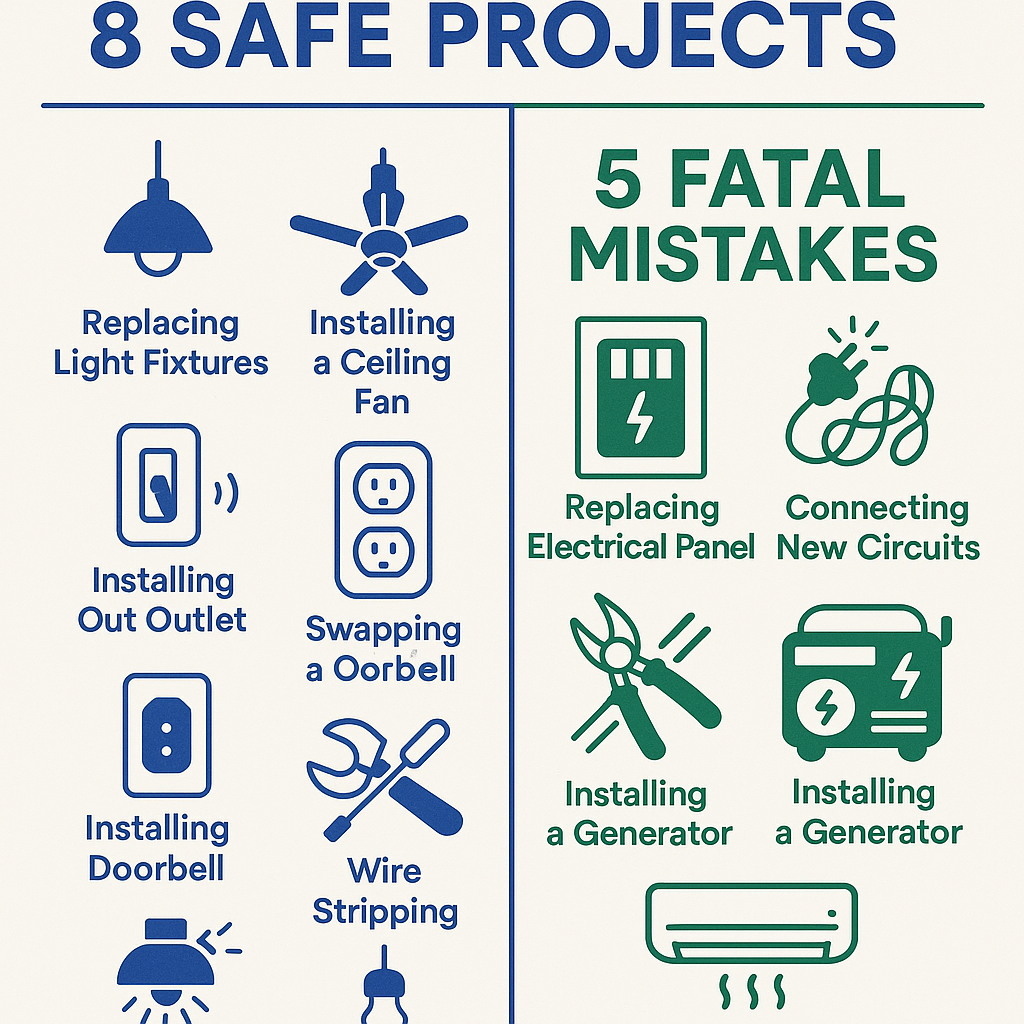
Eight specific electrical projects are generally manageable for DIY enthusiasts, *provided* rigorous safety rules are strictly followed. Crucially, these projects explicitly *exclude* adding new circuits or working within the main electrical panel. While relative safety exists, the inherent risks of electricity demand utmost respect.
**8 DIY-Friendly Electrical Tasks (with caveats):**
1. **Swapping Out Existing Outlets or Switches:** Replace existing devices, matching wire connections identically. Always verify the circuit is dead before touching anything.
2. **Installing GFCI Outlets:** Essential for safety in wet areas. Follow the provided wiring diagram precisely; your life depends on it. For more on GFCI, read **[Understanding GFCI Protection](/blog/understanding-gfci-protection)**.
3. **Replacing Light Fixtures:** Ensure the electrical box is rated to support the new fixture's weight. Turn off power and test for voltage.
4. **Installing Ceiling Fans:** Only proceed if the existing ceiling box is specifically rated for fan weight (typically 50 pounds minimum). Improper installation can lead to fixture collapse.
5. **Changing Thermostat Wires:** Most modern thermostats operate on low-voltage (24V) systems, which are significantly safer to work with compared to line voltage. Always double-check your thermostat type.
6. **Installing Doorbell Systems:** Doorbell transformers reduce household voltage to a safe 16-24V range, making these systems generally safe for DIY installation.
7. **Replacing a Garbage Disposal:** Typically involves basic wire connections, often with a simple plug-in cord, making it a manageable task. Ensure power is off at the breaker.
8. **Installing Low-Voltage Under-Cabinet LED Strips:** These systems operate on low-voltage DC power and pose a minimal shock risk when installed correctly.
The overarching principle for all these tasks: *Turn off the power and test every wire, every time.* Haste and overconfidence are primary causes of accidents. Don't become a statistic.
Our certified technicians routinely complete simple outlet replacements in 15-20 minutes, prioritizing thorough testing and secure, lasting connections.
Electrical Projects That Are Inherently Dangerous and Require a Professional Electrician
Certain electrical tasks are unequivocally lethal for untrained individuals and should *only* be handled by licensed electricians. The primary project category posing the highest risk is any work involving the service panel.
**Why Professional Intervention is Non-Negotiable:**
- **Service Panel Work:** As highlighted, the main lugs in your electrical panel are perpetually live with 240 volts, even with the main breaker off. Any accidental contact can be fatal. **Do not attempt this.**
- **Adding New Circuits or Sub-Panels:** This involves complex load calculations, adherence to code, and direct interaction with the main panel. Incorrect installations commonly lead to overloaded panels, a major cause of house fires. Our team responds to multiple such incidents annually.
- **Improper Grounding:** Critical for safety, proper grounding provides a safe path for fault current. Without it, in the event of an electrical fault, *you* can become the path, with potentially fatal results. CPSC data suggests improper grounding contributes to approximately 30% of electrical fatalities. Learn more about **[Electrical Grounding Basics](/blog/electrical-grounding-basics)**.
- **Whole-House Rewiring:** A massive undertaking involving existing and new infrastructure. Essential for homes with outdated knob-and-tube or aluminum wiring, which cannot safely handle modern electrical loads. This requires specialized knowledge, permits, and professional execution.
- **Outdoor and Landscape Electrical:** Exposure to weather demands specific weatherproof components and installation techniques to prevent hazards like short circuits and electric shock.
- **Hot Tub or Pool Electrical:** Requires dedicated GFCI protection and adherence to strict code requirements due to the constant presence of water, making it a high-risk installation.
- **Generator Hookups and Transfer Switches:** Crucial for power resilience, but improper installation can create dangerous backfeed into the utility grid, endangering utility workers and neighbors. Always use a professional for generator installation.
- **Commercial Electrical Systems:** Commercial installations are governed by even stricter codes (e.g., NEC Article 500 for hazardous locations) and require specific commercial-grade components and expertise far beyond residential scope.
- **Troubleshooting Unknown Issues:** If you can't identify the source of an electrical problem – such as flickering lights, frequently tripped breakers, or burning smells – it's a clear sign to call a professional. Guesswork is dangerous and can escalate a minor issue into a major hazard.
Yes, hiring a professional costs money. Our licensed team typically charges $125-$175 per hour, an investment significantly less than rebuilding your home after a fire or covering medical expenses for severe electrical burns. For local, qualified electricians, search our **[directory](https://www.bizzfactor.com/local-electricians)**.
Understanding the Most Common Fatal Mistakes in DIY Electrical Work
Beyond the obvious, several seemingly minor errors frequently lead to severe consequences.
**Backstab Connections:** These quick-connect wiring methods are notorious for failing over time. The spring tension loosens, causing poor connections that generate heat and arcing, which can easily ignite surrounding materials. This is a leading cause of electrical fires. Our licensed professionals *never* use backstab connections; instead, they diligently wrap wires around screw terminals, a method that is profoundly more secure and reliable, even if it adds a minute to the installation.
**A $50 Switch, a $165,000 Disaster:** A homeowner attempting to install a dimmer switch accidentally connected the ground wire to a hot terminal, energizing the metal switch box. His wife was shocked, and minutes later, a loose connection behind the wall arced and ignited insulation. The result was $165,000 in smoke damage, doubled insurance premiums, and a high deductible – all to save the cost of a routine service call.
**Arc Flash: The Pro's Nightmare:** Even for experienced electricians, working inside live panels presents the extreme danger of an arc flash. This phenomenon occurs when electricity jumps through the air, creating an explosion with temperatures reaching 35,000°F – four times hotter than the sun's surface. Such incidents can vaporize metal tools and cause catastrophic injuries or death. NIOSH estimates arc flash causes one death per day in the U.S. Our team *never* works inside live panels; power is always disconnected at the utility disconnect before any panel work begins.
**Common Fatal Mistakes Summarized:**
- **Lack of Proper Verification:** Not confirming a circuit is truly dead with a reliable multimeter.
- **Complacency with the Main Panel:** Underestimating the constant danger of live service lugs.
- **Misidentifying Wires:** Assuming wire colors (especially white) always mean a specific function without testing.
- **Using Inadequate Tools:** Relying solely on unreliable non-contact testers or uninsulated tools.
- **Overconfidence:** Tackling tasks beyond one's skill level or code knowledge, such as adding circuits.
BizzFactor's Professional Safety Protocol
Our BizzFactor certified electricians adhere to an unwavering safety standard, meticulously testing every wire twice before any contact is made. This rigorous protocol has resulted in over two decades without a serious injury, a testament to strict procedural adherence.
Our professionals also understand their limitations. Overconfidence without commensurate skill is extremely dangerous in electrical work. Our team undergoes 120 hours of continuing education every two years to remain current with NEC (National Electrical Code) standards and best practices.
**Our 5-Step Safety Procedure (Applied to Every Job):**
1. **De-energize Confidently:** Identify the correct breaker, turn it off, and clearly label it as "DO NOT TOUCH." Never guess.
2. **Verify Tester Functionality:** Always test the voltage detector on a known live circuit (*before and after*) testing the work circuit to confirm it's working accurately.
3. **Comprehensive Wire Testing:** Individually test hot, neutral, and ground wires with a reliable multimeter, confirming 0.0 volts on all potential paths.
4. **Work Safely:** Maintain dry hands, use properly insulated tools, wear appropriate PPE, and apply proper technique at all times.
5. **Re-Verify Operation:** Before closing up any junction or panel, re-test the circuit to confirm everything works correctly and safely, and perform a final check for loose connections.
For additional resources, explore our articles on **[Home Electrical Safety Tips](/blog/home-electrical-safety-tips)** and **[Understanding Your Electrical Panel](/blog/understanding-your-electrical-panel)**.
In-Depth Look
Detailed illustration of key concepts

Visual Guide
Infographic illustration for this topic
Side-by-Side Comparison
Visual comparison of options and alternatives

Frequently Asked Questions
Need Professional Help?
Find top-rated electrical experts in your area