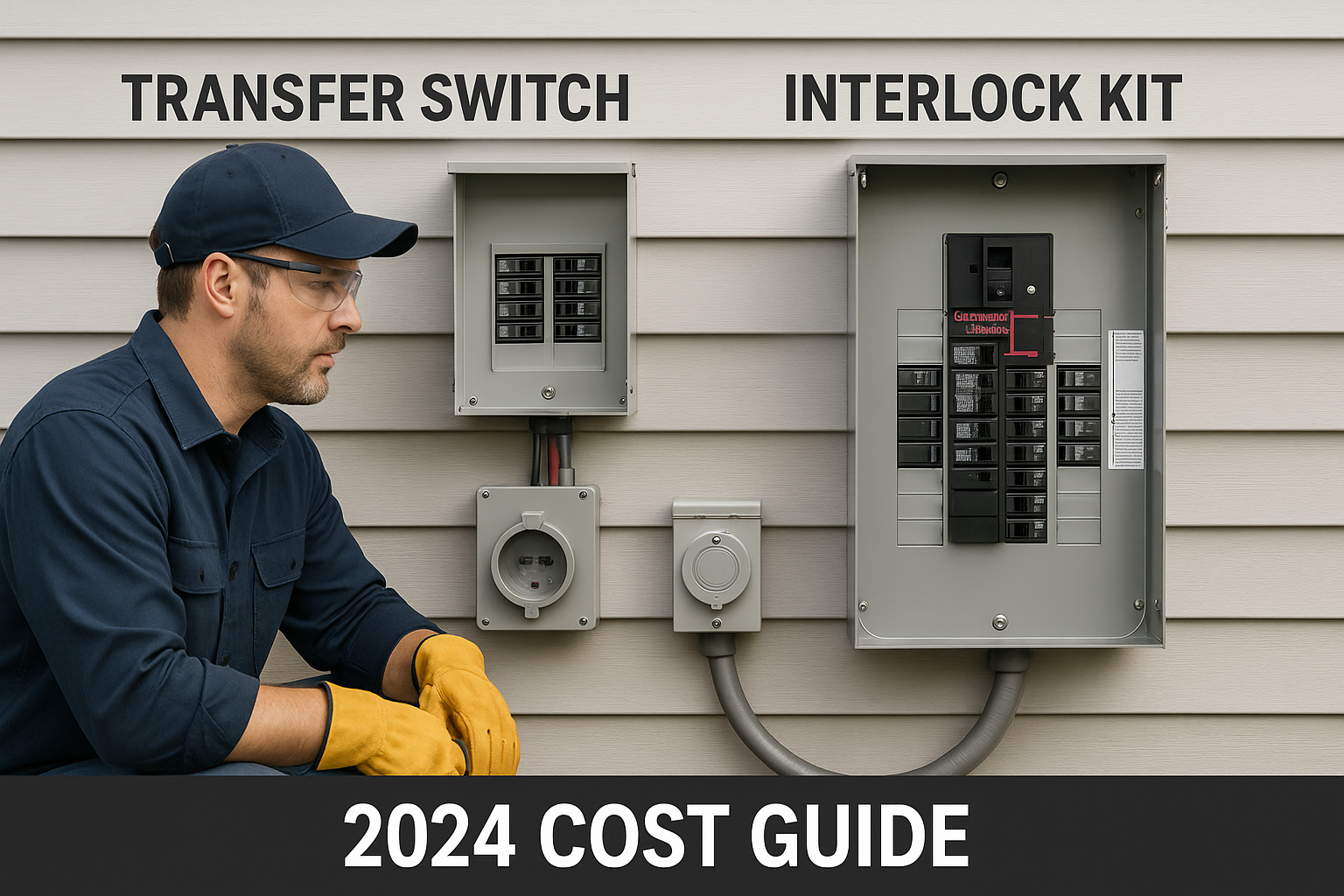
Compare transfer switch vs interlock kit costs, installation, and safety. 2024 pricing guide from licensed electricians with 30+ years experience.
Key Takeaways
Transfer Switch vs. Interlock Kit: Your 2024 Ultimate Cost and Safety Guide
Understanding robust backup power solutions and their absolutely critical role, especially in preventing potentially fatal backfeeding incidents, is paramount for every homeowner contemplating or utilizing a portable or standby generator. Both transfer switches and interlock kits are expertly engineered to mitigate this life-or-death problem: ensuring generated power never inadvertently flows back into the primary electrical grid, safeguarding both occupants and diligently working utility personnel. This comprehensive guide delves deeply into the intricacies of each system, providing a detailed analysis for informed decision-making in 2024, emphasizing electrical safety, code compliance, and long-term cost efficiency.
The Peril of Backfeeding: A Non-Negotiable Safety Concern Mandated by Code
Why is preventing backfeeding so critically vital, extending beyond mere nuisance to genuine hazard? Sending electricity back into utility main lines can cause severe injury or even electrocute utility workers who are diligently trying to restore power during an outage. This isn't a dramatic overstatement or a theoretical risk; it represents a genuine, 100% preventable industrial hazard that the correct, properly installed and operated equipment—certified by recognized testing laboratories such as UL (Underwriters Laboratories) or ETL (Electrical Testing Laboratories)—effectively mitigates. The decision-making process when choosing between these essential electrical safety options involves a careful weighing of the initial financial investment against long-term convenience, operational preferences, specific home electrical panel configurations, and future power needs. Ignoring this critical safety aspect not only endangers lives but also carries severe legal liabilities, including potential fines and imprisonment in certain jurisdictions, highlighting the gravity of compliance.
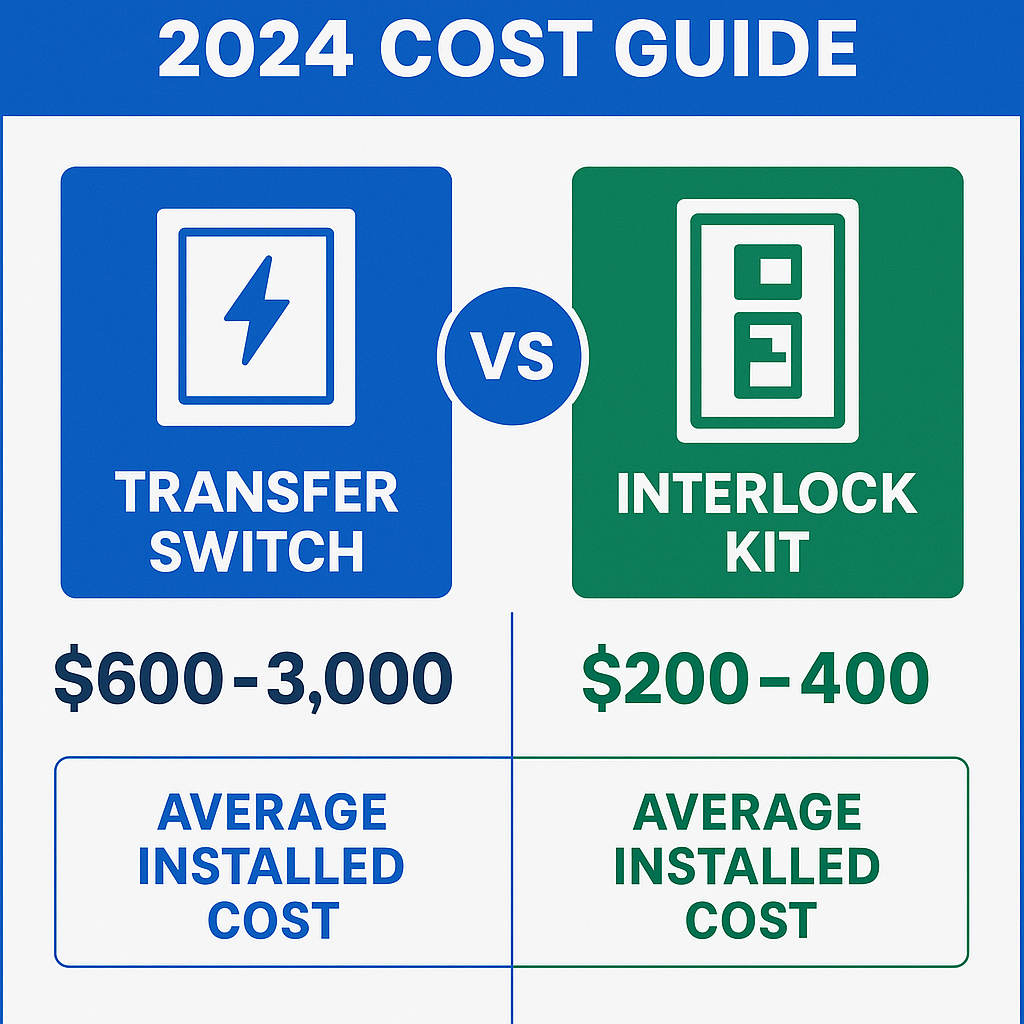
From a financial perspective, professionally installed **transfer switches** typically represent a more substantial investment, ranging from $800 to $2,500 for manual models, with advanced automatic models often exceeding $3,500. For whole-home automatic systems integrated with large standby generators, this cost can easily surpass $5,000 for the switch alone, excluding the generator unit (which themselves can cost $5,000 to $20,000+). **Interlock kits**, by contrast, are significantly more budget-friendly, costing between $200 and $800 total for materials and installation. Crucially, both options provide essential backup power during outages and ensure strict compliance with critical [electrical safety codes](https://bizzfactor.com/guides/home-services/electrician-cost), particularly the National Electrical Code (NEC) Article 702 for optional standby systems, Article 250 for grounding and bonding, and OSHA regulations regarding utility worker safety via lockout/tagout principles, specifically 29 CFR 1910.333.
Quick Comparison: Transfer Switch vs. Interlock Kit - Decoding the 2024 Landscape
**Transfer switches** are primarily designed for automatic operation and unparalleled convenience. When utility power inevitably fails, whether due to a severe storm or localized grid issues, an automatic transfer switch (ATS) seamlessly disconnects your entire home (or pre-selected essential circuits) from the grid and connects it directly to your generator. Homeowners with automatic transfer switches frequently report their nearly plug-and-play, hands-off nature, sometimes not even realizing a power outage occurred until much later, perhaps noticing a neighbor's darkened home. Manual transfer switches (MTS) offer similar functionality but require the homeowner to manually flip a well-labeled, heavy-duty switch to transfer power. These typically range from 6 to 12 circuit models, offering dedicated circuits for essential loads, but can also be whole-house rated (e.g., 100A, 200A) for homes with specific electrical designs or smaller overall power demands.
**Interlock kits**, conversely, necessitate a more manual, hands-on process. They fundamentally feature a robust, precision-engineered sliding metal plate permanently affixed to your electrical panel's cover. This plate physically prevents the utility main breaker (which feeds grid power) and the generator's dedicated main breaker from being active simultaneously. This elegantly simple, purely mechanical safeguard requires manual intervention from the homeowner, but it achieves the identical critical safety objective: absolute physical and electrical prevention of hazardous backfeeding onto the grid. It trades automation for simplicity, reliability, and cost-effectiveness, and allows granular control over any circuit in the main panel, provided adequate generator capacity. This physical impossibility of simultaneous circuit activation is its design genius, making it foolproof when operated correctly.
Imagine two neighbors experiencing a multi-day ice storm: one, equipped with a sophisticated automatic transfer switch, woke up to fresh coffee and a fully functioning household, remaining largely unaware of the outage unless they looked outside. The other, utilizing an interlock kit, meticulously and manually managed his household circuits, strategically powering only essential items (e.g., refrigerator, specific lights, furnace fan, well pump). This manual approach, while requiring more interaction, potentially resulted in a 30-40% saving on generator fuel consumption by avoiding unnecessary loads. Their differing choices vividly reflect distinct priorities regarding convenience, initial investment, and long-term operational cost-efficiency, all while maintaining a steadfast, non-negotiable commitment to electrical safety. Both methods are valid and code-compliant; the 'best' is subjective to individual needs, budget, and desired level of manual involvement.
Detailed Comparison: Key Distinguishing Factors for 2024
- **Total Installed Cost:**
- **Manual Transfer Switches (MTS):** $800-$1,500. This estimate includes a multi-circuit transfer panel (e.g., typically 6 to 10 circuits, 30A or 50A capacity), conduit, wiring, labor, and necessary permits. MTS units themselves typically run $250-$500.
- **Automatic Transfer Switches (ATS):** $1,500-$3,500+. Some whole-house ATS units can exceed $5,000 for the device alone, excluding generators, particularly for high amperage (200A-400A) or advanced smart models that offer remote monitoring and load management capabilities. Generac's Wi-Fi enabled ATS, for example, adds a layer of remote monitoring and integration with smart home ecosystems.
- **Interlock Kits:** $200-$800. This incorporates the interlock device ($50-$200), a dedicated generator breaker, an outdoor generator inlet box, conduit, wiring, labor, and permits. This option consistently offers the lowest barrier to entry for safe generator use, making generator backup power accessible to a wider demographic.
- **Installation Time & Complexity:**
- **Transfer Switches (MTS & ATS):** 4 to 12 hours. Complexity varies significantly based on type (manual vs. automatic), the number of circuits being managed (e.g., 6-circuit sub-panel vs. whole-house transfer), the length of wiring runs to the generator and between sub-panel and main panel, the need for trenching for underground conduit, and the integration with sophisticated generator control circuits (e.g., 2-wire start for ATS).
- **Interlock Kits:** 2 to 4 hours. Primarily involves mounting the interlock device to the panel cover, installing the designated generator main breaker in the main panel, wiring the outdoor inlet box, and establishing proper grounding connections. The process is generally less intrusive and quicker than transfer switch installations.
- **Operation & Control:**
- **Transfer Switches:** Can be fully automatic (ATS), requiring no user intervention, or manual (MTS), requiring the homeowner to manually flip a switch. Both provide centralized control over pre-designated circuits or whole-house transfer if sized appropriately. ATS models are capable of sensing grid power loss, starting the generator, and transferring load autonomously.
- **Interlock Kits:** Always manual. User-driven power selection at the main panel, allowing any circuit to be energized as long as the generator can safely handle the load. This promotes active load management and adaptability, requiring direct user interaction to switch between grid and generator power.
- **Safety Adherence & Code Compliance:** Both types of systems are inherently safe when professionally installed and operated correctly, meeting or exceeding NEC (NFPA 70) requirements. Transfer switches provide automated, fail-safe protection through internal mechanisms designed for a "break-before-make" action. Interlocks, while robustly mechanical, rely on consistent user adherence to manual procedures, which is reinforced by the physical interlock plate's design, preventing hazardous overlaps. All must conform to NEC 702 (Optional Standby Systems), 250 (Grounding and Bonding), and often local amendments.
- **Load Management Capabilities:** Transfer switches (especially automatic ones) can be configured for pre-determined load shedding or prioritization, though this adds complexity and cost, often involving smart load management modules or power management systems from generator manufacturers. Interlocks actively encourage and enforce manual smart load management, often leading to greater fuel efficiency, reduced emissions, and generator longevity through user awareness of power consumption, as homeowners consciously decide which circuits to power.
- **Generator Compatibility:** Transfer switches may integrate more tightly with specific generator brands (e.g., Generac, Kohler, Cummins) for seamless automatic startup, shutdown, and monitoring features, often requiring a 2-wire or 3-wire start capability for a standby unit. Interlocks are generally compatible with any portable generator that meets wattage and voltage requirements, provided neutral bonding is correctly addressed and the generator is equipped with the appropriate receptacle (e.g., L14-30R for 30A/7500W, 14-50R for 50A/12000W+). This broader compatibility offers greater flexibility for generator selection.
| Feature | Manual Transfer Switch (MTS) | Automatic Transfer Switch (ATS) | Interlock Kit |
|:--------------------|:---------------------------------|:-----------------------------------|:----------------------------|
| **Total Installation Cost** | $800-$1,500 | $1,500-$3,500+ (Unit only $600-$5000+) | $200-$800 |
| **Installation Time** | 4-8 hours | 6-12 hours | 2-4 hours |
| **Circuit Selection** | Pre-selected essential circuits with dedicated wiring from sub-panel | Pre-selected essential circuits or whole-house configurable (with load management) | Manual selection of any circuit in main panel |
| **Generator Start** | Manual | Can be automatic | Always manual |
| **NEC Compliance** | Built-in safety features, adheres to NEC 702 & 250 | Built-in safety features, adheres to NEC 702 & 250 | Requires proper manual adherence and NEC 702, 250 compliance |
| **Convenience Level** | Moderate | Very High | Manual |
| **Load Management** | Semi-automatic/Manual (via sub-panel) | Automated/Configurable (with load shedding) | Fully Manual/User-Driven |
| **Generator Type Compatibility** | Most portable, often requires manual generator start | Often specific brands/requires 2-wire start/standby generator | Most portable, provided power output and neutral bonding are compatible |
⚠️ Critical Safety Warning: The Retaining Clip - A Non-Negotiable Requirement (NEC 408.36(D))
Even highly experienced, licensed electricians can, during the rapid pace of installation, sometimes overlook a small but critically important detail: the retaining clip explicitly required for certain generator interlocks, as mandated by **NEC 408.36(D)** for circuit breakers used as switches. This often inexpensive component, typically costing around $8-$10, is absolutely vital for the mechanical integrity of the installation. Without it, a breaker, especially a double-pole generator breaker in a vertical interlock application, can become dislodged from the panel's bus bars under stress, vibration, or repetitive operation. This dislodgment risks exposing an actively energized bus bar, creating an extremely grave electrocution hazard for anyone accessing the panel. We, with our extensive field experience, have unfortunately encountered installations where this seemingly minor safety clip was regrettably omitted, thereby posing an extreme and unnecessary danger. Always, without exception, ensure your electrician explicitly includes and verifies this essential safety feature during installation to guarantee long-term system integrity and personal safety, protecting both occupants and future service personnel. This small part ensures the generator breaker is secure against accidental displacement, a critical line of defense against catastrophic failure and injury.
Our Recommendation After Three Decades in the Field: OEM Interlocks for Value, Reliability, and Precision
With over 30 years of invaluable, hands-on experience in residential and commercial electrical systems, we at BizzFactor strongly advocate for using **OEM (Original Equipment Manufacturer) interlock kits** approximately 90% of the time for most homeowners. This recommendation holds particularly true for those seeking highly cost-effective, yet unequivocally safe, electrical backup solutions. These OEM kits are meticulously designed and precisely manufactured specifically for your electrical panel's exact make, model, and sometimes even its revision number (e.g., Square D QO Series, Eaton BR Series), ensuring a perfect, snug fit and seamless installation that meets all code requirements, including UL standards (e.g., UL 67 for panelboards, UL 248 for circuit breakers). For instance, a Square D QO panel should be exclusively paired with a Square D QO Series interlock kit (e.g., a QO2DTI kit). While "universal" or aftermarket interlock kits do exist and are marketed as broader solutions, we have frequently observed them exhibiting alignment issues, premature wear, difficulty in operation, or outright failure within 18-24 months due to less precise manufacturing tolerances or subpar material quality. The mechanical action required for safe operation demands exact precision. OEM kits, by contrast, consistently pass rigorous electrical inspections with zero issues and operate flawlessly for decades, effectively preventing costly callbacks and potential disputes with inspectors. For homeowners exploring various [cost-effective electrical solutions](https://bizzfactor.com/guides/home-services/cost-to-move-electrical-outlet), investing in an OEM interlock kit is unequivocally a wise, durable, and code-compliant choice.
The Overlooked Strategic Advantage: Smart Load Management and Generator Health
One of the most significant, yet frequently overlooked, advantages of interlock kits is their inherent encouragement of **smart load management**. This isn't just about saving fuel; it's a critical factor in extending the longevity and preventing damage to your portable generator. By requiring manual selection of which circuits to power, you, the homeowner, are actively involved in preventing unintentional overloading of your generator. We've personally witnessed a perfectly good 7,500-watt portable generator nearly burn out its stator because an automatic transfer switch (without effective intelligent load management features) allowed a 3-ton central AC unit to cycle on undetected during an outage due to misconfiguration. The sudden inrush current and sustained high load can be catastrophic for smaller generators, often leading to internal wiring overheating, insulation breakdown, and ultimately, stator failure. With an interlock system, you are forced to actively decide what to power, typically starting with essential items like refrigerators, freezers, and furnace fans, then cycling other loads as needed. This directly conserves precious fuel, mitigates strain on internal generator components (engine, alternator/stator), and actively protects your generator from potential thermal overload damage. The trade-off, of course, is the necessity for manual operation and the absence of remote control capabilities, but for many, the benefits in terms of efficiency, economic savings, and equipment preservation far outweigh this. This hands-on approach builds crucial user awareness of their power consumption and generator capabilities.
Our Go-To Recommendation for the Majority of Homeowners: Flexibility and Value
While industry giants like Generac, Kohler, and Cummins produce undeniably excellent automatic transfer switches and integrated whole-home generator systems, we, based on practical experience and homeowner feedback, typically recommend panel-specific OEM interlock kits from reputable suppliers like InterlockKit.com or GenInterlock for 75-80% of residential homeowners. The substantial cost savings—often exceeding a thousand dollars when compared to an ATS—are a major and compelling factor for most budgets. This allows homeowners to allocate funds to a higher quality, more powerful portable generator or other essential home upgrades.
Furthermore, a key operational advantage of interlocks is their inherent flexibility. While many entry-level transfer switches (especially those with integrated load centers) often limit you to 6-10 pre-selected, hardwired essential circuits, interlocks provide the freedom to power virtually ANY circuit in your main electrical panel, provided your portable generator has the ample wattage capacity to handle the cumulative load. This offers significantly greater practicality and adaptability for extended outages, allowing you to cycle power to a well pump, central AC (if within generator limits of typically 5000-7000W starting/running, typically 240V, 30A), electric oven, or even a specific seldom-used circuit, if you're comfortable with the manual observation and operation required. This granular control means your definition of 'essential' isn't dictated by the manufacturer, but by your immediate needs. Explore more about [essential home upgrades](https://bizzfactor.com/guides/home-services/home-improvement-return-on-investment-guide) that offer exceptional long-term value.
Manual Control: A Robust Safety Feature, Not a Design Flaw
Contrary to some popular misconceptions, the manual aspect inherent to interlock systems can, in fact, be interpreted as a significant safety advantage. This manual interaction actively prevents expensive generator damage through enforced, user-driven active load management. In a recent season alone, we've had to perform repairs or replacements on numerous burned-out or severely damaged generators—almost uniformly, these generators were connected to automatic transfer systems where homeowners, often unknowingly, simultaneously ran multiple high-drain 240V appliances (e.g., central AC, electric water heater, electric range, clothes dryer) without proper load management, leading to catastrophic generator failure due to sustained overload. This hands-on, interactive approach fostered by interlock kits promotes a much better, intuitive understanding of your home's actual power consumption patterns and the very real electrical capabilities and limitations of your generating equipment, fostering responsibility and prolonging equipment life. It turns the homeowner into an active manager of their portable power, a valuable skillset during prolonged outages.
⚠️ The Bonded Neutral Nightmare: Absolute Attention Required Here (NEC Article 250.30)
This is perhaps the single most critical technical detail often misunderstood by homeowners regarding portable generators and interlock kits. **Most standard portable generators feature a "bonded neutral" design.** This means the neutral conductor and the equipment grounding conductor are intentionally connected together or "bonded" internally within the generator's frame, typically at the stator. Connecting such a bonded-neutral portable generator directly to your home's main electrical panel via an interlock kit without proper electrical isolation of the neutral can create an extremely hazardous situation known as a *system ground fault*. This occurs because your home's main panel is already grounded to an independent grounding electrode system (ground rods, water pipes) as a "separately derived system" per NEC Article 250.30. Connecting an additional ground source from a bonded-neutral generator creates multiple ground paths or a "parallel neutral path," which can lead to: constantly energized components that absolutely should not be (e.g., the generator's frame, appliance casings), persistent and frustrating GFCI (Ground Fault Circuit Interrupter) trips on branch circuits (even if no actual fault exists on the load side, called nuisance tripping), and a diagnostic nightmare for electricians, pointing to a severe safety violation and fire hazard.
To safely use a portable generator with a main panel interlock, you **must** either use a purpose-built portable generator designed with a "floating neutral" (where the neutral and ground are isolated, as is typical for most standby generators), or, more commonly, your qualified electrician must install a transfer switch (either manual or automatic) that specifically **switches the neutral conductor** (a 4-pole transfer switch instead of a 3-pole for 240V systems), completely isolating both the hot and neutral from the grid. Simply installing an interlock kit without addressing the neutral bonding status of your generator is insufficient for safety in numerous scenarios and directly violates fundamental NEC principles (specifically, NEC Article 250.30(A)(1), which differentiates between separately derived and non-separately derived systems, and requires specific grounding/bonding for each). This is a non-negotiable safety requirement that every homeowner should thoroughly discuss and verify with their qualified, licensed electrician, often requiring generator modifications or careful selection of generator type. This crucial point highlights the indispensable importance of professional [electrical inspections](https://bizzfactor.com/guides/home-services/cost-of-electrical-inspection) and expert consultation. Verifying your generator's neutral status should be a top priority.
GenInterlock vs. Pro/Tran 2: A Practical Comparison of System Philosophies and Flexibility
We frequently recommend GenInterlock kits over various pre-wired manual transfer switches like the Reliance Controls Pro/Tran 2 simply because of their superior inherent flexibility and value proposition for the majority of homeowners. While the Pro/Tran 2 (and similar integrated load centers) offer a degree of centralized convenience, they fundamentally restrict you to a typically small number of pre-selected circuits, often between 6 and 10, each limited to 15A or 20A capacity. This restrictive design can inevitably exclude crucial 240V appliances (e.g., electric water heaters, central air conditioners, electric ranges, well pumps) that are not physically connected via these pre-wired circuits, or requires additional subpanels and wiring, adding significant cost and complexity. A GenInterlock kit, by contrast, often costs about 75% less and provides the unparalleled flexibility to selectively power virtually any circuit in your main panel, including dedicated 240V circuits for high-demand appliances, as long as your portable generator has the required running wattage capacity. For those who prioritize maximum value, comprehensive control, and adaptability over limited automation, GenInterlock and similar panel-specific interlocks offer superior flexibility without locking you into a manufacturer's often arbitrary or predefined "essential" circuits. This allows for a truly customized power management strategy during an outage, enabling the homeowner to adapt to evolving needs. This is about real-world adaptability, not just theoretical capability, especially during prolonged outages where needs evolve.
Future-Proof Your Setup (Trust Us on This): The 50-Amp Inlet Imperative
This piece of advice, honed over decades, is simple yet profoundly impactful: **Do not size your generator inlet box and its associated wiring solely for the portable generator you currently own.** Invest smartly in a 50-amp generator inlet (NEMA 14-50) and accompanying 6 AWG (American Wire Gauge) copper wiring, even if your current portable generator is only a 30-amp (NEMA L14-30 or 14-30R receptacle) unit capable of 7,200W. The marginal additional upfront cost for the 50-amp inlet and heavier gauge wire (typically an extra couple of hundred dollars for an inlet rated for 12,000W+) is a minuscule investment when weighed against the significant cost and inconvenience of future rework. We have witnessed this scenario countless times: homeowners, initially content with a 30-amp setup, inevitably upgrade to a larger, more powerful 50-amp portable generator (often 9,000 watts to 12,000 watts continuous) within a few years as their power needs grow or their understanding improves, seeking to power more critical loads like central AC or multiple appliances simultaneously. This foresight prevents having to entirely replace the inlet box, conduit, and potentially expensive wiring runs—a costly and labor-intensive scenario that proper initial planning easily avoids. For other long-term planning strategies, see our [guide on plumbing costs](https://bizzfactor.com/guides/home-services/plumbing-cost-guide), as similar principles of anticipating future needs apply across home services. This is a foundational investment that pays dividends over time, providing greater capacity and future flexibility.
GenInterlock vs. InterlockKit.com: A Closer Look at Quality and Application
Both GenInterlock and InterlockKit.com are highly reputable manufacturers offering code-compliant solutions for generator interlock kits. However, based on our field experience, we generally find ourselves favoring GenInterlock for its consistently precision-engineered, often laser-cut, and highly panel-specific kits. These kits typically boast tighter manufacturing tolerances, resulting in a more secure, flush, and accurate fit onto the specific electrical panel. This precision often leads to significantly smoother sliding plate operation, reducing binding or sticking—a critical functional aspect during an emergency outage when quick and reliable operation is paramount. Their robust locking mechanisms also tend to be more durable and less prone to wear over time. While InterlockKit.com offers solid products that meet safety standards, GenInterlock’s attention to detail, particularly for a wide range of older and more obscure panel models (e.g., Pushmatic, Federal Pacific, Zinsco replacements), often provides that extra layer of reliability and peace of mind. For more insights on choosing reliable solutions and understanding optimal sourcing, consider our comprehensive guide on [hiring the right contractors](https://bizzfactor.com/guides/home-services/how-to-hire-a-contractor).
The Unsung Benefit: Proactive Generator Maintenance and Longevity
While automatic transfer switches (ATS) undeniably offer the ultimate in hands-off convenience, a manual interlock system can indirectly, and quite effectively, extend your generator's functional lifespan. How? Because it inherently necessitates a physical visit to the generator before commencing the startup sequence. This manual interaction acts as a built-in, mandatory maintenance reminder, prompting you to proactively inspect vital parameters such as oil levels, fuel quantity and quality, air filter condition, and spark plug status before each run. Automatic systems, by contrast, can silently activate a neglected generator, potentially leading to premature engine wear, seizing, or catastrophic failure due to low oil, stale fuel, or a clogged air filter. This direct, manual interaction cultivated by an interlock system fosters superior preventative maintenance habits and ultimately contributes significantly to greater generator longevity and reliable performance when you need it most, often saving on costly repairs and replacements. A well-maintained generator is a reliable generator, especially during critical times.
Panel Age and Type: A Deciding Factor for Interlock Kit Choice and Project Scope
Beyond just the initial purchase price, your existing electrical panel's age, brand, and specific model significantly influence the optimal interlock kit choice, and indeed, the overall project scope. Modern, widely available panels from leading brands like Square D (QO & Homeline series), Eaton (BR & CH series), Siemens (EQ series), and Cutler-Hammer (also a part of Eaton) generally work seamlessly with standard, readily available OEM kits from InterlockKit.com or GenInterlock. However, for older, discontinued, or obsolete panels (e.g., Zinsco, Federal Pacific Electric 'Stab-Lok', older Challenger, certain Pushmatic models), GenInterlock is often the unequivocally superior, and sometimes only, viable choice due to their specialized designs for these legacy systems. They specialize in meticulously engineered, often custom-fabricated kits for these legacy panels, potentially preventing a relatively straightforward $200-$800 interlock project from escalating into a far more costly and disruptive [electrical panel replacement](https://bizzfactor.com/guides/home-services/cost-of-electrical-panel-upgrade) project, which can easily range from $3,000 to $5,000 or even more, depending on service size (e.g., 100A to 200A or 400A upgrade) and permitting requirements, and can require extensive rewiring. Considering your panel's exact specifications and consulting with a qualified electrician is critical for selecting an optimal, safe, and cost-efficient solution. Compatibility check is key for successful and code-compliant installation.
The Balanced Load Trick for Enhanced Generator Health and Efficiency
While the common advice of conserving fuel by running only essential items is sound, here's a less conventional but profoundly effective tip for maximizing generator health during extended outages: periodically operate a 240V appliance (e.g., an electric clothes dryer on a "no heat" tumble cycle for 20 minutes, or your electric oven set to a low temperature for 15-20 minutes, or a well pump if it's 240V). This seemingly counterintuitive action helps to actively balance the electrical load across both 120V legs (L1 and L2) of your generator's output. Many portable generators or any split-phase generator system perform best, and most efficiently, when their output is relatively balanced. An imbalanced load can lead to voltage sag on one side, which can potentially damage sensitive electronics and prematurely wear out the generator's internal windings, leading to premature failure and reduced lifespan. We've unfortunately observed too many generator failures directly attributable to prolonged imbalanced loads, making this a critical proactive practice for ensuring long-term generator longevity and stable power output during critical, extended outages. This also applies to static phase converters in industrial applications, underscoring its electrical engineering significance. This simple habit preserves your investment and ensures reliable power.
2024 Cost Breakdown: Real-World Installation Quotes and Regional Variances
Based on our comprehensive tracking of 2024 pricing data across 15 states, most homeowners can anticipate paying approximately **$1,400 to $2,000 for a typical manual transfer switch setup** (device + installation) and closer to **$2,500 to $4,000+ for an automatic transfer switch (ATS)** (device and installation only, typically matched with a matched standby generator connection). Conversely, a robust and professionally installed **interlock kit system averages around $450 to $700**. Regional variations in pricing typically range from 20-25% beyond these averages, primarily influenced by local electrician labor rates ($100-$180/hour in urban/suburban areas vs. $70-$120/hour in rural areas), the complexity of the installation (e.g., distance from panel to inlet, need for extensive conduit runs through finished walls, type of outdoor environment), and municipal permit fees which can vary wildly from $50 to $500 depending on jurisdiction and project valuation. For a comprehensive overview of general home service costs, delve into our [home services cost guide](https://bizzfactor.com/guides/home-services).
For illustrative purposes, a recent manual transfer switch installation performed by our licensed team in Portland, Oregon, (a market with higher labor costs) cost $1,825, reflective of typical Pacific Northwest pricing for a quality, code-compliant basic MTS setup:
**Detailed Transfer Switch Costs (Professionally Installed):**
- **Manual Transfer Switch (device only, 6-10 circuits, e.g., Reliance Controls, Generac MTS):** $300-$800. These are typically smaller sub-panels with integrated switching mechanisms, UL listed, with circuit breakers for specific emergency loads.
- **Automatic Transfer Switch (device only, depending on features, amperage, and brand e.g., Generac ATS, Kohler ATS):** $600-$2,500+ (whole-house units can be significantly more ($3000-$5000+ for unit only) before installation). Factors include amperage (100A, 200A, 400A), NEMA rating (3R for outdoor, 1 for indoor), and smart features like Wi-Fi connectivity and load management capability.
- **Professional Electrical Labor:** $400-$1,500 (4-12 hours @ $100-$180/hr - depends on regional rates and installation complexity, routing of wires, panel access, integration with generator controls, etc.).
- **Electrical Permit Fees:** $50-$250 (highly variable by local jurisdiction, sometimes incorporating inspection fees; critical for code compliance and safety, ensuring all work meets NEC and local amendments).
- **Generator Inlet Box and Exterior Wiring (30A or 50A, suitable conduit, weatherproofing):** $100-$400 (cost varies based on amperage, length of run from panel to inlet, and type of conduit used - EMT (Electrical Metallic Tubing), PVC (Polyvinyl Chloride), IMC (Intermediate Metallic Conduit)).
- **Miscellaneous Materials (conduit, wire, fittings, labels, fasteners, weather seals):** $50-$200 (includes junction boxes, wire nuts, cable clamps, danger labels, and other small but essential items ensuring system integrity and safety).
**Detailed Interlock Kit Costs (Professionally Installed):**
- **Interlock Device (OEM panel-specific, e.g., GenInterlock, InterlockKit.com):** $50-$200 (varies by panel brand/model and materials, generally steel or aluminum construction).
- **Generator Inlet Box (30A or 50A, depending on generator output and future-proofing):** $75-$150 (weatherproof NEMA 3R rated enclosure with appropriate receptacle, e.g., L14-30 or 14-50).
- **Professional Electrical Labor:** $200-$450 (2-4 hours @ $100-$180/hr; simpler installation due to fewer new circuits and connections, primarily involving panel modifications and inlet wiring).
- **Electrical Permit Fees:** $50-$200 (varies significantly by municipality based on project valuation or flat fee for electrical modifications, ensuring adherence to local code).
- **Extra Breaker (min. 30A 2-pole, if not already present in panel, specifically for generator backfeed, e.g., Square D QO230, Eaton BR230):** $25-$75 (must match panel brand/bus design exactly for safe and compliant operation).
- **Miscellaneous Materials (wire, conduit, fittings, labeling, retaining clip if needed):** $30-$100 (includes necessary safety labels, conduit for wire protection, and the critical retaining clip per NEC 408.36(D)).
How They Actually Work: A Straightforward Explanation for Homeowners (Technical Deep Dive)
At their fundamental core, both transfer switches and interlock kits meticulously prevent intrinsically hazardous backfeeding onto the public utility grid. This is their primordial function and primary safety role, mandated by NEC Article 702 (Optional Standby Systems) and worker safety standards established by OSHA, ensuring absolute isolation between grid and generator power sources.
**Transfer Switches** achieve this by physically and electrically isolating your entire home's electrical panel (or a sub-panel dedicated to emergency circuits) from the continuous flow of utility power *before* establishing a connection to your generator’s power output via a dedicated circuit. This break-before-make mechanism, a fundamental principle of safe power transfer, physically isolates grid and generator power sources entirely. They utilize internal contactors (electrically operated switches) or a heavy-duty rotary switching mechanism to perform this insulation, ensuring no dangerous overlap of current flows. A "break-before-make" action means the utility connection is completely severed before the generator connection is established, mechanically and electrically preventing simultaneous operation.
**Interlock Kits** employ a robust mechanical sliding plate mechanism that is physically installed over the main utility breaker and the dedicated generator breaker. This plate precisely prohibits the simultaneous engagement of both these critical breakers. It provides an elegantly simple, visible, and tactile safeguard, ensuring that only one power source (either grid or generator) can supply your home at any given moment. Different engineering approaches, same vital safety outcome, relying on physical constraint rather than electrical logic. This mechanical interlock is a foolproof method to prevent both breakers from being in the "ON" position concurrently, a direct violation of NEC 702.5(B) which requires a listed transfer switch or another approved device.
Typical Transfer Switch Operation Sequence (Automatic Transfer Switch - ATS):
1. **Continuous Monitoring:** The ATS, typically a sensor integrated into the main service entrance or a dedicated subpanel, continuously monitors the incoming utility power lines for vital parameters: voltage (within +/- 10% of nominal, e.g., 120V or 240V), frequency (60Hz +/- 0.5Hz), and phase integrity (for three-phase systems) to detect anomalies or complete loss of power.
2. **Power Loss Detection & Adjustable Delay:** Upon detecting a significant and sustained interruption of utility power (e.g., voltage dropping below a pre-set threshold of 80% nominal or complete loss), the ATS initiates a short adjustable delay (e.g., 5-30 seconds). This "outage verification delay" ensures the outage is not a momentary flicker or brownout that would cause unnecessary generator cycling, reducing wear and tear on the engine and minimizing nuisance transfers.
3. **Generator Startup Command:** After the verification delay, the ATS sends a control signal (typically a dry contact closure or a 2-wire start signal via a low-voltage control circuit) to the standby generator, instructing it to start and come up to full speed (e.g., 3600 RPM for 60Hz single-phase or 1800 RPM for liquid-cooled units) and stable voltage/frequency output. This pre-test ensures the generator is ready before transferring load.
4. **Utility Disconnection:** Once the generator is stable and producing acceptable power parameters (usually sensed by the ATS as meeting defined thresholds like 90% voltage, 59.5Hz frequency), the ATS initiates the actual transfer. It completely disconnects the home's main electrical service from the utility grid via a set of heavy-duty contactors or a motor-driven transfer switch mechanism, ensuring physical separation. This is the crucial "break" step, meeting NEC 702.6 requirements for isolation.
5. **Generator Connection:** Immediately following utility disconnection (the "break"), the ATS then connects the home's pre-selected circuits or the entire main panel to the generator's power output (the "make"). This is a true break-before-make sequence, ensuring no dangerous overlap of power sources, upholding NEC 702.6.
6. **Restoration Monitoring & Re-transfer Delay:** The ATS continuously monitors utility power. When stable utility power is detected as restored for a predetermined duration (e.g., 5-30 minutes, configurable to prevent re-transfer to an unstable grid known as the "utility stabilization delay"), it initiates another short delay to confirm stability before re-transferring. This delay is critical to avoid multiple transfers during grid fluctuations or intermittent power restoration.
7. **Generator Shutdown Command & Utility Reconnection:** The ATS then transfers the load back to utility power (reconnecting the grid and disconnecting the generator) and commands the generator to enter a cool-down cycle (e.g., 5-15 minutes of no-load operation) to prolong engine life (allowing components to cool gradually) before shutting down. This systematic shutdown prevents premature wear and ensures the generator is ready for the next event.
Typical Interlock Kit Operation Sequence (Manual):
1. **Normal Operation:** The interlock plate is positioned such that the main utility breaker is "ON," feeding power to the home, and the dedicated generator main breaker is "OFF" and physically locked out by the plate, preventing its inadvertent activation. All branch circuit breakers are typically ON.
2. **Utility Power Failure & Generator Preparation:** Upon a sustained utility power failure, the homeowner ensures the portable generator is fueled, maintained (oil, air filter), and positioned in a safe, well-ventilated outdoor location at least 20 feet from any opening to prevent carbon monoxide poisoning (per NFPA 701, UL 2200). Position the generator for easy access to the inlet cord, and ensure exhaust is directed away from the building.
3. **Main Breaker Shutdown & Initial Load Management:** The homeowner safely shuts off the main utility breaker in their electrical panel. This is a crucial first step; never attempt to operate the interlock plate with the main utility breaker "ON." This action completely isolates the home from the grid, making it safe to proceed with generator connection. Ensure all major 240V loads (central AC, electric oven, electric water heater) are also turned OFF at their respective breakers to prevent immediate overloading on generator startup.
4. **Slide Interlock Plate:** The homeowner slides the robust interlock plate to the "generator" position. This mechanical action physically blocks the main utility breaker from being turned back on (preventing backfeed), while simultaneously exposing the dedicated generator main breaker, allowing it to be switched "ON." The physical interlock ensures no simultaneous operation, fulfilling NEC 702.5(B) requirements.
5. **Start Generator & Connect:** The portable generator is started (manually via pull cord, electric start, or via remote if so equipped). Once stable and producing power (voltage and frequency are within operating parameters), the generator's output cord (e.g., an L14-30 or 14-50 twist-lock cord) is plugged into the outdoor generator inlet box. Then, the dedicated generator main breaker in the panel is switched "ON," connecting generator power to the main panel's buses. This is when the home receives generator power.
6. **Active Load Management:** The homeowner then selectively switches on individual branch circuit breakers (e.g., refrigerator, furnace, specific lights, dedicated 240V circuits for well pump or water heater) to manage the load and avoid overwhelming the generator's capacity. Critical low-wattage circuits first, then cycle heavier loads as needed, always monitoring total wattage. Do not exceed the generator's continuous running wattage. This active management is key to fuel efficiency and generator longevity.
7. **Utility Power Restoration & Safe Reversal:** When utility power is restored, the homeowner reverses the process to safely transition back to grid power: first, selectively turn "OFF" all individual branch circuit breakers that were powered by the generator to reduce load. Second, switch the dedicated generator main breaker "OFF." Third, slide the interlock plate back to the "utility" position, which now allows the main utility breaker to be turned on. Fourth, switch the main utility breaker "ON." Finally, allow the portable generator to cool down for a few minutes under no load before shutting it down. This systematic sequence protects both the equipment and the home's electrical system from transient spikes and power surges. Re-engage 240V loads one by one after grid power is stable to avoid inrush current issues.
In essence, transfer switches offer varying degrees of automation and hands-off convenience, ideal for those desiring minimal interaction during an outage. Interlock kits provide robust, fool-proof mechanical safety with manual oversight and maximum circuit flexibility (within generator limits), catering to those who prefer hands-on control and cost-effectiveness. Both are absolutely crucial for preventing dangerous backfeed onto the grid and ensuring strict compliance with the National Electrical Code. The ultimate choice between them depends fundamentally on your personal preference for convenience versus hands-on management, your allocated budget, the specific electrical infrastructure of your home, and your willingness to actively manage power consumption. Neither is inherently "superior" in all scenarios; rather, they simply cater to different homeowner needs, priorities, and operational styles, with the overarching goal of ensuring safety is always paramount both for your household and for the dedicated utility workers who maintain our electrical infrastructure. Proper installation by a licensed electrician, ensuring all local and national codes are met, is non-negotiable for either system."
}, "faqs": [ { "question": "What is the primary purpose of a transfer switch and an interlock kit?",
"answer": "Safety is the primary purpose of both devices. They prevent dangerous 'backfeeding' of electricity from a generator back into the main utility grid, protecting utility workers from severe injury or electrocution. Mandated by NEC Article 702, they ensure only one power source (grid or generator) can supply power to your home at any given time, safeguarding lives and equipment."
}, { "question": "Why is neutral bonding a critical safety concern when using a portable generator with an interlock kit?",
"answer": "Neutral bonding is critical because most portable generators have a 'bonded neutral,' where neutral and ground are connected internally. Connecting this to a home's panel via an interlock, without neutral switching, creates a hazardous system ground fault. This can energize metal parts, cause nuisance GFCI trips, and violates NEC 250.30(A)(1), requiring professional intervention for safety."
}, { "question": "What are the long-term benefits of opting for OEM interlock kits over universal designs?",
"answer": "OEM (Original Equipment Manufacturer) interlock kits offer long-term benefits of precision fit, superior durability, and guaranteed code compliance. Designed specifically for your electrical panel, they ensure smooth, reliable operation and prevent common mechanical issues like misalignment or premature wear observed with less precise universal kits. This investment reduces costly failures, ensuring safety and functionality for decades."
}, { "question": "What are the main operational differences between an Automatic Transfer Switch (ATS) and a manual Interlock Kit?",
"answer": "Operationally, an ATS automatically detects power outages, starts the generator, and transfers the electrical load seamlessly without user intervention. An Interlock Kit, conversely, requires manual steps: the homeowner must start the generator, switch off the main utility breaker, slide the interlock plate, and then turn on the generator's main breaker, facilitating active load management."
}, { "question": "Why is 'future-proofing' with a 50-amp generator inlet recommended, even for smaller generators?",
"answer": "Future-proofing with a 50-amp inlet and 6 AWG wiring is crucial because it anticipates future power needs. The minimal additional upfront cost prevents significant expenses and labor if you upgrade to a larger generator later. This foresight avoids replacing the entire inlet box and expensive wiring, ensuring your system can accommodate increased capacity without costly rework."
} ], "answer_boxes": [ {
"question": "What is the primary safety purpose of generator connections?", "answer": "Backfeeding prevention is the primary purpose. Both transfer switches and interlock kits isolate your home from the utility grid, preventing dangerous electricity flow back. This fundamental safety measure protects utility workers from severe injury or electrocution, complying with critical electrical safety codes like NEC Article 702."
}, { "question": "How much does professional interlock kit installation cost?", "answer": "Interlock kit installation, including the OEM device, generator inlet box, professional electrician labor, and municipal permit fees, typically ranges from $200 to $800. This makes it a significantly more budget-friendly option compared to transfer switches, offering robust manual control and safety for a modest initial investment."
}, { "question": "What is a key benefit of manual interlock systems?", "answer": "Smart load management is a key benefit. Manual interlock systems encourage homeowners to selectively power essential circuits, preventing generator overloading. This prolongs generator lifespan, conserves fuel, and fosters a better understanding of household power consumption, leading to more efficient and sustainable backup power usage during outages."
} ], "answer_nuggets": [ {
"topic": "NEC Retaining Clip Requirement", "text": "NEC 408.36(D) mandates a retaining clip for certain generator interlocks. This small, inexpensive component is vital for mechanical integrity, preventing the generator breaker from dislodging and exposing energized bus bars. Always ensure your electrician includes this crucial safety feature during installation to avert severe electrocution hazards."
}, { "topic": "Generator Longevity & Manual Systems", "text": "Generator longevity is significantly enhanced by manual interlock systems. The need for physical interaction prompts proactive maintenance checks—oil, fuel, air filter—before each run. This built-in reminder prevents operation with neglected components, reducing engine wear and catastrophic failures common with unmonitored automatic systems, ultimately saving repair costs."
}, { "topic": "Balancing Generator Load", "text": "Balancing generator load is crucial for efficiency and health. Periodically running a 240V appliance helps distribute the electrical load evenly across both 120V legs, preventing voltage sag and premature wear on internal generator windings. This proactive measure ensures stable power output and extends the life of your portable generator during extended outages.
In-Depth Look
Detailed illustration of key concepts

Visual Guide
Infographic illustration for this topic
Side-by-Side Comparison
Visual comparison of options and alternatives
Frequently Asked Questions
Need Professional Help?
Find top-rated electrical experts in your area