
Stunned by your building's high electric bill? Our licensed inspectors reveal hidden energy hogs and show you how to cut costs by 40% or more. Stop wasting money today.
Key Takeaways
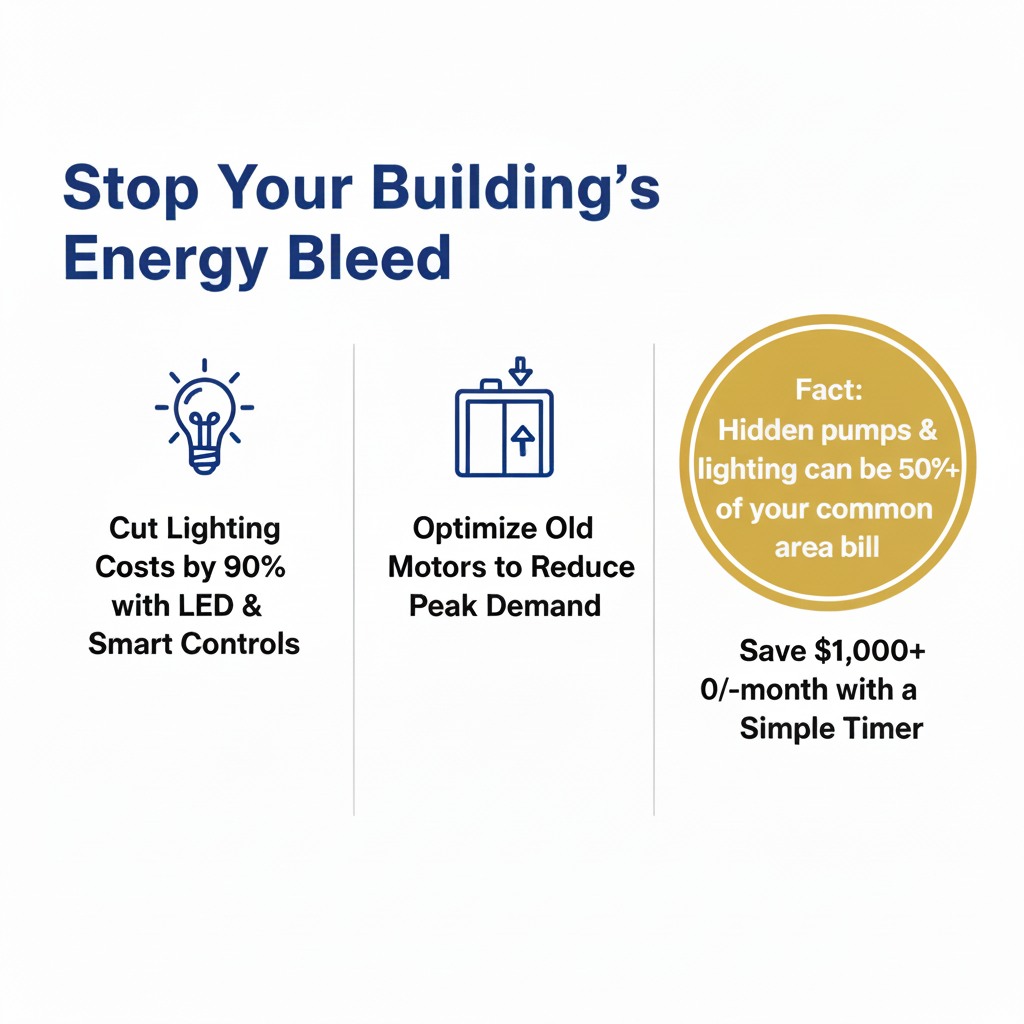
- **Common Area Lighting Systems:** Look, I've replaced probably 3,000 hallway fixtures in my career, and every single time the property manager says "I didn't think it'd make *that* much difference." Then they get their first post-retrofit bill. Hallways lit 24/7 with old fluorescent tubes? You're burning 60-70 watts per fixture, plus another 10% for ballast losses nobody talks about. Switching to [LED lighting solutions](/services/commercial-led-lighting-installation) isn't just smart — it's survival math. Drop those 4-footers down to 18-22 watts each. A parking garage I worked on in Sandy Springs had 200 fixtures pulling 70W constantly. Annual cost? $18,300 at their utility rate. We went LED. New annual cost: $5,250. The ROI was so fast the HOA president actually called to make sure we hadn't made a mistake on the invoice.
- **Elevator Systems:** Here's where it gets expensive if you're not careful. Those old hydraulic systems? Multi-speed AC motors in taller buildings? They're power hogs, yeah. But full motor replacement — gearless permanent magnet systems — can run you $80K to $150K depending on the building. Sometimes you need it. Sometimes you absolutely don't. A variable voltage, variable frequency drive (VVVF) retrofit cuts consumption by 30-50% in most cases, costs maybe a quarter of full replacement, and your elevator still works exactly the same. The drive matches motor speed to actual load instead of running everything at 100% all the time (which is insane when you think about it). I've seen both scenarios. One building in Decatur needed the whole motor replaced — 1970s hydraulic system, literally leaking fluid. Another place just needed smarter drive controls. $12,000 vs. $120,000. Big difference. [Learn more about electrical upgrades for mechanical systems](/services/electrical-panel-upgrades).
- **Mechanical Systems — The Silent Killers:** A 5 HP hot water circulation pump running 24/7 consumes over 3,700 kWh per month. That's absurd. Same goes for lobby HVAC, parking garage fans, all those mechanical systems running continuously for no actual reason. [Smart controls for HVAC systems](/services/commercial-hvac-electrical-services) aren't optional anymore — they're survival. This means schedules, occupancy sensors, variable frequency drives (VFDs) that scale power to demand. Common pitfall: thermostats are miscalibrated or set at extremes, causing constant battles nobody wins. We're talking precise controls, not casual adjustments.
Key Takeaways
High Building Electric Bill? An Expert Electrician Inspector's Guide to Smarter Energy Management
Last Tuesday, I watched a property manager in Buckhead literally throw his utility bill across the conference table. Three months running, over $3,200 for a 12-unit building's common areas. That kind of money — it doesn't just disappear into thin air.
Except it does.
Your building is bleeding cash through energy waste, and I've got two decades of field work that says you're probably looking in all the wrong places for the leak.
Does this hit close to home? You can stop it. But it takes a strategic approach — one that starts with finding the *actual* root causes, not the obvious ones. Seriously, don't just guess.
Most building managers and HOAs feel completely overwhelmed. They swap out a few lightbulbs, fiddle with a thermostat, then scratch their heads when the bill stays high. That's the trap. Here's what actually works — insights from thousands of inspections that'll help you diagnose and fix the real problems. Not the easy ones. The expensive ones.
Pinpointing the Energy Hogs in Your Commercial or Residential Building
Your biggest energy thieves? They're hiding in plain sight.
We're talking ancient lighting in common areas. Elevator motors from the Reagan administration. Pumps that just... run. All day. All night. Nobody watching.
I've seen these phantom loads eat 40%, sometimes 60% of a building's baseline draw. One property in Midtown? Their overnight consumption barely dipped from daytime levels — classic vampire behavior. Meanwhile the property manager kept adjusting AC setpoints by half a degree.
In hundreds of property inspections, I've watched managers obsess over $30 worth of thermostat adjustments while a circulation pump burns through $800 a month in the basement. The million-dollar question: where is all that power actually going?
Let's dig in.
- **Common Area Lighting Systems:** Look, I've replaced probably 3,000 hallway fixtures in my career, and every single time the property manager says "I didn't think it'd make *that* much difference." Then they get their first post-retrofit bill. Hallways lit 24/7 with old fluorescent tubes? You're burning 60-70 watts per fixture, plus another 10% for ballast losses nobody talks about. Switching to [LED lighting solutions](/services/commercial-led-lighting-installation) isn't just smart — it's survival math. Drop those 4-footers down to 18-22 watts each. A parking garage I worked on in Sandy Springs had 200 fixtures pulling 70W constantly. Annual cost? $18,300 at their utility rate. We went LED. New annual cost: $5,250. The ROI was so fast the HOA president actually called to make sure we hadn't made a mistake on the invoice.
- **Elevator Systems:** Here's where it gets expensive if you're not careful. Those old hydraulic systems? Multi-speed AC motors in taller buildings? They're power hogs, yeah. But full motor replacement — gearless permanent magnet systems — can run you $80K to $150K depending on the building. Sometimes you need it. Sometimes you absolutely don't. A variable voltage, variable frequency drive (VVVF) retrofit cuts consumption by 30-50% in most cases, costs maybe a quarter of full replacement, and your elevator still works exactly the same. The drive matches motor speed to actual load instead of running everything at 100% all the time (which is insane when you think about it). I've seen both scenarios. One building in Decatur needed the whole motor replaced — 1970s hydraulic system, literally leaking fluid. Another place just needed smarter drive controls. $12,000 vs. $120,000. Big difference. [Learn more about electrical upgrades for mechanical systems](/services/electrical-panel-upgrades).
- **Mechanical Systems — The Silent Killers:** A 5 HP hot water circulation pump running 24/7 consumes over 3,700 kWh per month. That's absurd. Same goes for lobby HVAC, parking garage fans, all those mechanical systems running continuously for no actual reason. [Smart controls for HVAC systems](/services/commercial-hvac-electrical-services) aren't optional anymore — they're survival. This means schedules, occupancy sensors, variable frequency drives (VFDs) that scale power to demand. Common pitfall: thermostats are miscalibrated or set at extremes, causing constant battles nobody wins. We're talking precise controls, not casual adjustments.
The Expert Tip Most Energy Guides Overlook: Prioritize Data Over Assumption
Don't rush into a $3,500 comprehensive energy audit.
I know that sounds completely backwards coming from someone who does energy audits for a living, but hear me out.
Our approach? Fast, cheap, actionable data first. We'll install temporary sub-meters on your main common area circuits — lighting panel, elevator feed, those pumps in the mechanical room everyone forgets exist. A month of real usage data tells you *exactly* where your money's going. Not where some consultant with a clipboard *thinks* it might be going. Where it's actually going. The difference matters.
Look — there was this property manager in downtown Seattle — absolutely convinced the ancient boiler was killing them. Had quotes lined up for a $40K replacement. We talked him into $800 worth of sub-metering first.
Boiler was fine. Slightly inefficient, sure, but fine.
Turns out a 3 HP hot water circulation pump had been running continuously since approximately the Clinton administration. Nobody even knew it *had* a pump down there. We slapped a $300 commercial timer on that circuit. Boom — thousands saved annually, and they kept their old boiler for another five years before replacing it on their own timeline.
That's why you measure before you spend.
What a Professional Energy Audit *Actually* Uncovers
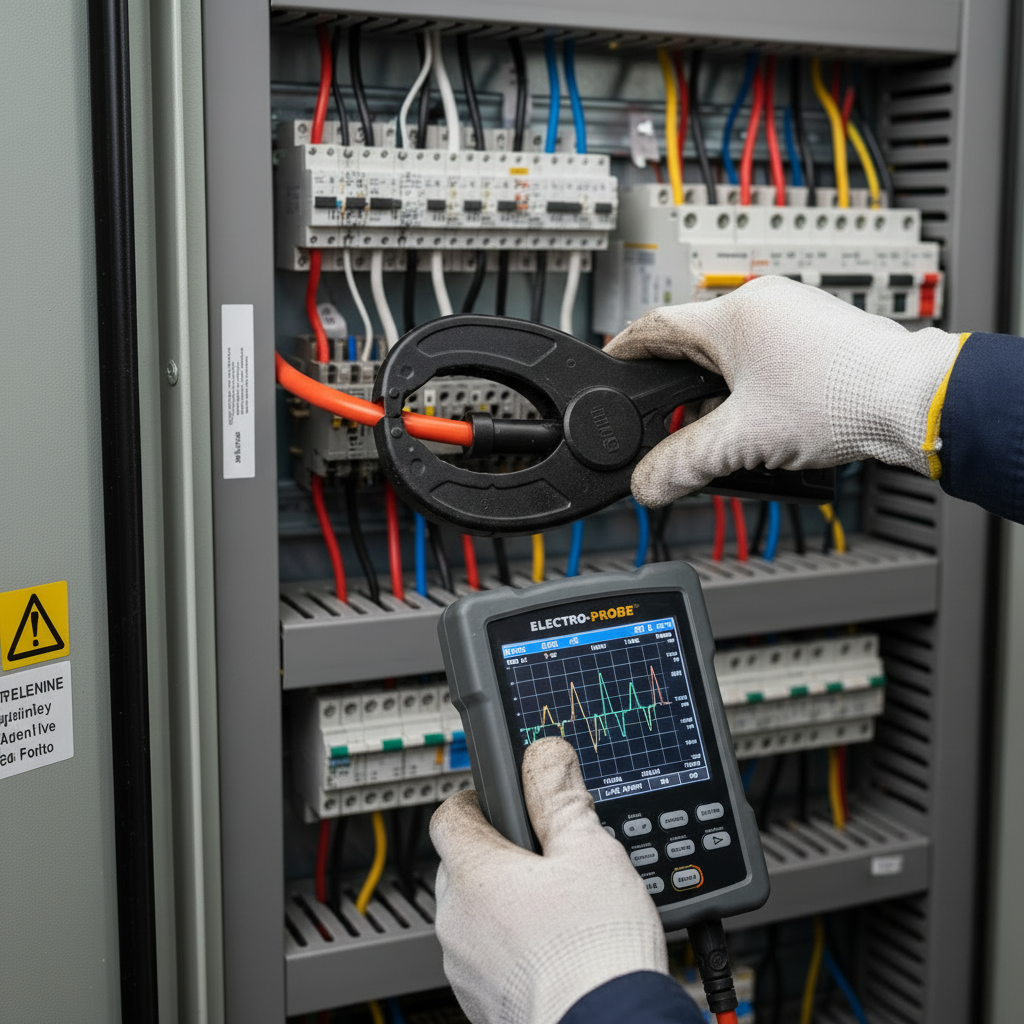
When I show up with my Fluke analyzers and start pulling real load data, property owners are wrong about the problem roughly nine times out of ten.
Everyone blames the lights. Always, always the lights.
Except usually? Not even close.
Here's the thing: my Fluke 1770 series power quality meter cost about what a used Honda Civic goes for, but it shows me voltage sags, power factor issues, harmonic distortion — the complete electrical picture of what's happening on every circuit. You can't fix what you can't measure. Guessing just drains your bank account while you feel productive.
Take this building I worked on in Chicago's Gold Coast. Twenty stories, gorgeous historic high-rise, the kind with actual character. Their tenants' association brought us in because common area electric bills had nearly doubled since 2021 — pushing $2,500 monthly. They'd already done the obvious thing, swapped maybe 40% of the hallway lights to LEDs.
Bill barely moved.
We brought in the Fluke 1770, got crystal-clear data in under an hour. Lighting? Not the monster. A 15 HP hot water circulation pump had been running continuously for a decade. Just... running. Pulling 11 kW around the clock, every single day, weekends, holidays, didn't matter.
Our electrician installed a commercial-grade digital timer on that circuit (took maybe 90 minutes including testing). Programmed it to cycle a few minutes each hour during peak demand periods — perfectly adequate for hot water distribution without the constant waste.
Monthly bill dropped 40%.
Over $1,200 saved every month, ongoing, forever, until something else breaks.
That's why data beats guesswork. That's also why an experienced eye, backed by actual numbers, transforms your [commercial electrical system](/services/commercial-electrical-services) efficiency basically overnight instead of burning money on expensive mistakes.
Strategic Lighting Upgrades: Your First Major Win for Energy Efficiency
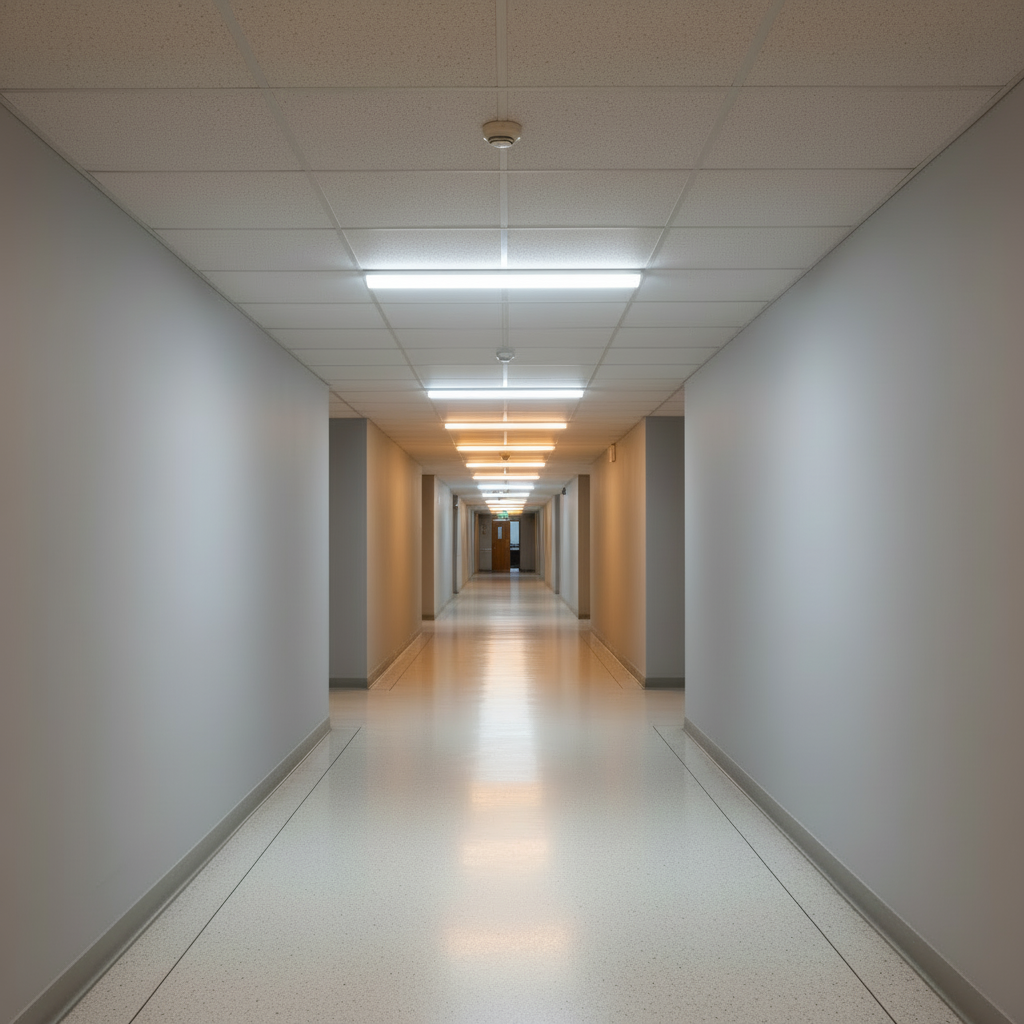
Here's the thing: upgrading common area lighting to commercial-grade LEDs with smart controls will slash your bill fast. Not "might reduce" or "could help" — *will slash it*. But this isn't about screwing in new bulbs. That's amateur hour.
A professional installation means a complete system overhaul: replacing old fixtures, adding motion sensors in low-traffic areas (stairwells, storage), installing photocells for exterior lights so you're only illuminating when actually needed. Check out our [commercial lighting solutions](/services/commercial-lighting-installation).
We usually recommend **PacLights**, **TCPI**, or **Philips Advance** fixtures. They're durable, efficient, and backed by solid warranties — often 50,000 to 100,000 hour L70 lifespans. Not cheap online throwaways that fail in six months. Don't skip quality here. A poor LED, even if "efficient" on paper, ends up costing more in replacement and labor.
So what separates a basic bulb swap from a professional installation?
The control layer. Where you actually save money.
1. **Smart Controls:** Stairwells. Hallways. Parking garages. These spaces sit empty probably 90% of the time, but most buildings light them like they're hosting a convention. Occupancy sensors — ultrasonic or PIR depending on the space — can drop your actual runtime to maybe 2-3 hours daily in a fixture that used to burn 24/7. A 100W fixture running constantly costs you around $131 annually at typical commercial rates. Same fixture with occupancy control? Maybe $16. The sensor pays for itself in under a year, then keeps saving you money basically forever. [Professional electrical control system installations](/services/electrical-control-system-installation) do this right — commercial-grade PIR sensors with 360-degree detection and adjustable timing that actually works instead of false-triggering every time the HVAC kicks on.
2. **Zoning and Dimming:** Not every area needs full brightness all the time. Dimming systems in lobbies during off-hours or creating separate zones for different usage patterns adds another layer of efficiency. Seriously. Some modern LED systems integrate directly with building management systems (BMS), allowing centralized control and monitoring. It's not just about the fixtures — it's about intelligent operation.
Now, 3. **Photocells for Exterior Areas:** If you're lighting parking lots, entry areas, or building perimeters during daylight, you're burning money for no reason. Photocells automatically adjust based on ambient light levels. Simple tech, massive impact.
Now, the bottom line? A guy in Buckhead ignored his parking garage lighting for six months after getting quotes. By the time he called us back, he'd paid an extra $2,400 in unnecessary electricity costs. Don't be that guy.
Most lighting retrofits I've worked on pay themselves back in under two years — some in 18 months, others closer to three years depending on your utility rates and usage patterns. After that? Pure savings dropping straight to your bottom line every single month.
In-Depth Look
Detailed illustration of key concepts
Visual Guide
Infographic illustration for this topic
Side-by-Side Comparison
Visual comparison of options and alternatives

Sources & References
- Lower Your High Electric Bill With Expert Advice
- How Can You Lower Your Electricity Bill? - Scott The Electrician
- Energy Efficiency Tips from Electricians: How to Lower Your ...
- Best Tool Brand for Electricians 2025: Expert Rankings - Wood Guide
- Top 20 Essential Electrician Tools for Pros (2026 List) - Workiz
- Best Electrician Tools Brand Guide
- Essential 2025 Electrician Tools & Safety Warnings (New & Pro Tips!)
- 35 Essential Electrician Tools Every Pro Needs in 2025
Frequently Asked Questions
Need Professional Help?
Find top-rated electricians experts in your area