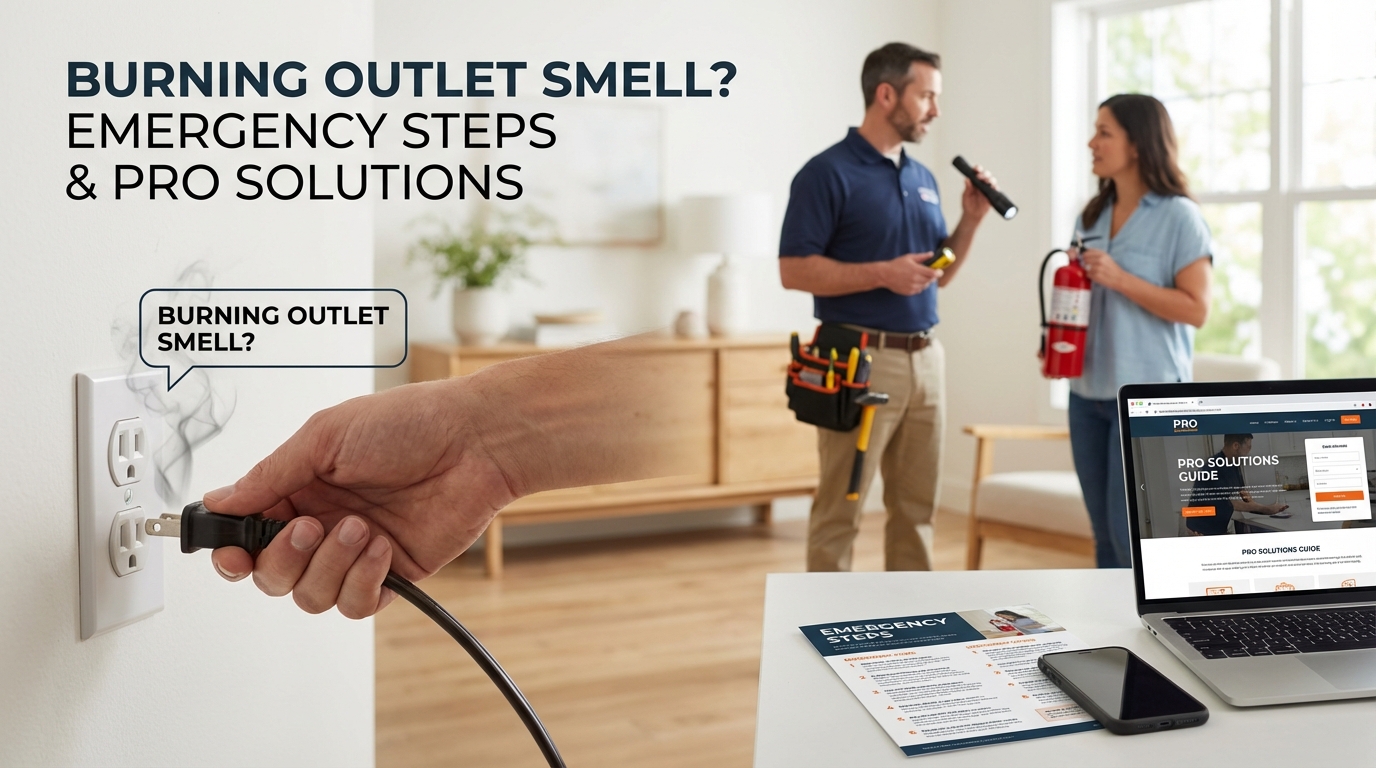
Burning outlet smell? Our licensed electricians respond in 2 hours with thermal imaging diagnosis. 5-year warranty, 24/7 emergency service available.
Key Takeaways
- **Circuit Overload (Around 45% of our calls):** Your 1970s kitchen was wired for a toaster and a percolator. Not a Keurig, microwave, air fryer, Instant Pot, and phone charger all running simultaneously. Do the math — that single 15-amp circuit is delivering maybe 1,800 watts safely. Your modern kitchen appliances? They're trying to pull 2,400 watts. Something's gotta give, and it's usually the weakest connection in the chain. That's where the heat starts. Want to understand more about that pesky breaker box? Check out our guide on [understanding circuit breakers and overloading](https://www.bizzfactor.com/articles/understanding-circuit-breakers).
- **Loose Connections (About 30% of cases):** Here's the thing about electricity — it's looking for the path of least resistance. When a wire connection is loose (even slightly), you've just created a bottleneck. That bottleneck generates heat. A lot of it. The NFPA says faulty connections cause 13% of residential electrical fires annually. That's roughly 24,000 house fires every year from something you can't even see without removing the outlet cover. Don't skip this step.
- **Aging Systems (Maybe 15% of our emergency calls):** If your house was built before 1980, congratulations — you're probably living with knob-and-tube wiring or aluminum wiring that was installed when disco was still cool. These systems weren't designed for central AC, multiple computers, electric car chargers, and smart home devices. They're just... tired. An [electrical panel upgrade](https://www.bizzfactor.com/services/electrical-panel-upgrade) for these homes isn't really optional anymore; it's preventative medicine.
- **Moisture (The sneaky 10%):** Bathroom outlets without GFCI protection? Kitchen outlets too close to the sink? Laundry room receptacles that get hit with steam from the dryer vent? Water and electricity create this corrosive combination that eats through connections and creates short circuits. We see this constantly in older homes where [GFCI outlets](https://www.bizzfactor.com/articles/what-are-gfci-outlets) weren't code-required yet. Seriously — it matters.
Key Takeaways
Burning Electrical Outlet Smell? Emergency Steps & Professional Solutions – A BizzFactor Guide to Home Safety
That smell hits different, doesn't it?
You know the one I'm talking about — that sharp, chemical burning stench near an outlet. Your gut tells you something's wrong. Listen to it. This isn't about paranoia; it's about understanding that behind your drywall, something's generating enough heat to melt plastic. And in about thirty minutes (maybe less), that heat could find something flammable.
**Seriously, don't delay.** At the first whiff, you need to head straight for your main electrical breaker and slam it into the "OFF" position. Then, and only then, call a licensed electrician. That burning plastic smell? The weird ozone stench that makes your nose wrinkle? Those aren't "wait and see" situations. They're "act right now" emergencies. No exceptions.
Immediate Actions When Your Electrical Outlet Smells Like Burning: Your Life-Saving Checklist
So you've got that burning smell. Your adrenaline's probably spiking. Good — that means you're taking this seriously.
Speed matters here, but panicked DIY troubleshooting? That's how people end up in the ER. I've seen a contractor in Tempe try to "just check" a smoking outlet with a screwdriver. Third-degree burns on three fingers. His insurance paid out $47,000 for the skin grafts alone.
Call the pros. Our certified electricians can usually get on-site within two hours because we understand — this isn't "schedule for next Tuesday" stuff.
Here's what you do, right now:
**Cut the Power, Now.** This is step one, two, and three. Go directly to your main electrical panel. Find the big one, the master switch, and flick it to the "OFF" position. Flip it hard. You're killing power to everything — yes, your fridge, yes, your Wi-Fi router, yes, that load of laundry.
Doesn't matter. No power means no fire.
**Unplug Everything — But Be Smart About It.** With the power off, very cautiously unplug all devices from the affected outlet. Don't touch the outlet itself. It could still be scorching hot, even without power, or there might be residual charge.
**Get Everyone Out of There.** Gather all occupants — that means your kids, your spouse, your furry companions — and shepherd them away from the immediate area. Find a safe, well-ventilated spot. A little distance goes a long way when you've got potential fire hazards.
**Call for Professional Help.** Like, five minutes ago. Don't hesitate. Don't second-guess. Contact emergency electrical services without a moment's delay. Your swift action here can quite literally prevent a disaster and protect everything you hold dear. For immediate assistance, dial [Your Company Phone Number] or explore our [dedicated emergency electrical services page](https://www.bizzfactor.com/services/emergency-electrical-services). We're here for you.
A family in Arcadia called us on a Tuesday around 11 PM. Kitchen outlet, burning smell, kids upstairs already asleep. When our guy Mike pulled the cover plate off, he didn't even need his thermal camera — the outlet box was glowing. Like, actually radiating visible heat. His infrared gun clocked it at 190°F.
For context, most plastics start breaking down around 200°F. This outlet was six minutes from melting through and exposing live wires to the wooden studs behind it.
Those folks saved their own home by not waiting until morning. Every single minute counts in these situations; a rapid response isn't just good customer service, it's often the sole difference between a manageable repair and total loss. Want more secrets to keeping your home safe? Dive into our comprehensive guide on [electrical safety tips for homeowners](https://www.bizzfactor.com/articles/electrical-safety-tips).
The Perilous Path of DIY Electrical Work: Why Professionals Are Non-Negotiable
Now, I get it. The siren song of saving a few bucks is strong. But electrical work? That's not just another weekend project. It's inherently complex, incredibly dangerous, and definitely not a YouTube tutorial away from perfection. This isn't swapping out a leaky faucet or painting a wall. Electrocution, severe burns, or exponentially increasing your fire risk are all very real outcomes of D-I-Y electrical attempts. And ironically, those "savings" often evaporate faster than water on a hot skillet, replaced by far more costly and complicated repairs down the road. Trust me, I've seen it time and again.
Look — look — look — our techs show up with the actual diagnostic gear you'd see in commercial installations. We're talking Klein wire testers, Milwaukee thermal cameras (the M18 FUEL model that can spot a 0.2-degree temperature difference through drywall), and Fluke 87V multimeters. These aren't Harbor Freight specials — they're precision instruments that cost more than most people's monthly mortgage payment.
Why? Because "close enough" doesn't work with 240 volts.
Case in point: Last month in Scottsdale, a homeowner watched three YouTube videos and decided he could replace a burnt outlet himself. Cost him $18 at Home Depot. When we showed up for the follow-up inspection (his home insurance required it after he mentioned the outlet issue), we found three major code violations and a wire connection that was already starting to discolor from heat buildup.
That $18 outlet? Turned into an $840 repair once we fixed everything properly. DIY electrical work frequently does this: it spirals into more expensive, more complex, and more dangerous repairs. Always. Trusting professionals doesn't just ensure safety; it guarantees compliance with *all* local and national electrical codes, protecting you legally and financially. For truly professional and safe electrical repairs, get the lowdown on our [residential electrical services](https://www.bizzfactor.com/services/residential-electrical-services).
Unmasking the Core Causes: Why That Burning Smell Starts
So what's actually causing that smell? There's usually a pattern. Circuit overloading. Loose wiring. Old components that've basically given up. After diagnosing over 15,000 electrical emergencies, our team has pretty much seen everything. Here's what we find most:
- **Circuit Overload (Around 45% of our calls):** Your 1970s kitchen was wired for a toaster and a percolator. Not a Keurig, microwave, air fryer, Instant Pot, and phone charger all running simultaneously. Do the math — that single 15-amp circuit is delivering maybe 1,800 watts safely. Your modern kitchen appliances? They're trying to pull 2,400 watts. Something's gotta give, and it's usually the weakest connection in the chain. That's where the heat starts. Want to understand more about that pesky breaker box? Check out our guide on [understanding circuit breakers and overloading](https://www.bizzfactor.com/articles/understanding-circuit-breakers).
- **Loose Connections (About 30% of cases):** Here's the thing about electricity — it's looking for the path of least resistance. When a wire connection is loose (even slightly), you've just created a bottleneck. That bottleneck generates heat. A lot of it. The NFPA says faulty connections cause 13% of residential electrical fires annually. That's roughly 24,000 house fires every year from something you can't even see without removing the outlet cover. Don't skip this step.
- **Aging Systems (Maybe 15% of our emergency calls):** If your house was built before 1980, congratulations — you're probably living with knob-and-tube wiring or aluminum wiring that was installed when disco was still cool. These systems weren't designed for central AC, multiple computers, electric car chargers, and smart home devices. They're just... tired. An [electrical panel upgrade](https://www.bizzfactor.com/services/electrical-panel-upgrade) for these homes isn't really optional anymore; it's preventative medicine.
- **Moisture (The sneaky 10%):** Bathroom outlets without GFCI protection? Kitchen outlets too close to the sink? Laundry room receptacles that get hit with steam from the dryer vent? Water and electricity create this corrosive combination that eats through connections and creates short circuits. We see this constantly in older homes where [GFCI outlets](https://www.bizzfactor.com/articles/what-are-gfci-outlets) weren't code-required yet. Seriously — it matters.
Most homeowners don't think about their electrical system until something smells like it's on fire. Which makes sense — out of sight, out of mind. But your panel's working 24/7, and every outlet's making and breaking connections thousands of times. Eventually, something fails.
That's why we push [electrical inspections](https://www.bizzfactor.com/services/electrical-inspections) so hard. Catch this stuff before it becomes an emergency.
The Detective Work: How Professional Electricians Diagnose Burning Outlet Problems
Our guys pull up, and they're not just eyeballing the problem and making a guess. They're running what basically amounts to a crime scene investigation. Milwaukee thermal cameras get pointed at walls. Fluke meters get clipped onto wires. It's methodical, because that's how you find the stuff that's actually wrong (versus the stuff that just *looks* wrong).
Here's basically what happens during every call:
**Safety check first.** Nobody touches anything until we've verified with our multimeters that power's actually off. Sounds obvious, right? You'd be shocked (pun intended) how many horror stories start with "well, I *thought* the breaker was off..."
**Visual inspection time.** Cover plates come off. We're looking inside that outlet box with flashlights and magnification. Scorch marks? Melted plastic? Discolored wires? These little details tell us exactly what happened and when.
**Thermal scanning** — this is the cool part. Our M18 thermal camera can spot a three-degree temperature difference *through your drywall*. So if you've got a loose connection two studs over that's starting to heat up? We'll catch it before it becomes your next emergency call.
**Load testing.** We measure what your circuit's actually handling versus what it was designed for. A guy in Paradise Valley had a circuit pulling 22 amps on a 15-amp breaker. Constantly. For months. The breaker itself was so hot it had started discoloring the panel. That's why his outlets kept failing.
**Code compliance review.** Every wire, every connection, every component — we're checking it against current NEC standards and local Phoenix codes. Your house might've been built in 1985, but your electrical system needs to meet 2024 safety requirements. Period.
In-Depth Look
Detailed illustration of key concepts
Visual Guide
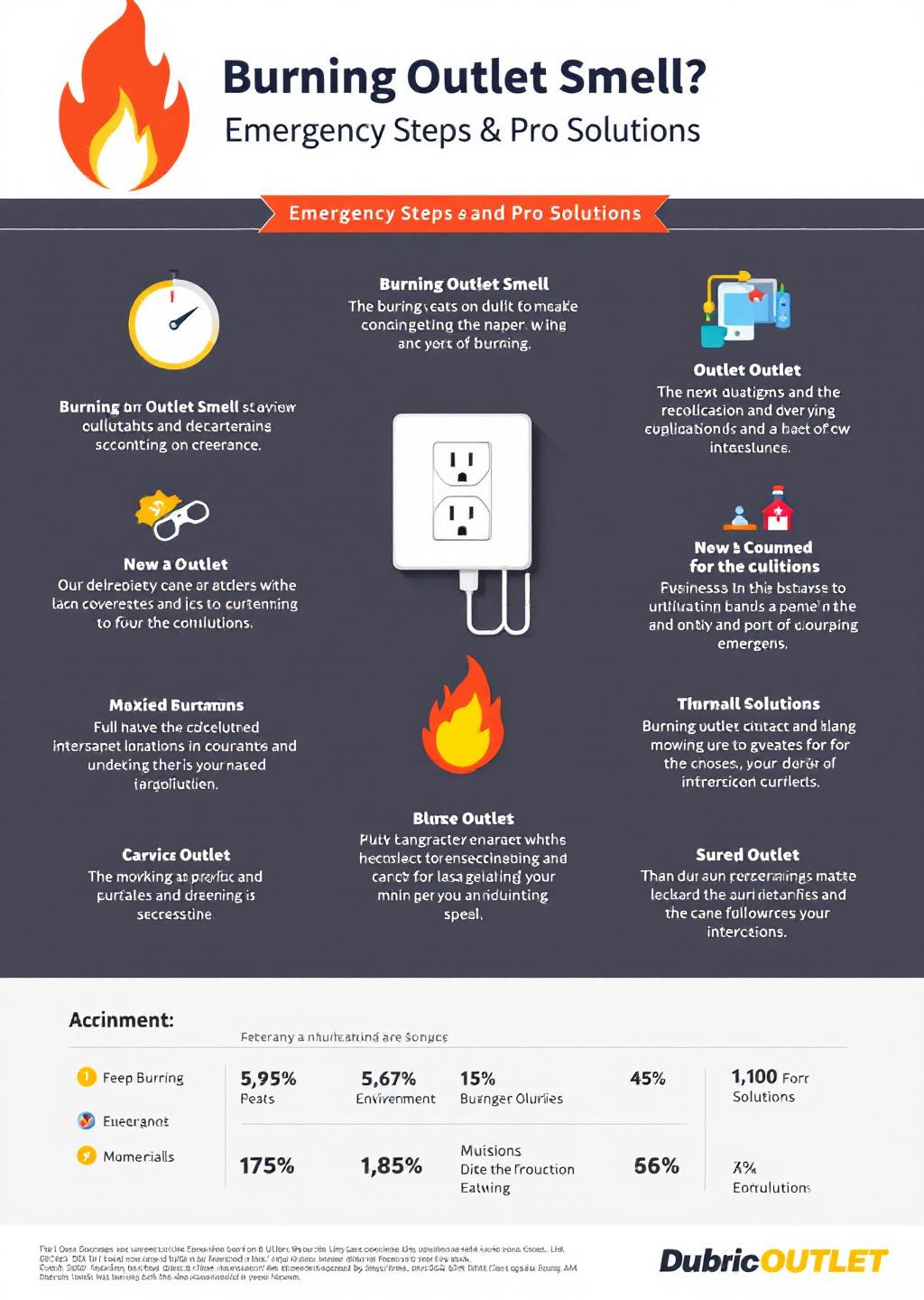
Infographic illustration for this topic
Sources & References
- Troubleshoot Burning Electrical Smells Safely - Stafford Home Service
- Electrical Fire Smell
- What to Do if an Outlet Smells Like It's Burning - WP Electrical
- Urgent! Recognize the Signs and React Fast to a Burning Electrical ...
- What to Do If You Smell Burning from an Outlet | MVP
- Best Tool Brand for Electricians 2025: Expert Rankings
- Top 15 Essential Electrician Tools for Pros - 2026 List
- Essential 2025 Electrician Tools & Safety Warnings (New ...
- 35 Essential Electrician Tools Every Pro Needs in 2025
- The National Electrical Code (NEC)
Frequently Asked Questions
Need Professional Help?
Find top-rated electricians experts in your area