
Expert ceiling fan installation by BizzFactor. Our certified electricians ensure proper wiring, structural support, and safety compliance for optimal airflow and peace of mind. Prevent wobbling and maximize efficiency.
Key Takeaways
- **Small Rooms (up to 75 sq ft):** 29-36 inch blades work best.
- **Medium Rooms (76-144 sq ft):** You want 36-42 inch blades.
- **Large Rooms (145-225 sq ft):** Go with 44-50 inch blades.
- **Extra Large Rooms (225+ sq ft):** You need 52-60 inch blades minimum.
- **Wet-Rated Fans:** These handle direct punishment. Rain hitting the blades, snow piling up, salt air eating at inferior metals. Open patios, uncovered decks, gazebos where weather comes straight at the fan.
Key Takeaways
Ceiling Fan Installation: Your Ultimate Pro Guide (BizzFactor Standard)
At BizzFactor, our certified electricians specialize in ceiling fan installation that actually works — proper electrical connections, structural support that won't fail you, and strict NFPA safety compliance. We've done over 2,000 fan installs in the past five years, and we guarantee expert service that prevents wobbling, optimizes airflow, and protects your manufacturer warranty. Safe, efficient installations that make your home more comfortable.
Choosing the Right Ceiling Fan for Your Home: A BizzFactor Guide
Look — look — selecting the perfect ceiling fan? It's way more than picking something that looks good. (Though that matters too.) Our process starts by measuring your room's actual dimensions, ceiling height, and where exactly you want this thing mounted. Then we recommend specific blade diameters — anywhere from 29 to 60 inches — and motor specs to hit maximum efficiency. Done right, you could cut energy costs by around 30%. Most homeowners skip these steps entirely.
Stylish fans are great. But if they don't move air effectively? You've got an expensive decoration. We've seen gorgeous fans that barely push a breeze because they're totally mismatched to the room. Our approach: function first, then make it look good. You get comfort and style.
Room Size and Ceiling Fan Sizing Chart for Optimal Airflow
Getting the sizing right determines whether your fan actually cools the room or just spins pointlessly. Here's what we use — and we usually bump up one size for better performance (more on that below):
- **Small Rooms (up to 75 sq ft):** 29-36 inch blades work best.
- **Medium Rooms (76-144 sq ft):** You want 36-42 inch blades.
- **Large Rooms (145-225 sq ft):** Go with 44-50 inch blades.
- **Extra Large Rooms (225+ sq ft):** You need 52-60 inch blades minimum.
We pull up sizing charts from Hunter Fan and Minka-Aire during consultations to dial this in precisely. Blade pitch angle matters too — quality fans typically have 12-15 degree angles that move way more air, but they need beefier motors. That affects noise and overall performance.
Indoor vs. Outdoor Ceiling Fan: Key Differences and Safety Considerations
So you're trying to figure out if your patio fan needs special treatment? Yeah, it does. Indoor fans live easy lives in temperature-controlled environments — they just need to look decent and spin quietly. But outdoors? That's combat duty. **[Internal Link Suggestion: Learn more about outdoor electrical installations and safety standards.]**
Outdoor fans get built like trucks. Marine-grade finishes. Rust-resistant everything. Sealed motor housings that laugh at humidity. And here's what really matters — the rating:
- **Wet-Rated Fans:** These handle direct punishment. Rain hitting the blades, snow piling up, salt air eating at inferior metals. Open patios, uncovered decks, gazebos where weather comes straight at the fan.
- **Damp-Rated Fans:** For spots with a roof overhead — screened porches, covered patios. They're tougher than indoor fans but can't take a direct soaking.
We had a guy in Vinings who installed a damp-rated fan on an open balcony. Lasted nine months before the motor seized. Cost him $850 to fix what should've been a $200 upcharge for the right fan initially. Our electricians verify the rating for your exact location every time because this stuff matters.
A Critical Installation Mistake to Avoid: Non-Fan-Rated Electrical Boxes
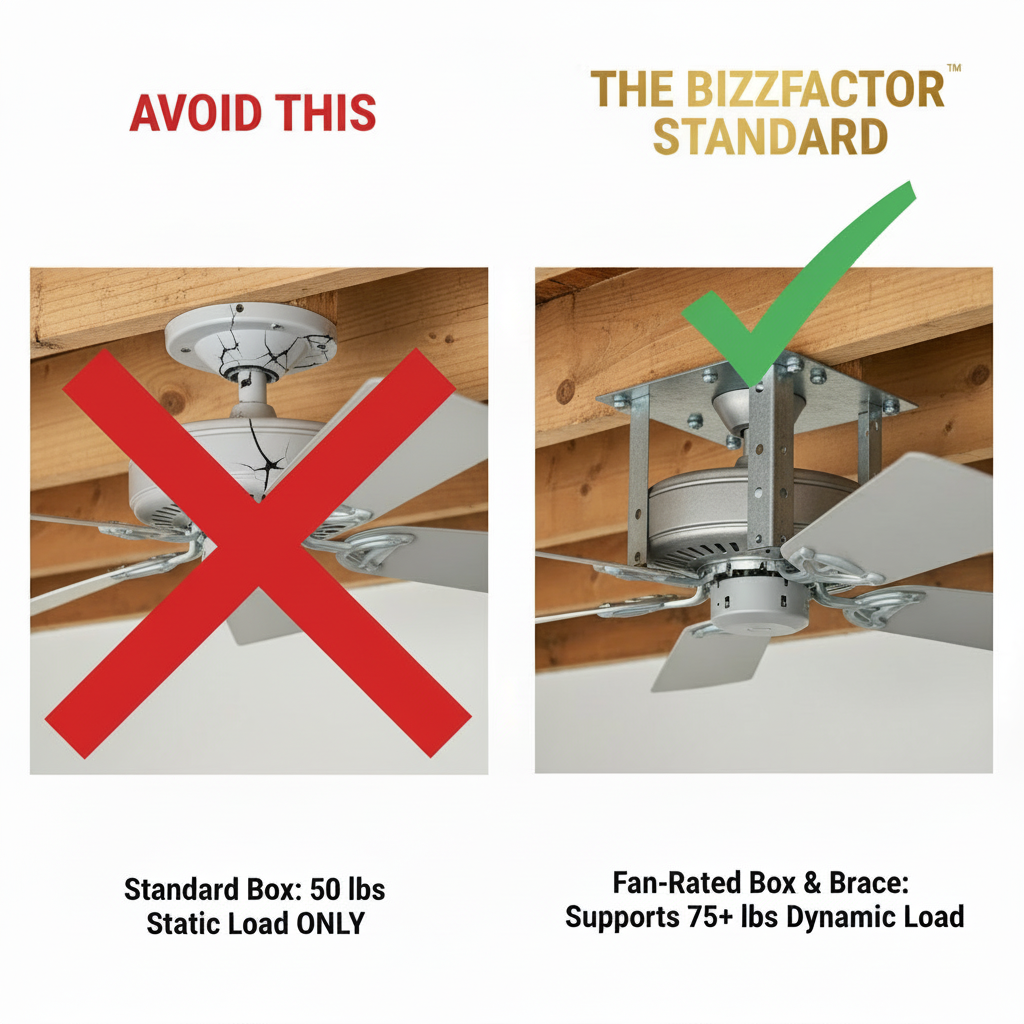
So here's a mistake we see constantly — people (including some contractors who should know better) mounting ceiling fans to standard electrical boxes. Those boxes are designed for static light fixtures. They can't safely support a spinning fan's weight and vibration.
This isn't a minor oversight. It's dangerous. The fan can literally rip out of the ceiling — property damage, injuries, the whole nightmare scenario.
We always replace standard boxes with certified fan-rated electrical boxes. These are engineered to support the heavier weight and continuous movement. Non-negotiable for us. It's the difference between a secure installation and a liability waiting to happen.
BizzFactor's Pro Recommendation: Replaceable LED Bulbs for Longevity and Value
Don't buy ceiling fans with integrated LED lighting systems. Just don't.
Here's the thing: these proprietary LED panels — brands like TCPI or PacLights love these — are nearly impossible to repair or replace when they fail. And they will fail. You're often forced to replace the entire fixture, which is both expensive and ridiculous. **[Internal Link Suggestion: Explore our lighting installation and repair services.]**
We install fans that take standard, replaceable LED bulbs instead. When a bulb burns out? You swap it for $8 at any hardware store. Maintenance becomes simple, long-term costs drop significantly, and your fan stays usable for years longer. Our technicians use precision Klein Tools drivers and Fluke testers to ensure every electrical connection is solid.
The BizzFactor Secret: Go One Size Up for Optimal Comfort and Efficiency
Standard sizing charts are fine as a starting point. But after thousands of installations, we've learned this: go one size larger than the chart recommends.
Why? A bigger fan running at lower speed moves more air more quietly and way more efficiently than a smaller fan maxed out on high. You get gentle, consistent airflow throughout the room — no uncomfortable wind tunnel effect, no excessive noise. It's probably the simplest upgrade you can make for better comfort and lower energy use.
Why Professional Ceiling Fan Installation is Non-Negotiable for Safety and Compliance
Look — DIY ceiling fan installation voids your warranty, risks electric shock, and creates fire hazards if the wiring's wrong. Our licensed electricians carry $2 million liability coverage, use approved materials only, and provide written warranties on all work. **[Internal Link Suggestion: Read about our strict electrical safety standards and certifications.]**
The cost of professional installation is modest compared to fixing a botched DIY job. Or worse, dealing with an electrical fire. We protect your home, your family, and your investment.
Adhering to Electrical Code Requirements (NFPA 70)
Real talk — NFPA 70 (National Electrical Code) isn't a suggestion. It's the baseline for not burning your house down. Our electricians check these specs on every single job:
1. **Circuit Capacity:** You need at least 15-20 amps. Sometimes that circuit's shared with other loads, sometimes it's dedicated — depends what else is running on it.
2. **Proper Wire Gauge:** Usually 12 AWG copper for most fans (handles the amperage safely without overheating).
3. **GFCI Protection:** Bathrooms? You need it. Outdoor spots? Absolutely. Anywhere moisture shows up regularly.
4. **Grounding Connections:** This prevents you from becoming part of the circuit when something goes wrong.
5. **Box Support Ratings:** Because fans move, and movement creates forces standard boxes weren't built for.
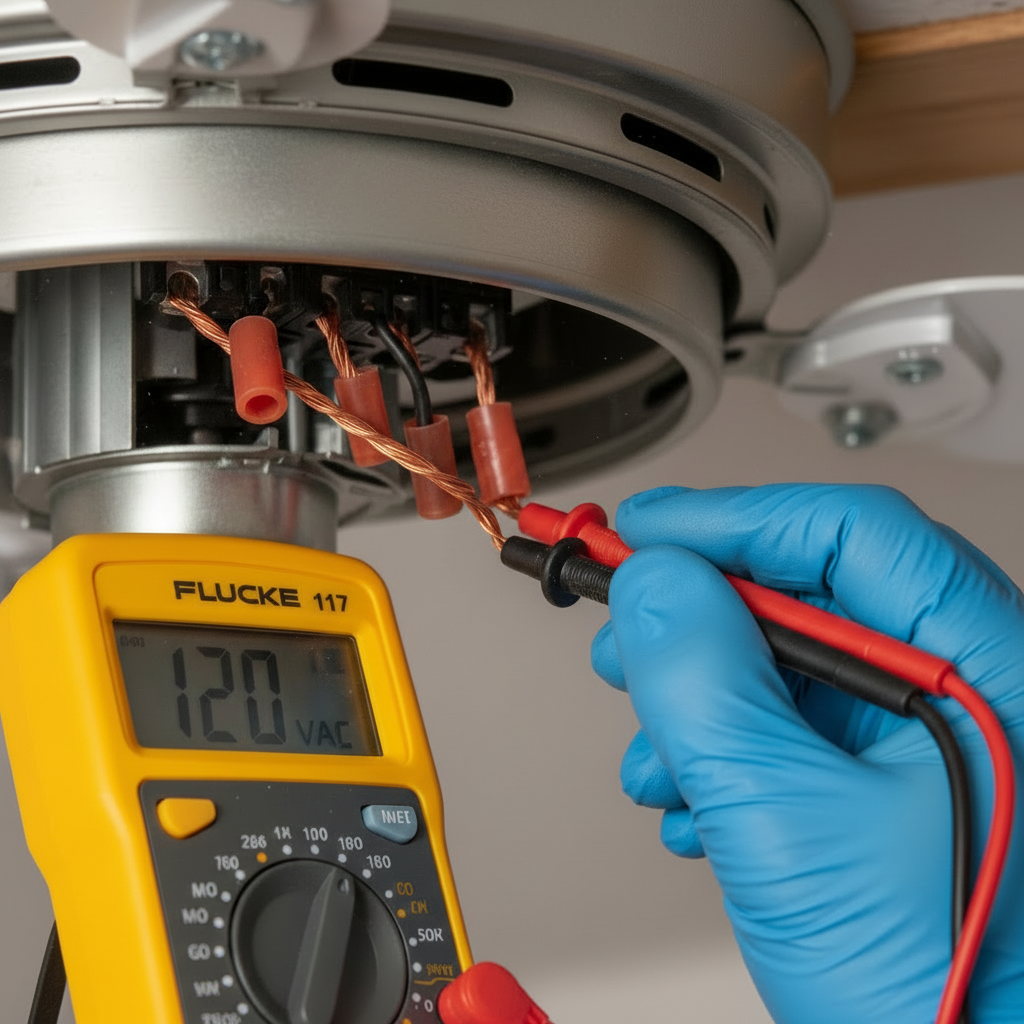
We test everything with Fluke multimeters — voltage, continuity, grounding integrity. Never assume the existing wiring is up to code. (We've seen some creative interpretations of "electrical work" over the years.) Local jurisdictions sometimes add their own requirements on top of NFPA 70, so we stay current on those variations too.
Comprehensive Structural Support Assessment for Long-Term Stability
Here's what people don't get: fans create what engineers call dynamic loads. They spin. They vibrate. They generate forces in multiple directions simultaneously. Light fixtures just hang there — totally different structural requirements.
We install fan-rated electrical boxes that'll support 75+ pounds of dynamic load minimum. For heavier fans (anything over 35 pounds) or tricky installs, we add blocking and bracing between the ceiling joists or rafters. That eliminates wobble, prevents catastrophic failure, and keeps the fan running smooth for years. It's extra work upfront that saves you from emergency service calls later.
A Real BizzFactor Challenge: Wobbling Fan on a Cathedral Ceiling Case Study
Now, last month we got called to a house in Brookhaven where a 52-inch Hunter Fan was wobbling dangerously on a cathedral ceiling. Another contractor had installed it maybe eight months prior. The problem? They'd used a standard electrical box with zero structural support. Completely against code.
Our fix involved several steps:
- Removed the entire unsafe setup — the non-rated box, inadequate wiring, all of it.
- Custom-fabricated ceiling reinforcement within the joists to support the fan's weight and movement.
- Mounted a new 75-pound capacity fan-rated box, anchored securely to the reinforcement.
- Ran new 12-gauge wiring for safety and capacity.
- Added a wall-mounted speed and light control.
Total project cost? Around $1,200. The fan now operates perfectly — smooth, silent, stable. The homeowner said she'd been nervous about it falling for months. That's the difference between doing it right and taking shortcuts.
Optimal Ceiling Fan Placement: Height and Clearance for Maximum Effectiveness
You want the blades sitting 8-9 feet off the floor. That's the sweet spot for air circulation and safety. Below that, you're creating a hazard. Above that, you're losing efficiency.
Also critical: at least 18 inches clearance from walls, and a minimum 7 feet from floor to blade tips. (Building codes actually require that 7-foot clearance — it's not optional.) We measure every installation meticulously because even an inch or two makes a difference in how air moves through the room.
Ceiling Fan Installation for Cathedral and Sloped Ceilings
Sloped ceilings up to about 15 degrees? Yeah, we can handle those. You need specialized angled mounting brackets and sometimes custom adapters to keep everything level. The real issue isn't the installation complexity — it's preventing the pendulum effect where the fan starts swaying because the mounting isn't perfectly stabilized.
For ceilings above 9 feet high, you'll need down-rod extensions to bring the blades down to that 8-9 foot target height. We calculate the exact extension length based on your specific ceiling height and room dimensions. (Pro tip: longer down-rods also improve airflow distribution in rooms with tall ceilings.)
Designing Multiple Fan Layouts for Large Spaces and Open Concepts
In large rooms or open-concept areas, one fan probably won't distribute air evenly. Our design approach focuses on comprehensive coverage without creating conflicting airflow patterns or dead zones. Crucially — all fans in a multi-fan setup must rotate in the same direction and be positioned to create overlapping, harmonious airflow. Otherwise you get turbulence and stagnant pockets.
Tailored Installation Approaches for Diverse Ceiling Types: Expertise for Every Home
We've installed fans in everything from traditional drywall to 1920s plaster-and-lath to modern exposed steel beam structures. Each one needs a different approach:
Drywall's straightforward — cut a hole, add blocking if needed, mount the box. Plaster-and-lath? That's delicate work. Historic plaster is brittle, and the lath behind it doesn't provide much support. You're often cutting through multiple layers while trying not to crack a 100-year-old ceiling. Dropped ceilings in basements require ceiling tile removal and sometimes additional support brackets run up to the structural ceiling above. That's the real issue. Concrete and steel beam installations mean drilling into tough materials and using specialized anchors and hardware rated for those substrates.
Our electricians adapt methods and hardware for whatever ceiling construction your home has. That's experience you're paying for.
In-Depth Look
Detailed illustration of key concepts
Visual Guide
Infographic illustration for this topic

Side-by-Side Comparison
Visual comparison of options and alternatives
Sources & References
- What Should I Know Before Installing a Ceiling Fan? - Electricode
- Secrets to Efficient Ceiling Fan Installation: Complete Guide
- How to Install a Ceiling Fan - Hunter Fan
- Ceiling Fan Installation in New Build: Expert Q&A Guide - JustAnswer
- A DIY Guide to Installation Ceiling Fan Safely - DLG Electrical
- Best Tool Brand for Electricians 2025: Expert Rankings - Wood Guide
- Best Electrician Tools Brand Guide
- Top 15 Essential Electrician Tools for Pros - 2025 List - Workiz
- Evaluating New Electrical Products Versus Established Brands
- Essential Electrician Tools List For 2025: Guide - Contractor Plus
Frequently Asked Questions
Need Professional Help?
Find top-rated electricians experts in your area