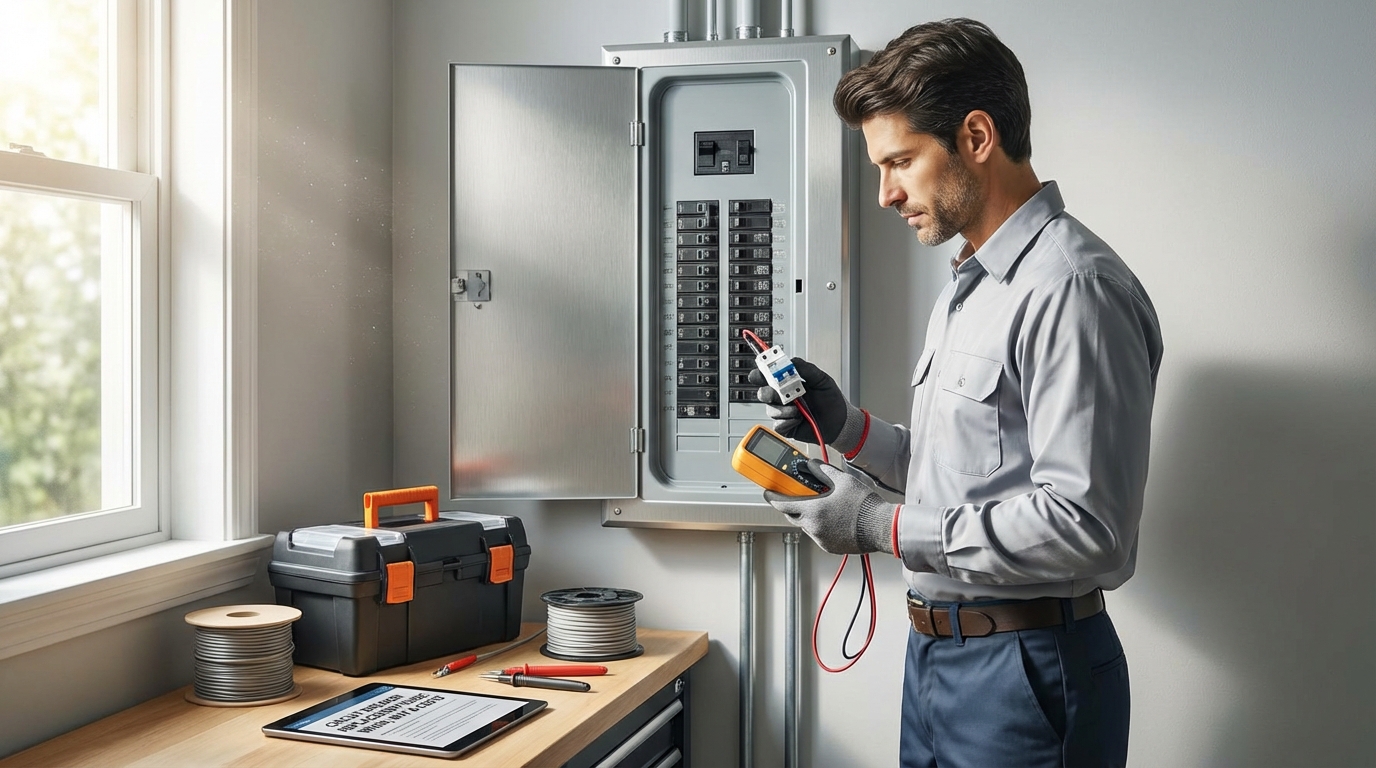
Learn circuit breaker replacement signs, costs, and why professional installation matters. Expert electricians explain when you need new breakers.
Key Takeaways
- **Standard Circuit Breakers (Thermal-Magnetic)**: These remain the most common type, providing fundamental overcurrent protection for general lighting circuits, wall receptacles, and standard appliances throughout your home. They work with two separate trip mechanisms working in tandem: a thermal piece (basically a bimetallic strip that bends when it heats up from sustained overload — think 10 seconds to a couple minutes depending on how bad the overcurrent is) and a magnetic component (an electromagnet that slams shut instantly when it senses a massive surge, like when two wires touch during a short circuit). That dual setup lets them handle both slow burns and sudden disasters. Ratings typically range from 15A to 30A for single-pole, 120V circuits, offering interrupt capacities (AIC — Amperes Interrupting Capacity) of 10,000 to 22,000 Amperes, meaning they can safely clear fault currents up to that magnitude without self-destructing. These are primarily governed by UL Standard 489.
- **Ground Fault Circuit Interrupter (GFCI) Breakers**: Required by code in bathrooms, kitchens, garages, and anywhere water meets electricity — and for good reason.
- **Arc Fault Circuit Interrupter (AFCI) Breakers**: So yeah, this is where things get high-tech.
- **Combination Arc-Fault Circuit Interrupter (CAFCI) Breakers**: Think of these as the Swiss Army knife of breaker protection. They bundle AFCI and GFCI into one unit, covering both series arcs (like when a connection loosens inside a switch box and starts cooking itself) and parallel arcs (nail through a cable, direct wire-to-wire contact). Plus they'll catch ground faults. Code's pushing these harder now for circuits that need multiple layers of protection — saves panel space, simplifies the install, and you're not gambling on which hazard shows up first.
- **Double-Pole Breakers**: Specifically engineered for high-voltage and high-amperage appliances and heavy-duty loads like central air conditioning units, electric water heaters, electric clothes dryers, electric ranges/ovens, and sometimes subpanels. These take up two slots right next to each other in your panel, and they're managing two hot wires at once — usually delivering 240 volts to whatever appliance needs it. They include two independent thermal-magnetic trip mechanisms linked by a common trip bar, meaning if one pole trips, the other does too, completely de-energizing the 240V circuit to prevent half-voltage hazards. They often range from 30A to 60A, and sometimes higher for specific applications, always adhering to specific wire gauge requirements set by NEC Article 210.19 to prevent conductor overheating.
Key Takeaways
Circuit Breaker Replacement: When, Why & How Much It Costs — Your Ultimate BizzFactor Guide to Electrical Safety
Is your home's electrical system exhibiting concerning symptoms such as lights flickering, warm outlets, or a persistent, acrid smell?
A breaker that keeps tripping, makes a buzzing sound, or shows visible burn marks isn't just annoying — it's screaming at you that something's seriously wrong. While this might seem like a straightforward problem, figuring out whether you actually need a **circuit breaker replacement** (versus fixing something deeper in your electrical system) requires someone who's opened a few thousand panels and knows what they're looking at. At BizzFactor, we routinely assist homeowners grappling with concerns about malfunctioning breakers, and our extensive experience consistently reveals that the root cause often transcends the breaker itself, pointing to more profound, underlying electrical system challenges that, left unaddressed, can pose significant hazards to life and property.
Unveiling the Guardians of Your Home's Electrical System: Understanding Circuit Breakers
Here's the deal: circuit breakers are the unsung heroes of your electrical system.
Most people never think about them until something goes wrong. But these compact boxes of metal and wiring do one job — keep your house from burning down. They watch every electron flowing through your circuits, and the second something looks off (a surge, a short, a wire touching something it shouldn't), they cut the power. No drama, no warning. Just *click*.
When a breaker "trips," it's reacting to trouble — usually within milliseconds. You'll find units from Square D, Siemens, Eaton, or Leviton in most homes. Under normal conditions? They'll last 20-30 years, easy. But here's where it gets tricky: "normal conditions" is doing a lot of work in that sentence. Frequent tripping wears them down. Heat buildup from a crowded panel degrades components. Poor installation (loose connections, undertorqued screws) accelerates failure. And age alone causes calibration drift — the bimetallic strips bend differently, the contacts pit and corrode. Eventually, a breaker that's tripped fifty times isn't the same device it was when it left the factory.
Your Panel's Probably Running One of These (and You Should Know Which)
- **Standard Circuit Breakers (Thermal-Magnetic)**: These remain the most common type, providing fundamental overcurrent protection for general lighting circuits, wall receptacles, and standard appliances throughout your home. They work with two separate trip mechanisms working in tandem: a thermal piece (basically a bimetallic strip that bends when it heats up from sustained overload — think 10 seconds to a couple minutes depending on how bad the overcurrent is) and a magnetic component (an electromagnet that slams shut instantly when it senses a massive surge, like when two wires touch during a short circuit). That dual setup lets them handle both slow burns and sudden disasters. Ratings typically range from 15A to 30A for single-pole, 120V circuits, offering interrupt capacities (AIC — Amperes Interrupting Capacity) of 10,000 to 22,000 Amperes, meaning they can safely clear fault currents up to that magnitude without self-destructing. These are primarily governed by UL Standard 489.
- **Ground Fault Circuit Interrupter (GFCI) Breakers**: Required by code in bathrooms, kitchens, garages, and anywhere water meets electricity — and for good reason.
A GFCI constantly compares the current going out (hot wire) versus what's coming back (neutral). If even 5 milliamps goes missing — meaning it's leaking somewhere, probably through *you* if you're touching something wet — the breaker cuts power in about 25 milliseconds. That's faster than your nervous system can register what's happening, which is exactly the point.
You've probably seen GFCI outlets (the ones with "test" and "reset" buttons). That's the real issue. GFCI breakers do the same job but protect an entire circuit from the panel. They're tested to UL 943, and they've probably saved more lives than any other electrical safety device in the last 40 years. Don't skip these in wet locations.
- **Arc Fault Circuit Interrupter (AFCI) Breakers**: So yeah, this is where things get high-tech.
Look — AFCIs don't just watch for overloads. They listen for *arcs* — those nasty electrical sparks that happen when wire insulation cracks, connections loosen, or a nail punctures a cable inside your wall. Regular breakers miss these entirely (the current draw isn't high enough to trip them), but the arc itself can hit 10,000°F and ignite studs, insulation, whatever's nearby.
AFCIs use microprocessors to distinguish between normal sparking (light switch flipping, vacuum motor brushes) and dangerous sustained arcing. When they detect the bad kind, they trip in roughly 33 milliseconds. Seriously. Code requires them in bedrooms, living areas, most 15A and 20A circuits in newer homes (NEC Article 210.12). They conform to UL 1699, and honestly? If your house was built before 2008, you probably don't have them — which is a problem.
- **Combination Arc-Fault Circuit Interrupter (CAFCI) Breakers**: Think of these as the Swiss Army knife of breaker protection. They bundle AFCI and GFCI into one unit, covering both series arcs (like when a connection loosens inside a switch box and starts cooking itself) and parallel arcs (nail through a cable, direct wire-to-wire contact). Plus they'll catch ground faults. Code's pushing these harder now for circuits that need multiple layers of protection — saves panel space, simplifies the install, and you're not gambling on which hazard shows up first.
- **Double-Pole Breakers**: Specifically engineered for high-voltage and high-amperage appliances and heavy-duty loads like central air conditioning units, electric water heaters, electric clothes dryers, electric ranges/ovens, and sometimes subpanels. These take up two slots right next to each other in your panel, and they're managing two hot wires at once — usually delivering 240 volts to whatever appliance needs it. They include two independent thermal-magnetic trip mechanisms linked by a common trip bar, meaning if one pole trips, the other does too, completely de-energizing the 240V circuit to prevent half-voltage hazards. They often range from 30A to 60A, and sometimes higher for specific applications, always adhering to specific wire gauge requirements set by NEC Article 210.19 to prevent conductor overheating.
- **Quad Breakers**: Picture cramming two full double-pole breakers into the footprint of two standard singles. That's what a quad does — usually giving you two 240V circuits and two 120V circuits in the same amount of space. They're often found in older or smaller panels where additional circuits are needed without the prohibitive cost or labor of replacing the entire panel. It's crucial for these to be properly specified and installed, as incorrect application or exceeding panel thermal ratings can lead to localized overheating if not carefully monitored and professionally installed according to panel listings.
Look — every breaker has its amp rating stamped right on the toggle. 15A, 20A, 30A, whatever.
That number isn't arbitrary. The wire feeding that breaker has to match. 14-gauge copper? You're running 15 amps, max. 12-gauge gets you 20 amps. 10-gauge? 30 amps. (I'm assuming 75°C insulation here, which is what you'll find in probably 95% of residential wiring.) The NEC spells this out in Article 240.4 — overcurrent protection has to coordinate with conductor ampacity, period.
Here's what goes wrong when it doesn't: Undersized breaker? Trips all the time. Annoying, but safe. *Oversized* breaker? That'll let the wire cook itself, melt the insulation, and start a fire somewhere you can't see it — all while the breaker just sits there like everything's fine. I've seen 12-gauge wire on a 30A breaker in a Decatur remodel — the wire insulation was literally brown and brittle. That homeowner got lucky nobody died.
When is Circuit Breaker Replacement Truly Necessary? Key Indicators & Warning Signs
Look — a breaker needs replacing when it can't do its job anymore.
Sounds simple, right? But figuring out *when* that line gets crossed isn't always obvious, which is why you need an electrician who knows what they're looking at. Usually we're talking about breakers that trip constantly even when you're not running anything crazy, breakers that won't stay reset no matter how many times you flip them, visible burn marks or melted plastic, that weird burning smell (people describe it as "fishy" sometimes — that's insulation breaking down), or buzzing and crackling noises coming from the panel itself.
Real talk — we had a homeowner in Vinings whose kitchen kept going dark whenever she ran the microwave and coffeemaker at the same time. Pretty standard complaint. But when we opened the panel? That 20-amp breaker had been slowly dying for years. The internal contacts were pitted and blackened from all those micro-arcs every time it heated up and cooled down. The bimetallic strip had warped enough that it was tripping early — loads it should've handled fine were kicking it offline. That's the real issue. The magnetic coil looked degraded too, which meant the whole trip curve was off-spec. We swapped it for a new Square D breaker (same amperage, UL-listed, obviously), talked through some better load management habits, and recommended adding a dedicated circuit for small appliances per NEC 210.52(B). Problem solved. Cost her about $320 including the service call. Point is — what looked like an overload problem was actually a worn-out breaker that had lost its ability to protect anything.
Critical Warning Signs Suggesting an Immediate Breaker Replacement:
1. **Breaker Fails to Stay Reset**: If a breaker consistently trips immediately after being manually reset (or within a very short period, sometimes accompanied by a distinctive 'snap' sound), it strongly indicates
In-Depth Look
Detailed illustration of key concepts
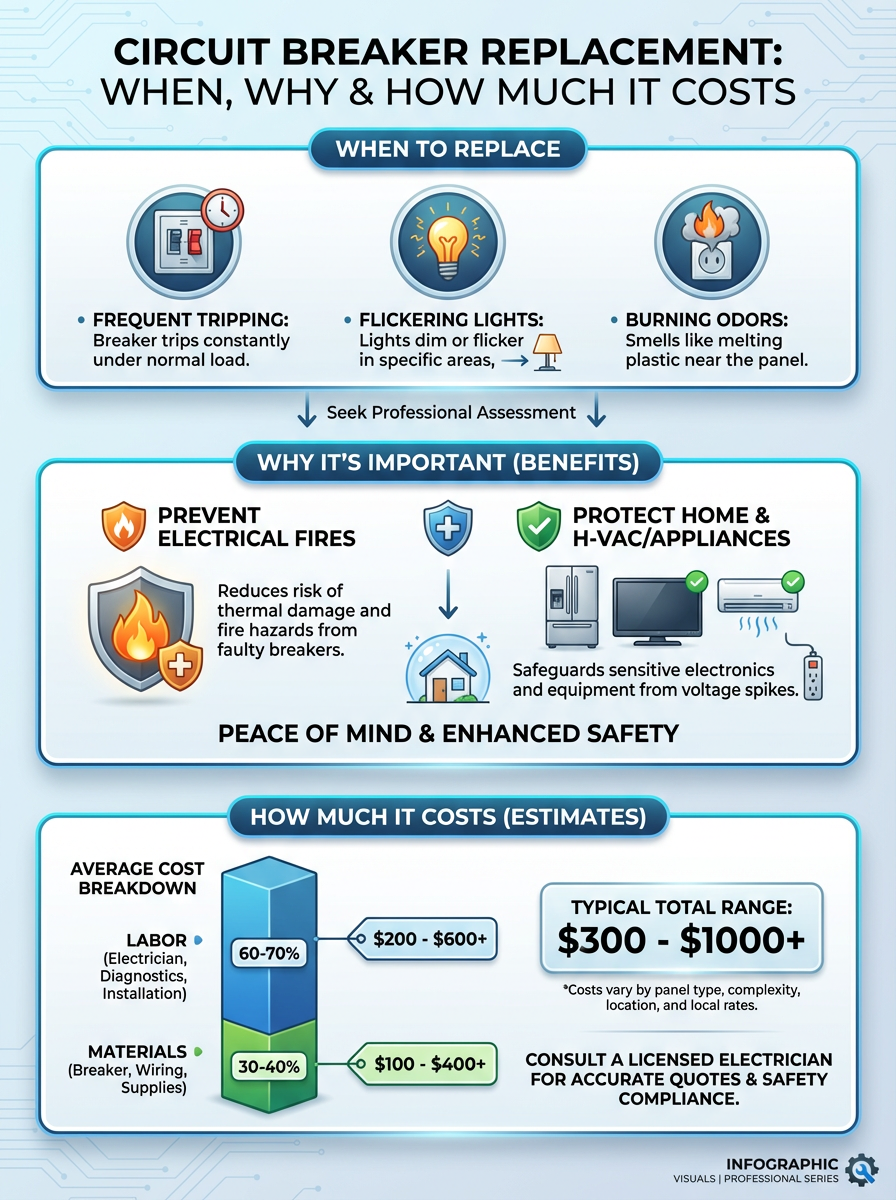
Visual Guide
Infographic illustration for this topic
Sources & References
- The Ultimate Outlet Replacement Guide: 10 Mistakes ... - YouTube
- How to Change Out a Receptacle - The Right Way! - YouTube
- Expert Advice on Replacing Plug-In Switches | JustAnswer Electrical
- Best Tool Brand for Electricians 2025: Expert Rankings - Wood Guide
- Top 20 Essential Electrician Tools for Pros (2026 List) - Workiz
- Best Electrician Tools Brand Guide
- Essential 2025 Electrician Tools & Safety Warnings (New & Pro Tips!)
- 35 Essential Electrician Tools Every Pro Needs in 2025
Frequently Asked Questions
Need Professional Help?
Find top-rated electricians experts in your area