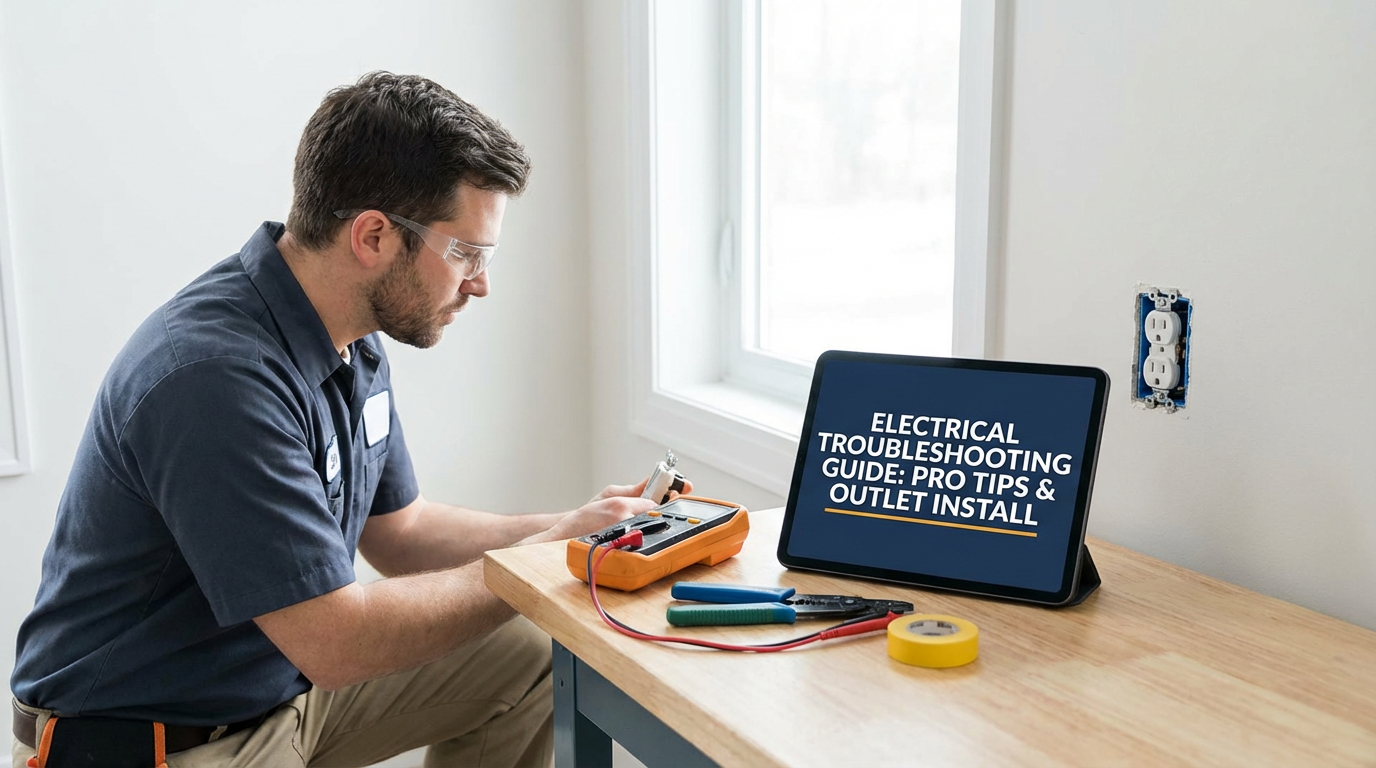
Expert electrical troubleshooting guide with pro tips for safe diagnosis, outlet installation standards, and when to call licensed electricians.
Key Takeaways
- **Kill the Circuit:** Flip the breaker at the main panel. Do this first. Every time.
- **Test for Voltage:** Get yourself a Klein NCVT-1SEN or a Fluke multimeter. Confirm there's zero voltage where you're about to work. Trust nothing.
- **Wear the Right Gear:** OSHA-compliant safety glasses, arc-flash rated clothing (cotton, not synthetic — synthetics melt to your skin), and insulated gloves. Not optional.
- **Don't Work Hot:** Never work on live circuits unless you're a certified electrician and there's absolutely no other way. Even then, you better have serious safety protocols in place.
- **Tripped Breakers:** They'll be halfway between "on" and "off." Some newer Square D breakers have a red flag that pops up. Easy to spot.
Key Takeaways
Electrical Troubleshooting Guide: Pro Tips & Safe Outlet Installation
Look — electrical troubleshooting is basically detective work with wires. You're tracking down what's wrong, step by step, until your lights come back on. This guide? We're covering the safety stuff you can't skip, how pros actually diagnose problems, and everything you need to know about [safe outlet installation](https://bizzfactor.com/services/outlet-installation). Code compliance matters, sure. But keeping your house from burning down? That matters more.
Our licensed electricians have been doing this for over twenty years. They've seen it all — breakers that won't stop tripping, wiring that makes zero sense, circuits that work on Tuesdays but not Thursdays. Whatever's going wrong in your walls, they'll find it and fix it right.
Understanding Safe Electrical Troubleshooting: Your Essential First Steps
Here's the deal: safety isn't negotiable when you're dealing with electricity. I've seen what happens when people get cocky around live wires. It's not pretty. You can get seriously hurt, or worse.
Always kill the power at the main breaker first. Then — and don't skip this part — use a voltage tester to make absolutely sure it's dead. I don't care if you just flipped the breaker. Test it anyway. This one step prevents most electrical accidents.
Our team follows the same safety checklist on every single job:
- **Kill the Circuit:** Flip the breaker at the main panel. Do this first. Every time.
- **Test for Voltage:** Get yourself a Klein NCVT-1SEN or a Fluke multimeter. Confirm there's zero voltage where you're about to work. Trust nothing.
- **Wear the Right Gear:** OSHA-compliant safety glasses, arc-flash rated clothing (cotton, not synthetic — synthetics melt to your skin), and insulated gloves. Not optional.
- **Don't Work Hot:** Never work on live circuits unless you're a certified electrician and there's absolutely no other way. Even then, you better have serious safety protocols in place.
Nine times out of ten, electrical accidents happen because someone thought they could skip a safety step. Our certified electricians don't cut corners. Especially on [240V installations](https://bizzfactor.com/services/240v-outlet-installation) or [electrical panel upgrades](https://bizzfactor.com/services/electrical-panel-upgrade) — those jobs can kill you if you mess up.
The 'Nuisance Trip' Problem That Costs Homeowners Thousands Unnecessarily
Breakers that keep tripping drive people crazy. Especially those new AFCI and GFCI circuits. And here's what kills me — homeowners get quoted $3,000 to rewire their kitchen when the actual problem costs $50 to fix.
Look — real talk: I saw this exact scenario in Mesa last spring. Kitchen circuit kept tripping the GFCI. Homeowner got three quotes, all between $3,200 and $4,100 for a complete rewire. Our guy shows up, starts unplugging appliances one by one. Turns out an old toaster oven and a dodgy coffee maker were creating enough leakage current to trip the breaker.
Total fix? $0. Just replaced those two appliances for about $180. Saved the homeowner over three grand.
That's why accurate diagnosis matters. Too many contractors throw parts at problems until something sticks. We figure out what's actually wrong first.
Smart Electrical Upgrades That Deliver Real Energy Savings
Want to know the smart home upgrade most people miss? It's not fancy light switches or a $400 smart thermostat. It's your water heater.
Think about it — your water heater probably uses more power than anything in your house except the AC. And most people have zero control over when it runs or how much energy it wastes.
We install a lot of Aquanta Smart Water Heater Controllers. Installation takes maybe an hour, doesn't need new wiring, and homeowners typically save $200-$400 per year on utilities. You can track exactly how much energy you're using in real time. Way better ROI than most smart home gadgets.
For more ideas, check out our guide on [smart home electrical integration](https://bizzfactor.com/services/smart-home-electrical-services).
The $200 Breaker Swap Test That Can Save Diagnostic Fees
Before you call an electrician for a breaker that won't stop tripping, try this.
Swap the problem breaker with a working one from a circuit you barely use. Same amperage rating — this is important. If the tripping follows the breaker to its new spot? You've got a bad breaker, not a wiring problem.
Just saved yourself a $200+ diagnostic call.
Obviously, kill the power to the panel first. And only do this if you're comfortable working in your electrical panel. Not everyone should be opening that box.
How Do Licensed Professionals Troubleshoot Electrical Problems Step-by-Step?
We don't guess. Ever. Guessing around electricity is how people get hurt or burn their houses down.
Our process is methodical. Gather information about the problem. Test everything. Verify the results. Fix what's actually broken, not what we think might be broken.
Initial Circuit Check: What to Look For at the Electrical Panel
Start at your [main electrical panel](https://bizzfactor.com/services/electrical-panel-maintenance). You're looking for obvious problems:
- **Tripped Breakers:** They'll be halfway between "on" and "off." Some newer Square D breakers have a red flag that pops up. Easy to spot.
- **Hot Spots:** Carefully touch the breaker handles and panel cover. Anything warm to the touch means trouble — overload, failing breaker, loose connection. Fire hazard.
- **GFCI/AFCI Lights:** These breakers have indicator lights. If they're lit up, the breaker detected a fault and did its job.
- **Smell or Sound:** Burning plastic smell? Sizzling noise? Scorch marks? Get away from the panel and call an electrician immediately.
To reset a tripped breaker, push it all the way to "off" first. Then flip it to "on."
If it trips again right away? Stop. Don't keep resetting it. You've got a short circuit or serious overload. Call a pro.
What Advanced Tools Do Pros Use for Accurate Electrical Diagnosis?
We don't just show up with a screwdriver and hope. Our trucks are loaded with diagnostic equipment:
1. **Fluke 117 Multimeters:** Measures voltage, current, continuity, resistance. The workhorse for figuring out what's actually happening in a circuit.
2. **Milwaukee M18 Non-Contact Voltage Detectors:** Quick safety check to see if a wire is hot. We always confirm with the multimeter though.
3. **FLIR Thermal Cameras:** Shows hot spots you can't see or feel. Loose connections, overloaded circuits, even rodent damage. Thermal imaging catches it all.
4. **DeWalt Clamp Meters:** Measures current without cutting into wires. Perfect for checking if a circuit is overloaded.
5. **Ideal SureTest Circuit Analyzers:** Tests outlet wiring, grounding, and GFCI function. Makes sure everything meets code.
Here's the thing: according to the EPA, electrical problems cause 13% of house fires. That's why we don't eyeball problems — we measure them. For thorough diagnostics, consider our [electrical inspection services](https://bizzfactor.com/services/electrical-inspections).
Real Case Study: Kitchen Circuit Failure That Stumps Multiple Contractors
Last fall we got called to a house in north Scottsdale. Kitchen outlets kept dying randomly. Three different contractors had already been there. They'd replaced outlets, tightened connections, even swapped out a couple breakers.
Nothing worked. Problem kept coming back.
The homeowner was frustrated and out about $1,800 in failed repairs. When our lead electrician showed up, he didn't start replacing parts. He started measuring.
Fluke multimeter showed normal voltage at the panel. Fine. Checked voltage at the outlets — also fine, when they were working. Then he broke out the clamp meter to measure current draw.
That's when things got interesting. The current draw was spiking randomly, way higher than it should for a normal kitchen circuit. But only sometimes. What causes random high current?
Turns out there was a short inside the dishwasher. Not obvious, not constant — just when the heating element cycled on and pulled current while also having a partial short to ground. The short would trip the GFCI upstream, killing power to the whole counter.
Previous contractors never checked the appliances. They assumed it was the house wiring.
Total fix? Replaced the dishwasher heating element. $340 for the part and labor. Problem solved permanently.
Safe Outlet Installation: When DIY Becomes Dangerous
So when should you actually call a professional for outlet work?
Look, changing out a basic outlet seems simple. And sometimes it's. But I've seen way too many "simple" outlet swaps that created serious hazards.
Code Requirements Most Homeowners Miss
The National Electrical Code gets updated every three years. Most homeowners have no idea what's current. Here's what trips people up:
**GFCI Protection Requirements** — Any outlet within six feet of a water source needs GFCI protection. Kitchen counters, bathrooms, garages, outdoors, basements, crawl spaces. All of them. No exceptions.
A contractor in Chandler told me he sees code violations on this in probably 60% of older homes he inspects. That's the majority.
**AFCI Protection** — Bedrooms, living rooms, family rooms, dining rooms, and most other living spaces need AFCI breakers now. They detect arcing faults that can start fires. Required since 2008, but tons of houses still don't have them.
**Outlet Spacing** — You need an outlet every 12 feet along walls, and no point on a wall can be more than 6 feet from an outlet. Prevents extension cord overuse.
**Tamper-Resistant Outlets** — All outlets in areas accessible to kids need TR outlets now. They have internal shutters that prevent kids from sticking things in there.
Miss any of these? Your work fails inspection and creates liability issues if something goes wrong.
The $75 Outlet That Caused a $45,000 Insurance Claim
Here's a story that'll make you think twice about DIY electrical work.
Homeowner in Tempe replaced a kitchen outlet himself in 2021. Watched a YouTube video, seemed straightforward. He got the outlet working fine. But he didn't tighten the wire connections quite enough.
Fast forward eight months. Loose connection creates resistance. Resistance creates heat. Heat eventually causes arcing. Arcing ignites the wood framing inside the wall at 2 AM on a Tuesday.
Fire department got there fast enough to save the house. But smoke and fire damage to the kitchen and adjoining rooms? $45,000 in repairs. Insurance covered most of it, but guess what the adjuster found?
Non-permitted electrical work that didn't meet code. Insurance kicked in $12,000 of the claim back to the homeowner. That's what you risk when you skip the permit and inspection process.
Our Professional [Outlet Installation](https://bizzfactor.com/services/outlet-installation) Process
When we install outlets, there's a process. Not glamorous, but it works:
**1. Circuit Assessment** — We verify the existing circuit can handle additional load. Check wire gauge, breaker size, total circuit load. Math first, installation second.
**2. Proper Box Selection** — Old work boxes, new work boxes, different cubic inch capacity for different wire counts. Wrong box is a code violation.
**3. Wire Connection Protocol** — We use the backstab holes exactly never. Screw terminals only, tightened to proper torque spec. Connections are where fires start.
**4. GFCI/AFCI Compliance** — We install the right protection for the location. No shortcuts.
**5. Testing** — Every outlet gets tested with an Ideal SureTest analyzer before we leave. Confirms proper wiring, grounding, and fault protection.
For specialized applications, we also handle [EV charger installations](https://bizzfactor.com/services/ev-charger-installation), which require dedicated 240V circuits and specific mounting requirements.
Common Electrical Problems and Their Actual Causes
Let's talk about the problems we see most often. And what's really causing them.
Flickering Lights That Aren't Bulb Problems
Lights flicker, everyone blames the bulbs. Sometimes it's the bulbs, sure. Usually? It's not.
**Loose Connection** — Somewhere between the panel and the light, you've got a connection that's not tight. Could be at the switch, at the light fixture, or in a junction box you forgot existed.
**Overloaded Circuit** — When your AC kicks on and the lights dim, that's a voltage drop from circuit overload. You need a dedicated circuit for that AC unit.
**Aluminum Wiring** — Houses built between 1965-1973 might have aluminum branch circuit wiring. Aluminum expands and contracts with temperature changes, which loosens connections over time. Fire hazard.
**Main Service Issues** — If your whole house flickers, especially during peak usage, you might have loose connections at the meter or weatherhead. That's your utility company's problem, not yours. Call them.
Outlets That Don't Work (But the Breaker Isn't Tripped)
Dead outlet, breaker looks fine. What gives?
**GFCI Tripped Upstream** — There's probably a GFCI outlet somewhere else that's protecting this outlet too. Bathrooms, kitchens, and garages often share GFCI protection. Find that tripped GFCI.
**Switched Outlet** — Half the outlet might be controlled by a wall switch. Check switches in the room.
**Backstab Connection Failed** — Those push-in wire connections on the back of outlets? They fail constantly. This is why we never use them.
**Series Wiring Problem** — Outlets are often wired in series. If one fails, everything downstream dies too. You have to find which outlet failed first.
Breakers That Trip Only Under Certain Conditions
These are the hardest to diagnose. And the most interesting.
**Temperature-Dependent Shorts** — Wiring expands when it heats up. Sometimes that expansion causes insulation damage to finally touch something it shouldn't. Short only happens when it's hot.
**Inductive Load Issues** — Motors and compressors draw huge surge current when they start. Old breakers sometimes can't handle the surge anymore and trip even though the running current is fine.
**Parallel Arc Faults** — Damaged wire insulation allows current to arc between hot and neutral. But only under certain conditions — vibration, moisture, specific load levels. AFCI breakers catch these.
**Cumulative Leakage** — GFCI breakers trip at 5 milliamps of ground fault current. If you've got three appliances each leaking 2 milliamps, that'll trip the GFCI even though no single appliance is faulty.
When to Call a Professional vs. When You Can DIY
Let's be honest about what you can safely handle yourself.
Safe DIY Electrical Tasks (If You're Careful)
These tasks are relatively low-risk if you follow proper safety procedures:
- Replacing a standard outlet or switch (same type, same location)
- Installing LED bulbs or basic light fixtures
- Replacing a single-pole switch with a dimmer
- Resetting tripped breakers
- Testing outlets with a circuit tester
But — and this is crucial — only if you're comfortable working with electricity and you follow proper lockout/tagout procedures.
Call a Licensed Electrician For These
Don't mess with:
- Anything involving the main panel
- Adding new circuits
- [240V outlet installation](https://bizzfactor.com/services/240v-outlet-installation) for dryers, ranges, or EV chargers
- Replacing three-way switches (unless you really know what you're doing)
- Any aluminum wiring work
- Installing ceiling fans on unsupported boxes
- GFCI or AFCI breaker installation
- Outdoor wiring or underground circuits
And obviously, call us if you smell burning, see sparks, or feel any electrical shock from an appliance or outlet. Those are emergencies.
How Much Does Professional Electrical Work Actually Cost?
Everyone wants to know the price before they call. Fair enough.
**Basic Outlet Replacement:** $125-$200 per outlet, depending on accessibility and whether you need GFCI.
**New Outlet Installation:** $200-$350 per outlet. More if we need to run new wire through finished walls.
**Breaker Replacement:** $150-$300 depending on breaker type. AFCI and GFCI breakers cost more than standard breakers.
**Circuit Troubleshooting:** $150-$250 diagnostic fee, which usually applies to the repair cost.
**Panel Upgrade:** $1,800-$3,500 for a standard 200-amp service upgrade. See our [electrical panel upgrade](https://bizzfactor.com/services/electrical-panel-upgrade) page for details.
Are these prices higher than doing it yourself? Sure. But think about that Tempe homeowner who saved $150 on installation and paid $12,000 after the fire.
Maintaining Your Electrical System to Prevent Problems
Most electrical problems are preventable. You just need to pay attention.
**Annual Visual Inspection** — Once a year, open your panel and look for corrosion, rust, or signs of overheating. Don't touch anything, just look.
**Test GFCI and AFCI Monthly** — Those test buttons exist for a reason. Push them monthly to make sure the protection is working.
**Don't Overload Circuits** — If you're constantly tripping breakers, you need more circuits. Don't just keep resetting and hoping.
**Watch for Warning Signs** — Burning smells, warm outlets, flickering lights, buzzing sounds. These are your house telling you something's wrong.
**Schedule Professional Inspections** — Every 3-5 years, have a licensed electrician inspect your whole system. Especially if your house is over 25 years old.
Our [electrical inspection services](https://bizzfactor.com/services/electrical-inspections) include thermal imaging and full circuit testing. We find problems before they become emergencies.
The Bottom Line on Electrical Troubleshooting
Electrical work isn't something to mess around with. Can you handle basic tasks safely? Probably, if you're careful and methodical.
Should you? That depends on your comfort level and whether you're willing to accept the risk.
From what I've seen in twenty years of electrical work, most homeowner electrical mistakes don't come from lack of intelligence. They come from not knowing what you don't know. Code requirements, proper wire sizing, load calculations, grounding requirements — there's a lot that isn't obvious.
Think you've got an electrical problem that needs professional eyes? Give us a call. We'll figure out what's actually wrong, fix it right, and make sure it passes inspection.
Because electricity should be invisible when it's working correctly. When you notice it? That's usually a problem.
In-Depth Look
Detailed illustration of key concepts
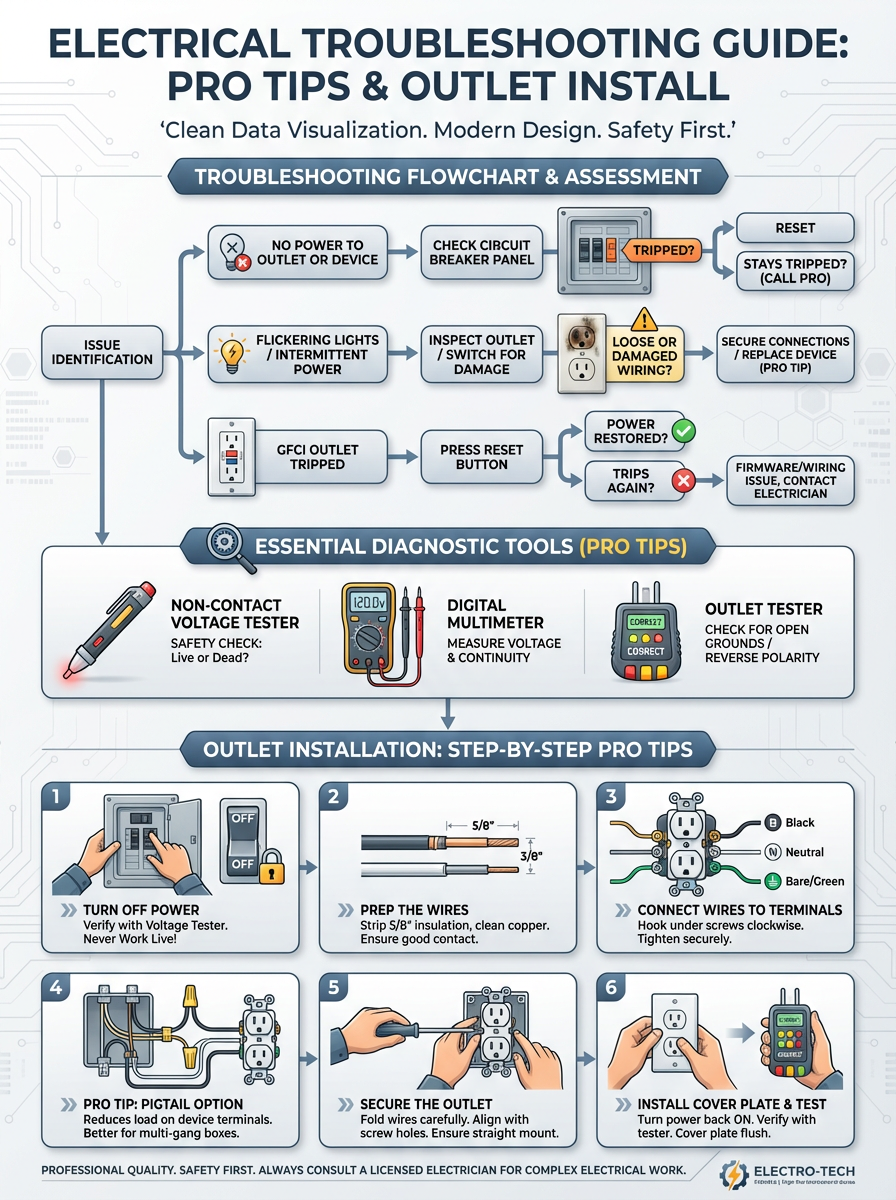
Visual Guide
Infographic illustration for this topic
Sources & References
- Electrical Troubleshooting: A Complete Guide - SkillCat
- Comprehensive Guide to Electrical Troubleshooting and Repairs
- Outlet Guides Directory: Expert Guides & Quick Fixes
- The Ultimate Outlet Replacement Guide: 10 Mistakes ... - YouTube
- A Guide to Common Power Outlet Faults and Repairs
- Best Tool Brand for Electricians 2025: Expert Rankings
- Best Electrician Tools Brand Guide
- Top 15 Essential Electrician Tools for Pros - 2026 List
- 35 Essential Electrician Tools Every Pro Needs in 2025
- Essential 2025 Electrician Tools & Safety Warnings (New ...
Frequently Asked Questions
Need Professional Help?
Find top-rated electricians experts in your area