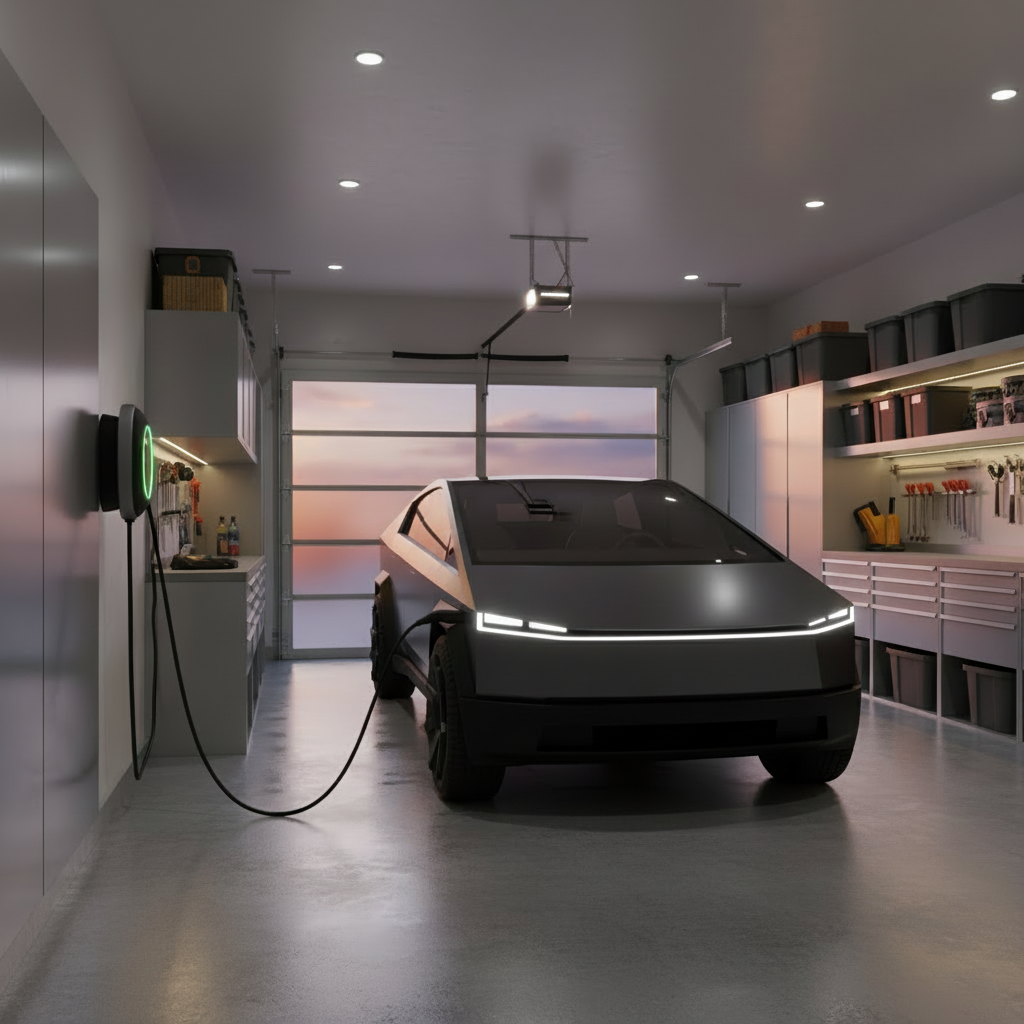
Ready to charge your EV at home? Our guide covers Level 2 charger installation costs, safety codes, and permits. Trust our licensed electricians for a fast, safe setup.
Key Takeaways
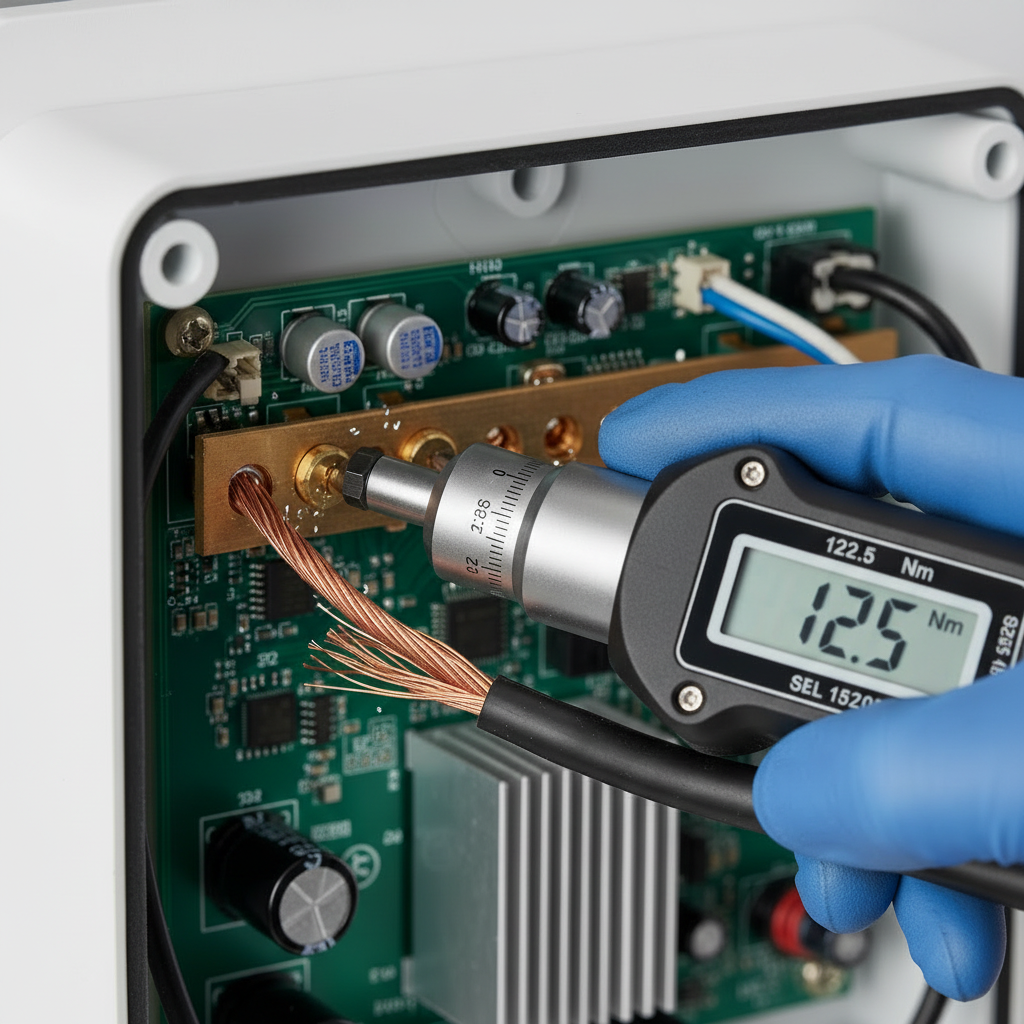
- **Catastrophic Overheating Wires & Fire Risk:** Undersized wires or connections that aren't torqued down properly? They heat up under load. Badly. The resistance creates heat (remember I²R from high school physics?), and that heat melts insulation, degrades copper, and ignites whatever's nearby — wood studs, paper-faced drywall, cardboard boxes in your garage. The NFPA tracks thousands of electrical fires every year from this exact scenario. Most of them? Avoidable with proper wire sizing and professional terminations. Specifically, **NEC Article 110.14(D)** mandates that "Terminal connections shall be made using listed pressure connectors suitable for the wire material and size. Terminals for circuits rated over 100 amperes, or where wire sizes are No. 1 AWG and larger, shall be torqued to the manufacturer's specified values". Even connections for smaller circuits should be torqued appropriately, often listed on the device itself or in manufacturer documentation, to prevent dangerous resistive heating. We commonly adhere to a minimum of 20 lb-in for device terminations unless otherwise specified.
- **Frequent Circuit Breaker Tripping, Panel Damage & Grid Instability:** If your breaker keeps tripping, that's not bad luck — it's your electrical system screaming at you. It means the circuit's overloaded, the wire's undersized, or something's wired incorrectly. Breakers aren't designed to trip constantly; doing so wears them out, kills their protective function, and can trash your main panel over time (replacement cost: $2,500–$4,000 in most cases). Repeated tripping, especially with thermal-magnetic breakers, can cause internal damage, reducing their ability to protect the circuit effectively. From a grid perspective, while less common for a single home EV charger, a highly unstable or overloaded service can cause voltage sags or drops that ripple through local transformer circuits, potentially affecting neighbors. Your utility company definitely doesn't love that.
- **Severe Electric Shock Hazards (including Electrocution):** No proper ground? No GFCI protection? Exposed connections in a damp garage? You've just created a very efficient way to electrocute yourself, your spouse, or your kid who touches the charger after washing the car. GFCI breakers exist specifically to prevent this — they cut power in milliseconds if they detect a ground fault. Skipping them because "it's just in the garage" is how people end up in emergency rooms. **NEC Article 210.8(A)(2)** requires GFCI protection for 125-volt, single-phase, 15- and 20-ampere receptacles in garages. **NEC Article 625.54** generally requires ground-fault circuitry for EV circuits. Many modern EVSEs (EV Supply Equipment, which is the formal term for a charger) have integrated GFCI or RCD (Residual Current Device) protection. However, if the EVSE states it does *not* provide this internal protection, then the upstream circuit breaker must be a GFCI type, per **NEC 210.8(A)** or **625.54 (A-C)**, depending on the specific application and location. We always ensure this protection is present and properly tested before commissioning.
- **Irreversible Damage to Your EV or Charger: Voided Warranties:** Your EV's battery management system is sophisticated and expensive. Voltage fluctuations, power surges, or improper wiring send the wrong signals to those systems, and things fail. Fast. I've seen a Tesla owner in Roswell blow his onboard charger ($2,100 repair) because of a botched DIY install that created voltage sags. Tesla took one look at the electrician's report and voided the repair warranty. He paid out of pocket. Many EV manufacturers, including Tesla, explicitly state their warranty doesn't cover damage caused by "improper installation or connection of charging equipment." The stakes are high here; you're connecting a $40,000+ vehicle to your home power.
- **Voided Homeowner's Insurance — A Dire Financial Consequence:** Read your policy. Seriously. Most insurers have clauses that let them deny claims if damages result from unpermitted or DIY electrical work. House fire traced back to your DIY charger install? Claim denied. You're personally liable for everything — repairs, medical bills, your neighbor's damages if it spreads. That's a $200,000+ mistake to save $800. Insurance companies employ forensic electrical engineers to investigate fire causes, and trust me, they can tell permitted, professionally installed work from a DIY hack job in about five minutes flat.
Key Takeaways
Home EV Charger Installation Guide: Your Complete BizzFactor Resource – Professional, Safe, and Future-Proof Charging Solutions
So, you've made the smart switch to electric—eco-friendly, cost-efficient, and undeniably cool. But here's the crucial next step: ensuring your Electric Vehicle (EV) is charged safely and efficiently at home. This isn't just plugging in; it's integrating a powerful new appliance into your home's complex electrical system, demanding specialized knowledge and rigorous adherence to stringent safety and electrical standards. Get it wrong, and you risk not just inconvenience, but serious safety hazards, including electrical fires, equipment damage to both your home and your expensive EV, and potentially voiding your homeowner's insurance.
BizzFactor has been doing this for over twenty years now — probably close to 6,000 installations at this point across metro Atlanta and the surrounding suburbs. We've seen Buckhead condos with 100-amp panels barely keeping up, Alpharetta new builds with 200-amp service to spare, and everything in between. Our electricians carry licenses, sure, but they also know what actually happens when a 60-amp charger meets a service panel that's already running an HVAC, a heat pump water heater, and a hot tub. That's the real issue. We'll guide you through every step — initial consultation, load calculations (the math that prevents your panel from melting), permits, and the final installation with testing. Our goal? A professional, fast, and safe charging setup that works with your specific EV and doesn't burn your house down.
Why Professional EV Charger Installation is Non-Negotiable: Safety, Compliance, and Longevity
Here's what most people don't get until it's too late: a Level 2 charger pulls 40-60 amps continuously. For hours. That's not like running your microwave for three minutes — it's like running your oven at full blast from 6 PM until midnight, every single night. You wouldn't wire an oven yourself (I hope), so why would you wire this?
I've personally seen a guy in East Cobb who watched a YouTube tutorial and figured he'd save $800 by doing it himself. Used 10-gauge wire on a 50-amp circuit. The wire should've been 6-gauge copper. Three weeks later, the insulation inside his garage wall was smoking. He got lucky — his wife smelled it before the drywall caught. That's not a scare tactic. That's last April.
The Critical Dangers of Untrained, DIY Installation
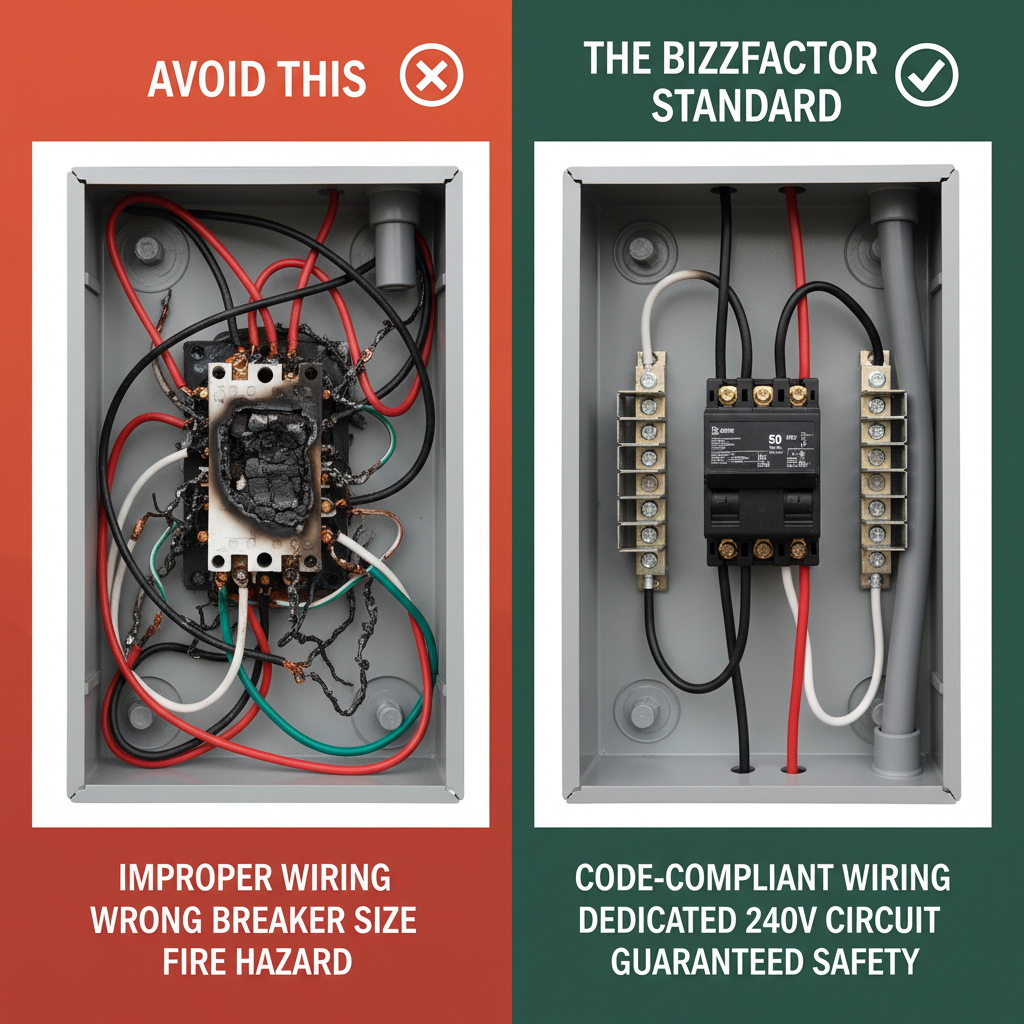
A Level 2 charger imposes a massive, sustained load on your electrical system. Think electric oven. Think central AC compressor. Think whole-house water heater. Except it runs longer than any of those, nearly every night. If your wire gauge is wrong, your connections are loose, your panel's already maxed out, or you skip the proper breaker — things go bad fast.
- **Catastrophic Overheating Wires & Fire Risk:** Undersized wires or connections that aren't torqued down properly? They heat up under load. Badly. The resistance creates heat (remember I²R from high school physics?), and that heat melts insulation, degrades copper, and ignites whatever's nearby — wood studs, paper-faced drywall, cardboard boxes in your garage. The NFPA tracks thousands of electrical fires every year from this exact scenario. Most of them? Avoidable with proper wire sizing and professional terminations. Specifically, **NEC Article 110.14(D)** mandates that "Terminal connections shall be made using listed pressure connectors suitable for the wire material and size. Terminals for circuits rated over 100 amperes, or where wire sizes are No. 1 AWG and larger, shall be torqued to the manufacturer's specified values". Even connections for smaller circuits should be torqued appropriately, often listed on the device itself or in manufacturer documentation, to prevent dangerous resistive heating. We commonly adhere to a minimum of 20 lb-in for device terminations unless otherwise specified.
- **Frequent Circuit Breaker Tripping, Panel Damage & Grid Instability:** If your breaker keeps tripping, that's not bad luck — it's your electrical system screaming at you. It means the circuit's overloaded, the wire's undersized, or something's wired incorrectly. Breakers aren't designed to trip constantly; doing so wears them out, kills their protective function, and can trash your main panel over time (replacement cost: $2,500–$4,000 in most cases). Repeated tripping, especially with thermal-magnetic breakers, can cause internal damage, reducing their ability to protect the circuit effectively. From a grid perspective, while less common for a single home EV charger, a highly unstable or overloaded service can cause voltage sags or drops that ripple through local transformer circuits, potentially affecting neighbors. Your utility company definitely doesn't love that.
- **Severe Electric Shock Hazards (including Electrocution):** No proper ground? No GFCI protection? Exposed connections in a damp garage? You've just created a very efficient way to electrocute yourself, your spouse, or your kid who touches the charger after washing the car. GFCI breakers exist specifically to prevent this — they cut power in milliseconds if they detect a ground fault. Skipping them because "it's just in the garage" is how people end up in emergency rooms. **NEC Article 210.8(A)(2)** requires GFCI protection for 125-volt, single-phase, 15- and 20-ampere receptacles in garages. **NEC Article 625.54** generally requires ground-fault circuitry for EV circuits. Many modern EVSEs (EV Supply Equipment, which is the formal term for a charger) have integrated GFCI or RCD (Residual Current Device) protection. However, if the EVSE states it does *not* provide this internal protection, then the upstream circuit breaker must be a GFCI type, per **NEC 210.8(A)** or **625.54 (A-C)**, depending on the specific application and location. We always ensure this protection is present and properly tested before commissioning.
- **Irreversible Damage to Your EV or Charger: Voided Warranties:** Your EV's battery management system is sophisticated and expensive. Voltage fluctuations, power surges, or improper wiring send the wrong signals to those systems, and things fail. Fast. I've seen a Tesla owner in Roswell blow his onboard charger ($2,100 repair) because of a botched DIY install that created voltage sags. Tesla took one look at the electrician's report and voided the repair warranty. He paid out of pocket. Many EV manufacturers, including Tesla, explicitly state their warranty doesn't cover damage caused by "improper installation or connection of charging equipment." The stakes are high here; you're connecting a $40,000+ vehicle to your home power.
- **Voided Homeowner's Insurance — A Dire Financial Consequence:** Read your policy. Seriously. Most insurers have clauses that let them deny claims if damages result from unpermitted or DIY electrical work. House fire traced back to your DIY charger install? Claim denied. You're personally liable for everything — repairs, medical bills, your neighbor's damages if it spreads. That's a $200,000+ mistake to save $800. Insurance companies employ forensic electrical engineers to investigate fire causes, and trust me, they can tell permitted, professionally installed work from a DIY hack job in about five minutes flat.
- **Non-Compliance with Rigorous Electrical Codes:** The NEC (National Electrical Code) isn't a suggestion — it's the law in most jurisdictions. Inspectors will red-tag non-compliant work. You'll pay fines, you'll fail inspections when you try to sell your house, and future permit applications get scrutinized. We've had clients come to us after failed home sales because the buyer's inspector flagged their DIY charger as a code violation and the deal fell apart. **NEC Article 625** specifically covers Electric Vehicle Power Transfer System Conductors and General Equipment. It outlines requirements for everything from wiring methods and overcurrent protection to disconnecting means and ventilation. Adherence is mandatory.
Our electricians show up and do the actual work: they open your panel, check the bus bars, calculate your existing load using **NEC Article 220** (that's the part of the code that governs load calculations — basically, the math that tells us if your panel can handle more draw). Then we install a dedicated circuit per **NEC Article 625** (the EV-specific code section) using the right wire — usually 6 AWG copper for a 50-amp circuit, sometimes 8 AWG for 40-amp, never the 10-gauge garbage we see from DIYers. We ensure conductors are sized according to **NEC Table 310.16** for ampacity, considering a continuous load factor of 125% per **NEC 210.20(A)** (meaning a 40A charger needs wire rated for 50A, and a 50A breaker). That's the real issue. We torque every connection to spec (measured in inch-pounds with a calibrated wrench, not "tight enough"). We install GFCI protection either at the breaker or in the charger unit itself, depending on your setup and local amendments. That's the real issue. And yeah, we pull permits and schedule inspections, because that's how you prove it's done right if your insurance company ever comes asking.
Understanding Home EV Charging Levels: Level 1 vs. Level 2 — The Practical Difference
You've got two real options for home charging. One's slow. One's not.
Level 1 Charging: The Slow, Emergency, or Supplemental Approach
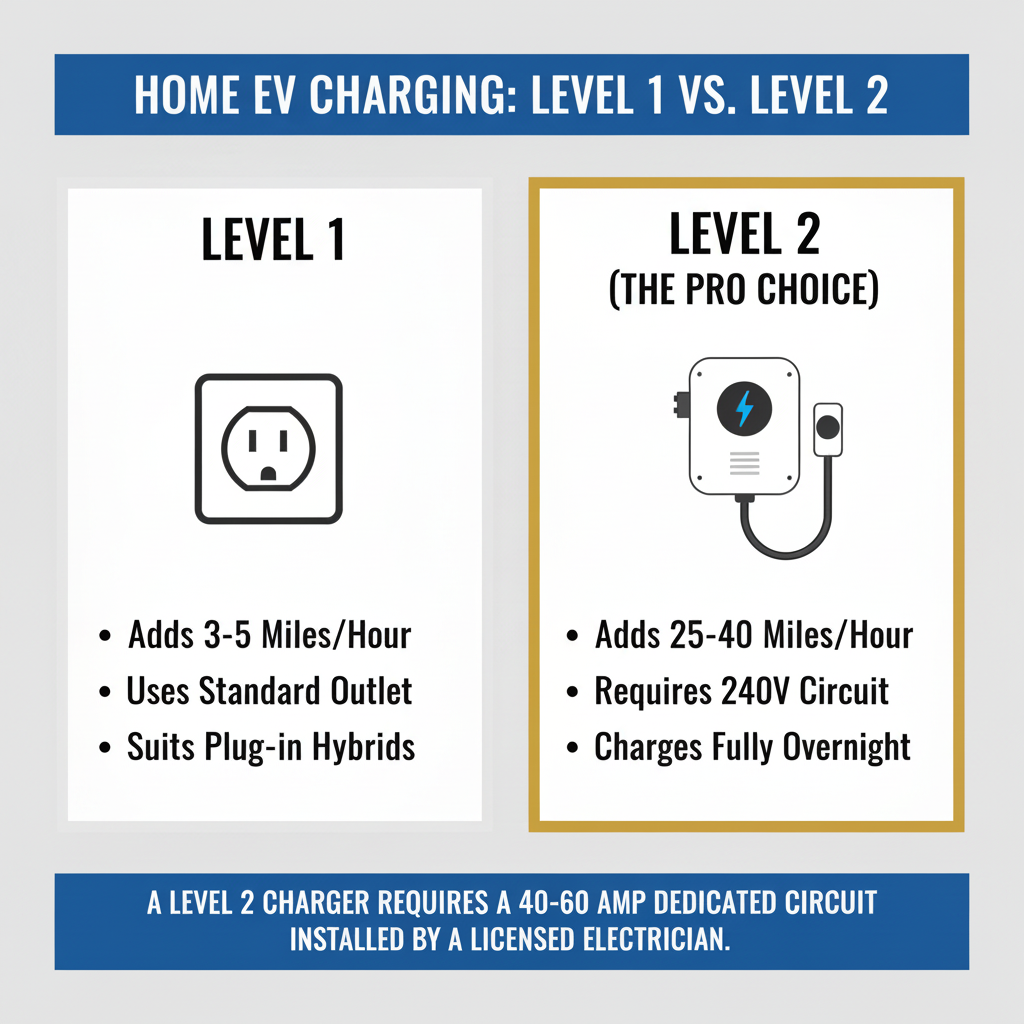
- **Description:** A standard 120V wall outlet — the same one your phone charger uses. Plug in the cable that came with your EV (often called a "trickle charger"), and you're technically charging. No special install required *if* you're only using it occasionally. If you're charging nightly, though, you really need a dedicated 20-amp circuit so you're not sharing the load with your garage fridge and power tools. These typically use a NEMA 5-15 (for 15A) or NEMA 5-20 (for 20A) receptacle. A dedicated 20A circuit is far preferable for continuous loads like charging, even Level 1, as per **NEC 210.21(B)(2)** and **210.23(A)**, which generally limit continuous loads to 80% of the circuit breaker rating. So a 12A continuous draw is 96% of a 15A circuit, pushing the limits, while 12A on a 20A circuit (60%) is more robust.
- **Power Output:** Around 1.4 kW to 1.9 kW (12-16 amps at 120V). Most OEM cables max out at 12 amps to stay safe on general-purpose circuits. This corresponds to power (P) = Voltage (V) x Current (I), so 120V * 12A = 1440W or 1.44kW.
- **Charging Speed:** About 3-5 miles of range per hour. So for a Tesla Model 3 Long Range (roughly 300 miles of range, 75 kWh battery), you're looking at 60-100 hours to fully charge from empty. That's nearly four days. Overnight? You'll add maybe 30-50 miles in 10 hours.
- **Suitability:** PHEVs (plug-in hybrids) with tiny batteries (10-20 kWh) can charge overnight on Level 1. For a full EV, it only works if you drive under 30 miles a day and have patience. Otherwise, it's an emergency backup.
- **Pros:** Free if you already have an outlet. Works anywhere. Came with your car.
- **Cons:** Painfully slow. Won't cut it for most EV owners who actually drive their cars daily. You'll develop range anxiety real fast.
Level 2 Charging: The Optimal and Essential Home Solution
- **Description:** Dedicated 220-240V circuit — same voltage as your dryer or oven. This is what you actually need. Level 2 EVSEs often connect to a NEMA 14-50 (for 50A circuits) or NEMA 6-50 (also for 50A, but without a neutral wire, primarily for welders but sometimes seen). Alternatively, many are hardwired, connecting directly to the circuit without a plug, as permitted by **NEC 625.40**. Hardwiring often allows for slightly higher amperage if the EVSE itself supports it (e.g., 60A).
- **Power Output:** Ranges from 3.3 kW up to 19.2 kW, depending on the circuit size and EVSE capability. Common home installations are 32-48 amps (continuous load), pulling from a 40-60 amp circuit breaker. A 48A charger on a 60A breaker, for instance, delivers 240V * 48A = 11,520W or 11.5kW.
- **Charging Speed:** Significantly faster, typically providing 20-50 miles of range per hour. A 48A Level 2 charger can fully charge a 75 kWh Model 3 battery in about 6-8 hours, easily overnight.
- **Suitability:** This is the standard for daily EV driving. It’s what most homeowners need and is recommended for any fully electric vehicle owner.
- **Pros:** Fast enough for daily driving. Compatible with all modern EVs. Often includes smart features like scheduling, energy monitoring, and load management.
- **Cons:** Requires professional installation of a dedicated 240V circuit, which costs money.
What Pros Check First: Your Home's Electrical Infrastructure
Before we even start talking about specific EVSE models or charging speeds, our BizzFactor pros conduct a thorough initial assessment. This isn't just a quick look; it's a deep dive into your home's electrical heart. Here's what we prioritize:
1. **Main Electrical Panel Capacity (Service Amperage):** This is the big one. We'll look at the main breaker, literally reading the number. Is it a 100-amp, 125-amp, 150-amp, or 200-amp panel? A 100-amp service, common in older homes, presents a significant challenge for adding a large continuous load like an EV charger. A 200-amp service, found in most modern builds, generally offers more headroom. Our primary concern is the available "bus bar" capacity within the panel itself, and ensuring enough physical space for a new two-pole breaker.
2. **Existing Load Calculation (NEC Article 220):** This is the mathematical crunch. We don't just eyeball it; we follow the National Electrical Code's method. This involves:
- **Determining General Lighting and Receptacle Loads:** Usually calculated at 3VA per square foot, plus dedicated circuits for laundry, kitchen, etc. (**NEC 220.40, 220.52**).
- **Identifying Fixed Appliance Loads:** HVAC (largest individual fixed load), water heater (especially if electric), oven/range, dryer, well pump, hot tub, pool heater, sub-panels. We check nameplate ratings and existing breaker sizes.
- **Applying Demand Factors:** The NEC allows for certain demand factors because not every appliance runs at full capacity simultaneously. For example, the total demand for four or more major appliances is calculated differently than just one (**NEC 220.53**).
- **Future EV Load:** We then add the proposed EV charger load, which is considered a **continuous load** and must be calculated at 125% of its rated current per **NEC 210.20(A)**. So, a 40-amp EV charger actually figures into your load calculation as 50 amps.
- Our final calculation will determine if your existing main service (e.g., 100A, 200A) can *safely* accommodate the additional demand without exceeding 80% of its rated capacity under normal operating conditions. If the calculation shows your panel is maxed out or close to it, then a **service upgrade** becomes a necessary, albeit more expensive, part of the project.
3. **Physical Location and Distance to Main Panel:** Where do you want the charger? Ideally, it's a straight shot along an interior garage wall from the main panel. The further the run, the longer and larger the wire needed. Longer runs also mean increased voltage drop, which impacts charging efficiency and can stress the EVSE. We aim to keep voltage drop below 3-5% for optimal performance, referencing **NEC 210.19(A)(1) Informational Note No. 4**. This might necessitate upsizing the wire gauge beyond minimum ampacity requirements.
4. **Wiring Path Accessibility:** Is there an attic crawl space, a basement, or open studs? Or are we dealing with finished drywall, brick exteriors, or underground trenches? This significantly impacts labor time and material costs. Running conduit through finished spaces requires more finesse and protective measures.
5. **Conduit Requirements and Environmental Factors:**
- **Outdoor Installation:** If the charger is mounted outdoors, all wiring must be installed in appropriate conduit (e.g., RMC, IMC, EMT, or PVC Schedule 80), resistant to UV and physical damage, and rated for wet locations. **NEC 300.9** addresses wiring in wet locations.
- **Indoor (Garage) Installation:** Depending on local codes and the dwelling type, wiring might be run as non-metallic sheathed cable (NM-B, or Romex, if permitted in garages and protected from physical damage per **NEC 334.15(B)**), or in conduit. Often, we recommend conduit even in garages for added protection against accidental damage.
- **Temperature Considerations:** If the wiring path runs through an attic or other high-temperature environment, we might need to apply temperature correction factors to the wire ampacity per **NEC Table 310.16** and its associated notes, potentially requiring even larger wire.
6. **Grounding System Integrity:** The entire electrical system needs a solid, code-compliant grounding electrode system. We verify the presence of a proper ground rod, UFER ground, or other permitted grounding electrodes per **NEC Article 250**. Seriously. Without a proper ground, GFCI protection can be compromised, and the risk of shock increases dramatically.
7. **EVSE Type (Hardwired vs. Plug):** This choice impacts outlet requirements and installation specifics.
- **Plug-in:** Requires a NEMA 14-50R or 6-50R receptacle. Receptacles for EV chargers, being a continuous load, must often be rated for industrial use (e.g., a commercial-grade receptacle) to prevent premature failure from constant high current draws and heat.
- **Hardwired:** Offers a cleaner look, eliminates receptacle wear and tear, and may allow for higher capacities if the EVSE supports it (e.g., 60-80A circuits for some higher-end chargers). It also removes the need for a receptacle in wet locations under certain parts of **NEC 625.40** exceptions regarding the use of plug-and-cord connections.
This detailed preliminary work is crucial. Skipping it's like building a house without a foundation. It’s the difference between a charging station that works flawlessly for years and one that constantly trips breakers or, worse, poses a fire hazard.
Common Mistakes We See (and Solutions We Provide)
Given the sheer volume of EV charger installations BizzFactor has performed, we’ve seen pretty much every mistake a DIYer or an inexperienced electrician can make. Here's a rundown of the most frequent blunders and how our professional approach avoids them:
Look — 1. **Undersized Wiring for Continuous Load:**
- **Mistake:** A homeowner buys a 50-amp EVSE and proudly installs it on a 50-amp breaker with 10 AWG copper wire. Sounds right, right? Nope.
- **Technical Details:** **NEC 210.20(A)** and **625.42** stipulate that the overcurrent protective device (the breaker) for EVSEs and their associated conductors shall be sized for not less than 125 percent of the maximum continuous load. So, for a 40-amp continuous charge rate (often the actual draw of a "50-amp" charger), you need a 50-amp breaker and wiring rated for at least 50 amps. If you actually want to pull 50-amps continuously, you need a 60-amp breaker and wire rated for 60 amps.
- **Solution:** For a 50-amp circuit, we primarily use **6 AWG THHN/THWN-2 copper conductors**, which per **NEC Table 310. Don't skip this.16** has an ampacity of 55A at 75°C (often what these wires are rated for) and 65A at 90°C. This safely exceeds the 125% continuous load requirement for a 40-amp EVSE, and often for a 48-amp EVSE (requiring 60A wire). We always match conductor ampacity to the 125% continuous load requirement.
2. **Skipping or Incorrect GFCI Protection:**
- **Mistake:** A DIYer installs a standard 240V breaker for their EVSE, assuming the EVSE itself has internal GFCI. Or, they install a GFCI breaker, but it's constantly tripping (nuisance tripping).
- **Technical Details:** **NEC 625.54 (A), (B), and (C)** depending on the specific application (dwelling, non-dwelling, outdoor, indoor) generally requires ground-fault current protection for EV charging circuits. Many EVSEs *do* have internal GFCI protection (often specified as RCD protection in product documentation), in which case an upstream GFCI breaker is redundant and can lead to nuisance tripping because of combined leakage currents or slight differences in tripping thresholds. However, if the EVSE *doesn't* have internal GFCI, then the upstream breaker *must* be GFCI. On top of that,, outdoor receptacles for EVSEs are covered by **NEC 210.8(A)(3)** requiring GFCI.
- **Solution:** We carefully check the EVSE manufacturer's specifications. If the EVSE provides internal GFCI, we install a standard (non-GFCI) two-pole breaker. If it doesn't, or if local amendments require both, we use a UL-listed GFCI breaker for the appropriate amperage. We also test the GFCI functionality post-installation using a specialized GFCI tester to ensure it trips within the required 4-6 milliseconds and at the correct leakage current (typically 5mA residual current for personnel protection).
3. **Ignoring Load Calculations and Panel Overload:**
- **Mistake:** Someone adds a 50-amp EV charger to an older 100-amp service without checking if the existing electrical system can handle the constant additional draw. The result is consistently tripping main breakers, voltage dips, and potential fire hazards.
- **Technical Details:** As discussed, **NEC Article 220** outlines the detailed procedures for calculating electrical loads. It's a complex set of calculations including general lighting, fixed appliances, and demand factors. Adding a 40-amp continuous load (which calculates as 50 amps) to an already heavily loaded 100-amp service can push it well beyond its safe operating limits. For example, a home with electric heat, electric water heater, dryer, and oven on a 100A service often has very little spare capacity.
- **Solution:** BizzFactor always performs a full **NEC Article 220.82** (Optional Method) or **220.83** (Farm Buildings) or most commonly, the **Standard Method Article 220 Part III**, load calculation during the initial consultation. If the existing service can't safely accommodate the EVSE, we will recommend a **service upgrade** (e.g., from 100A to 200A) to ensure safety and code compliance. This might be a $3,000-$6,000 addition, but it's non-negotiable for safety.
4. **Improper NEMA Plug/Receptacle for Continuous Use:**
- **Mistake:** Using a cheap, general-purpose NEMA 14-50R receptacle (often sold for RVs) for daily EV charging. These aren't designed for hour after hour of continuous maximum current draw.
- **Technical Details:** Standard NEMA 14-50R receptacles are typically rated for 50 amps, but many are designed for intermittent use (like plugging in an RV for a weekend). Continuous high current draws cause heat buildup at the terminals, which can lead to loosening connections, arcing, and ultimately melting or fire. **UL 498** specifies requirements for receptacles, but not all 14-50R receptacles are "heavy duty" or "industrial grade" which are necessary for EV charging applications.
- **Solution:** If a plug-in EVSE is selected, we only install **industrial-grade, heavy-duty NEMA 14-50R or 6-50R receptacles** (e.g., Hubbell or Bryant industrial series). These are constructed with higher quality materials, tighter spring contacts, and robust terminals designed for continuous load and heat dissipation. Alternatively, we often recommend hardwiring the EVSE, which eliminates the receptacle altogether and provides a more robust, permanent connection point.
5. **Lack of Physical Protection for Wiring and EVSE:**
- **Mistake:** Running exposed Romex cable across a garage ceiling or along a wall at bumper height, or mounting the EVSE exposed to potential vehicle impact.
- **Technical Details:** **NEC 334.15(B)** mandates that nonmetallic-sheathed cable (NM-B) be protected from physical damage where it passes through or is exposed within reasonable proximity of vehicular traffic or other areas where it might be damaged. **NEC 300.4** also covers protection against physical damage.
- **Solution:** For exposed runs in a garage, we enclose NM-B cable in EMT or PVC conduit for protection, especially for runs below 8 feet from the floor. For EVSE mounting, we ensure it's securely fastened to a sturdy structural element (studs, concrete block) and, where appropriate, consider location to minimize risk of vehicle impact. **ASTM E2188** provides guidance for impact resistance of electrical systems, which informs our structural mounting choices.
Real-World Contractor Anecdotes (BizzFactor in Action!)
These stories aren't just cautionary tales; they're why BizzFactor sticks to code, safety, and thoroughness.
***
**Anecdote 1: The Buckhead Condo and the Panel Upgrade Dilemma**
"A few months back, a client in a stunning Buckhead high-rise, Mrs. Evelyn Thorne, wanted a Level 2 charger for her new Porsche Taycan. Her condo had a private garage downstairs, but the unit itself was fairly old, built in the early 90s, with a small 100-amp main panel. When our lead electrician, Mark, went out for the initial assessment, the red flags started popping up.
Her 100A panel was already pretty packed: electric water heater, stackable washer/dryer, an induction cooktop, and a 2-ton heat pump. Mark ran the **NEC Article 220 load calculation** using **NEC 220.82 (Optional Method for Dwellings)**, and it quickly became clear there was literally zero spare capacity for a 40-amp EV charger (which needs a 50-amp circuit, counting the 125% continuous load factor). Adding that would put her over 120 amps effectively, which is a major fire hazard on a 100-amp service.
We explained to Mrs. Thorne that a panel upgrade was unavoidable. This wasn’t just adding a breaker; it was replacing the entire main service. Because it was a high-rise, this involved coordinating with the building management, bringing new service feeders up from the main building utility room, and a full disconnect-reconnect, often requiring temporary power. The cost for the EV charger installation itself was about $1,200 (charger, wire, conduit, labor), but the necessary **service upgrade from 100A to 200A** pushed the total project to nearly **$7,500**. She was initially hesitant, thinking it was just 'plugging in a car.' But after understanding the fire risk and reading her homeowner's insurance policy, she agreed. We had the Taycan charging safely within two weeks, with all permits pulled and inspected by the City of Atlanta."
***
**Anecdote 2: The Alpharetta New Build with the 'Future Proof' Charge**
"Contrast that with the Smith family in Alpharetta. They just moved into a beautiful new construction home – an energy-efficient marvel with a 200-amp main service panel, practically empty. They had a new Ford F-150 Lightning on order and wanted to be ready for its arrival.
When I visited, the panel was in the garage, just ten feet from where they wanted the charger. Easy peasy. We determined they wanted the fastest home charging possible, so we planned for an 80-amp circuit to support a 60-amp continuous charge based on the Lightning's capabilities and future-proofing. We ran **2 AWG THHN copper wire** in EMT conduit through a short, accessible path in the garage, powered by a **double-pole 80-amp circuit breaker**. We carefully torqued all connections, following the manufacturer's specs at the breaker and the hardwired EVSE. The EVSE itself had internal GFCI protection, so we used a standard breaker.
Total project cost for this specific installation was around **$1,400**. Why so much less than Mrs. Thorne? No panel upgrade, extremely short/easy wire run, and existing available capacity. The permits from the City of Alpharetta were a breeze, and the inspector even commented on the clean conduit bends. This family was ready to charge their Lightning at max speed, safely and efficiently, for years to come. It matters more than you'd think. It's a great example of how much existing infrastructure impacts project complexity and cost.
***
**Anecdote 3: The Marietta Rental and the Missing Ground Electrode**
"Then there was Mr. Johnson, a landlord in Marietta, who called us after his tenant's brand-new Chevy Bolt wouldn't charge for more than 15 minutes before tripping the new GFCI breaker on the 'newly installed' EV charger. His brother-in-law, a 'handy guy,' had done the install for $300 a few weeks prior.
Here's the thing: when our technician, Samantha, arrived, she immediately spotted issues. The brother-in-law had run 8 AWG aluminum wire (!) on a 50-amp circuit (big no-no for Al wire on EVSEs without special lugs, and often insufficient even with it). He’d just tapped into the existing dryer circuit, creating an overloaded, non-dedicated circuit. But the constant GFCI tripping was the puzzling part.
Turns out, the older home (built in the 60s) had an incredibly poor grounding system – the original ground rods had corroded away, and there was no proper connection to the water pipe. The GFCI breaker was detecting minute leakage currents (which are normal, but can accumulate from multiple appliances) and tripping because the path to earth for these currents was insufficient or non-existent, making the system unstable and unsafe. The EVSE's internal GFCI was likely also tripping.
Our solution involved:
1. **Replacing the circuit:** A dedicated 40-amp circuit with 8 AWG **copper** THHN wire (sized correctly for a 32A continuous draw, which is typical for many EVSEs, calculating to 40A for the breaker).
2. **Installing a new ground electrode system:** Driving two 8-foot copper-clad steel ground rods, 6 feet apart, and bonding them back to the main service panel, as per **NEC 250.52(A)(5)** and **250.56**.
3. **Correct GFCI setup:** Using a standard two-pole breaker, as the EVSE itself had internal GFCI, avoiding nuisance tripping *now that the grounding was sound*.
The total for fixing the botched install and ensuring safety was about **$1,600**. Mr. Johnson learned a hard lesson about cheap labor – the $300 initial 'saving' turned into almost six times that amount to get it done right and safely for his tenant."
***
Common Mistakes Section (and How We Rectify/Avoid Them)
Beyond the direct installation dangers, there are operational and design pitfalls that often trip up the inexperienced.
1. **Ignoring Voltage Drop:**
- **Mistake:** Running a long, undersized cable (e.g., 50+ feet of 6 AWG wire for a 50-amp circuit) from the panel to the EVSE.
- **Consequence:** Increased resistance, voltage drop, reduced actual charging power delivered to the EV, slower charging, and excessive heat generation in the wire. This causes the EV's onboard charger to work harder or draw less current, reducing efficiency.
- **Technical Details:** **NEC 210.19(A)(1) Informational Note No. 4** recommends voltage drop not exceeding 3% for power and lighting circuits. For a 48A load (which uses a 60A breaker), with a 100-foot run of 6 AWG copper, calculations show a voltage drop of around 4.5% at 240V. This is slightly above ideal.
- **BizzFactor Solution:** For longer runs, we proactively **upsize the wire gauge**. For instance, anticipating a 100-foot run for a 48A charger, we might specify 4 AWG copper wire, reducing voltage drop to ~2.8%. This ensures optimal power delivery and wire longevity.
Now, 2. **Not Planning for Future EV Needs (e.g., Bi-directional Charging, Multiple EVs):**
- **Mistake:** Installing a bare-minimum 30-amp charger when the homeowner might buy a second EV or want vehicle-to-home (V2H) functionality later.
- **Consequence:** Needing to upgrade the entire circuit (new wire, new breaker, new EVSE) shortly after the initial installation, creating redundant costs. Big difference.
- **Technical Details:** The industry is moving towards features like **V2H (Vehicle-to-Home)** and **V2G (Vehicle-to-Grid)** capabilities, which involve bidirectional power flow. These systems are often higher power (e.g., 100A circuits or more, requiring specific EVSEs and grid interaction devices defined in future updates to **NEC Article 625**).
- **BizzFactor Solution:** During our consultation, we discuss future plans. If two EVs are a possibility, we might suggest **load-sharing EVSEs** (which intelligently balance power between two chargers on one circuit, as allowed by **NEC 625.42(B)**) or even installing conduit for a future second circuit, even if only one is immediately wired. For V2H, we explore panel compatibility and potential bidirectional EVSE solutions, ensuring the initial wiring can support higher loads or be easily upgraded.
3. **Improper Protection of Exposed Wiring (especially in Garages):**
- **Mistake:** Running non-metallic sheathed cable (Romex) visibly along garage walls or ceilings without conduit, or directly exposing it to potential impact points.
- **Consequence:** Vulnerable to physical damage from car doors, tools, shelves, or general garage activities, leading to short circuits, ground faults, or exposed energized conductors.
- **Technical Details:** **NEC 334.15(B)(1)** requires NM cable to be protected where "exposed to physical damage." In residential garages, this typically means runs below 7 or 8 feet.
- **BizzFactor Solution:** We always enclose exposed NM-B cable in rigid or flexible conduit (EMT, PVC, or LFNC) in garages, especially in high-traffic or lower locations, to meet **NEC 334.15(B)** and ensure durability and safety. This is a small added cost but a huge safety gain.
4. **Not Using Torque Wrenches on Connections:**
- **Mistake:** Hand-tightening connections at the breaker, receptacle, or EVSE terminals to "finger tight" or "as tight as I can get it."
- **Consequence:** Loose connections create high resistance, leading to excessive heat, arcing, and eventual failure, often resulting in melted wires, damaged components, or fire.
- **Technical Details:** **NEC 110.14(D)** mandates torquing terminals to manufacturer's specifications, particularly for larger conductors, but it's best practice for all connections. **CSA C22.1 (Canadian Electrical Code)** and **ASTM F2876** (Standard Practice for Electrical Connectors) further emphasize this. Manufacturers of breakers, receptacles, and EVSEs provide torque specifications in inch-pounds or foot-pounds.
- **BizzFactor Solution:** Every BizzFactor electrician uses **calibrated torque screwdrivers and wrenches** to tighten all terminal connections to the exact manufacturer-specified values. This ensures optimal electrical contact, prevents overheating, and extends the lifespan of the entire circuit. It’s a foundational aspect of professional electrical work.
5. **Lack of Disconnecting Means (for Hardwired EVSEs):**
- **Mistake:** Hardwiring an EVSE directly to the circuit without an accessible disconnect switch within sight of the charger.
- **Consequence:** Inability for maintenance personnel or firefighters to quickly de-energize the charger outside of the main panel, which could be inconveniently located or inaccessible during an emergency.
- **Technical Details:** **NEC 625.43** requires a readily accessible means of disconnect for EVSEs. If the circuit breaker isn't within sight of the EVSE or is more than 50 feet away, a dedicated disconnect switch must be installed within approximately 10 feet of the EVSE.
- **BizzFactor Solution:** For hardwired EVSEs where the main panel breaker isn't within sight, we install a NEMA 3R (weather-rated if outdoors) **non-fusible disconnect switch** within close proximity to the charger. This provides a clear, local cut-off point, enhancing safety during servicing or emergencies.
By being acutely aware of these common pitfalls and implementing best practices from the outset, BizzFactor ensures that your EV charger installation isn't only powerful and efficient but also inherently safe and compliant, giving you peace of mind for years to come.
In-Depth Look
Detailed illustration of key concepts
Visual Guide
Infographic illustration for this topic
Side-by-Side Comparison
Visual comparison of options and alternatives
Sources & References
- Everything You Need To Know About Installing A Home ...
- Residential Charging Station Installation Handbook ...
- Complete Guide to EV Charging Station Installation - SolarTech
- How to Prepare Your Home for EV Charger Installation
- Essential Guide to EV Charger Installation Requirements
- Best Tool Brand for Electricians 2025: Expert Rankings - Wood Guide
- Best Electrician Tools Brand Guide
- Top 15 Essential Electrician Tools for Pros - 2025 List - Workiz
- Essential Electrician Tools List For 2025: Guide - Contractor Plus
- Evaluating New Electrical Products Versus Established Brands
Frequently Asked Questions
Need Professional Help?
Find top-rated electricians experts in your area