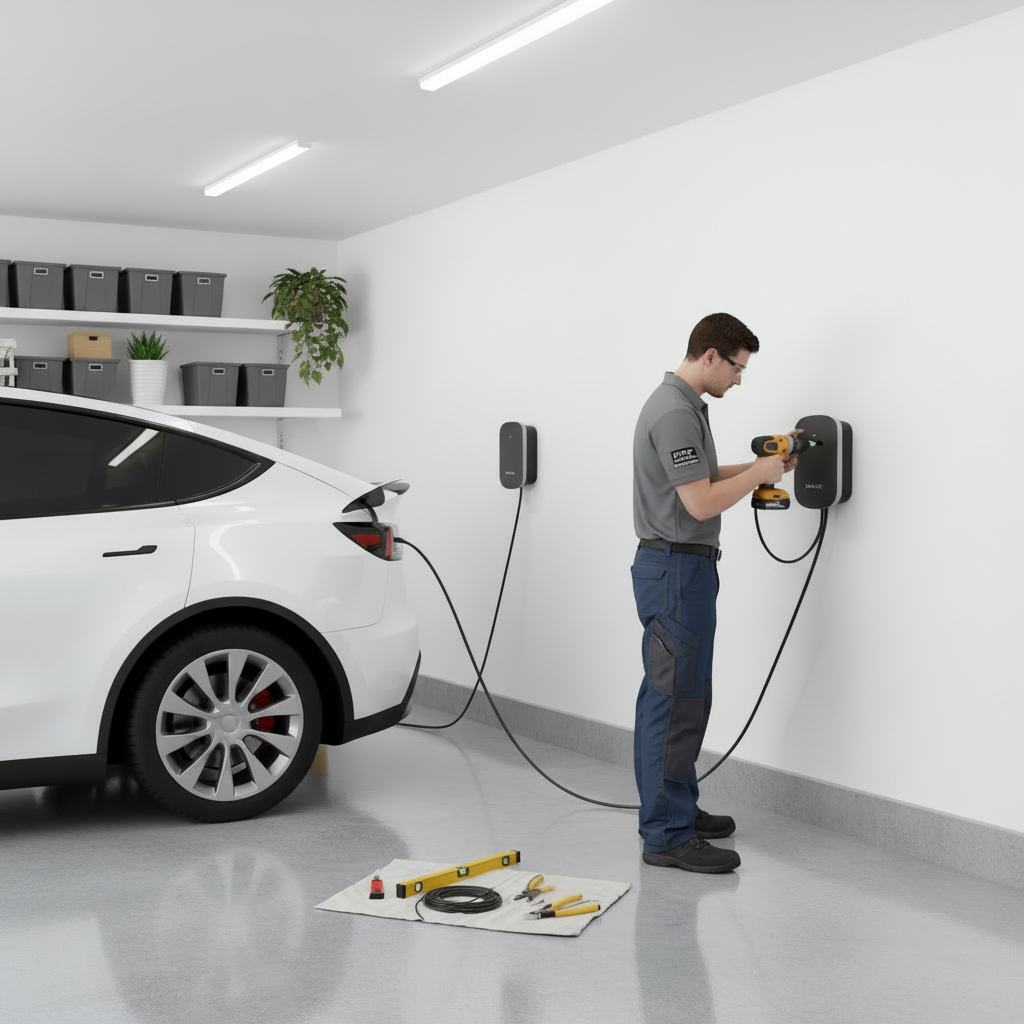
Compare professional EV charger installation vs. DIY costs & risks. Learn about continuous high-amperage loads, GFCI, and dedicated circuits.
Key Takeaways
- **Continuous High-Amperage Loads:** You're maxing out the circuit for 6-8 hours straight. Not cycling. Not pulsing. Just full-throttle power delivery, which means your wiring heats up and stays hot. Standard 14-gauge Romex? Forget it. You need heavy-gauge copper that can handle thermal buildup without melting the insulation. This is the real killer for standard setups.
- **Mandatory GFCI Protection:** Ground Fault Circuit Interrupter protection isn't a suggestion. It's an absolute requirement for preventing electrical shocks, particularly in outdoor environments where moisture is a factor. It saves lives.
- **Dedicated Circuits:** EV chargers must be on their own dedicated circuit. Period. This prevents overloading your home electrical panel and ensures stable power delivery without nuisance tripping or catastrophic damage.
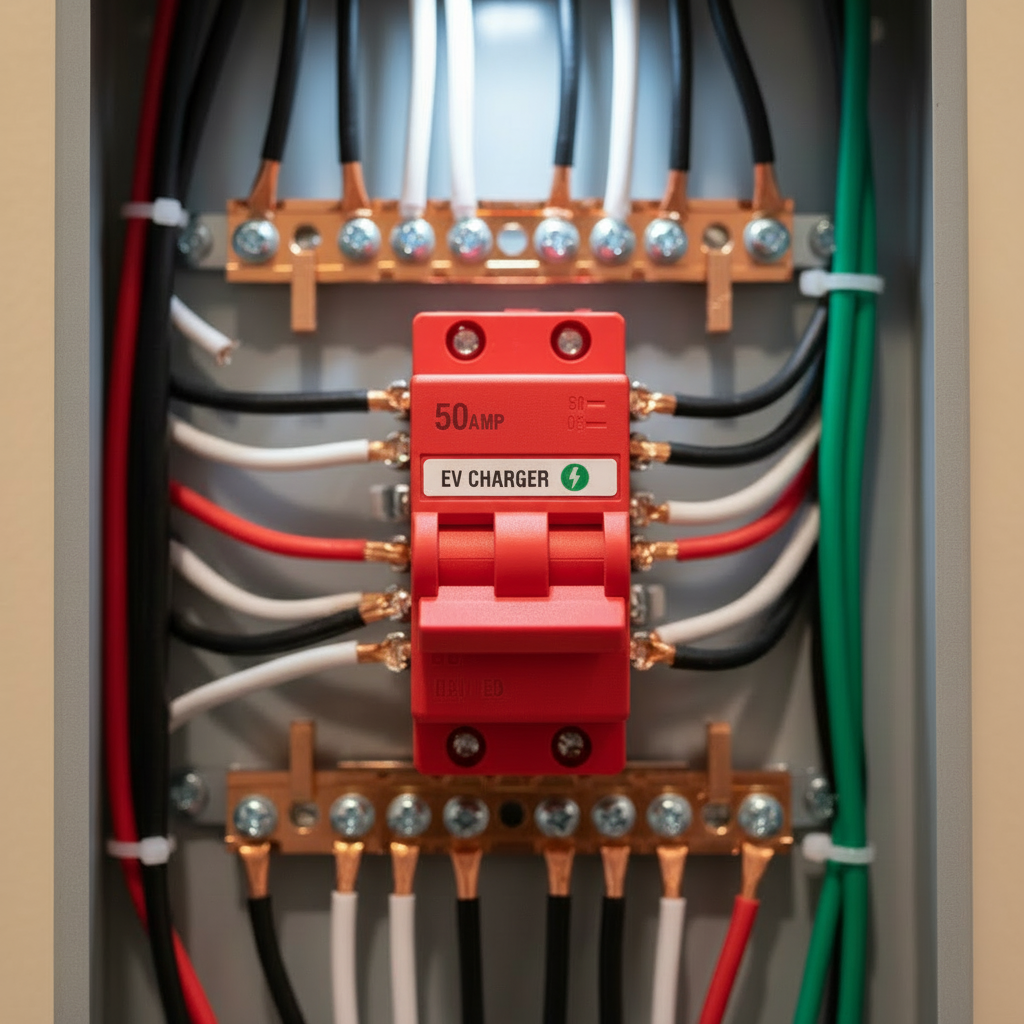
- **Specialized Safety Equipment:** You need overcurrent protection matched to your charger's continuous duty rating — not just any 50-amp breaker from Home Depot. Most EVSE units pull 80% of rated capacity continuously, which triggers different safety calculations than your dryer (which cycles on and off). Don't skip this.
- **Weather-Resistant Components:** Outdoor installations require components built to withstand driving rain, heavy snow, extreme temperatures (120°F Arizona summers to -20°F Minnesota winters), and prolonged UV exposure. Durability isn't optional.
Key Takeaways
EV Charging Station Installation: Professional Service vs. DIY Costs & Risks – An Expert's Guide
A couple in Scottsdale paid $8,400 last year to fix what a handyman "installed" for $600. The charger worked for three weeks. Then their garage caught fire.
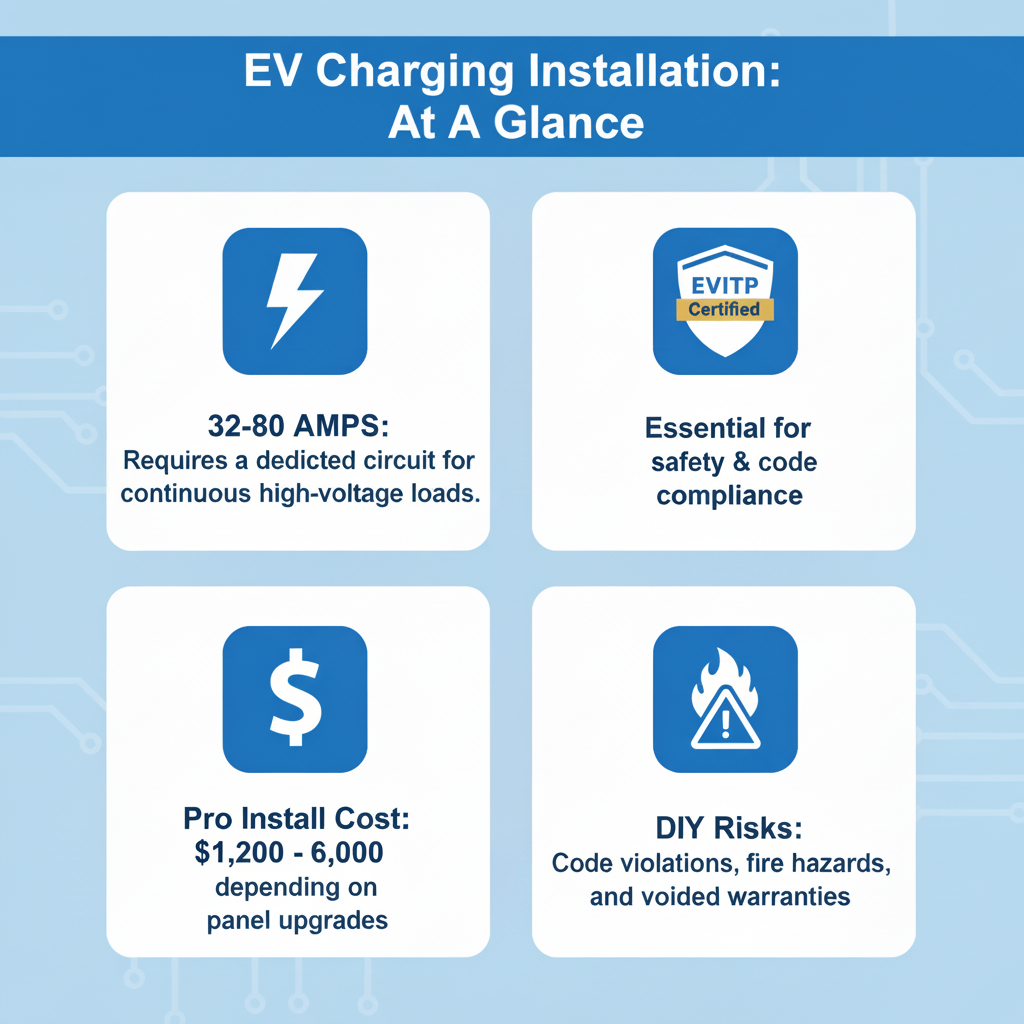
EV charging installations sit somewhere between household wiring and industrial infrastructure. You're about to plug in a $60,000+ vehicle for 6-8 hours straight, every single night. At BizzFactor, our EVITP-certified electricians handle residential circuits from 32 to 80 amps daily (we've done commercial setups at 400 amps). That's the real issue. That's serious, sustained power demand — it requires expert knowledge and flawless execution to ensure safety, efficiency, and code compliance.
Your home, your family, your vehicle. They deserve better than a YouTube tutorial.
Understanding the Unique, Demanding World of EV Charging Installation
Most people think their EV charger works like a dishwasher or microwave — cycling on and off throughout the day.
Wrong.
EVs pull continuous high-voltage loads for hours. Your Tesla Model 3 Performance or Lucid Air Grand Touring needs uninterrupted power like a medical device needs stable electricity. You're asking your home's wiring to deliver restaurant-grade kitchen power — except it's running all night, every night, in your garage. That's the real issue. Most houses weren't built for that kind of sustained demand (mine sure wasn't when I bought my first EV in 2019).
A Lucid Air Dream can draw up to 19.2 kW during charging. That's equivalent to running two central AC units plus a clothes dryer simultaneously for eight hours straight. I've seen breakers trip at 2 AM because someone tried to charge their Rivian on the same panel feeding their pool pump. The math just doesn't work without proper planning.
We recently helped a family in suburban Phoenix whose electric SUV (80-mile daily commute) couldn't keep up with a 30-amp circuit. It simply wasn't cutting it. Our experience shows that daily driving patterns, vehicle battery capacity, and charging habits significantly influence the optimal setup. One-size-fits-all doesn't exist here.
**Here's why EV charging is a completely different beast from regular electrical work:**
- **Continuous High-Amperage Loads:** You're maxing out the circuit for 6-8 hours straight. Not cycling. Not pulsing. Just full-throttle power delivery, which means your wiring heats up and stays hot. Standard 14-gauge Romex? Forget it. You need heavy-gauge copper that can handle thermal buildup without melting the insulation. This is the real killer for standard setups.
- **Mandatory GFCI Protection:** Ground Fault Circuit Interrupter protection isn't a suggestion. It's an absolute requirement for preventing electrical shocks, particularly in outdoor environments where moisture is a factor. It saves lives.
- **Dedicated Circuits:** EV chargers must be on their own dedicated circuit. Period. This prevents overloading your home electrical panel and ensures stable power delivery without nuisance tripping or catastrophic damage.
- **Specialized Safety Equipment:** You need overcurrent protection matched to your charger's continuous duty rating — not just any 50-amp breaker from Home Depot. Most EVSE units pull 80% of rated capacity continuously, which triggers different safety calculations than your dryer (which cycles on and off). Don't skip this.
- **Weather-Resistant Components:** Outdoor installations require components built to withstand driving rain, heavy snow, extreme temperatures (120°F Arizona summers to -20°F Minnesota winters), and prolonged UV exposure. Durability isn't optional.
Many general electricians (good as they're for typical household work) aren't fully acquainted with these requirements. This knowledge gap leads to hazardous, inefficient, or illegal installations that require costly corrections. We see it constantly. For more information on electrical safety, visit our guide on [<a href="/blog/electrical-safety-tips">electrical safety tips</a>].
The Unquestionable Importance of Qualified EV Charging Installers
Look — having a general electrical license doesn't cut it anymore for EV installations. **EVITP certification** is what separates the specialists from the generalists. It signifies rigorous, hands-on training focused specifically on EV infrastructure. These electricians understand complex electric vehicle power systems and adhere to the highest safety standards established for EV infrastructure.
It's like comparing a general practitioner to a heart surgeon.
Both are medical doctors, but you want the specialist for complex procedures.
At BizzFactor, we partner exclusively with certified professionals who've completed hundreds of EV installations. These specialists aren't just reading manuals — they're proficient in manufacturer specifications for diverse EVSE brands, knowledgeable about local electrical codes (which vary significantly, even city-to-city), adept at complex load calculations, and skilled in handling advanced integration challenges like smart home energy management systems.
They've seen it all. And fixed what others couldn't.
**What you should actually look for in an EV electrician:**
- **EVITP Certification:** Hands-on training in EV infrastructure setup, ongoing maintenance, and adapting to emerging tech. Not just a weekend seminar — we're talking 24+ hours of classroom and practical assessments. It's a commitment to continuous learning.
- **National Electrical Code (NEC) Training:** Article 625 covers Electric Vehicle Power Transfer Systems specifically. Most electricians haven't touched that section since licensing exams (if ever). Your installer should know it cold — derating factors, conductor sizing, grounding requirements, all of it. The NEC is their Bible.
- **Load Calculation Expertise:** This is where most DIY installs fall apart. You can't just add up nameplate ratings from your appliances and call it done. Demand factors, continuous loads, temperature adjustments — it's complex math requiring precise calculations, not guesswork.
- **Smart Charging System Knowledge:** Can they integrate your ChargePoint with your Tesla Powerwall? Do they understand OCPP protocols for networked charging? What about Vehicle-to-Grid setups or dynamic load sharing between two EVs? The technology's evolving fast, and your electrician needs to keep pace.
Our certified installers use professional-grade tools from Klein Tools, Fluke, Milwaukee, and DeWalt. This isn't about expensive toys — it's about ensuring precision, durability, and adherence to manufacturer guidelines. Inferior tools lead to inferior installations.
Think about it: a shoddy install risks everything.
When verifying an electrician's qualifications, ask for their EVITP certification number. Cross-reference it with the credentialing body. Check state licensing boards. Request references from previous EV installations. We're always transparent and happy to provide ours. Learn more about choosing the right [<a href="/blog/how-to-hire-an-electrician">electrician for your home</a>].
The Professional EV Charging Installation Process: Methodical Precision
Professional EV installation isn't a weekend DIY project. It's a carefully orchestrated process following strict protocols designed for safety, code compliance, and long-term performance. Our certified team conducts comprehensive assessments and detailed planning before touching a single wire.
Yeah, it takes time. There's a reason for that.
Comprehensive Electrical Load Assessment: The Foundation
Before unrolling a single cable or mounting any hardware, a detailed **electrical load calculation** is performed. This isn't optional — it's fundamental. This step determines with certainty if your existing electrical panel can safely support the additional demands of an EV charger without risking a dangerous overload. Often (especially in older homes — those charming 1950s ranches or Victorian-era beauties), residences require an [<a href="/blog/electrical-panel-upgrade-costs">electrical panel upgrade</a>] to accommodate modern EVs.
Don't underestimate this. It's a common requirement.
We once encountered a Craftsman home in Pasadena where the 100-amp service (perfectly adequate for daily life) was insufficient for a homeowner's desired 50-amp Level 2 EV charger capable of 9.6kW output. Why? Their existing electrical usage — central AC, electric oven, clothes dryer — already neared capacity during peak hours. We performed a service upgrade to 200 amps before safely installing the charging station, ensuring future readiness and preventing potential electrical hazards.
That homeowner was grateful.
**Here's what we're actually checking during the assessment:**
- **Main Electrical Service Capacity Evaluation:** What's your service entrance rated for? 100 amps is common in older homes, 200 amps in newer construction. We need to know your ceiling before we start planning additions.
- **Existing Circuit Load Analysis:** I'll measure what you're already using — and I mean actually measure it, not guess based on nameplate ratings. On a hot Tuesday afternoon in July, with the AC cranking and someone doing laundry, what's your panel actually pulling? That's your real baseline.
- **Available Panel Space Verification:** Do you have physical room for new breakers? Sometimes panels are totally maxed out — every slot filled. In that case, we're looking at a subpanel or a full service upgrade before we even talk about the charger.
In-Depth Look
Detailed illustration of key concepts
Visual Guide
Infographic illustration for this topic
Side-by-Side Comparison
Visual comparison of options and alternatives
Sources & References
- Complete Guide to EV Charging Station Installation - SolarTech
- EV Charger Installation Guide: Home Setup & Costs 2026
- Top EV Charging Station Installation Tips for Aspiring Renewable ...
- Step-by-Step Guide: How to Install an Electric Car Charging Station
- EV Charging Station Installation Tips & Cost Guide - Fields & Fowler
- Best Tool Brand for Electricians 2025: Expert Rankings - Wood Guide
- Top 20 Essential Electrician Tools for Pros (2026 List) - Workiz
- Best Electrician Tools Brand Guide
- Essential 2025 Electrician Tools & Safety Warnings (New & Pro Tips!)
- 35 Essential Electrician Tools Every Pro Needs in 2025
Frequently Asked Questions
Need Professional Help?
Find top-rated electricians experts in your area