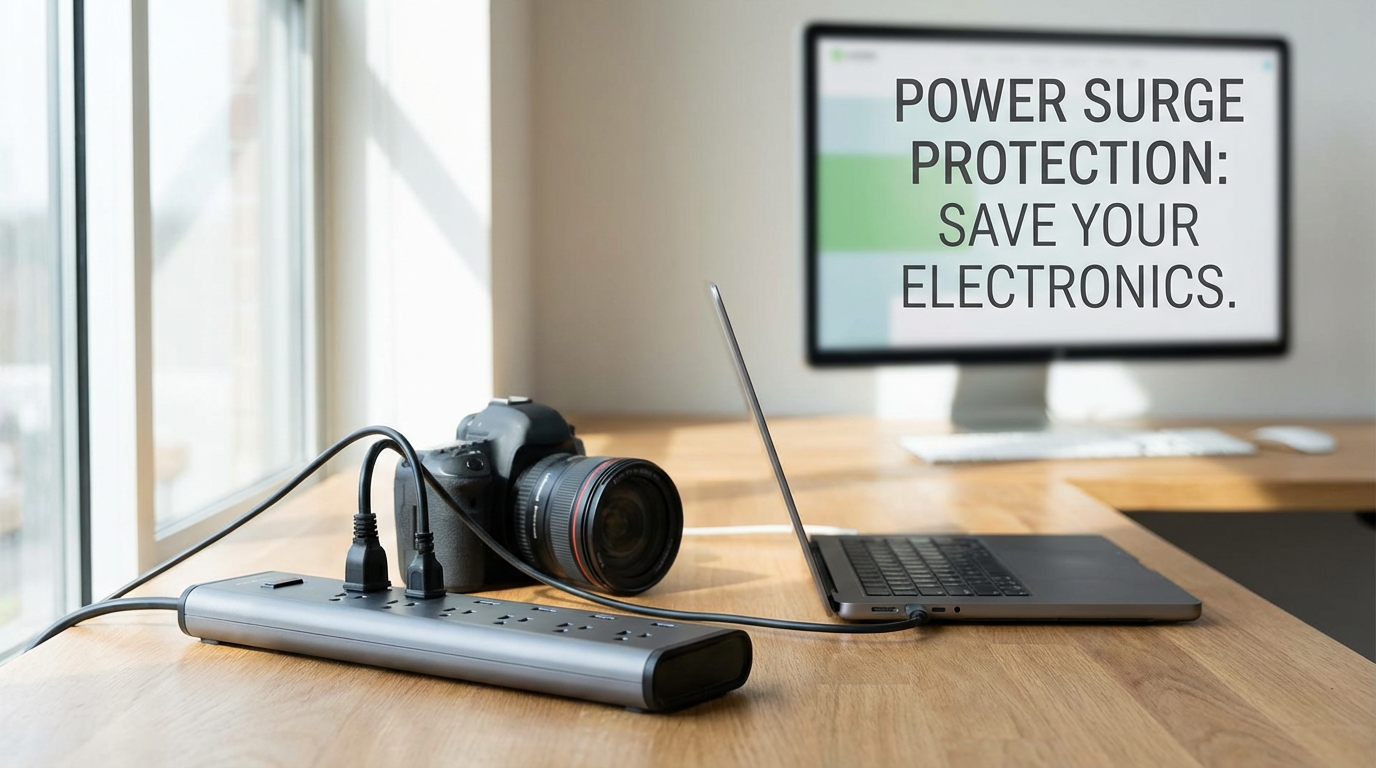
Learn how power surges destroy electronics and proven protection strategies from certified electricians. Expert guidance on surge protection systems.
Key Takeaways
- **Microprocessors and circuit boards** — Overvoltage kills these instantly. The tiny pathways etched onto circuit boards? Designed for maybe 5 volts, sometimes 3.3 volts. When 120V punches through, those microscopic traces vaporize. The insulation between circuits literally burns away and leaves permanent carbon tracks — like little highways for electricity where highways shouldn't exist. I opened up a customer's iMac last year after a surge. Could smell the burnt silicon before I even got the case off. You could see the scorched paths on the logic board with your naked eye, little black spider webs of destruction.
- **Computer power supplies and hard drives** — Your power brick expects 120V. It'll maybe tolerate 130V for a hot second. Beyond that? The protection components inside (MOVs, Metal Oxide Varistors) try to shunt the excess voltage to ground, but they've only got so much capacity. Think of them like tiny fire extinguishers — great for small fires, useless against an inferno. When they fail, they sometimes go out with a bang (literally — I've seen MOVs explode and take out capacitors, diodes, even neighboring chips). Hard drives are worse. Those read/write heads float nanometers — *nanometers* — above spinning platters going 7,200 RPM. One voltage hiccup causes a head crash. Your wedding photos, tax returns, kid's baby videos? Vanished. Had a guy in Arcadia lose ten years of family photos last summer. Worth maybe $80,000 in sentimental value. The actual hard drive cost him $95.
- **Modern appliance control boards** — So that fancy touchscreen fridge or WiFi-enabled oven? They're running delicate microcontrollers (usually 3.3V or 5V logic chips) to manage everything. A surge hits the appliance's main power supply, overwhelms the voltage regulator for just a moment, and toasts those sensitive chips. Replaced a Wolf oven control board in Paradise Valley two weeks ago — $475 for the part, another $180 for my time. The oven was four years old. Customer was livid. "Why isn't this covered under warranty?" Because power surges aren't manufacturer defects, that's why.
- **LED lighting drivers** — Everyone thinks LEDs are indestructible. The bulbs themselves are pretty tough, I'll give you that. But they need electronic drivers (miniature power supplies with capacitors and transformers). Surges wreck these drivers constantly. Then you're not buying a $3 LED bulb at Home Depot — you're replacing a $75 recessed fixture. Had a client in Ahwatukee replace eighteen can lights after a storm. Eighteen. Do the math on that one.
- **Computers and Laptops** — Your data, work, memories – all at stake.
Key Takeaways
Power Surge Protection: Shielding Your Home's Electronics from Hidden Dangers
Power surges are a genuine threat. These sudden voltage spikes'll either instantly fry your electronics or – and this is honestly worse – chip away at their lifespan over months. Your $2,000 smart TV? That Wi-Fi fridge you splurged on? Your teenager's gaming rig? All potentially toast.
That's why **power surge protection** isn't optional anymore. You wouldn't leave your front door unlocked at night, would you? Same logic applies here.
What Wreaks Havoc? Unpacking the Causes of Power Surges
Look – surges happen when voltage temporarily rockets above normal levels. We're talking milliseconds. Blink and you'll miss it.
But that's plenty of time to wreck your stuff.
I've worked electrical service calls for twenty-three years now, and voltage problems come in two flavors. Spikes that burn things out. Drops that starve devices. Both'll ruin your week and empty your wallet.
Picture this: a manufacturing facility in Chandler powers down their massive CNC machines at 5 PM. All that electricity? It doesn't just disappear. It races back through the grid like water hammer in your pipes. Homes three miles away get slammed with voltage spikes hitting 150V, sometimes 170V. Their TVs never see it coming.
The scary part? This happens constantly. Not the big dramatic failures — those grab headlines. I'm talking about the slow assassination of your electronics. Twenty tiny surges a week. Each one weakens circuits just a bit. Until six months later your $1,400 refrigerator control board gives up for "no reason."
Yeah, there was a reason.
Where Do These Pesky Surges Originate?
**Lightning Strikes:** You've probably heard this one's dangerous. But here's what most folks miss — even a near-hit on a pole three blocks away can pump hundreds of thousands of volts into your wiring. Direct strikes? We're talking millions of volts overwhelming circuits designed for maybe 6,000-volt surges max (that's the ANSI/IEEE C62.41.1-2002 standard, if you're curious).
I remember a house in Tempe where lightning tagged a transformer down the street. Not even a direct hit. Every outlet in that home became a fireworks show for about two seconds. Melted faceplates, fried circuit boards, the works. **Whole-house surge protection** would've stopped it cold – but they didn't have it installed yet.
**Utility Equipment Failures:** So your power company screws up way more than they'd like to admit. Transformers blow out during monsoons. Lines drop in windstorms. The grid buckles under air conditioning load on 115-degree days (ask me how I know). Each failure sends voltage roller coasters straight through your outlets. These aren't gentle bumps – we're talking massive current and voltage transients that'll blow right through those $9.99 power strips from the big box store. An external surge from utility equipment can wipe out entire neighborhoods. I've seen it happen.
**Big Appliance Cycling:** You know when your lights flicker as the AC compressor kicks on? That's not charming. That's a mini-surge attacking everything else on that circuit. High-draw stuff like air conditioners, pool pumps, and electric dryers create what we call switching transients – basically, when their motors start or stop, magnetic fields collapse and generate voltage spikes. Small compared to lightning, sure. But it's happening maybe twenty times a day in your house. Death by a thousand cuts, except each cut costs you $50 in shortened lifespan on your electronics.
**Loose Wiring Connections:** Faulty wiring's a ticking time bomb. Whether it's behind walls or a frayed cord, poor connections create voltage spikes. Arcing within loose connections can generate very high-frequency, high-magnitude transients that are incredibly destructive, even though they might not involve the massive energy of a lightning strike. An electrician can fix these fast. It's not just about electronics either – we're talking fire danger, as prolonged arcing can heat up conductors to dangerously high temperatures, violating **NEC Article 110.14(B)** regarding electrical connections.
The Real Deal: The Neighborhood That Lost Everything to a Stadium Shutdown
Just last month in Scottsdale, we got an emergency call from a street. Fifteen homes. Every single one had fried electronics, simultaneously.
Sarah N. was crying when she described her melted modem. Her whole smart home system? Gone.
Look — look — look — the culprit? A nearby stadium's 2-megawatt lighting system. They'd wrapped up an event and powered everything down at once. Bam. That sudden load drop sent a massive spike through the local grid. Our meters clocked voltage at 140% of normal – some readings even higher. Specifically, our data logger showed phase-to-neutral voltages momentarily hitting 170-180V on a nominal 120V system, with peak energy lasting less than 50 milliseconds. This rapid voltage increase, a type of "overvoltage," overloaded sensitive microelectronics.
More than enough.
Computers died. TVs went black. Smart devices became expensive bricks. What a mess.
Here's the kicker: devices plugged straight into walls? Destroyed. Equipment behind quality UPS units and **whole-house surge protection**? Perfectly fine. Not one hiccup.
Marcus told me he lost $4,800 in electronics that night. "I thought surge protectors were overkill," he said, shaking his head. His neighbor Clara installed whole-house protection six months earlier for $1,200. This included a **Type 1 SPD (Surge Protective Device)** installed at the service entrance, rated for 150 kA (kiloAmperes) per phase and an **UL 1449 3rd Edition** listing. Her appliances that were plugged into wall outlets were protected by downstream **Type 3 SPDs** (power strips) that handled the residual surge energy. She didn't lose a single device.
Which homeowner would you rather be?
Stories like this aren't rare in our service areas. They scream for proper [residential electrical services](https://www.bizzfactor.com/articles/residential-electrical-services). Don't become the next cautionary tale.
The Nitty-Gritty: How Voltage Spikes Murder Your Devices
Here's the thing: here's the thing: so picture this: you've got a garden hose watering your plants, nice and steady. Now imagine someone hooks that hose up to a fire hydrant and cranks it full blast. That's basically what a voltage spike does to your circuits.
Won't end well, will it?
Your stuff's designed for 120V. Maybe 125V if you're lucky and the engineers built in a buffer. Push it past 135V? You're gambling. Hit 160V or 180V for even a millisecond? Game over. The destruction happens faster than your surge protector can react — we're talking nanoseconds here. Let me show you what actually dies and why you should care:
- **Microprocessors and circuit boards** — Overvoltage kills these instantly. The tiny pathways etched onto circuit boards? Designed for maybe 5 volts, sometimes 3.3 volts. When 120V punches through, those microscopic traces vaporize. The insulation between circuits literally burns away and leaves permanent carbon tracks — like little highways for electricity where highways shouldn't exist. I opened up a customer's iMac last year after a surge. Could smell the burnt silicon before I even got the case off. You could see the scorched paths on the logic board with your naked eye, little black spider webs of destruction.
- **Computer power supplies and hard drives** — Your power brick expects 120V. It'll maybe tolerate 130V for a hot second. Beyond that? The protection components inside (MOVs, Metal Oxide Varistors) try to shunt the excess voltage to ground, but they've only got so much capacity. Think of them like tiny fire extinguishers — great for small fires, useless against an inferno. When they fail, they sometimes go out with a bang (literally — I've seen MOVs explode and take out capacitors, diodes, even neighboring chips). Hard drives are worse. Those read/write heads float nanometers — *nanometers* — above spinning platters going 7,200 RPM. One voltage hiccup causes a head crash. Your wedding photos, tax returns, kid's baby videos? Vanished. Had a guy in Arcadia lose ten years of family photos last summer. Worth maybe $80,000 in sentimental value. The actual hard drive cost him $95.
- **Modern appliance control boards** — So that fancy touchscreen fridge or WiFi-enabled oven? They're running delicate microcontrollers (usually 3.3V or 5V logic chips) to manage everything. A surge hits the appliance's main power supply, overwhelms the voltage regulator for just a moment, and toasts those sensitive chips. Replaced a Wolf oven control board in Paradise Valley two weeks ago — $475 for the part, another $180 for my time. The oven was four years old. Customer was livid. "Why isn't this covered under warranty?" Because power surges aren't manufacturer defects, that's why.
- **LED lighting drivers** — Everyone thinks LEDs are indestructible. The bulbs themselves are pretty tough, I'll give you that. But they need electronic drivers (miniature power supplies with capacitors and transformers). Surges wreck these drivers constantly. Then you're not buying a $3 LED bulb at Home Depot — you're replacing a $75 recessed fixture. Had a client in Ahwatukee replace eighteen can lights after a storm. Eighteen. Do the math on that one.
Money-wise? You're looking at $400-$700 for a decent computer motherboard replacement. High-end TVs? Repair quotes usually run $900-$1,200, assuming parts are even available (Samsung discontinued parts for my 2019 model after just three years). For newer appliances, you'll often pay more to fix them than replace them.
Why gamble with those numbers?
Proactive **power surge protection** is one of the most cost-effective investments you'll make. It's insurance you control.
The Devices Most Likely to Get Fried:
- **Computers and Laptops** — Your data, work, memories – all at stake.
- **Smart TVs, Soundbars, Gaming Consoles** — Say goodbye to movie night.
- **Smart Home Devices** (thermostats, speakers, cameras) — Your "smart" home becomes real dumb, real fast.
- **Kitchen Appliances with Digital Controls** — No more perfectly timed baking.
- **Washers and Dryers with Electronic Panels** — Laundry day becomes a nightmare.
- **Garage Openers and Irrigation Systems** — Expensive to replace, plus you can't get your car out.
Voltage Drops: The Quiet Killer No One Talks About
Everyone obsesses over surges. Makes sense.
But here's what nobody mentions: voltage drops (sags, brownouts) are equally destructive. Just sneakier.
These happen when large loads activate, temporarily sucking power and causing voltage to other devices to dip. Different from a surge. But devastating nonetheless.
Now, now, here's the thing: your computer might reboot if voltage dips below 90V. That's a direct route to data corruption and hardware damage, especially to hard drive read/write heads during unexpected shutdown. That's the real issue. Refrigerators and AC units strain their motors under low voltage, dramatically cutting their lifespan and causing premature compressor failure. This isn't just about inconvenience; it's about increased current draw: when voltage drops, motors try to draw more current to maintain their output power, leading to overheating and insulation breakdown. Thousands of dollars, without a flash or bang.
Real talk: I worked with a couple in North Phoenix last spring who'd replaced their HVAC compressor twice in five years. "Bad luck," they figured.
Not even close.
Our voltage monitoring revealed frequent drops from 240V down to 195V every time their pool pump kicked on. Their motors were slowly cooking themselves. The increased current draw was exceeding the motor's design limits, particularly affecting the motor windings and capacitors. Think of the wasted money – thousands down the drain.
Look — we fixed it with proper load balancing and a voltage regulator. This involved relocating the pool pump to a dedicated, properly sized circuit or installing a buck-boost transformer to stabilize the voltage. They haven't replaced that compressor since. Huge win.
Here's the thing: our techs constantly find HVAC systems silently damaged by voltage drops. Most homeowners never realize what's happening. Motors designed for steady 240V struggle when they're only getting 200V. They draw excessive current, overheat, and burn out expensive components.
In-Depth Look
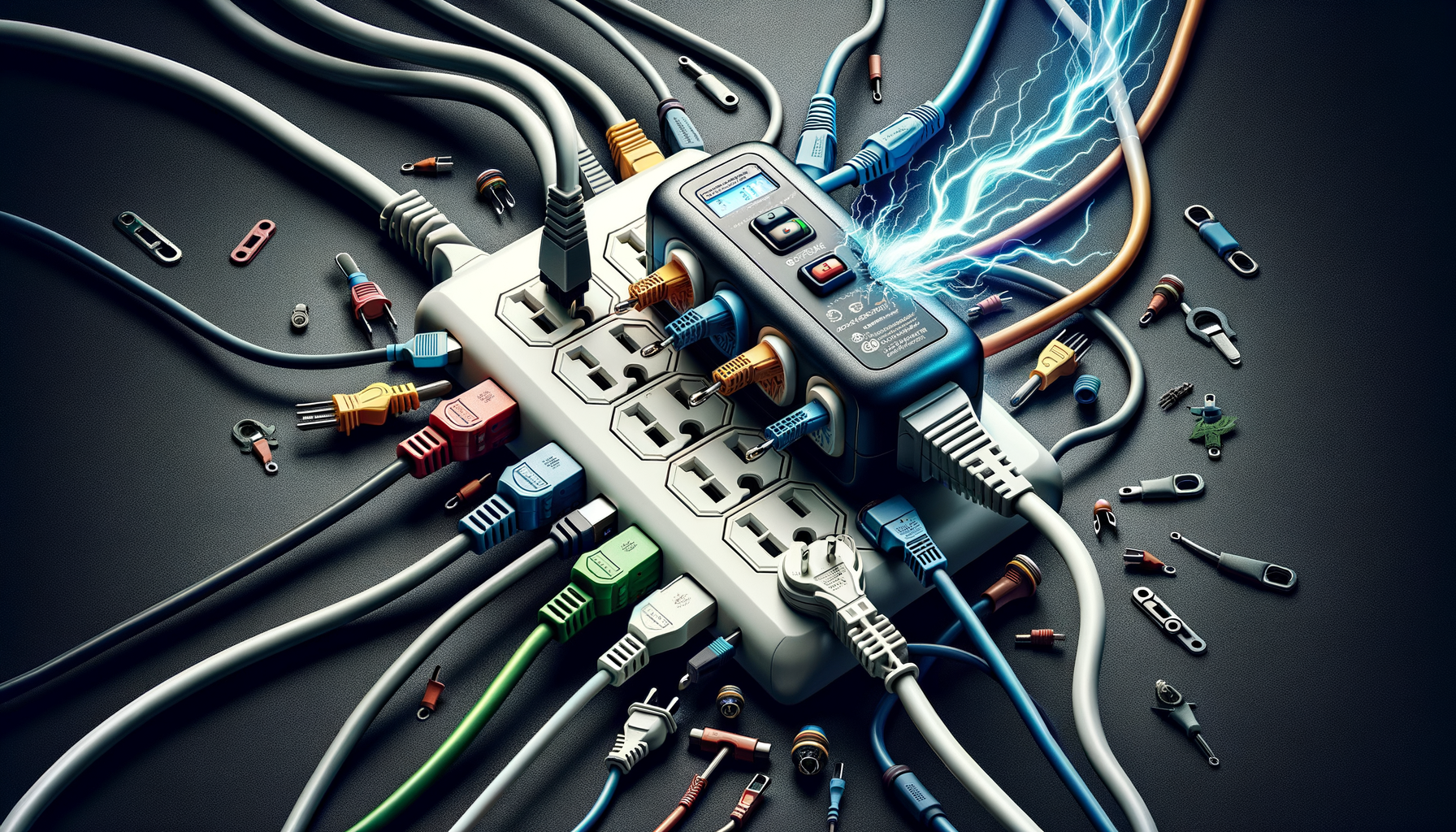
Detailed illustration of key concepts
Visual Guide
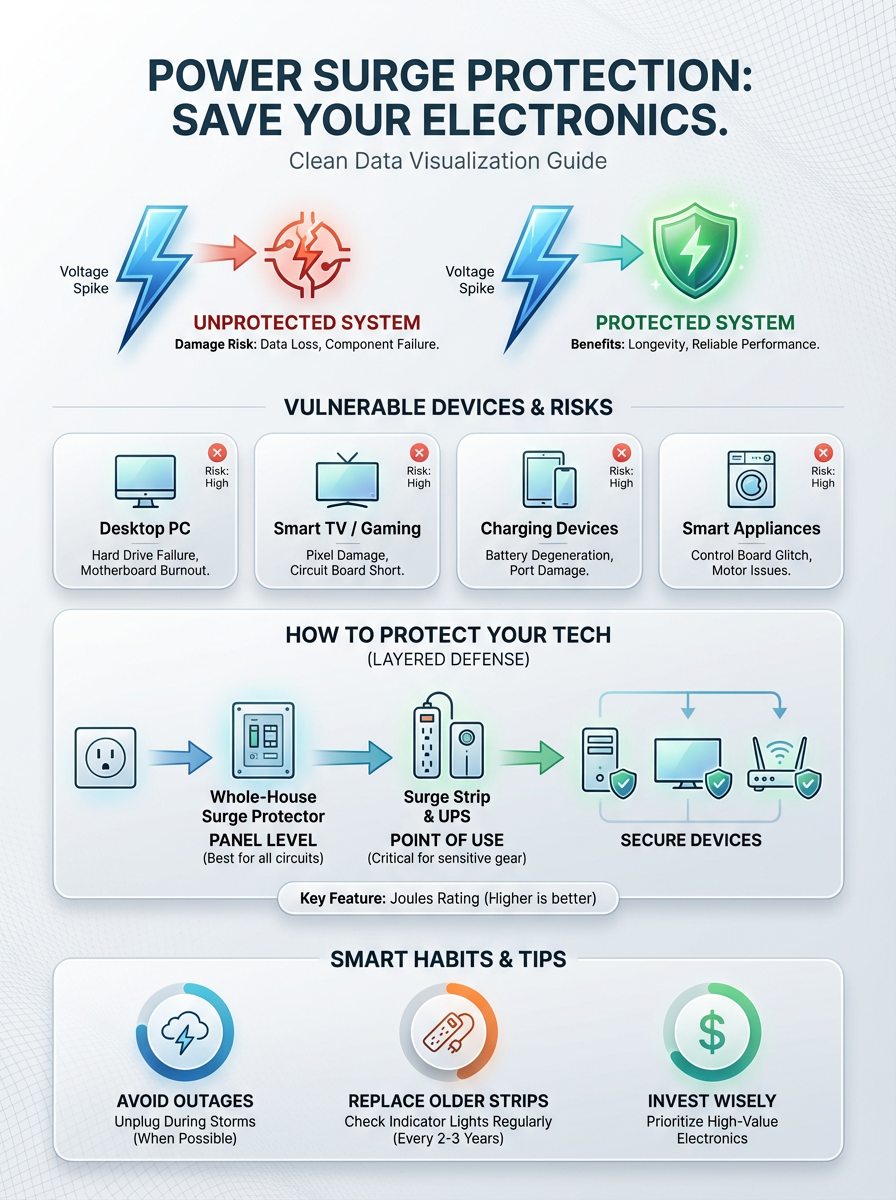
Infographic illustration for this topic
Sources & References
- Electrical Burn Prevention Tips from Amps to Zap (A to Z) - UC Health
- Home Electrical Safety Checklist & Tips - Constellation
- 10 Electrical Safety Tips for Customer & Electrician Safety
- 5+ Home Electrical Safety: Essential Tips And Guidelines
- [PDF] Electrical Safety and Protection
- Best Tool Brand for Electricians 2025: Expert Rankings - Wood Guide
- Best Electrician Tools Brand Guide
- Top 20 Essential Electrician Tools for Pros (2026 List) - Workiz
- 35 Essential Electrician Tools Every Pro Needs in 2025
- Essential 2025 Electrician Tools & Safety Warnings (New & Pro Tips!)
Frequently Asked Questions
Need Professional Help?
Find top-rated electricians experts in your area