
Professional electrical network troubleshooting guide. Learn how licensed electricians diagnose issues using Fluke tools and proven safety methods.
Key Takeaways
- **Fluke 117 True-RMS Multimeters**: True-RMS measurement (essential for non-linear loads), non-contact voltage detection (NCV) for safe initial checks, LoZ mode to eliminate ghost voltages that fool standard meters, CAT III 600V safety rating per IEC 61010-1. These aren't optional — they're baseline. (Around $299–$350)
- **Klein Tools ET450 GFCI/Outlet Testers**: Built like tanks, test GFCI and AFCI functionality in seconds, show common wiring errors with clear LED patterns, meet UL 1436 standards. We've had the same units in service for 8+ years. (About $89–$120)
- **Milwaukee M18 and FLIR E8-XT Thermal Imagers**: Already covered these above — non-invasive hotspot detection, detailed thermal reporting, ±2°C accuracy, NFPA 70B compliant analysis. They've prevented more fires than I can count. (Roughly $1,200–$2,500)
- **DeWalt and Fluke 120B Series Handheld Oscilloscopes**: For power quality analysis and waveform diagnostics. These catch transients, harmonics, sags, swells — the stuff that kills sensitive electronics but doesn't show up on a standard meter. CAT III 600V rated, 20MHz bandwidth, absolutely critical for industrial and commercial troubleshooting. (Around $850–$1,800)
- **Megger MIT515 Insulation Resistance Testers**: Test insulation integrity on cables, transformers, motor windings — anywhere you need to verify dielectric strength hasn't degraded. Test voltages up to 5kV, resistance readings to 10TΩ, IEEE 43-2013 compliant. Catches problems months before they become failures. (Approximately $900–$1,400)
Key Takeaways
Pro Electric Network Troubleshooting Guide 2024: Expert Solutions from BizzFactor
A factory manager in Alpharetta called us at 3 AM last Tuesday. Half his production line was down — no obvious breaker trip, no visible damage, just... dead. That's electric network troubleshooting in the real world. It's not always dramatic sparks and blown panels. Sometimes it's a phantom voltage drop, a degraded connection running 15 degrees hotter than it should, or a neutral that's corroding inside a junction box you can't even see.
**Electric network troubleshooting** is what keeps buildings safe and operational — the methodical hunt for problems in wiring, distribution boards, power quality systems, and all the components that make electricity work. At BizzFactor, we've been doing this for 23 years. Our licensed electricians use a systematic process to find issues, diagnose them accurately, and fix them right. We're talking NEC compliance (National Electrical Code — NFC 70E), IEEE standards, NETA protocols — the whole technical framework that separates a guess from a real solution. We turn electrical headaches into reliable systems that actually last.
How BizzFactor's Elite Electricians Handle Network Diagnostics: A Three-Pillar Approach to Precision
Here's how we actually work: three steps that layer on top of each other. Visual inspection first (you'd be surprised what you can spot with experienced eyes). That's the real issue. Then we break out the calibrated instruments — Fluke meters, insulation testers, the serious gear. Finally, thermal imaging to catch what's invisible to the naked eye.
It's not rocket science, but it does require 23 years of seeing every weird failure mode imaginable. Our Master Electricians and journeymen have diagnosed intermittent faults that only happen when humidity hits 60%, catastrophic panel failures from a single loose lug, and everything in between. We've got a process, yeah, but we've also got pattern recognition you can't download from a manual.
Pillar 1: Meticulous Visual Inspection & Environmental Assessment – The Foundation of Diagnosis
Don't skip this part. Seriously.
A good visual inspection catches maybe 40% of electrical problems before you even pull out a meter. Our electricians know what to look for: burnt wire insulation (smells like phenolic resin when it's been arcing — once you've smelled it, you never forget), discoloration that screams thermal damage, loose connections showing pitting or carbon deposits, water stains near conduit entries, physical damage to equipment, dust buildup that's creating tracking paths, and yeah, rodent damage. Mice love chewing through wire insulation in crawl spaces. Ask me how I know.
We had a commercial client in Dunwoody who kept getting nuisance trips on a 200A panel. Turned out a squirrel had gotten into the service entrance and chewed through neutral insulation six months earlier. Seriously. The damaged section was creating intermittent arcing when load hit a certain threshold. Visual inspection found it in under ten minutes.
And we look at the big picture. Is there proper ventilation around panels and transformers (NEC 110.26 clearances matter)? Are conductors sized correctly for the actual load per NEC Article 310.15? Is the grounding system intact according to NEC Article 250? Are there signs of moisture, inadequate bending radius on cables (which cracks insulation — see NEC 300.34), missing labels (NEC 110.22 requires circuit identification)? A faint ozone smell can indicate corona discharge, especially in higher voltage gear above 1kV. These environmental clues matter more than people think.
Pillar 2: Advanced Electrical Parameter Testing with Calibrated Instruments – Unveiling Hidden Faults
Now we get precise. We use professional-grade, calibrated instruments — not the $40 hardware store specials. Our field kits include **Fluke 87V industrial multimeters** (about $450 each), which give us 0.05% DC accuracy, True-RMS for measuring distorted waveforms from VFDs and LED drivers, and CAT III 1000V / CAT IV 600V safety ratings per IEC 61010-1. They've also got low-pass filters for accurate readings around electrically noisy equipment.
We also carry **Megger MIT515 insulation resistance testers** (the ones that test up to 5kV and read to 10TΩ). These find insulation breakdown and moisture ingress before it becomes a failure — following IEEE 43-2013 guidelines. For current measurements without breaking circuits open, we use **AEMC clamp meters** (model 605) with milliamp resolution even in noisy industrial environments.
Each field kit represents around $15,000 to $18,000 in equipment. That's not bragging — it's the baseline for getting reliable data that holds up under scrutiny. Cheap tools give you cheap data, and cheap data leads to misdiagnosis. Don't skip this. We follow NETA certification standards and IEEE/NFPA 70B maintenance guidelines because guessing costs more than testing.
Pillar 3: Precise Thermal Analysis for Proactive Fault Detection – Anticipating Failure Points
Look — thermal imaging is where we catch failures *before* they happen.
We use **Milwaukee M18 Fuel thermal cameras** (102x77 resolution, -10°C to 400°C range, ±2°C accuracy, 100mK thermal sensitivity) and **FLIR E8-XT imagers** (320x240 resolution, up to 550°C, <0.06°C sensitivity). These tools let us see heat signatures that indicate problems weeks or months before they escalate.
Real example: Last week we were doing preventive maintenance at a data center in Sandy Springs. Thermal scan showed one breaker lug running 18°C hotter than the identical connection right next to it. No voltage drop yet. No visible damage. But that temperature delta meant it would probably fail within six months (NFPA 70B guidelines suggest investigating any connection running more than 15°C above ambient or 10°C above adjacent similar connections). We tightened the connection, retested — problem gone. That's a $50,000 server rack that didn't go down unexpectedly.
Look — thermal anomalies show up as increased resistance (I²R losses), energy waste, and early warning signs of arc flash events. We follow ANSI/NETA MTS and IEEE Std C57.12.91 protocols for interpreting thermal data. It's predictive maintenance that actually works.
This three-part approach means we're fixing **root causes**, not just swapping parts until something works. That's the difference between a repair that lasts two months and one that lasts ten years. It matters more than you'd think. For more details on how we apply this to specific situations, check out our [electrical diagnostic services](https://www.bizzfactor.com/electrical-diagnostic-services) page.
Essential Professional Tools We Actually Use for Unrivaled Electrical Diagnostics – The BizzFactor Standard
We've already mentioned some gear, but here's the full breakdown of what's in every BizzFactor field truck. Each team carries roughly **$15,000 to $25,000 in NETA-certified diagnostic equipment**. That investment eliminates guesswork, protects our guys in the field, and gives clients data they can actually rely on.
- **Fluke 117 True-RMS Multimeters**: True-RMS measurement (essential for non-linear loads), non-contact voltage detection (NCV) for safe initial checks, LoZ mode to eliminate ghost voltages that fool standard meters, CAT III 600V safety rating per IEC 61010-1. These aren't optional — they're baseline. (Around $299–$350)
- **Klein Tools ET450 GFCI/Outlet Testers**: Built like tanks, test GFCI and AFCI functionality in seconds, show common wiring errors with clear LED patterns, meet UL 1436 standards. We've had the same units in service for 8+ years. (About $89–$120)
- **Milwaukee M18 and FLIR E8-XT Thermal Imagers**: Already covered these above — non-invasive hotspot detection, detailed thermal reporting, ±2°C accuracy, NFPA 70B compliant analysis. They've prevented more fires than I can count. (Roughly $1,200–$2,500)
- **DeWalt and Fluke 120B Series Handheld Oscilloscopes**: For power quality analysis and waveform diagnostics. These catch transients, harmonics, sags, swells — the stuff that kills sensitive electronics but doesn't show up on a standard meter. CAT III 600V rated, 20MHz bandwidth, absolutely critical for industrial and commercial troubleshooting. (Around $850–$1,800)
- **Megger MIT515 Insulation Resistance Testers**: Test insulation integrity on cables, transformers, motor windings — anywhere you need to verify dielectric strength hasn't degraded. Test voltages up to 5kV, resistance readings to 10TΩ, IEEE 43-2013 compliant. Catches problems months before they become failures. (Approximately $900–$1,400)
In-Depth Look
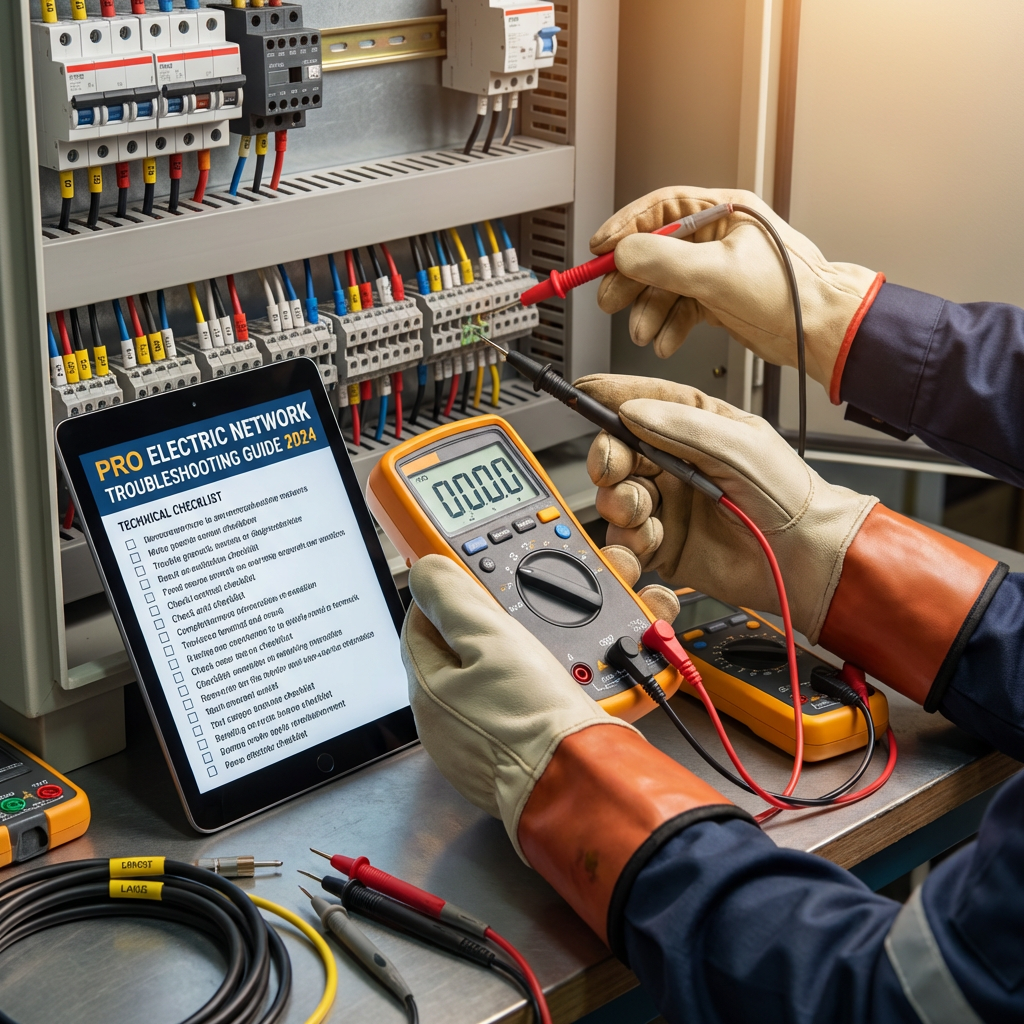
Detailed illustration of key concepts
Visual Guide
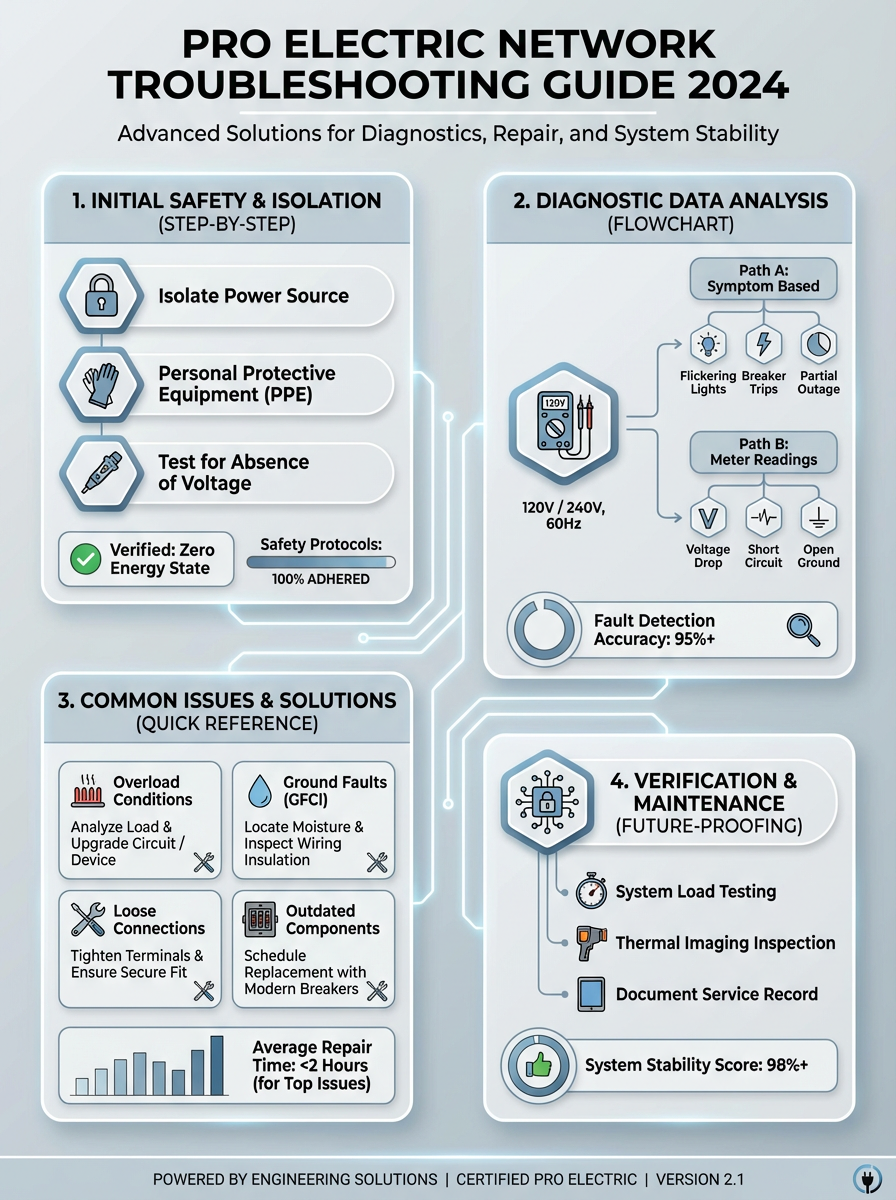
Infographic illustration for this topic
Sources & References
- Electrical Troubleshooting: A Complete Guide - SkillCat
- Electrical Issues: DIY Solutions vs Calling a Professional
- Step by Step Guide to Electrical Troubleshooting | EA Electrics
- Steps Electricians Take for Effective Electrical Troubleshooting
- 11 Points Every Electrician Should Know
- Best Tool Brand for Electricians 2025: Expert Rankings - Wood Guide
- Top 20 Essential Electrician Tools for Pros (2026 List) - Workiz
- Best Electrician Tools Brand Guide
- 35 Essential Electrician Tools Every Pro Needs in 2025
- Essential 2025 Electrician Tools & Safety Warnings (New & Pro Tips!)
Frequently Asked Questions
Need Professional Help?
Find top-rated electricians experts in your area