Learn about three-phase electrical connections for modern homes. Expert guide covers installation, benefits, and when to upgrade from single-phase systems.
Key Takeaways
- Three-phase systems deliver consistent power through three separate conductors for high-demand homes
- Professional installation prevents overloads and improves electrical efficiency by up to 10%
- Upgrading becomes necessary when single-phase service cannot handle modern appliance loads
BizzFactor Quick Guide
The BizzFactor Standard: Always use a licensed electrician with three-phase certification for 240V+ installations
Key Takeaways
The BizzFactor Standard
3 Non-Negotiable Requirements for Elite Workmanship
Licensed & Three-Phase Certified
Electrician must hold valid license with specialized three-phase training and current NEC knowledge
Professional Testing Equipment
Uses Fluke meters and proper testing tools to verify phase balance and system integrity
Code Compliance Documentation
Provides permits, inspection certificates, and warranty coverage for all three-phase installations
Three-Phase Electrical Connections: The Definitive Guide for Modern Homes (2024)
A homeowner in Glendale called us last August — breakers tripping every afternoon around 3 PM like clockwork. Pool pump, AC, dryer. Pick any two and you're fine. Run all three? Click. Darkness. That's the reality of modern homes trying to survive on single-phase power in 2024. This isn't a unique story; we hear variations of it all the time. That's the real issue. It's like trying to run a six-lane highway's worth of traffic through a two-lane country road. Things are gonna bottleneck, and eventually, they're gonna stop.
Your fridge, your HVAC, those two EVs in the garage, the 75-inch TV, the heat pump water heater... it all adds up fast. A **three-phase electrical system** isn't some industrial overkill anymore (though I still get that look when I bring it up with clients). It's three separate AC waveforms, each offset by exactly 120 degrees, delivering power that doesn't buckle when you're running multiple heavy loads at once. Seriously. We're talking serious robustness here, able to handle the simultaneous demands of modern luxuries and necessities without batting an eye.
Look — look — what does that actually mean for you? Your equipment lasts longer. Your breakers stop tripping. And you're not playing appliance roulette every time someone plugs in a space heater while the AC is running. Imagine: no more walking on eggshells around your electrical panel, no more strategically planning which major appliance can run when. It's about freedom and reliability.
So here's the thing most people don't get: the electrical demands on your home aren't static. They're climbing. Every year. We're seeing this huge shift toward electrification — gas stoves becoming induction, tank water heaters swapped for heat pumps, and don't even get me started on EVs. My neighbor just bought his second Tesla. His wife has a Rivian. That's potentially 19.2kW of charging demand right there, and their panel was installed in 1987. You see where this is going? This guide breaks down how three-phase systems work, why they matter, what installation actually involves, and whether your house needs one.
Understanding Three-Phase Power Distribution: A Deeper Scientific and Engineering Perspective
Think of three-phase power like this: three separate conductors, each carrying AC current, but they peak at different moments. Precisely 120 degrees apart. When these waves work together, you get smooth, continuous power delivery. No dips. No pulsing. Zero gaps.
Now, if you want the technical version (and I promise this matters): each phase voltage swings up and down in a sine wave. Phase A hits its peak, then 120 degrees later Phase B peaks, then another 120 degrees and Phase C peaks. Mathematically, if you're into that stuff, Phase A might be V_peak × sin(ωt), Phase B is V_peak × sin(ωt - 2π/3), Phase C is V_peak × sin(ωt - 4π/3). The ω part is just the angular frequency — in North America that's based on our 60 Hz grid. The point? This staggering means the total instantaneous power to a balanced load stays constant. Single-phase power oscillates — up, down, up, down. Three-phase? Flat line. Steady Eddie.
That matters a lot when you're running modern HVAC systems, EV chargers, and smart home tech that doesn't tolerate voltage swings. These devices often contain rectifier circuits converting AC to DC, and a stable AC input voltage directly translates to a more stable DC output, reducing ripple current and extending component life.
Single-phase power? It works, sure. But it fluctuates — you'll see momentary sags when big loads kick on. Three-phase doesn't do that. Each phase in a typical residential setup usually carries somewhere between 25-40 amps (though I've seen 60-100+ amp configurations depending on service capacity and what the transformer's rated for). The whole system has to comply with **NEC Article 220 (Branch-Circuit, Feeder, and Service Load Calculations)** — basically the rulebook for calculating loads safely.
There's this method called the "Standard Calculation" (NEC 220.82) that electricians use for houses. You add up your fixed loads, lighting circuits, kitchen appliances, then apply these demand factors. First 3000 VA? Count it all. Next 117,000 VA? Only 35% of that typically gets used simultaneously. Anything beyond that drops to 25%. It's not arbitrary — it's based on decades of studying how people actually use electricity. Nobody runs *everything* at once (usually). Compliance is non-negotiable; shortcuts here lead to dangerous, overloaded systems.
Here's the thing: from our work at BizzFactor, homeowners don't realize how precise this stuff gets. We'll show up with a **Fluke 1736 power logger** (around $3,200, not exactly a Home Depot impulse buy) to verify phase balance. That's the real issue. This device not only logs current and voltage but also power factor, harmonics, and transient events over time. This helps us precisely diagnose root causes of tripping breakers or equipment malfunctions. When phases are balanced — meaning each one carries roughly the same load within acceptable tolerances, typically within 10-15% of each other per **IEEE Standard 1159 (Recommended Practice for Monitoring Electric Power Quality)** — your voltage stays stable even when the AC compressor and EV charger fire up simultaneously. That's the real issue. A guy in Encino learned this the hard way after his $8,500 whole-home generator kept tripping because nobody bothered balancing his phases during installation. The generator, designed for a balanced three-phase load, was experiencing excessive current on one phase, causing its internal overcurrent protection to activate prematurely. This isn't just an inconvenience; it can damage expensive equipment. For more on keeping your electrical system healthy long-term, check out our guide on [Residential Electrical Inspections](link-to-residential-electrical-inspections).
The Physics Behind Stable Current and Reduced Losses
Here's the thing: single-phase power delivery actually pulses. Twice every cycle, it drops all the way to zero. In a 60 Hz system, the instantaneous power of a single-phase AC circuit is P(t) = V_peak × I_peak × sin²(ωt) = (V_peak × I_peak / 2) × (1 - cos(2ωt)). Notice the 2ωt component? The power pulsates at 120 Hz, momentarily dropping to zero. You don't notice it (60 times per second is fast), but your wiring does. Your motors definitely do. That pulsing creates stress and forces motors to work harder during startup, which is wildly inefficient because they have to overcome momentary losses of torque. This phenomenon is known as "torque ripple."
With three-phase, the power delivery stays constant. No drop-offs. The math works out to P_total = 3 × V_L-N × I_line × PF (that's line-to-neutral voltage times line current times power factor). When the load's balanced, this number doesn't bounce around. It just... sits there. Delivering exactly what you need.
Think of it like three pistons firing in sequence — there's always forward momentum. Always torque. This constant delivery reduces losses in motors (less heat, smoother magnetic fields) and cuts down on wasted energy. Seriously. For the same amount of power, three-phase systems need less copper than single-phase. This is because, for a given power level, the current per phase is lower in a three-phase system compared to a single-phase system, leading to smaller conductors (wire gauge) required to meet the same amperage rating, as specified in **NEC Table 310.16 (Allowable Ampacities of Insulated Conductors)**. Smaller wire. Lower material costs. More compact installation.
Less heat also means less thermal expansion and contraction in your wiring, which extends the life of your electrical infrastructure. Around here (Southern California), that matters when you're looking at 25-30 year service panels baking in attic heat, where temperatures can regularly exceed 130°F (54°C). This thermal cycling is a major contributor to insulation breakdown and connection loosening over time, per **ASTM D3032 (Standard Test Methods for Hookup Wire Insulation)**.
Why Three-Phase Makes Sense for Modern Homes
Going from single-phase to three-phase isn't just an upgrade. It's more like swapping out a two-lane road for a six-lane freeway — you're not getting 3x the capacity, you're getting better flow, less congestion, and room to grow. More efficient transmission, way less stress on your wiring, longer equipment life, fewer service calls. Real talk: it's about building an electrical backbone that doesn't become a bottleneck when you add solar, a second EV charger, or that woodshop you've been planning.
The big wins? Capacity and stability.
Your central air, your EV (Level 2 or even Level 3 DC fast charging if you've got the setup, which requires substantial three-phase input), your induction cooktop, your double oven — they can all run at the same time without causing voltage drops that kill electronics or wear out motors prematurely. **NEC Article 210.19(A)(1) permits a maximum voltage drop of 3% for branch circuits and 5% for feeder circuits and branch circuits combined.** Hitting those targets consistently with heavy, intermittent loads is way easier with three-phase power. That smooth power waveform prevents voltage sag. It's what keeps sensitive electronics running properly and extends appliance lifespan.
That's future-proofing. As technology advances, homes are becoming increasingly electrified. Planning for this demand now instead of reactive upgrades down the line is economically savvy.
Three-phase motors (the kind you'll find in bigger residential HVAC systems, well pumps, commercial-grade pool equipment) usually hit around 95-97% efficiency. Single-phase equivalents? Maybe 85-90% on a good day. The difference comes from continuous power delivery reducing torque ripple and copper losses. Translation: lower electric bills and less wear on expensive equipment. It's smart money. These efficiency gains are especially noticeable in variable frequency drives (VFDs) often found in modern high-efficiency HVAC compressors and well pumps, which perform best with a stable three-phase input.
Real-World Performance Advantages of Three-Phase Power:
- **Consistently Stable Voltage Delivery:** That smooth power waveform prevents voltage sag, which is what stresses sensitive electronics and shortens appliance lifespan. Your $6,000 Sub-Zero fridge will absolutely thank you. (Ask me how I know — I've seen compressor failures from chronic undervoltage in Pasadena homes where unstable single-phase power led to high inrush currents and overheating of the compressor windings.)
- **Way Less Electromagnetic Interference (EMI):** Balanced three-phase power produces less electrical noise. Matters for high-fidelity audio systems, smart home hubs, and medical equipment (if you've got a home office with sensitive diagnostic tools). The cancellation of magnetic fields in balanced three-phase conductors reduces radiated EMI according to **FCC Part 15 regulations** for unintentional radiators. Cleaner power, clearer signals. Less buzz in your speakers.
- **Lower Neutral Current:** In a balanced Wye system, neutral current drops way down — sometimes close to zero if everything's perfectly distributed (which never happens in real life, but you get close). In a perfectly balanced three-phase, four-wire Wye system, the sum of the instantaneous currents in the three phase conductors is zero, thus the neutral current is zero. Even in typical conditions with slight imbalances, it's dramatically lower than single-phase. Less current means less heat in the neutral conductor, which means safer installation and sometimes allows for smaller neutral conductors (though the NEC typically requires the neutral to be sized for the largest ungrounded conductor in the system, per **NEC 220.61**). Basic Kirchhoff's Current Law stuff.
- **Enhanced Safety Features:** Balanced loading plus three-phase breakers with common-trip mechanisms drastically cut the risk of localized overloads and arc faults. A common-trip three-pole breaker (NEC 240.20(B)) will disconnect all three phases simultaneously if an overcurrent condition occurs on *any* one of the phases, preventing potential damage to three-phase equipment.
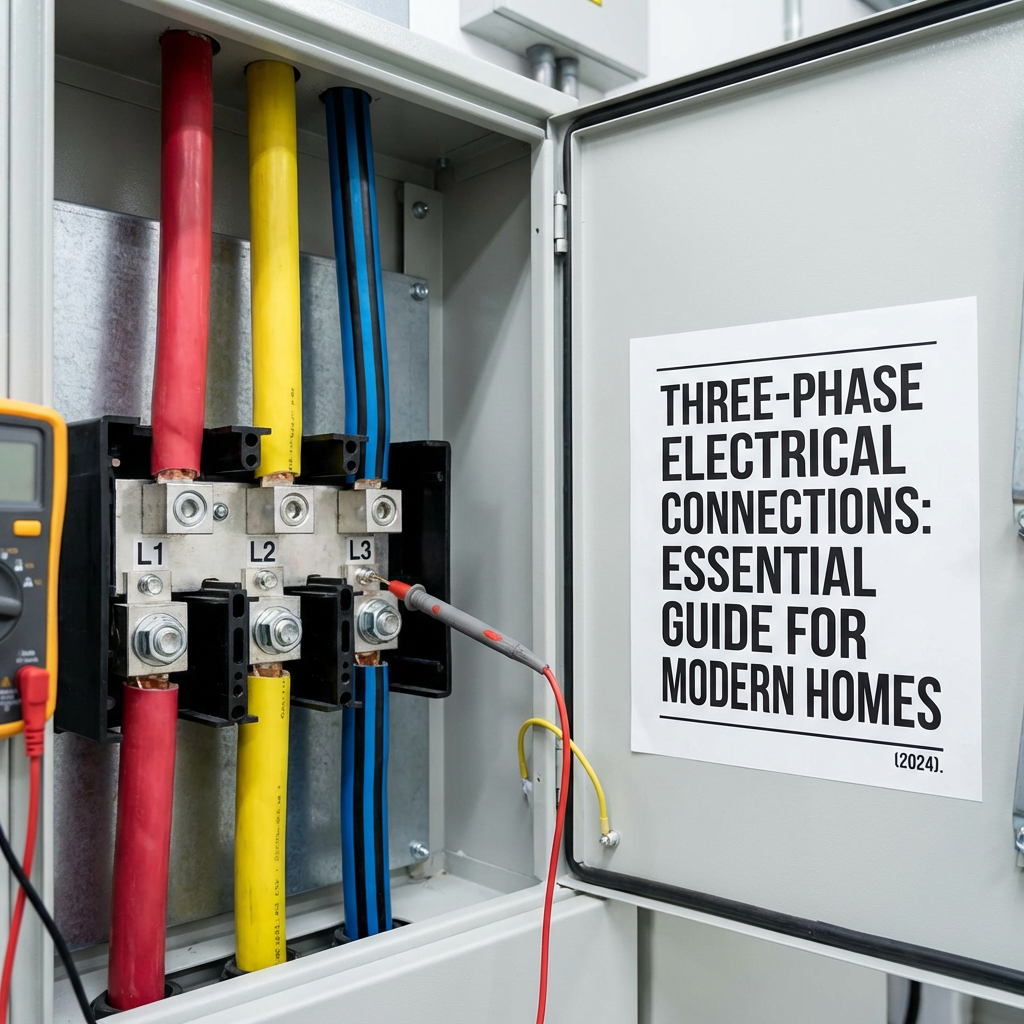
In-Depth Look
Detailed illustration of key concepts
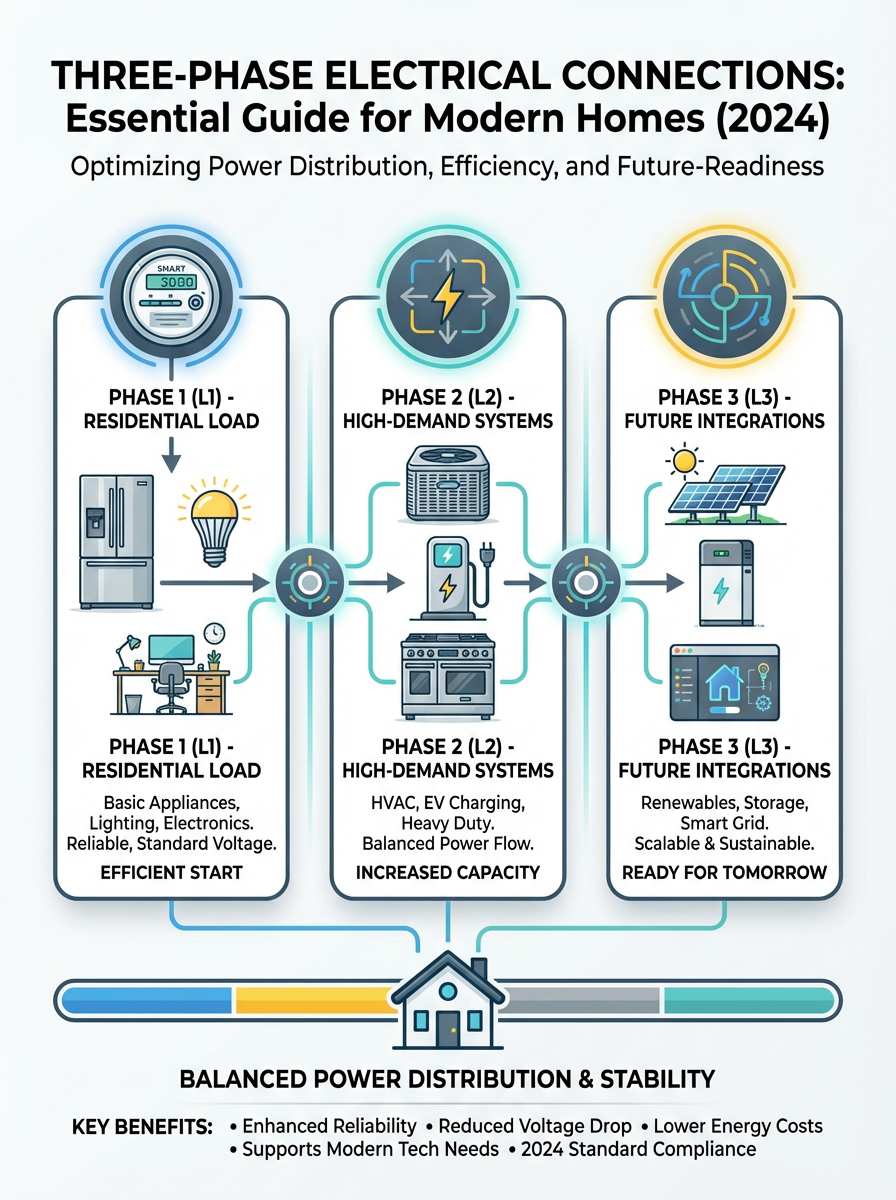
Visual Guide
Infographic illustration for this topic
Sources & References
- The Utimate Guide to Three Phase Electricity - YouTube
- Three Phase Electrical Wiring Installation in Home - NEC & IEC
- Three Phase Electrical Power Basics. - YouTube
- Best Tool Brand for Electricians 2025: Expert Rankings - Wood Guide
- Best Electrician Tools Brand Guide
- 35 Essential Electrician Tools Every Pro Needs in 2025
- Essential 2025 Electrician Tools & Safety Warnings (New & Pro Tips!)
- Top 20 Essential Electrician Tools for Pros (2026 List) - Workiz
Frequently Asked Questions
Need Professional Help?
Find top-rated electricians experts in your area