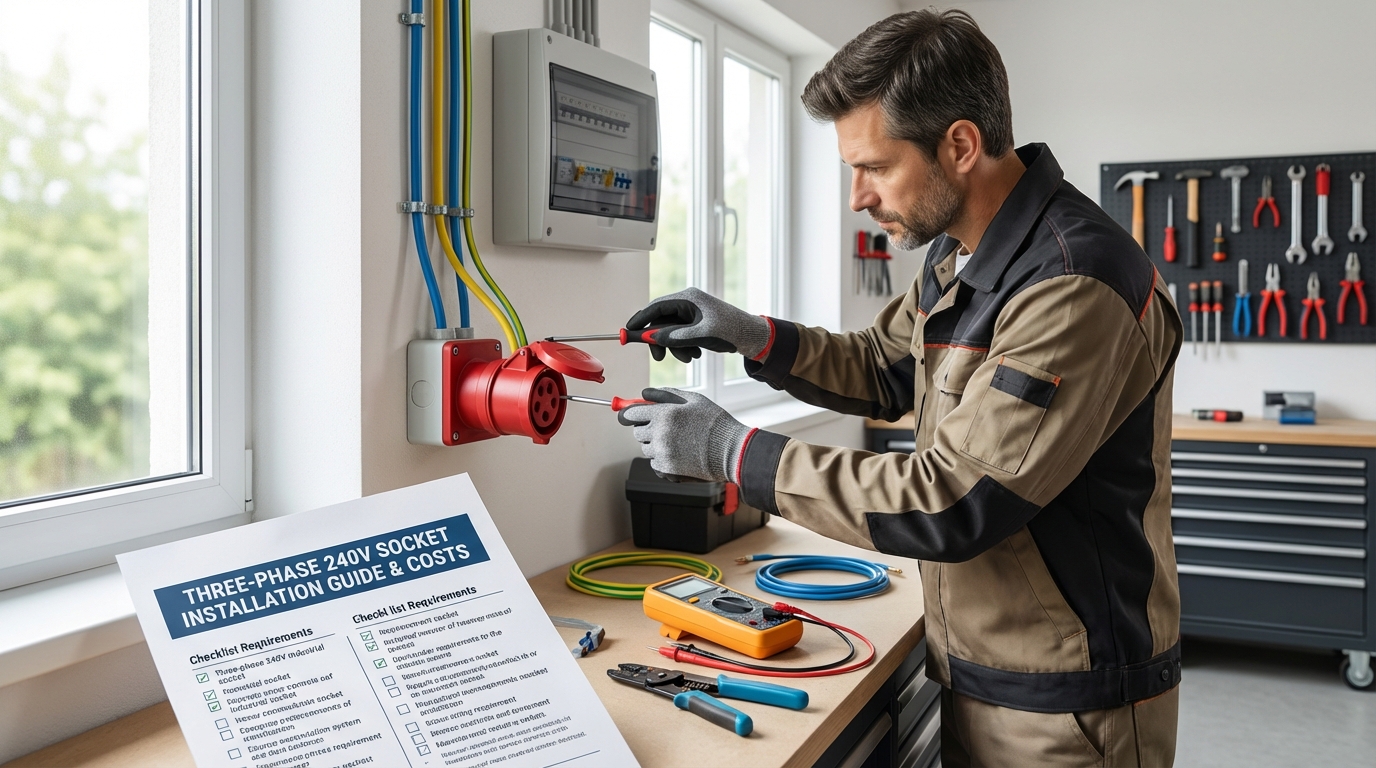
Get expert three-phase 240V socket installation. Licensed pros explain costs ($1,500-$12,000), requirements, and when you need commercial power upgrades.
Key Takeaways
- **Commercial Induction Cooktop:** 18 kW monster. Insane temperature control, but you're not plugging this into a regular outlet.
- **Dual Convection Ovens:** 12 kW each. Professional bakers would be jealous.
- **Commercial Exhaust Hood:** 4 kW just for ventilation. This thing could probably create a small tornado.
- **Walk-in Wine Cellar:** 3 kW climate control system. Guy had about $200,000 worth of wine he wanted kept at exactly 55°F.
- **Distance from Electrical Panel:** Long runs get expensive fast. Heavy-gauge copper wire isn't cheap, and labor adds up. We had one installation where the panel was 150 feet from where the client needed the socket. Just the wire run added $2,800 to the project.
Key Takeaways
Three-Phase 240V Socket Installation: Costs & Requirements Guide
Ever walked into a factory or high-end restaurant kitchen and felt that distinct electrical presence? That low hum of serious power? That's three-phase electricity doing its thing. And honestly? It's in a completely different league than what's powering your coffee maker at home.
A three-phase 240V socket isn't some fancy version of a regular outlet. It's fundamentally different. We're talking industrial-grade power delivery for equipment that laughs at standard residential electricity. Your typical 120V outlet? Cute. Even most 240V single-phase circuits? They're adorable compared to this.
What Exactly *Is* Three-Phase Power, and When Do You Absolutely Need It?
Here's the deal: three-phase electrical systems use three separate AC currents, each hitting its peak at different moments. It's beautifully choreographed. Think of it like three pistons in an engine, each firing in perfect sequence to create smooth, continuous power.
Single-phase systems max out around 100-200 amps for most homes. Fine for everyday stuff. Three-phase? We're talking 400 amps or more without breaking a sweat.
So when do you actually need this upgrade? If you've got equipment pulling more than 7,500 watts, you're probably already there. And here's where it gets interesting — we see people buy expensive commercial equipment all the time without checking their power situation first.
Big mistake.
I remember this homeowner in Coral Gables who dropped $18,000 on a professional-grade induction range. Gorgeous unit. He'd planned this dream kitchen renovation for months. Problem? His house ran on single-phase power, and this beast needed three-phase to even turn on. The range sat in his garage for three weeks while we sorted everything out with the utility company. Cost him another $8,500 just to get the right power to his house.
In a three-phase system, power flows through three conductors. Each phase is offset by 120 degrees. Why does this matter? Because you get incredibly stable, consistent power delivery. No voltage sags when everything kicks on at once. No flickering lights. No equipment struggling during high-demand moments.
That stability alone can extend your equipment's lifespan by years.
Why Three-Phase Absolutely Crushes Single-Phase for Heavy Loads
Commercial equipment needs consistent power. Period. With single-phase systems, you'll see those annoying voltage dips — lights dimming when the AC compressor starts up, that sort of thing.
Three-phase? Basically eliminates the problem.
Our electricians see this every single day: three-phase motors run smoother, last longer, and use energy more efficiently. We had a restaurant owner in Brickell who switched from struggling with single-phase to proper three-phase power. His equipment maintenance costs dropped 40% in the first year.
Not an exaggeration. Actual numbers from his books.
Which Appliances Are Screaming for Three-Phase Socket Installation?
Most commercial-grade appliances over 7,500 watts? They need three-phase. It's not a preference thing. They literally won't operate properly without it.
This covers everything from massive kitchen equipment to industrial machinery to those crazy-fast EV charging stations everyone wants now.
We just finished a project in Pinecrest — luxury home, serious home chef situation. The client wanted restaurant-level performance in his kitchen. Here's what demanded three-phase power:
- **Commercial Induction Cooktop:** 18 kW monster. Insane temperature control, but you're not plugging this into a regular outlet.
- **Dual Convection Ovens:** 12 kW each. Professional bakers would be jealous.
- **Commercial Exhaust Hood:** 4 kW just for ventilation. This thing could probably create a small tornado.
- **Walk-in Wine Cellar:** 3 kW climate control system. Guy had about $200,000 worth of wine he wanted kept at exactly 55°F.
Total project cost? Around $47,000, with about $9,200 going specifically to the three-phase service upgrade and installations.
Worth every penny, according to him.
Equipment Categories That *Absolutely Demand* Three-Phase Power:
1. **Commercial Kitchen Appliances:** Industrial ranges, massive convection ovens, deep fryers, walk-in coolers, commercial dishwashers. Real talk: if it belongs in a restaurant, it probably needs three-phase.
2. **Large HVAC Systems:** We're talking 5-ton-plus units. Commercial chillers. Anything cooling or heating serious square footage.
3. **Industrial Workshop Equipment:** Professional welders, plasma cutters, large compressors, CNC machines. The stuff that actually builds things.
4. **EV Fast-Charging Stations:** Level 3 DC fast chargers? Almost exclusively three-phase. You want that 80% charge in 20 minutes? This is how you get it.
5. **High-Capacity Pool Equipment:** For those massive resort-style pools. We're not talking about your neighbor's 15-footer here.
6. **Server Racks and Data Centers:** Downtime costs money. Sometimes thousands per minute. Three-phase keeps everything running. For more on this, check out our guide on [data center electrical solutions](link to an article about data center electrical solutions).
Now here's the kicker: most residential properties run single-phase. Converting to three-phase? That's a major infrastructure project. Often requires deep coordination with your utility company. Sometimes they need to run new lines to your property.
Not a weekend DIY situation.
Look — for general electrical upgrade info, our article on [home electrical upgrades](link to an article about home electrical upgrades) covers the basics, but three-phase is honestly a different animal entirely.
How Much Does This Power Upgrade Actually Cost?
The price swings wildly depending on your existing setup.
Already have three-phase service at your main panel? You're looking at **$1,500 to $3,000** for adding a socket. Pretty manageable.
Starting from scratch with single-phase service? Buckle up. **$5,000 to $12,000 or more.** And that "or more" can get significant if your property's far from existing three-phase lines.
I've seen quotes hit $18,000 for rural properties where the utility had to run new transformers and distribution lines. One guy in Southwest Ranches got quoted $22,000 because he was literally a quarter mile from the nearest three-phase service.
He ended up going with a large single-phase setup and different equipment. Sometimes that's the smarter play.
At BizzFactor, we don't quote this stuff over the phone. Too many variables. We insist on on-site assessments because we've learned — the hard way — that assumptions about electrical infrastructure are usually wrong. For insights on related upgrade costs, our guide on [electrical panel upgrade costs](link to an article about electrical panel upgrade costs) might help.
What Factors Make That Three-Phase Installation Bill Go Up (or Down)?
So many things affect the final number:
- **Distance from Electrical Panel:** Long runs get expensive fast. Heavy-gauge copper wire isn't cheap, and labor adds up. We had one installation where the panel was 150 feet from where the client needed the socket. Just the wire run added $2,800 to the project.
- **Service Upgrade Requirements:** This is usually the big cost driver. Converting from single-phase to three-phase utility service? You're potentially talking new transformers, upgraded meter mains, completely new distribution panels. And the utility company? They'll charge you for their work too. Sometimes substantially.
- **Conduit Installation:** Protective conduit isn't optional for exposed runs or anything going through walls. Whether it's rigid metallic, intermediate, or EMT, it adds material and labor costs. But it's also what keeps your installation code-compliant and safe for decades.
- **Permit and Inspection Fees:** High-voltage work requires permits. Always. Multiple inspections at different stages. These fees aren't trivial — usually $300 to $800 depending on your jurisdiction — but they ensure safety compliance. Your insurance company will thank you later.
- **Equipment Specifications:** Specialized three-phase breakers, heavy-gauge wiring, industrial-rated receptacles (those NEMA locking types aren't cheap). Quality components cost more upfront but last way longer. In most cases, they'll outlive the building.
Typical Price Ranges Our Clients See:
1. **Simple Replacement/Addition (Existing Three-Phase Service):** $800 - $1,200. You already have three-phase at the panel, just need an outlet nearby. Low complexity.
2. **New Circuit Installation (Existing Three-Phase Panel):** $1,500 — $3,000. Running a new dedicated circuit across the building, but leveraging existing three-phase service.
3. **Complete Service Upgrade (Single to Three-Phase Conversion):** $5,000 - $12,000+. This is the full transformation. New utility connection, panel upgrades, the works.
Look — that cheapest bid will always be tempting. Human nature. But for high-voltage work, cheap usually means corners get cut. And in electrical work? Cut corners can literally kill people.
We've been called to fix "bargain" three-phase installations more times than I can count. Usually costs the property owner double what doing it right would've cost originally.
For safe, code-compliant work, choose [licensed and insured electricians](link to an article about choosing an electrician) with actual three-phase experience. Ask for references. Check their license status. It matters.
What's the Professional Three-Phase Socket Installation Process Really Like?
Our licensed electricians follow a specific process for every three-phase installation.
Starts with a comprehensive electrical assessment. We use Fluke voltage testers, thermal imaging cameras, and load calculation software. This isn't eyeballing it. We're gathering actual data about your existing system, calculating exact loads, and determining what infrastructure changes you'll need.
This initial phase usually takes 1-2 hours for residential properties. Commercial sites? Sometimes a full day.
From there, we develop a detailed installation plan that covers utility coordination, panel modifications, conductor sizing, and receptacle specifications. Everything adheres to National Electrical Code (NEC) standards and local amendments. Because passing inspection matters, and more importantly, keeping people safe matters.
The Step-by-Step Installation Timeline:
**Phase 1: Assessment and Planning (1-3 days)**
We evaluate your current electrical service, calculate total load requirements, and determine if a utility upgrade's necessary. If you need three-phase brought to your property, we coordinate with your utility company. This coordination alone can take 2-6 weeks depending on their schedule and any infrastructure they need to install.
Not our favorite part, honestly. Utility companies move at their own pace.
**Phase 2: Permitting (3-10 business days)**
We handle all permit applications with your local building department. Pull together technical drawings, load calculations, equipment specifications. Most jurisdictions take about a week to review and issue permits for this type of work.
**Phase 3: Utility Upgrade (if required, 2-8 weeks)**
If you're converting from single-phase, the utility company needs to install new service. This might mean new transformers, upgraded service lines, new meter equipment. Timeline depends entirely on their workload and any construction required.
We had one client wait 11 weeks because the utility needed to install a new pad-mount transformer. Frustrating? Absolutely. But unavoidable.
**Phase 4: Panel and Circuit Installation (1-3 days)**
Once three-phase service reaches your property, we install or upgrade your main distribution panel. Run new circuits using appropriately sized conductors (usually 6 AWG to 2/0 AWG depending on amperage requirements). Install dedicated circuit breakers rated for three-phase loads.
**Phase 5: Receptacle Installation and Testing (1 day)**
Install the industrial-grade three-phase receptacle. These aren't your standard outlets — we're talking NEMA L15-20, L15-30, or L21-30 configurations typically. Locking mechanisms, weather-resistant if needed, properly grounded and bonded.
Then comes testing. We verify voltage balance across all three phases, check for proper grounding, test under load conditions, and confirm everything meets spec.
**Phase 6: Final Inspection and Documentation (1 day)**
Schedule final inspection with local authorities. They verify code compliance, proper installation techniques, appropriate materials. Once you pass (and with our work, you will), you get your signed-off permit and we provide you complete documentation of the installation.
Keep that documentation. Future buyers will want it.
Common Installation Challenges We Run Into:
**Inadequate Panel Space:** Older homes often don't have room in their main panel for additional three-phase breakers. Solution? Subpanel installation or complete main panel upgrade. Adds $1,200 — $3,500 to the project usually.
**Underground Conduit Runs:** If your socket location requires running underground, you're talking trenching, proper burial depth (usually 18-24 inches for residential), and inspections before backfilling. Adds time and expense, but sometimes it's the only option. A plumber in Kendall told me he spent $4,100 just on the underground run for his shop equipment — 80 feet through landscaped areas. Worth it for him, but definitely a budget consideration.
**Load Balancing Issues:** Adding significant three-phase loads to your system means recalculating your entire electrical service capacity. Sometimes your existing service is maxed out. We've had to upgrade main services from 200A to 400A just to accommodate the new three-phase equipment safely.
Think that's overkill? Tell that to the guy whose main breaker kept tripping every time he ran his equipment.
Safety Requirements You Can't Ignore
Three-phase power is dangerous. Way more dangerous than standard residential electricity. We're talking 240V across three phases, high amperage, and serious potential for arc flash incidents if something goes wrong.
Every three-phase installation must include:
- **Proper Grounding:** Equipment grounding conductors sized per NEC Article 250. Ground fault protection where required. This isn't optional or negotiable.
- **Arc Flash Protection:** Warning labels indicating arc flash boundaries and required PPE. In commercial settings, detailed arc flash studies might be required.
- **Lockout/Tagout Capability:** For maintenance purposes, you need proper disconnects that can be locked in the off position. OSHA requirements if you have employees.
- **GFCI Protection:** Depending on location and use, ground fault circuit interrupter protection may be required. Especially for outdoor installations or anywhere near water sources.
We had a manufacturing client in Hialeah who skipped GFCI protection on an outdoor three-phase outlet to save maybe $200. Six months later, a ground fault during rain caused $15,000 in damaged CNC equipment.
Penny wise, pound foolish.
Is Three-Phase Power Actually Worth the Investment?
For the right applications? Absolutely. For others? Maybe not.
If you're running equipment that genuinely needs three-phase power, you don't really have a choice. That equipment won't function properly — or at all — on single-phase power. So the question isn't "is it worth it?" but rather "what's the most cost-effective way to make it happen?"
From what I've seen over the years, three-phase installations make the most sense for:
- **Commercial operations:** Restaurants, light manufacturing, auto shops, anywhere running multiple high-demand appliances simultaneously.
- **Serious home workshops:** If you've got professional welding equipment, large lathes, serious machinery, three-phase makes sense.
- **EV charging:** If you're installing Level 3 fast charging, especially for commercial or fleet use, three-phase is basically required.
- **Large residential HVAC:** Those massive homes with 10+ ton cooling requirements? Three-phase systems are more efficient.
It probably doesn't make sense for:
- **Typical residential upgrades:** Unless you truly need it for specific equipment, the cost usually doesn't justify the benefit.
- **Single appliance use:** If you only need power for one piece of equipment, exploring single-phase alternatives is usually smarter financially.
Real talk: nine times out of ten, when homeowners think they need three-phase, there's a single-phase solution that'll work fine and cost half as much.
But that tenth time? Three-phase is absolutely the right call.
Finding the Right Electrical Contractor for Three-Phase Work
Not all electricians are qualified for three-phase installations. This is specialized work requiring specific experience, equipment, and honestly, a comfort level with high-voltage systems that many residential electricians don't have.
When you're vetting contractors, ask:
- **How many three-phase installations have you completed in the last year?** You want someone who does this regularly, not someone figuring it out as they go.
- **Can you provide references from similar projects?** Talk to previous clients. Ask about timeline accuracy, budget adherence, and whether everything worked properly after installation.
- **What's your experience coordinating with the local utility?** This coordination can make or break project timelines. Experienced contractors have established relationships and know the process.
- **Are you licensed, bonded, and insured for commercial electrical work?** Your standard residential license might not cover three-phase installations depending on your state.
And honestly? Get at least three quotes. But don't automatically pick the cheapest.
A qualified contractor will:
- Insist on a site visit before quoting
- Provide detailed, written estimates breaking down materials and labor
- Explain potential challenges specific to your property
- Offer realistic timelines that account for utility coordination
- Pull all necessary permits and schedule all required inspections
If someone's quoting over the phone or promising unrealistic completion times, that's a red flag the size of Texas.
Bottom Line
Three-phase 240V socket installation isn't a simple weekend project. It's serious electrical infrastructure work that requires planning, proper permitting, often utility coordination, and always professional installation.
Costs range from around $1,500 for simple additions to existing three-phase service, up to $12,000 or more for complete single-phase to three-phase conversions. Your specific cost depends on distance, existing infrastructure, utility requirements, and equipment specifications.
But when you need it, you need it. And doing it right the first time — with qualified electricians, proper permits, quality materials — saves you money, protects your equipment, and keeps people safe.
That's not something you compromise on.
In-Depth Look
Detailed illustration of key concepts
Visual Guide
Infographic illustration for this topic
Sources & References
- How to CONNECT three-phase plug and socket | Tutorial - YouTube
- How to Master Commercial Panel Wiring: Tips Electricians Swear By!
- three phase sockets - Electricians Forums
- Best Tool Brand for Electricians 2025: Expert Rankings - Wood Guide
- Top 20 Essential Electrician Tools for Pros (2026 List) - Workiz
- Best Electrician Tools Brand Guide
- Essential 2025 Electrician Tools & Safety Warnings (New & Pro Tips!)
- 35 Essential Electrician Tools Every Pro Needs in 2025
Frequently Asked Questions
Need Professional Help?
Find top-rated electricians experts in your area