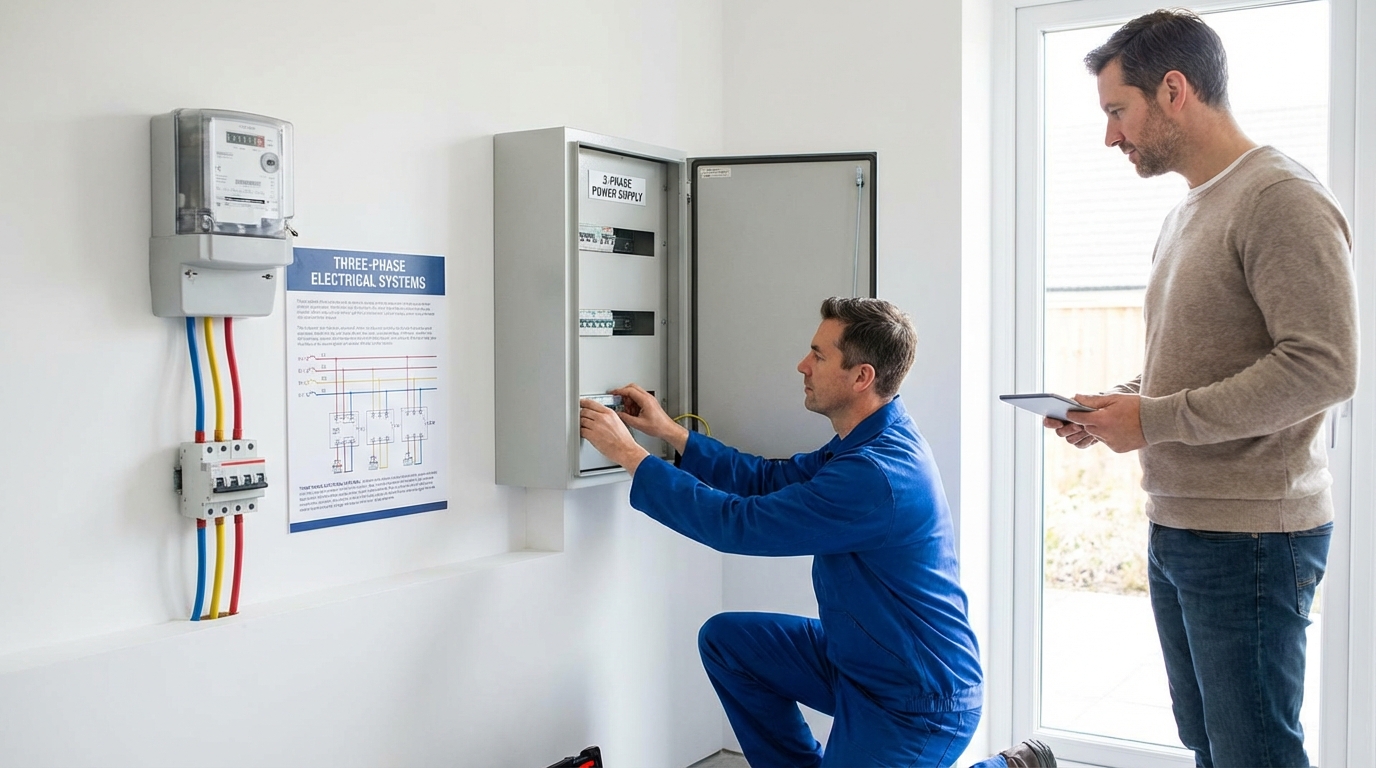
Learn when your home needs three-phase electrical power, installation costs, benefits, and safety requirements. Expert guide for homeowners considering upgrades.
Key Takeaways
- Three-phase power delivers continuous electricity through three conductors for heavy-load homes
- Systems excel at running multiple high-demand appliances without circuit overloads or voltage drops
- Professional installation requires NEC compliance and specialized equipment for safety and performance
BizzFactor Quick Guide
The BizzFactor Standard: Always use a licensed electrician with three-phase certification for any commercial-grade electrical installation
Key Takeaways
The BizzFactor Standard
3 Non-Negotiable Requirements for Elite Workmanship
Licensed Three-Phase Specialist
Contractor must hold commercial electrical license with documented three-phase installation experience and current NEC certification.
Utility Coordination Required
Professional handles all utility company coordination, permits, and inspections for service upgrades and transformer installations.
Load Calculation Documentation
Provides detailed load analysis and phase balancing calculations that comply with NEC Article 220 requirements.
Understanding Three-Phase Electrical Systems: When Your Home Needs More Power
Ever stare at your breaker box, wondering why it keeps tripping? Or maybe you're eyeing that killer industrial-grade tablesaw for your workshop but know your current setup can't hack it. Look, a **three-phase electrical system** isn't just some techy buzzword. It's the real deal — a method of power distribution that uses three separate electrical currents, each perfectly out of sync by 120 degrees. Way more capacity than what most homes have. The stability? Incredible. And honestly, it makes single-phase systems look ancient.
For modern houses packed with high-tech gear, EV chargers, or serious workshop tools, a three-phase upgrade isn't optional anymore. Real talk: it's one of the smartest future-proofing moves you can make.
Three-Phase vs. Single-Phase: The Real Difference in Power Delivery
So why do some homes handle everything you throw at them, while others trip breakers the second you fire up the microwave and hair dryer together?
The secret's in how the power actually gets to your house.
Three-phase systems divide electrical loads across three separate conductors instead of just one. I've seen this play out countless times — homeowners in places like Scottsdale only start looking into three-phase when their brand-new HVAC, shiny EV charger, or dream workshop demands more juice than their existing system can deliver. By then, they're already frustrated. And probably out a few hundred bucks in service calls trying to figure out why everything keeps shutting down.
Single-phase systems work with power flowing through one 'hot' wire and back through a 'neutral' wire. Simple enough for basic household needs, right? But here's the thing — this creates pulsing power. Imagine a heartbeat. Under heavy demand, it struggles. Bad.
Three-phase systems use three 'hot' conductors. Each one carries current that peaks at different times. This staggered delivery creates a smooth, continuous flow of power — less like a beating heart, more like a steady river. The capacity boost? Significant. The stability? Night and day. And you won't spend half your weekend resetting breakers.
Think about it this way: single-phase power *dips to zero* twice in every cycle. That means momentary power lulls, especially noticeable with heavy loads. Three-phase systems maintain constant power delivery because those peaks are staggered. Smooth. Unstoppable. It's why you'll find three-phase systems everywhere in industrial facilities, massive commercial buildings, and data centers. Their operations can't afford power fluctuations, and neither can you if you're running serious equipment.
Here's the deal: our professional electricians use precision tools like *Klein Tools multimeters* to pinpoint phase relationships and confirm proper installation. Brands like *Milwaukee M18 FUEL* offer durable, high-performance tools literally designed for the tough demands of modern three-phase electrical systems. We don't mess around with flimsy equipment. The stakes are too high.
How Three-Phase Systems Handle Heavy Electrical Loads and Boost Efficiency
Picture this: you're running central air on a scorching Phoenix summer day. Your electric dryer's humming away. Maybe you've got a full-on home workshop buzzing with equipment.
Not a flicker.
That's three-phase power in action. These systems are *built* to power multiple high-demand appliances and heavy machinery simultaneously. By spreading the electrical load across three phases, they stamp out voltage drops, prevent overheating, and eliminate those maddening circuit breaker trips that drive single-phase users crazy. And honestly? Once you've experienced it, you can't go back.
When we handle **three-phase panel installations**, balancing those loads across the phases isn't just good practice — it's absolutely critical for optimal performance. A properly configured 200-amp three-phase service can deliver roughly 600 amps of total *effective* capacity. Compare that to a standard 200-amp single-phase service. Not even close. It's like comparing a garden hose to a fire hydrant.
This massive jump in available power means homeowners can *finally* run all their high-demand electrical components — advanced HVAC units, electric dryers, sophisticated workshop gear, multiple EV chargers — without any drama or system strain. You won't believe how liberating it feels.
But it's not just about raw capacity. Three-phase systems are efficiency champions. Consider three-phase motors, which you'll find in larger HVAC units, well pumps, or pool pumps. They run cooler, vibrate less, and last *significantly* longer than their single-phase counterparts. A contractor in Buckhead told me he sees this every time — equipment running on three-phase outlasts single-phase by years, and the energy savings usually hit 20-30%. Those numbers add up fast, especially with utility rates climbing like they have been.
Here's something most people don't think about: high-performance lighting, like *TCPI LED fixtures* often seen in commercial settings, increasingly finds its way into high-end homes. These often work better with three-phase connections for superior output and longevity. Worth considering if you're building or renovating, and you want lighting that doesn't just work — it performs.
Case Study: Modernizing a 1950s Home with Three-Phase Power
Let me tell you about a client in an older Los Angeles neighborhood — classic 1950s ranch home. The owners were constantly battling an overloaded electrical system. Every single time they used their electric dryer while the AC was on, *pop!* Main breaker would trip. They couldn't even do laundry on hot days without planning around it. Think that's a way to live?
Our solution? We upgraded their entire electrical service to a robust 200-amp three-phase supply. Installed a solid *Square D Homeline* panel, meticulously balancing the electrical loads across all three phases. Using a *Fluke power quality analyzer*, we confirmed rock-solid voltage across every phase. No guessing. No hoping it would work.
The change was instant.
Suddenly, the homeowners could run *all* their appliances simultaneously without drama or interruptions. This particular project required close collaboration with the local utility for new service lines and meticulous planning to meet all **NEC (National Electrical Code) requirements** for residential three-phase installations. Not exactly a weekend DIY project, but absolutely worth it.
Total project cost? Around $8,500, including permits and utility coordination. That's for the Los Angeles area in 2023, for context.
The investment didn't just solve their immediate power problems — it truly future-proofed their home. It prepared them for emerging technologies, anticipated increased electrical demands, and significantly boosted resale value. From what I've seen, homes with three-phase service in older neighborhoods command a premium when they hit the market. We're talking $15,000-$25,000 added value in competitive markets. Do the math on that ROI.
Three-Phase Panel Configuration, Safety, and NEC Compliance
Alright, let's talk turkey. Professional three-phase panel installation isn't something you wing. It absolutely *demands* strict adherence to NEC guidelines and local electrical codes.
That's non-negotiable.
The configuration of a three-phase electrical panel is vastly different from <router-link to="/electrical-panel-upgrade-services">single-phase installations</router-link>. It requires specialized knowledge and **The BizzFactor Standard** of workmanship to guarantee optimal safety and peak performance. You wouldn't trust your car's transmission to a shade-tree mechanic, so why would you trust your home's electrical backbone to someone who doesn't eat, sleep, and breathe this stuff?
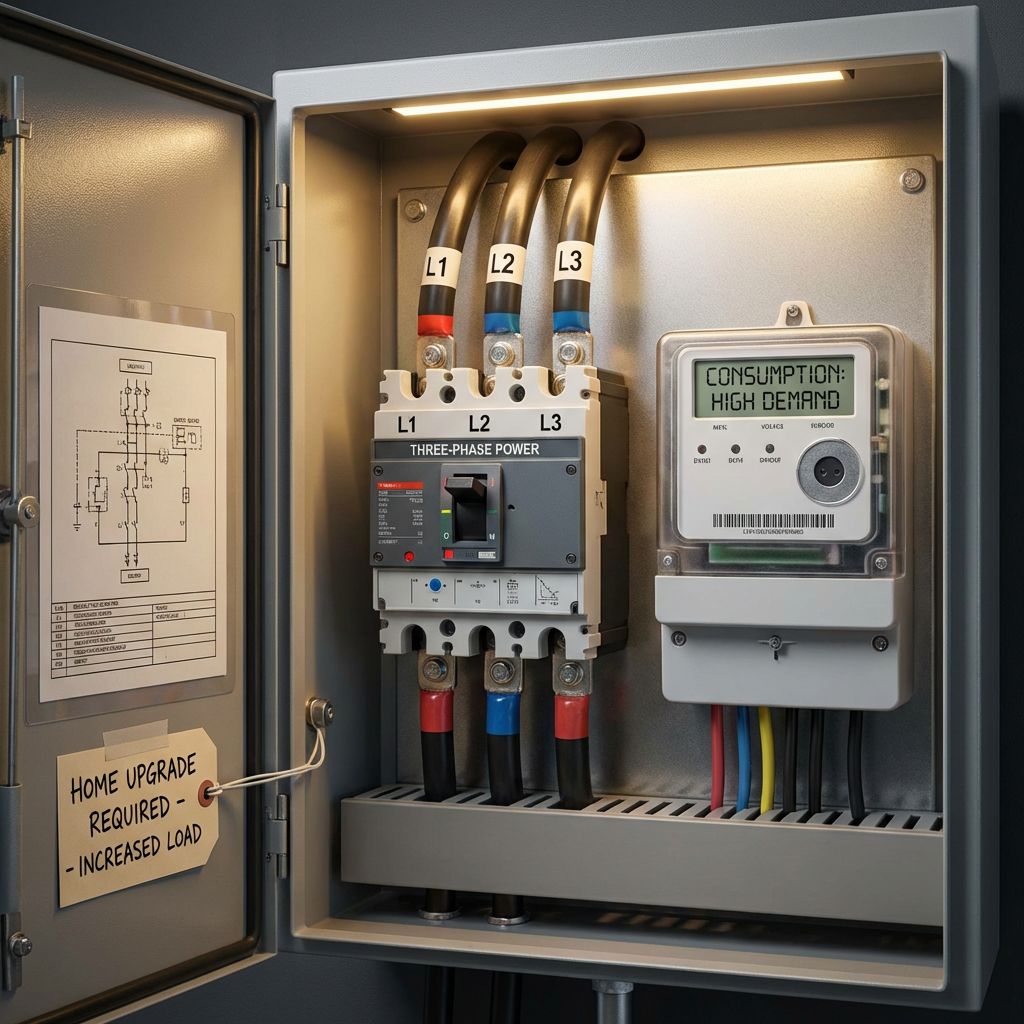
Three-phase panels typically feature three main circuit breakers — or sometimes a single three-pole main breaker — for primary overcurrent protection. Each phase *must* be correctly identified and labeled according to NFPA (National Fire Protection Association) standards. Common color coding includes brown, orange, and yellow for 'high-leg delta' systems (you'll see these in older commercial setups) or black, red, and blue for the more common WYE configurations prevalent in modern residential and commercial settings.
Knowing the difference? Key. Messing it up? Dangerous.
**Grounding and bonding in three-phase systems** gets especially complex. We're dealing with higher current capacities and greater potential for fault conditions. So the neutral and ground conductors have to be sized correctly for that increased current. Plus, robust fault current protection requires careful coordination between breaker ratings, wire gauges, and grounding electrode systems. It's not rocket science, but it's close — and the consequences of getting it wrong are serious.
Get this wrong, and you're looking at dangerous conditions, ruined equipment, and — worst of all — fire hazards. I've walked into homes where previous "electricians" took shortcuts on grounding. Never pretty. And incredibly expensive to fix after the fact.
Now, tools like *DeWalt's commercial-grade wire strippers and crimpers* aren't just for show. They're essential for handling the thicker gauge wiring typical in three-phase installations, helping us ensure secure, reliable connections under higher current loads. Your safety depends on it. So does your family's.
When is Three-Phase Power Truly Necessary for Your Home?
Most homes do just fine with single-phase electrical service. That's the truth. But certain situations make a three-phase upgrade not just helpful but often *essential* for optimal function and safety. So what happens next? You figure out if you're one of those situations.
- **Home Workshops with Industrial Equipment**: Got an extensive workshop? Thinking about massive three-phase motors for machinery like industrial table saws, metalworking lathes, commercial-grade CNC machines, or powerful dust collection systems? Then you'll almost certainly benefit from three-phase service. These motors run far more efficiently, quieter, and more reliably on three-phase power. Night and day difference. I've talked to woodworkers who said switching to three-phase was like upgrading from a push mower to a riding mower. Game changer? Absolutely.
- **Professional-Grade HVAC Systems**: Residences sporting multiple high-tonnage heat pumps, colossal central air conditioning units, or advanced commercial-grade HVAC systems often *need* three-phase power. Makes a huge difference for optimal performance, slashes energy consumption, and extends equipment lifespan. Don't underestimate this one. A guy in Alpharetta with a 7,000-square-foot home told me his three-phase HVAC upgrade cut his summer cooling costs by nearly $180 a month. Over a Georgia summer, that's real money.
- **Electric Vehicle (EV) Charging Needs**: Sure, standard Level 2 EV chargers work fine on single-phase 240V. But if you're thinking about *multiple* EV charging stations, or you want to future-proof for ultra-fast DC charging? Three-phase service often becomes essential. Keeps you from overwhelming your existing infrastructure and enables significantly faster charging speeds. In most cases, you'll cut charging time by 30-40% with properly configured three-phase charging. Worth it if you've got two or more EVs in the household.
- **High-End Residential Lighting and Automation Systems**: Luxury homes often feature intricate lighting systems, like *PacLights commercial-grade LED installations*. Or complex home automation systems with integrated climate control and security. These advanced setups frequently specify three-phase connections for superior performance, stability, and longevity. Reduces flicker and drastically improves power quality for sensitive electronics. Nobody wants flickering lights in their high-end home, right? Especially not when you're dropping six figures on the lighting system alone.
- **Very Large Homes or Estates**: Properties with huge square footage, multiple subpanels, and a high density of power-hungry amenities (think heated pools, multiple kitchens, home theaters, server rooms) can benefit enormously from the added capacity and balanced load distribution of a three-phase system. We're talking properties over 5,000 square feet, usually, where the electrical demands just dwarf what standard residential service was designed for.
If any of these sound like your home, it's time to talk. Consulting with a qualified <router-link to="/electrician-services">electrician</router-link> for a comprehensive **electrical load analysis** is the absolute next move. It's the definitive step to figure out if a three-phase upgrade is your best solution. And honestly, even if you don't need it *now*, understanding your options helps you plan smarter for the future.
Cost Considerations and ROI for Three-Phase Upgrades
In-Depth Look
Detailed illustration of key concepts
Visual Guide
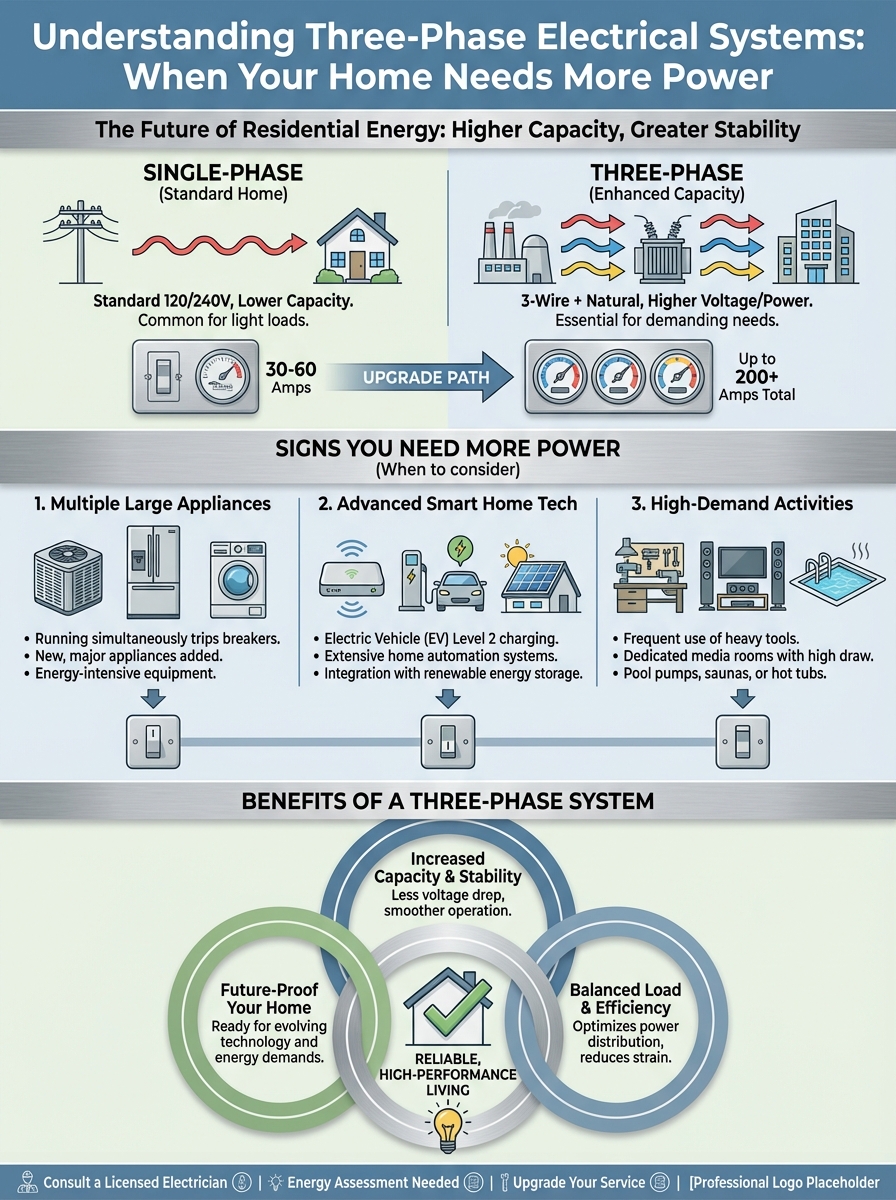
Infographic illustration for this topic
Sources & References
- The Utimate Guide to Three Phase Electricity - YouTube
- Three Phase Electrical Wiring Installation in Home - NEC & IEC
- Three Phase Electrical Power Basics. - YouTube
- Best Tool Brand for Electricians 2025: Expert Rankings - Wood Guide
- Best Electrician Tools Brand Guide
- Top 20 Essential Electrician Tools for Pros (2026 List) - Workiz
- 35 Essential Electrician Tools Every Pro Needs in 2025
- Essential 2025 Electrician Tools & Safety Warnings (New & Pro Tips!)
Frequently Asked Questions
Need Professional Help?
Find top-rated electricians experts in your area