Compare water heater timers vs. smart switches to save energy. Learn pros, cons, and essential safety tips for automation. Discover which is best for your home.
Key Takeaways
- **Who should buy one?** Honestly, anyone who leaves for work at 7:15 AM and comes home around 6 PM, five days a week. Retired couple who does laundry on Tuesday mornings? Perfect. The less your routine changes, the better these work.
- **Advantages:**
- **They just don't quit.** No software updates. No cloud servers going offline. These things run for years on the same schedule because there's nothing digital to fail.
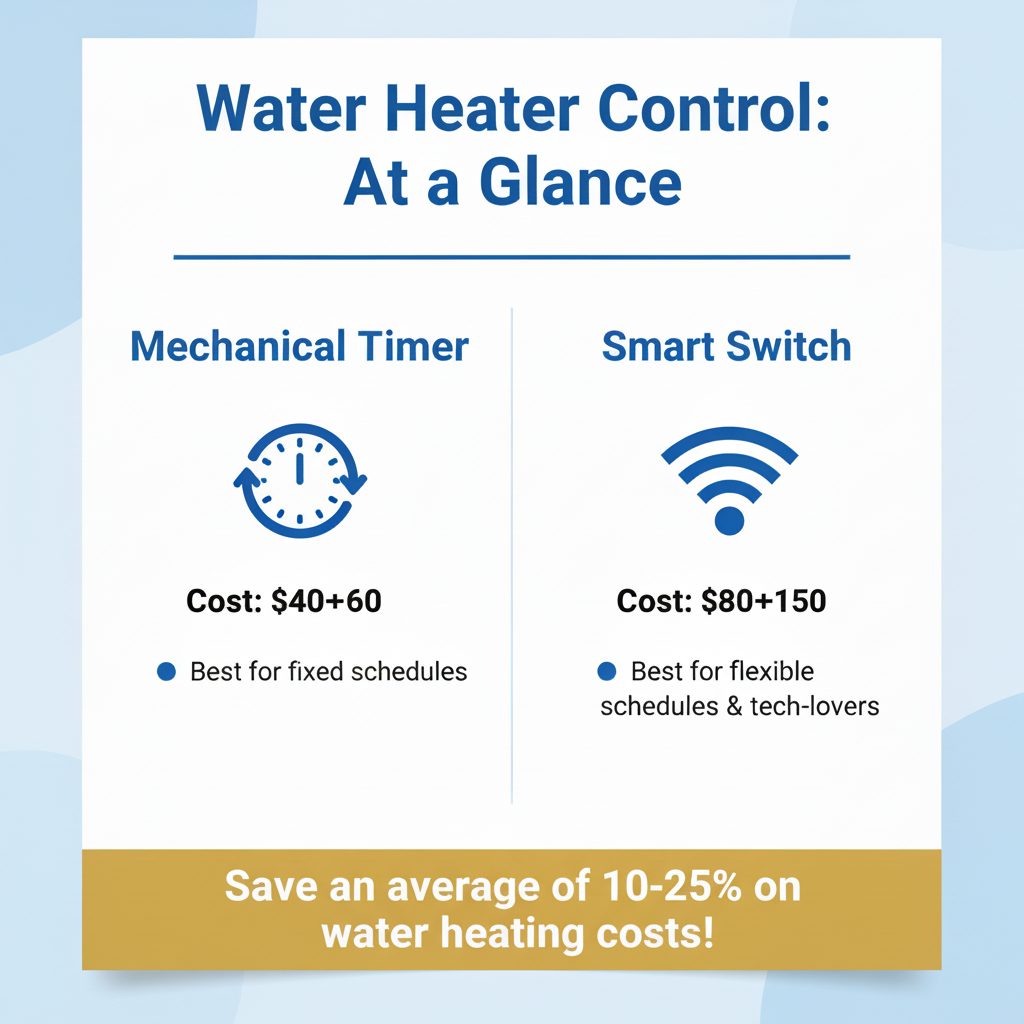
- **Cheap upfront.** You're looking at $40-$60, installed by an electrician for maybe $200-$300 total.
- **Internet? Don't need it.** Power outage knocks out your Wi-Fi? Doesn't matter. Timer keeps ticking.
Key Takeaways
Water Heater Timer vs. Smart Switch: Which is Best for Your Home?
A guy in East Dallas just saved $380 on his annual electric bill. His secret? A $90 smart switch and a phone call to a licensed electrician.
Look, if you're trying to cut energy costs without freezing in the shower, automating your water heater is one of the smartest moves you can make. But here's where most online guides fail you: **this is 240-volt, 30-amp wiring we're talking about**. Professional installation by a licensed electrician isn't a suggestion—it's the only safe play. That's the real issue. I've seen what happens when people treat this like installing a doorbell.
Water Heater Automation: Timer vs. Smart Switch
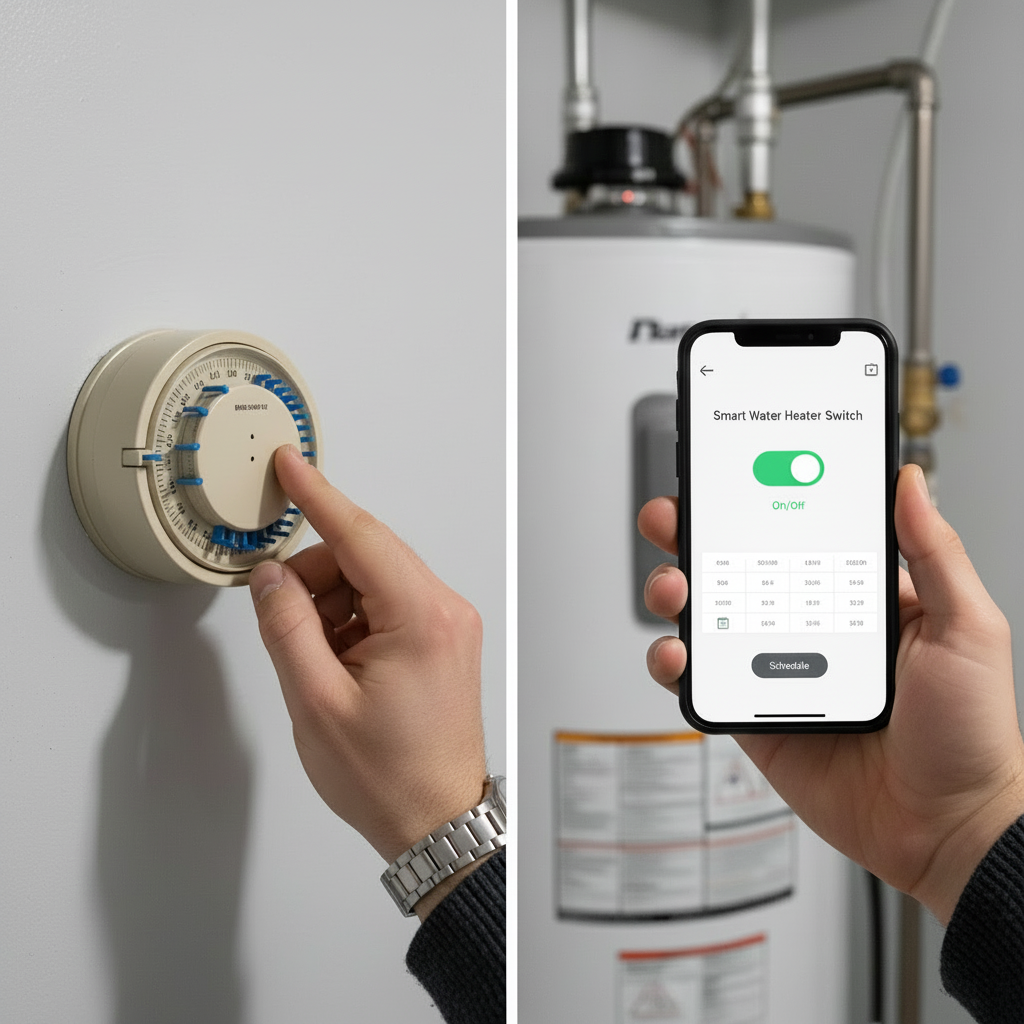
The choice between a traditional timer and a smart switch really comes down to how you live. Got a routine that rarely changes? A mechanical timer does the job for sixty bucks. Schedule all over the place, or want to heat water from your phone while you're stuck in traffic? Smart switch. Different tools for different lives.
Mechanical Timers: Robust, Reliable, and Simple
Mechanical timers are basically the Honda Civic of water heater controls. They work without Wi-Fi, without apps, without any of that connectivity nonsense that breaks when your router has a bad day. You've got a physical dial, you pop in some plastic pins for your schedule, and it runs that schedule until the apocalypse.
- **Who should buy one?** Honestly, anyone who leaves for work at 7:15 AM and comes home around 6 PM, five days a week. Retired couple who does laundry on Tuesday mornings? Perfect. The less your routine changes, the better these work.
- **Advantages:**
- **They just don't quit.** No software updates. No cloud servers going offline. These things run for years on the same schedule because there's nothing digital to fail.
- **Cheap upfront.** You're looking at $40-$60, installed by an electrician for maybe $200-$300 total.
- **Internet? Don't need it.** Power outage knocks out your Wi-Fi? Doesn't matter. Timer keeps ticking.
- **Dead simple to use.** My 70-year-old dad set his own schedule. If he can do it, anyone can.
- **Limitations:**
- **Changing the schedule means opening the panel and physically moving those little pins around.** Not hard, just annoying if your life isn't predictable.
- **You get on/off scheduling. That's it.** No remote access, no usage reports, nothing that requires a screen.
Smart Switches: Flexible, Connected, and Feature-Rich
Smart switches plug your water heater into the same ecosystem as your thermostat and doorbell. Control from your phone. Change schedules without crawling into a utility closet. Some (like Aquanta) actually learn your patterns and optimize themselves—basically AI for hot showers, which sounds ridiculous until you realize it works.
- **Best fit?** Shift workers, freelancers working from home three days a week, families with teenagers who shower at random 10 PM intervals. Anyone whose schedule changes week-to-week. Also tech people who track everything (you know who you're).
- **Advantages:**
- **You can turn your water heater on from the grocery store** if you realize you'll need hot water earlier than usual. App on your phone, done in 10 seconds.
- **Different schedules for different days.** Monday through Friday it heats at 5 AM. Weekends? Sleep in, heat at 8 AM. Takes about two minutes to set up.
- **Some models show you exactly how much electricity you're using.** Track it by day, by week, figure out what schedule actually saves the most money instead of guessing.
- **Works with Alexa or Google Home** if you're into that. "Hey Google, turn on the water heater." (Useful exactly never, but it's possible.)
- **Limitations:**
- **You're spending $80-$150 instead of $50.** Plus installation, you're probably $350-$400 all-in.
- **No Wi-Fi? Limited functionality.** Some features work offline, but remote control obviously doesn't.
- **You're trusting the company's app will exist in five years.** Most do, some don't. That's tech for you.
⚠️ Critical Electrical Safety Alert: The Continuous Load Rule
Here's where a shocking number of installers—even some who should know better—get it wrong. And it's dangerous.
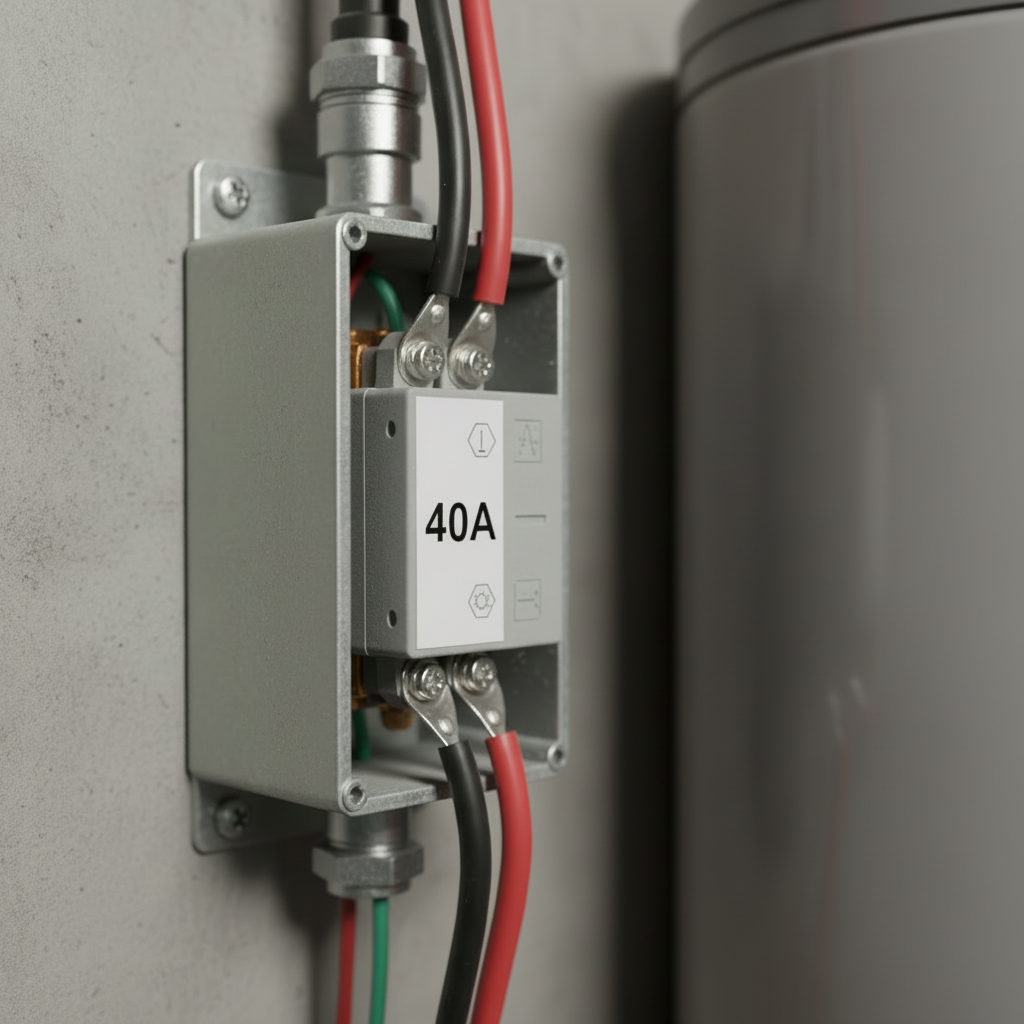
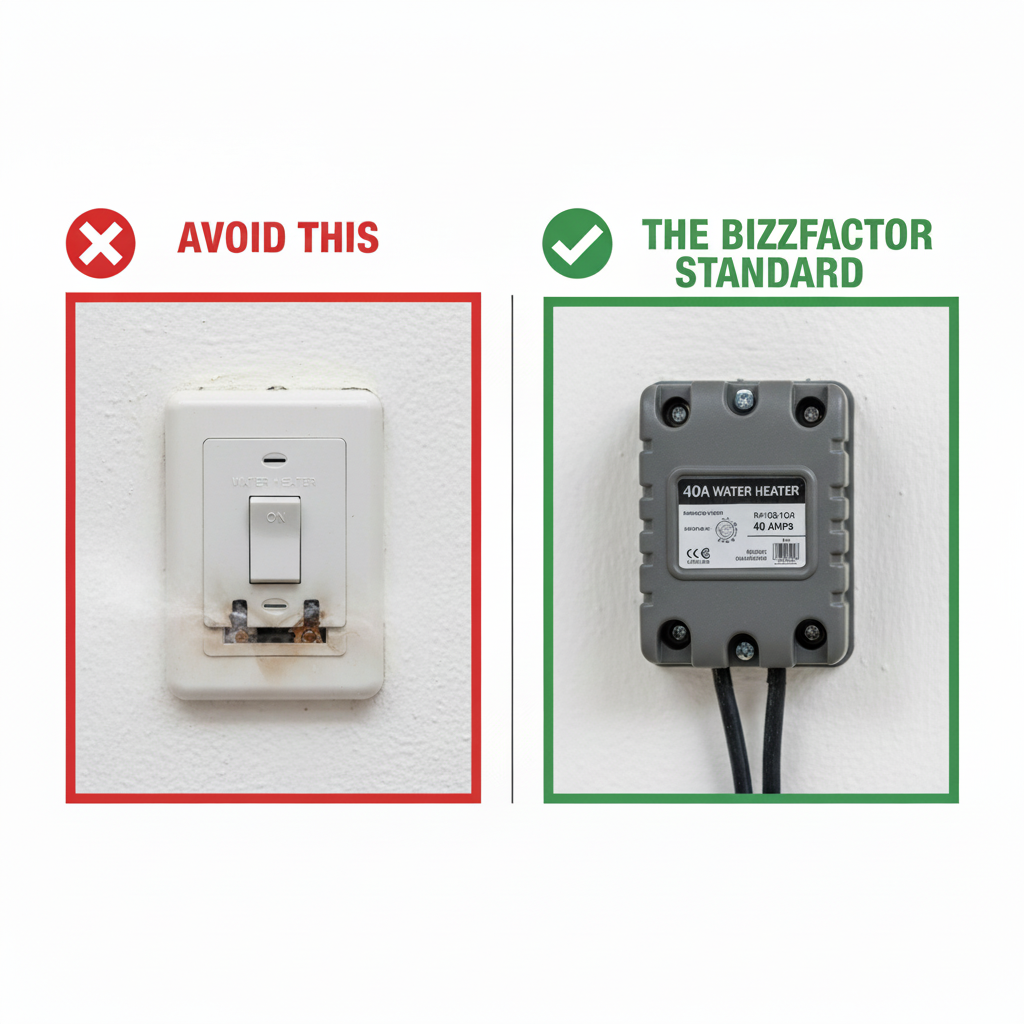
Your water heater is what the National Electrical Code calls a "continuous load" (anything that runs for three hours or more). The NEC doesn't mess around with these. It requires all protective devices and conductors to be rated at **125% of the load's maximum current**.
So here's what that actually means: your standard 30-amp water heater circuit needs a switch rated for at least 37.5 amps (30 × 1.25). Since 37.5-amp switches don't exist, you round up to **40 amps**. Use a 30-amp switch and you're creating a fire hazard that gets hotter every time your water heater cycles.
That's the real issue.
Licensed electricians know this in their sleep. Handymen charging $75 cash? Maybe not. For more on electrical safety, see our guide on [understanding your home's electrical panel](link-to-electrical-panel-article).
Our Pro Tool Recommendation: Ensuring Absolute Safety
I won't install anything on a 240V circuit without a voltage tester I'd trust with my life.
Look — look — the **Klein Tools ET250** is what most of our guys carry now—yeah, Fluke makes excellent testers, but Klein's at about half the price and gives you three ways to know the circuit's dead: LEDs light up, it beeps, and it vibrates in your hand. That triple confirmation matters when you're about to touch wires that could kill you. It's probably the best $60 you'll spend if you're doing any electrical work (though honestly, for water heaters, just hire someone).
Maximize Savings: Beyond Basic Scheduling
Most people miss this completely: check if your power company does time-of-use rates.
In Dallas, TXU charges almost double during peak hours (2-7 PM) compared to overnight. So instead of heating water all day like an idiot, program your system to heat overnight when electricity's dirt cheap. Your tank holds that heat for 12-16 hours easy (assuming it's insulated decently). Heat water at midnight for $0.09/kWh, use it at 6 PM when the rate's $0.18/kWh. You're basically gaming the system.
A client in Plano—accountant, detail-oriented guy—tracked this for three months. Saved an extra $14 monthly just by shifting his heating schedule to off-peak. That's on top of the regular timer savings. For more smart home energy solutions, check out our article on [energy-efficient home upgrades](link-to-energy-efficient-upgrades-article).
The Tangible Benefits: Energy Savings & Extended Appliance Lifespan
So why bother with any of this? Two reasons that actually matter: you'll spend less money every month, and your water heater will probably last longer. Real talk—stopping your unit from running 24/7 typically cuts electricity bills by 10-25%. That's real money. And all that downtime? It's easier on the heating elements, which means fewer repair calls.
Think about "standby heat loss" for a second. Your water heater keeps reheating the same water all day and night, even when nobody's home. Even when you're asleep. Even when you're on vacation. It's just burning electricity to maintain temperature in a tank nobody's using. Scheduling kills that waste completely. We've got clients saving $20-$40 monthly after this one upgrade.
Here's the thing: here's the thing: and here's the bonus—less run time means less mineral scale baking onto your heating elements. Scale acts like insulation (the bad kind), forcing elements to work harder and burn out faster. Giving your water heater regular breaks actually extends its life. Win-win.
Real-World Case Study: The Perils of DIY Electrical Work
Last September, we got a panic call from a couple in Travis Heights.
The husband had bought a Wemo smart plug—the kind you'd use for a Christmas tree—and wired it into their water heater circuit. I'm talking a 15-amp plug on a 30-amp, 240V circuit. When we opened the junction box, the plastic housing had started melting. Black scorch marks everywhere. The smell hit you from three feet away.
They were maybe 48 hours from a legit house fire.
We pulled the melted plug, installed a proper UL-listed 40-amp controller (Intermatic EH40), and used a Fluke T5-1000 to verify the actual draw was within spec. Total job was $340. Their homeowner's insurance would've laughed them out of coverage if that thing had caught fire—DIY electrical work voids most policies. Ask me how I know. For insights into certified professionals, read our guide on [choosing a reliable electrician](link-to-choosing-electrician-article).
The Professional Installation Process: Expect Precision and Safety
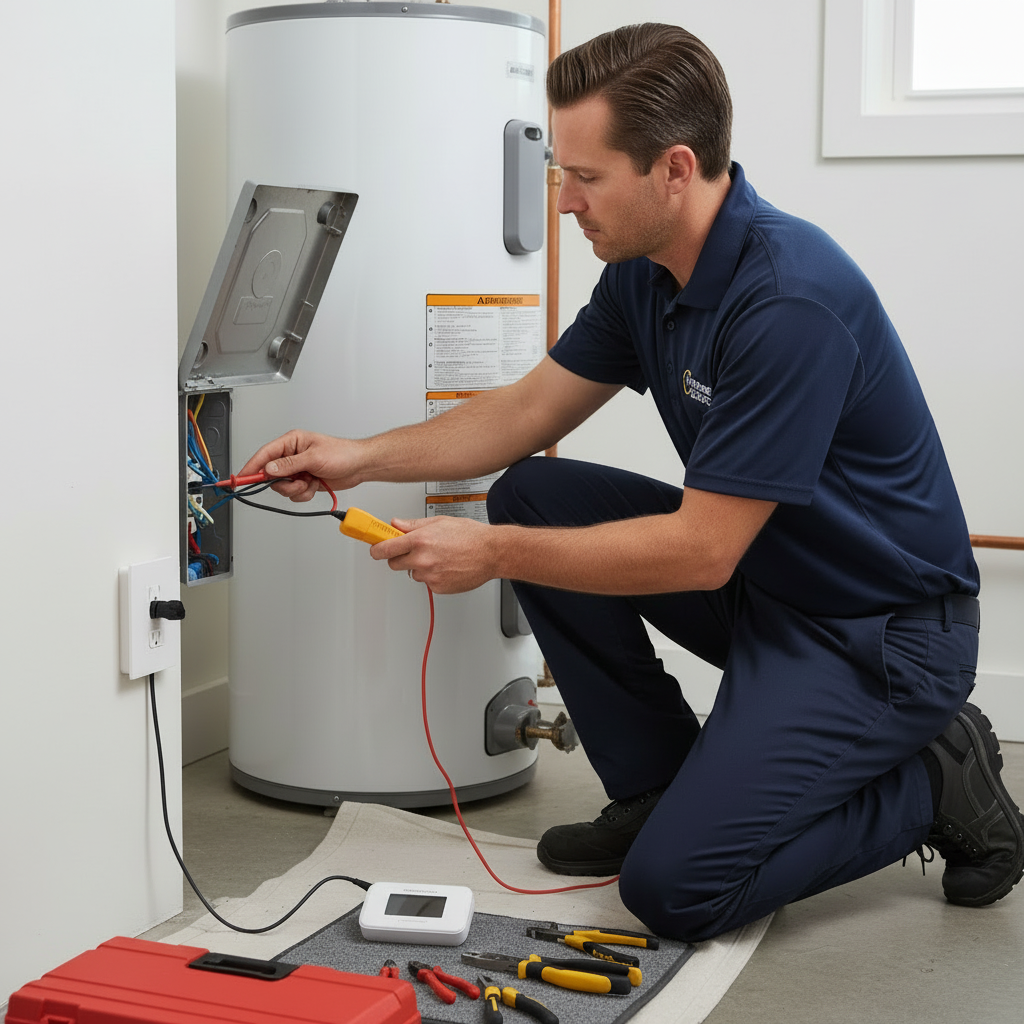
I've installed probably 200 of these switches over the last five years. Every single one follows the same process because high-voltage work has zero margin for screw-ups. Here's what actually happens when you hire someone who knows what they're doing:
**Kill the power. Then prove it's dead.**
First thing? Flip the double-pole breaker at your main panel. Label it so nobody "helpfully" turns it back on while you're elbow-deep in wiring.
Then—and this is non-negotiable—test for voltage. We use a Klein ET250 or similar non-contact tester on every wire. Both hot leads and the ground. I don't care if I just watched you flip the breaker. Test it anyway. Electricity doesn't care about assumptions.
**Inspect everything while you're in there.**
Junction box open? Time to look around. Wire gauge correct for the load? (Should be 10 AWG copper minimum for 30A circuits.) Insulation cracked or brittle? Box securely fastened to a stud, or is it just floating in the drywall?
You'd be shocked how often we find sketchy wiring that's been hidden behind a cover plate for 15 years. Better to catch it now than during a kitchen fire.
**Wire it right, torque it tight.**
Every connection gets made with insulated tools (Klein screwdrivers are the standard). Strip the wire to the correct length—not too much, not too little. That's the real issue. Connections get torqued to manufacturer spec, which is usually around 20-30 inch-pounds for terminals. "Feels tight" isn't a spec.
Loose connections arc. Arcing melts things. Melting things start fires. We've seen it.
**Make it look professional.**
Wires get routed so nothing's pinched when you close the box. Device mounts flush and square. Cover plate sits flat—if it's crooked or has gaps, something's wrong inside.
These finishing details seem small, but they're how you spot a pro versus someone who doesn't know what they're doing.
**Test the whole system before you leave.**
Power back on. Run a complete cycle—heat, hold, shut off. For smart switches, we'll get it on your network and walk you through the app setup.
Final step: clamp meter on the hot leads (Fluke 323 is our go-to) to verify actual amperage draw. If it's pulling more than expected, we troubleshoot before we call it done. You're paying for certainty, not "probably works."
---
FAQs
**Why is professional installation essential for a water heater timer or smart switch?**
Water heater timers and smart switches involve high-voltage electrical circuits (240V and up to 30-40 amps). It matters more than you'd think. Incorrect installation can lead to severe hazards like electrical fires, electrocution, and damage to your appliance or home. A licensed electrician ensures the installation complies with the National Electrical Code (NEC), uses appropriately rated components (like a 40-amp switch for a 30-amp heater), and guarantees safe and reliable operation. This is critical for your home's safety and insurance validity.
**Can a smart switch really save me money on my energy bill?**
Yes, absolutely. By allowing you to precisely control when your water heater operates, a smart switch eliminates 'standby heat loss' – the energy wasted by your heater continuously reheating water when not needed. You can schedule it to run only during periods of actual demand or, even better, during off-peak electricity rate hours if your utility offers them. This strategic scheduling can lead to significant savings, often 10-25% on your water heating costs, equating to $20-$40 per month for many households.
In-Depth Look
Detailed illustration of key concepts
Visual Guide
Infographic illustration for this topic
Side-by-Side Comparison
Visual comparison of options and alternatives
Sources & References
- The Ultimate Guide to Water Heater Timers - Aquanta
- Water Heater Timer Installation - Save money on your Electric #howto
- How To Install a Water Heater Timer - DIY - Step by Step - YouTube
- How To Install Your Smart Switch Yourself - Everyworks Singapore
- Best Tool Brand for Electricians 2025: Expert Rankings
- Best Electrician Tools Brand Guide
- 35 Essential Electrician Tools Every Pro Needs in 2025
- Best Residential Grade Electrical Devices Top Brands ...
- Top 15 Essential Electrician Tools for Pros - 2026 List
Frequently Asked Questions
Need Professional Help?
Find top-rated electricians experts in your area