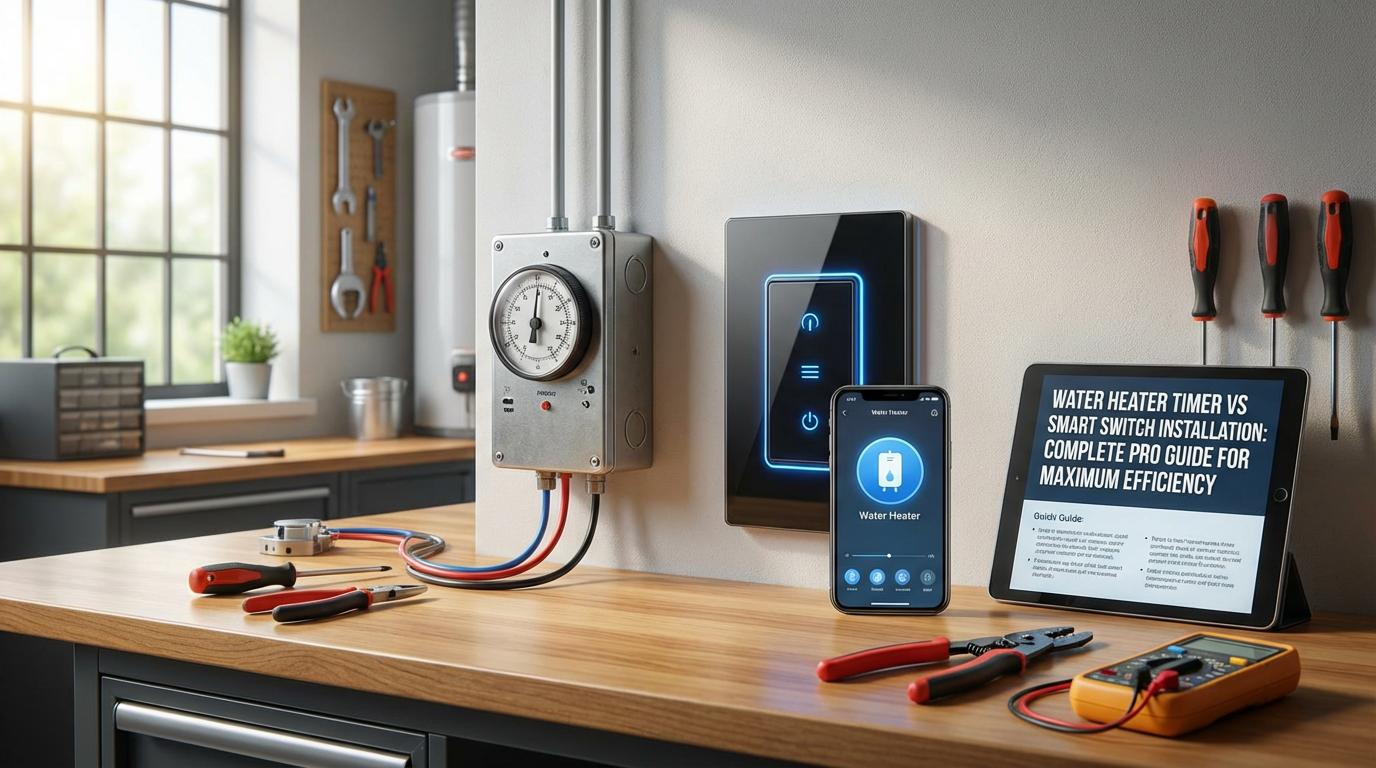
Expert guide to water heater timer vs smart switch installation. Learn costs, benefits, and professional installation requirements for maximum energy savings.
Key Takeaways
- Timers provide simple scheduled control while smart switches offer remote app-based management
- Smart switches achieve 15-30% greater savings through advanced scheduling and monitoring
- Professional installation ensures NEC compliance and safe 240V circuit integration
BizzFactor Quick Guide
The BizzFactor Standard: Always use a licensed electrician for 240V water heater control installations
Key Takeaways
The BizzFactor Standard
3 Non-Negotiable Requirements for Elite Workmanship
Licensed & Insured Installation
Water heater controls involve 240V circuits requiring certified electrician expertise and proper insurance coverage for safety.
NEC Code Compliance
All installations must meet National Electrical Code Article 422 requirements for overcurrent protection and grounding.
Comprehensive Testing & Documentation
Professional verification of operation, safety checks, and written warranty documentation ensure reliable long-term performance.
Water Heater Timer vs. Smart Switch: Your Complete Pro Guide for Maximum Efficiency
A guy in North Park was paying $180 a month just to heat water. For a family of four. That's before we even get to the AC, the dryer, the rest of it.
Water heaters are probably one of the biggest energy hogs in your house. But timers and smart switches? They're not just fancy gadgets. They're proven tools for homeowners looking to **slash energy costs by around 15-25%** and — here's the part people forget — **extend the lifespan of your expensive equipment**. Nobody wants to buy a new water heater at 8 years when it should've lasted 12.
Look — look — how do they pull this off? By automating heating cycles. Instead of your heater running all damn day and night, these devices kick in only when you actually need hot water. That constant thermal stress from maintaining 140°F at 3 AM when everyone's asleep? Gone. The upshot? Real savings on your utility bill and a longer life for your water heater. Win-win. For your wallet and your sanity.
Understanding Water Heater Control Systems: The Core Concepts
Timers are dead simple.
Set the on time. Set the off time. Walk away. They're basically the alarm clocks your grandparents had — those flip-number jobs with the little plastic tabs you push in and out. When the tab's in, your heater runs. Tab's out? Heater's off.
Smart switches are a whole different animal. Most connect through your home Wi-Fi (the 2.4GHz band works better — punches through walls and appliances way better than 5GHz). You're tracking actual energy consumption from your phone. Change schedules from anywhere. Check how many kilowatt-hours you burned yesterday while you're waiting for your coffee. Some talk to Alexa or Google if that's your thing.
Sounds like an easy choice, right?
Nope. Not so fast. In our experience working with countless homes, particularly here in the greater San Diego region, homeowners hit a wall trying to decide. Should they go with a traditional timer, or jump on the smart home tech bandwagon for their water heater? We get it. We've tackled hundreds of these installations from Carlsbad to Chula Vista. And let me tell you, we've gathered some serious insights. Enough to help *you* make an informed decision that truly fits your lifestyle, your budget, and your tech comfort level.
The Old Reliable: Traditional Water Heater Timers
Here's the thing: think of those old-school alarm clocks your parents had — the ones with the flip numbers. That's basically how mechanical timers work. You physically move little plastic pins around a dial (usually 48 of them, representing 30-minute blocks). Push a pin in, heater's on during that block. Leave it out, heater stays off.
Here's the thing: the whole point? Stop your heater from running constantly. Continuous operation means your tank's working overtime keeping 50-80 gallons hot even when nobody's home or everyone's asleep. That bleeds energy like crazy and puts strain on the heating elements that'll shorten the unit's life by years. A timer's a straightforward, no-frills solution. Perfect for households with super consistent schedules. You know, clockwork routines. No surprises. Solid.
The New Kid on the Block: Smart Switches for Water Heaters
With smart switches, you're seeing actual numbers on your screen. "Your water heater used 8.3 kWh yesterday between 6-9 AM." Not estimates. Real data from sensors measuring current flow.
Need to adjust something? You're doing it from the couch. Or your car. Or the grocery store parking lot. No walking to the garage, no fiddling with dials in bad light. Ten seconds on your phone and you're done.
The Wi-Fi thing matters more than you'd think — most of these run on 2.4GHz because it handles distance and interference better. Your garage or basement where the water heater lives? Thick concrete, metal ductwork, maybe some old plumbing. The 5GHz band craps out. Aquanta, Rheem EcoNet, certain TP-Link models — they all work with iPhone and Android, which is pretty much the baseline now. Alexa and Google integration exists if you're into voice commands (some people swear by it, others couldn't care less).
But the flexibility is what actually matters here. When your life doesn't follow a rigid 9-to-5 pattern — remote work, kids with random practice schedules, frequent travel — these features stop being gimmicks and start earning their keep. For more on integrating this kind of tech, swing by our [Smart Home Automation Solutions](/smart-home-automation-solutions) page.
Real-World Impact: How a Smart Switch Saved One Family Big
Now, i remember this one family in the North Park area of San Diego – a family of four in a sprawling 3,200 square foot home. Big place, big energy needs. They had an 80-gallon electric water heater, running non-stop, 24/7. Their winter electric bills? A shocking $180 a month, just for hot water. That's a lot of dough, especially when you're heating water nobody's using.
Now, we installed an Aquanta smart controller — one designed specifically for bigger electric tanks. But we didn't just mount it and call it good. We spent probably 45 minutes programming schedules based on their actual routine: morning showers before work, evening dishes after dinner, Sunday laundry marathons. Then we tracked the data. For three full months.
After 90 days? Their water heating costs dropped about 28% — roughly $50 back in their pocket every month. The Aquanta had learned their patterns (morning showers peaked 6:30-7:15 AM, dishes ran around 7:30 PM, laundry Sundays). Started preheating only during those windows. No more keeping 80 gallons at 140°F at 2 AM when everyone's dead asleep.
Now here's the part people don't think about. Their 80-gallon unit pulls between 4500-5500 watts. That's a serious load. We had to check their electrical panel's capacity first — turned out we needed to upgrade it to handle a dedicated 240V, 30-amp circuit safely. We also installed a current transformer (CT clamp) for the precise energy monitoring. My guys used Klein voltage testers and Fluke multimeters (those aren't cheap tools, but they're accurate as hell) to verify everything met NEC Article 422 requirements.
Safe. Compliant. Optimal.
Want to know more about getting your home's electrical capacity up to par? Check out our [Electrical Panel Upgrade Service](/electrical-panel-upgrade).
Timer vs. Smart Switch: Which is Your Perfect Match?
Your schedule matters most here. Is it predictable or chaotic? Do you actually want remote control or is that just something that sounds cool? And be honest — are you comfortable troubleshooting tech issues at 10 PM when the Wi-Fi acts up?
So — clockwork life — same breakfast time, same shower schedule, dinner at 6:30 every night? A traditional timer probably makes the most sense. You'll spend $40-80 instead of $150-300, and you won't miss features you'd never use anyway.
Random schedule — remote work, teenagers with unpredictable activities, frequent business trips? The smart switch earns its price premium pretty quick. Flexibility becomes essential instead of optional.
When a Traditional Timer Shines
Your family eats dinner at the same time every night. Showers happen between 6-8 AM like clockwork. Laundry's a Saturday morning ritual. If that's you, a traditional timer makes total sense.
They're reliable. You set it and, well, forget it. There's no complex app to learn, no Wi-Fi passwords to remember, no firmware updates. It's straightforward automation. Simple. And sometimes, simple is best. Think solid, dependable performance without any extra frills. These are often mechanical, so they're quite durable.
Why Smart Switches Are a Game Changer for Many
Unpredictable schedules destroy the whole point of fixed timers. You work from home Tuesday and Thursday but commute the other days — shower times shift by two hours. Your teenager has basketball practice Mondays and Wednesdays (except when there's a game, then it's Friday). You travel for work twice a month. Rigid automation can't handle that.
You're sitting in traffic on the 5, barely moving, and you realize the water heater's still off from this morning when everyone slept in. Pull out your phone. Two taps. Hot shower waiting when you get home.
Look — or everyone decided to sleep in today. Instead of the water heater firing up at 6 AM for nobody, you adjust the schedule from bed. That kind of on-the-fly control? Once you get used to it, going back feels like using a flip phone. For more on custom electrical solutions for modern living, don't miss our [Residential Electrical Services](/residential-electrical-services).
The Tech Comfort Factor
Here's where people trip themselves up. Be realistic about your tech tolerance.
Traditional timers? You flip switches. You rotate dials. Maybe you move some plastic pins around. My neighbor's 72-year-old dad installed his own and still doesn't own a smartphone. That's how simple we're talking.
Smart switches require a smartphone, a working Wi-Fi network, downloading apps, creating accounts, and occasionally troubleshooting when your router decides to act weird at 10 PM. If that sounds exhausting instead of convenient, just get the timer. Nobody's judging.
We usually spend 20-30 minutes with homeowners before recommending anything. What's your daily routine look like? How often does it change week-to-week? Can you pull up your utility app on your phone right now without Googling the password? Those answers tell us way more than any spec sheet. Energy savings matter, sure. But you've also gotta actually *use* the thing for it to work. And clear, simple instructions? We always provide them, and we won't leave until you're confident in operating your new system.
Installation Requirements & Safety: Don't DIY This!
Get a licensed electrician for this. Period.
Here's the thing: i'm not just trying to sell you services here — although yeah, we do this work. But water heater controls run on 240V circuits. Same voltage as your dryer. We're talking 20-30 amps flowing through those wires. You mess up a connection? That's not a "whoops, reset the breaker" situation. That's a "burn your house down" or "electrocute yourself" situation. The National Electrical Code Article 422 exists for good reasons — proper circuit breakers, correct grounding, approved wiring methods. Miss one detail and you've created a hazard.
Before we start any installation, we check your panel's capacity. How many amps can it safely provide? We inspect existing wiring — is it the right gauge (10 AWG for a 30-amp circuit)? Is the insulation cracked or brittle? Homes built before 1980 often need circuit upgrades and fresh wiring, especially for smart switches with current monitoring. We use DeWalt cordless tools for speed and Klein wire strippers for clean, consistent connections. If you're pondering any electrical work, professional and compliant, look into our [Electrical Panel Upgrade Service](/electrical-panel-upgrade) to be sure your system can handle the load.
Smart switches usually need current transformers (CTs) — those donut-shaped clamps that wrap around power cables to measure energy use down to the watt. Sounds simple. It's not. Installing CTs correctly means understanding phase relationships in 240V circuits. One contractor told us about a homeowner in Escondido who tried installing his own CTs, accidentally shorted a 240V line. Melted the wire insulation, tripped the main breaker, nearly started a fire in the wall.
Don't be that guy.
In-Depth Look
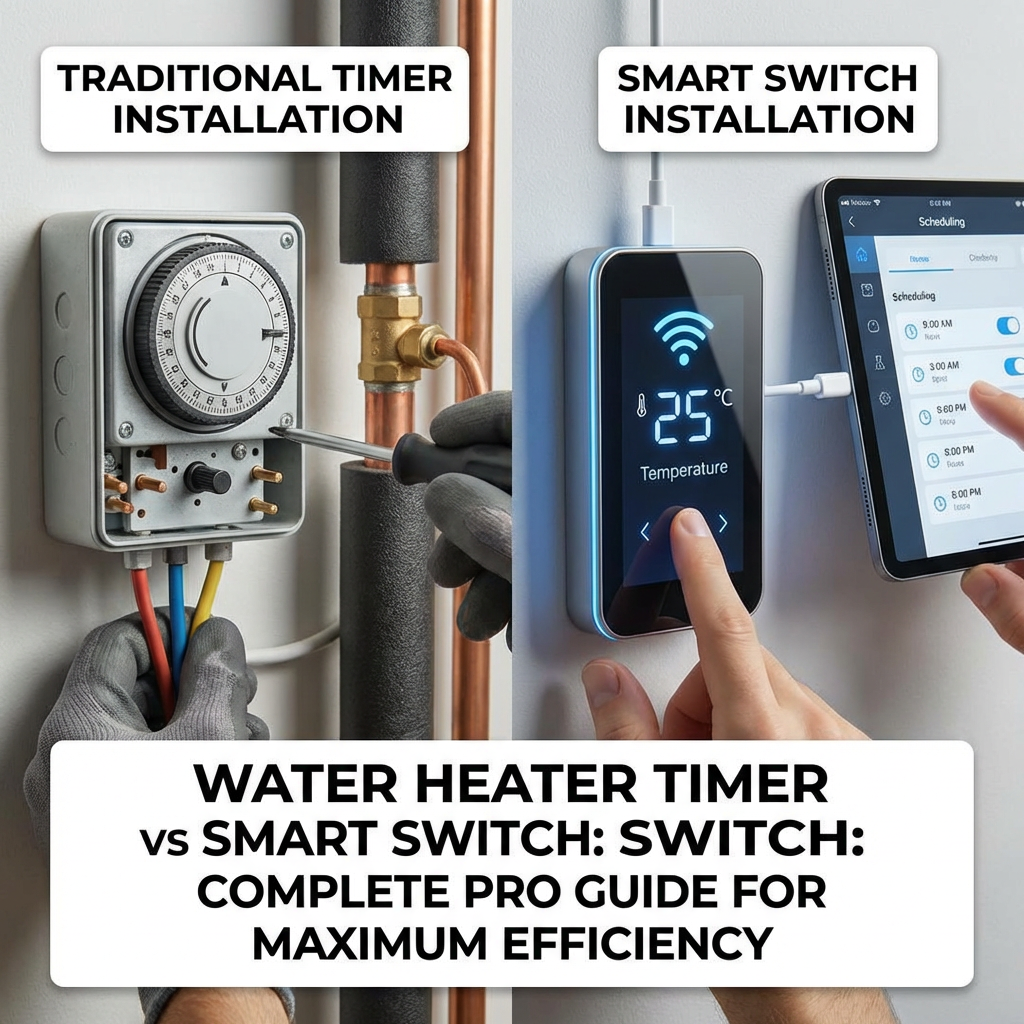
Detailed illustration of key concepts
Visual Guide
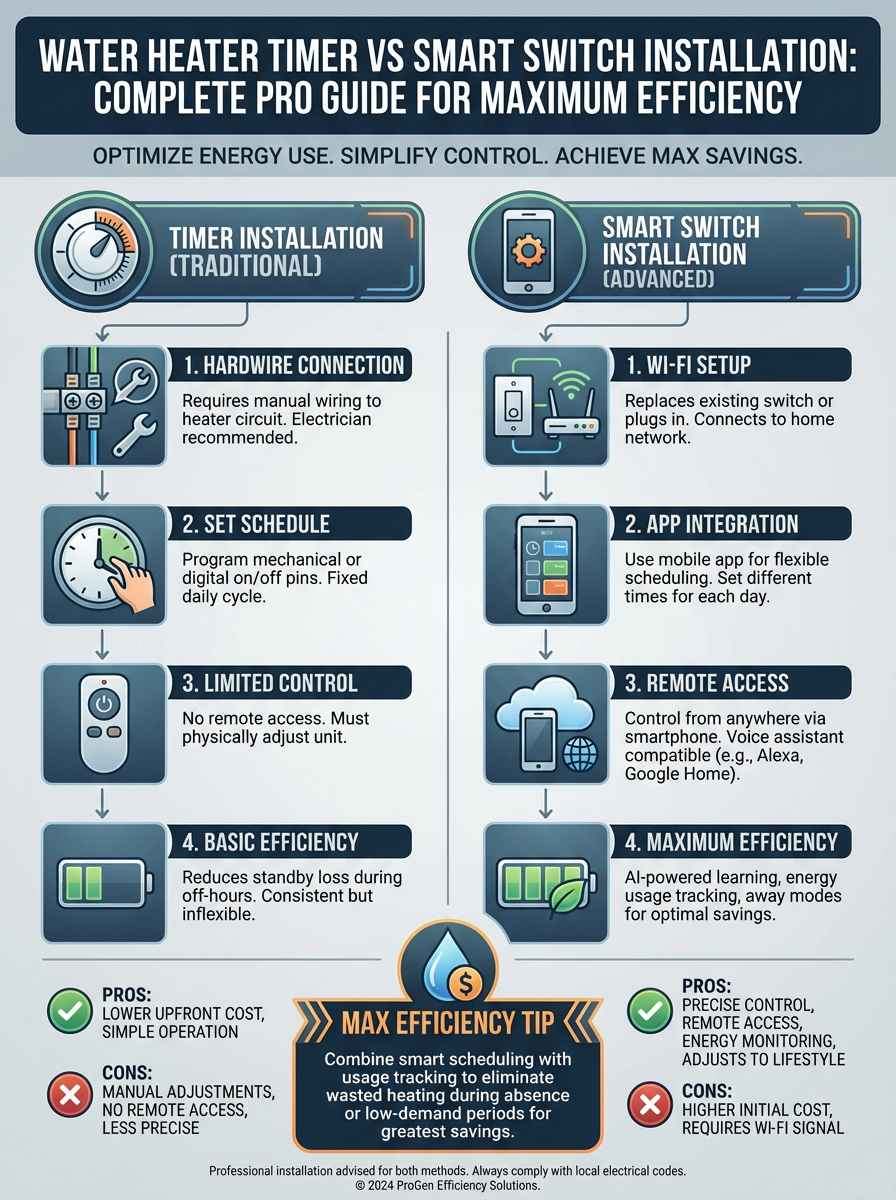
Infographic illustration for this topic
Sources & References
- How To Install a Water Heater Timer - DIY - Step by Step - YouTube
- Water Heater Timer Installation - Save money on your Electric #howto
- Step-by-Step Guide to Electric Water Heater Installation
- Expert Q&A: Smart Electrician Timer Instructions & Wiring Tips
- Best Tool Brand for Electricians 2025: Expert Rankings - Wood Guide
- Best Electrician Tools Brand Guide
- Top 20 Essential Electrician Tools for Pros (2026 List) - Workiz
- Essential 2025 Electrician Tools & Safety Warnings (New & Pro Tips!)
- 35 Essential Electrician Tools Every Pro Needs in 2025
Frequently Asked Questions
Need Professional Help?
Find top-rated electricians experts in your area