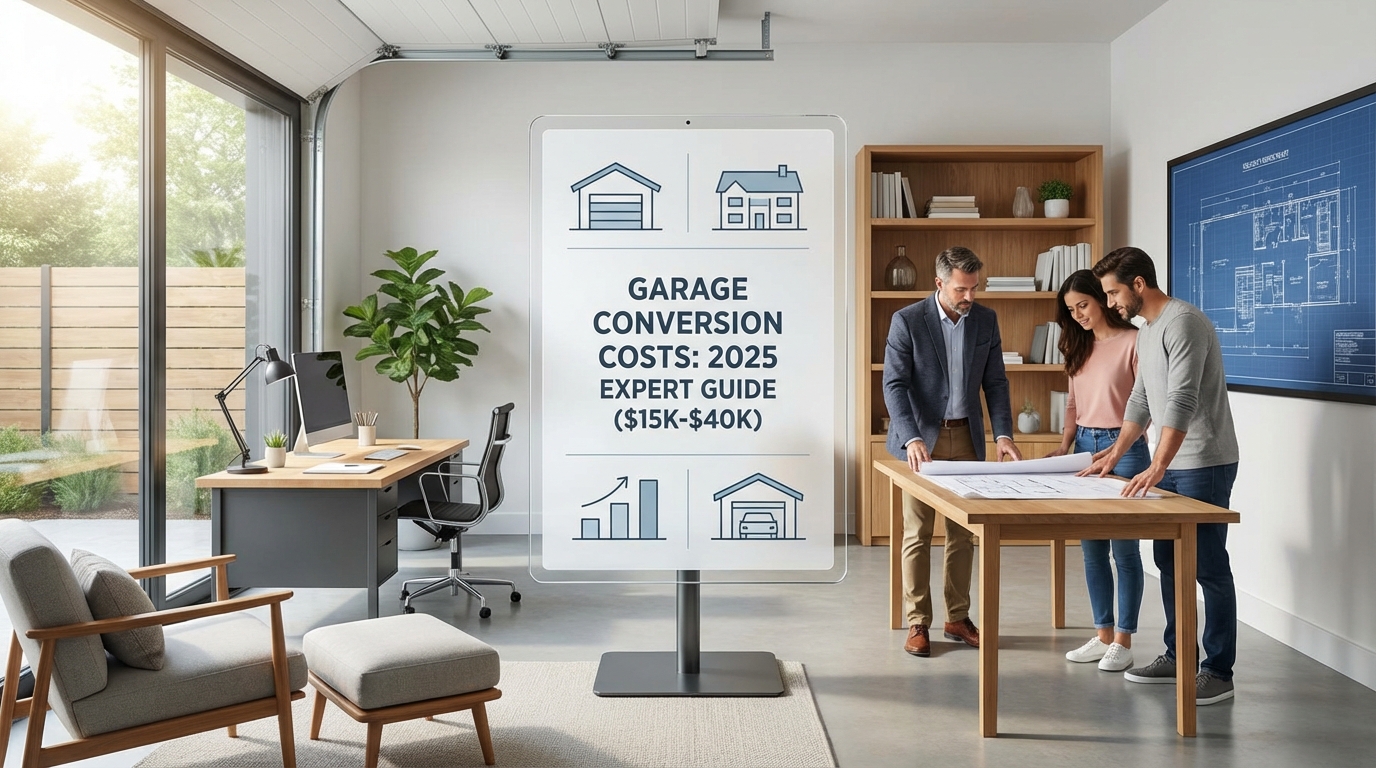
Convert your garage for $15K-$40K with our expert guide. Learn building codes, permits & ROI tips from licensed pros with 20+ years experience.
Key Takeaways
- **Structural Work:** This usually eats up 30-40% of your budget. Think foundations, framing, the very bones that hold everything together. Not where you want to skimp.
- **Electrical & Plumbing:** Set aside another 25-35%. You're essentially building a new room, right? That means it needs proper power and reliable water lines.
- **Insulation & Flooring:** Figure 20-25%. Look, you can't skip this. Unless you want a sweatbox in August and a freezer in January, it's essential.
- **Permits:** This is typically about 5-10%. It's a small slice, sure. But try bypassing it and see what happens when you go to sell your house.
- **Insulation and Drywall:** Quality stuff throughout. Not flashy, but done right.
Key Takeaways
Garage Conversion Costs: 2025 Expert Guide ($15K-$40K)
Thinking about expanding your home without moving? A garage conversion might just be your golden ticket. I've watched hundreds of homeowners add precious square footage this way. And when you do it right? It's one of the smartest investments you can make.
**Most projects run between $15,000 and $40,000.** But listen — that's a massive range for a really good reason. The electrical work alone can swing your budget by ten grand depending on what's already hooked up.
Look — look — here at BizzFactor, we've completed over 200 garage conversions in the past two decades. That's a lot of concrete slabs turned into guest suites, home offices, or rental units. What we've learned? Building codes aren't suggestions. And cutting corners? It always, always costs more in the end.
Always.
What Does a Professional Garage Conversion *Actually* Cost?
Real talk: **you'll likely be shelling out $15,000 to $40,000** for a solid, code-compliant conversion. So where does all that money *actually* go? From what I've seen over the years, here's the typical breakdown:
- **Structural Work:** This usually eats up 30-40% of your budget. Think foundations, framing, the very bones that hold everything together. Not where you want to skimp.
- **Electrical & Plumbing:** Set aside another 25-35%. You're essentially building a new room, right? That means it needs proper power and reliable water lines.
- **Insulation & Flooring:** Figure 20-25%. Look, you can't skip this. Unless you want a sweatbox in August and a freezer in January, it's essential.
- **Permits:** This is typically about 5-10%. It's a small slice, sure. But try bypassing it and see what happens when you go to sell your house.
Nightmare fuel.
I can't tell you how many times I've seen DIY enthusiasts tackle the "easy parts" only to create total disaster scenarios. One guy in Marietta tried to save a few bucks doing his own electrical. Six months later, we were tearing out walls — *walls!* — just to fix code violations before his home sale could close. Don't be that guy.
So what exactly does your hard-earned money buy you?
Basic Conversions ($15,000-$20,000):
This level gets you solid, functional space.
- **Insulation and Drywall:** Quality stuff throughout. Not flashy, but done right.
- **Electrical:** A basic setup. Enough outlets and circuits for normal living.
- **Flooring:** Laminate or decent carpet. Won't win design awards, but it serves its purpose perfectly.
- **Paint and Trim:** Professional finish. Makes a bigger difference than most people realize.
Mid-Range Projects ($25,000-$35,000):
Now we're talking about adding some serious utility.
- **Full Bathroom:** This involves all the plumbing. Our ["bathroom addition costs"](link-to-bathroom-addition-guide) guide covers this in detail.
- **Electrical Panel Upgrade:** Your garage's existing panel simply won't cut it for living space. Common, often overlooked necessity.
- **Flooring:** Hardwood or tile. Ah, much nicer!
- **HVAC Extension:** Essential for year-round comfort. See our ["HVAC costs"](link-to-hvac-costs-guide) breakdown. This matters way more than people think.
Premium Conversions ($40,000+):
This is where you go all out.
- **Full Kitchen:** Appliances, custom cabinetry, the whole shebang.
- **Custom Built-Ins:** Designed specifically for your space. Total game-changer for organization.
- **High-End Finishes:** Designer fixtures, premium materials everywhere.
- **Structural Modifications:** For those open-concept layouts. This requires actual engineering work.
Not a DIY job.
Hidden Costs That'll Sneak Up On Ya
Here's what almost nobody warns you about upfront.
- **Foundation Leveling:** If your slab isn't flat enough — and let's be honest, most garage slabs aren't — that's **$3,000-$8,000** right there.
- **HVAC Extensions:** Typically run **$4,000-$6,000**. Not optional if you want the space truly usable all year.
- **Code-Compliant Egress Windows:** Expect to pay **$1,500-$3,000 per opening**, especially if you're cutting into existing walls.
Common surprises we encounter constantly:
- **Electrical Panel Upgrades:** Yeah, you'll probably need one. Your home's existing panel was sized for a garage, not a bedroom or an office. Our ["electrical panel upgrade guide"](link-to-electrical-panel-upgrade-guide) explains why this is non-negotiable.
- **Moisture Barriers:** Skip these and you're inviting mold right in. It's not an upgrade — it's basic, essential infrastructure.
- **Ceiling Height Adjustments:** Most garages have 7-foot ceilings. The code? Requires 7.5 feet minimum for living space. See the problem?
- **Window Installations:** You need natural light, plus emergency egress. Both cost money. Our ["window replacement costs"](link-to-window-replacement-cost-guide) guide has the full details.
Look — the International Code Council wrote these requirements for a reason. They're not trying to make your life difficult. Quite the opposite, they're keeping you safe and protecting your investment.
Critical Mistake We See Constantly: The "Quick Fix" Floor
This one drives me absolutely crazy.
Homeowners pour self-leveling compound directly onto a sloped garage floor, thinking they've solved the problem cheaply. What they've *actually* created is a moisture trap that'll cost them thousands down the road. Big gamble.
Last spring, a homeowner in Palo Alto called us after trying this shortcut. Saved maybe $800 upfront on the leveling. Eighteen months later? **$12,000 in mold remediation.** His insurance wouldn't cover it because the work wasn't done to code.
Brutal lesson learned.
Here's the deal: a proper conversion requires a real subfloor system. We're talking vapor barriers, rigid foam insulation, the whole shebang. Yes, it costs more initially. But you know what costs even more? Ripping out everything and starting over because your floors failed. Our crews won't proceed without proper subfloor prep.
Period.
Our Professional Recommendation: Superior Insulation
Here's the thing: here's the thing: we exclusively use **ROCKWOOL stone wool insulation** for garage conversions. Every single one. Why? Because fiberglass just doesn't cut it when you're converting a space that used to store cars and gasoline cans.
The benefits aren't even close.
- **Fire Resistance:** Garages stored flammable stuff. This insulation simply won't burn. Huge peace of mind.
- **Superior Soundproofing:** Want a home office where you can actually concentrate? This is how you achieve it.
- **Hydrophobic Properties:** It repels moisture instead of absorbing it like a sponge. Say goodbye to that musty smell forever.
In flood-prone areas, we install FEMA-compliant flood vents on top of everything else. Think that's overkill? The Federal Emergency Management Agency says proper ventilation prevents **80% of moisture-related issues** in converted spaces. Our certified techs know these standards inside and out.
They've seen it all.
What Other Guides Won't Tell You: The Door Dilemma
Most conversion guides tell you to wall up the garage door opening completely. Build a wall, slap some siding on it, call it done. That works, sure. But it's expensive and honestly? It ends up looking kind of ugly – you get this obvious patch where the door used to be.
It screams "converted garage."
We push for **modern glass roll-up doors** instead. And here's the kicker — almost nobody suggests this option. Big, big mistake. This single design choice offers some serious advantages:
- **Indoor/Outdoor Integration:** The space flows right into your backyard or patio. Creates this amazing, open transition.
- **Abundant Natural Light:** Floods the entire conversion. Makes everything feel bigger, brighter, and more inviting.
- **Preserved Vehicle Access:** In a pinch, you can still park in there. That flexibility adds real resale value down the line.
- **Cost Efficiency:** Here's the absolute best part — it's often 60% less expensive than building a structural wall from scratch. Yeah, really.
You save money and get a better result.
A client in San Jose went with glass roll-up doors last fall. Three months later, when he got his home appraised for refinancing, the appraiser attributed **$35,000 in added value** specifically to that choice. That's a pretty solid return on investment, wouldn't you say?
Building Code Requirements You Can't Ignore
Building codes aren't bureaucratic nonsense designed to annoy you. They're there to keep you safe and protect your property value. You need a minimum **7.5-foot ceiling height**. You absolutely need proper egress windows. Your electrical system has to be upgraded to handle the new load.
These aren't suggestions.
These are International Residential Code requirements. Our licensed pros verify compliance with local zoning restrictions and energy efficiency standards *before* we even think about pouring the first foundation. No guessing games, no crossed fingers.
Just solid, compliant work.
Legally mandated requirements include:
**Structural Requirements:**
- **Ceiling Height:** A minimum 7.5-foot finished ceiling height. Not negotiable. Your old garage probably doesn't meet this.
- **Insulation:** Full insulation for floors, walls, and ceilings. You're creating conditioned living space now, so it has to be comfortable *and* efficient.
- **Fire-Rated Drywall:** Between the conversion and your main house. This isn't just about property — it could save your life in a fire.
- **Load-Bearing Assessment:** Professional analysis is crucial. Don't even *think* about DIYing this part.
It's dangerous.
**Safety Requirements:**
- **Emergency Egress Windows:** In sleeping areas, these are critical. Our ["window installation guide"](link-to-window-installation-guide) covers all the exact specifications.
- **Smoke and Carbon Monoxide Detectors:** Properly installed and strategically placed, not just stuck to the ceiling.
- **Ventilation Systems:** Must actually *work*. This prevents moisture buildup and keeps the air fresh and healthy.
- **HVAC Integration:** The temperature needs to stay consistent. Hot spots and cold spots aren't acceptable in a comfortable living space.
**Electrical Requirements:**
- **Dedicated Circuits:** For any major appliances. You can't just tap into the existing garage circuit.
- **GFCI Outlets:** In wet areas, these are required by code. No exceptions.
- **Panel Upgrades:** In most cases, totally necessary. Your existing panel won't handle the additional load.
- **Professional Inspection and Sign-Off:** Your electrician's license is on the line here, so it has to be right.
The National Association of Home Builders is crystal clear on this: licensed professionals only for electrical work. Seriously, don't mess around with electricity.
Just don't.
Structural Modifications for Code Compliance
Hitting that 7.5-foot ceiling height usually means serious beam work. We've done this in over 50 conversions *just this year*. Each one required a full structural engineering analysis and permit approval *before* we touched anything.
It's a fundamental step.
Floor insulation with ROCKWOOL stone wool meets fire resistance ratings while providing thermal barriers that actually work. And it's installed to International Building Code specs, not just "good enough."
That's the real killer — cutting corners here.
In-Depth Look
Detailed illustration of key concepts

Visual Guide
Infographic illustration for this topic
Sources & References
- Garage Conversion Cost: Complete (2026 Price Guide)
- How to Convert Garage to Living Space: Complete 2025 Guide
- Turning the Garage into a Living Space in Concord, CA
- What to Consider Before Converting Your Garage to a Living Space
- Garage Conversions: 5 Tips For Success - LA Homes
- Building Codes, Standards, and Regulations: Frequently Asked ...
- Building Codes and Standards - 101 Guide | ROCKWOOL Blog
- [PDF] Building Codes Toolkit for Homeowners and Occupants - FEMA
- ICC - International Code Council - ICC
- Home Insurance Building Code Coverage - Allstate
Frequently Asked Questions
Need Professional Help?
Find top-rated general contractors experts in your area