Learn when to hire structural engineers vs general contractors for home projects. Expert guide covers costs, legal requirements & red flags to avoid.
Key Takeaways
- **Logistics & Procurement:** Imagine juggling dozens of deliveries and managing a bustling construction site. That's a contractor's daily grind. They ensure materials arrive on time and are stored properly. Big job.
- **Subcontractor Oversight:** Vetting, scheduling, supervising, and then quality-checking *all* the specialized trades. It's like herding cats, but with power tools.
- **Permitting & Inspections:** They handle all the paperwork for permit applications and coordinate those mandatory inspections with local authorities. Don't go rogue here. (Our guide on [navigating home renovation permits](/articles/navigating-home-renovation-permits) can demystify this for you.)
- **Project Management:** They track timelines minute-by-minute, keep budgets tight, update you on progress constantly, and hit all those important project milestones. That's what you pay them for.
- **Safety & Site Management:** Safety first, always. They enforce protocols, keep the job site tidy (which helps with safety, believe it or not), and ensure everyone plays by the local building code rules.
Key Takeaways
Structural Engineer vs. General Contractor: Who You Really Need for Your Home Project
A contractor in Decatur just called me at 6:47 AM. His crew had exposed a beam during demo that was — and I'm not exaggerating — held up by a 2x4 wedged against a stack of shims and what looked like part of an old fence post.
Nobody knew it was there. The plans didn't show it. The homeowner had lived there for twelve years and had no idea their master bedroom was essentially resting on lumber scraps and prayers.
This is why we're having this conversation.
Understanding when you need a structural engineer versus when a general contractor can handle things isn't some academic exercise. It's the difference between a renovation that adds value to your home and one that ends with an insurance claim and a GoFundMe page.
What Does a Structural Engineer Do? GUARDING Your Home's Foundation and Framework
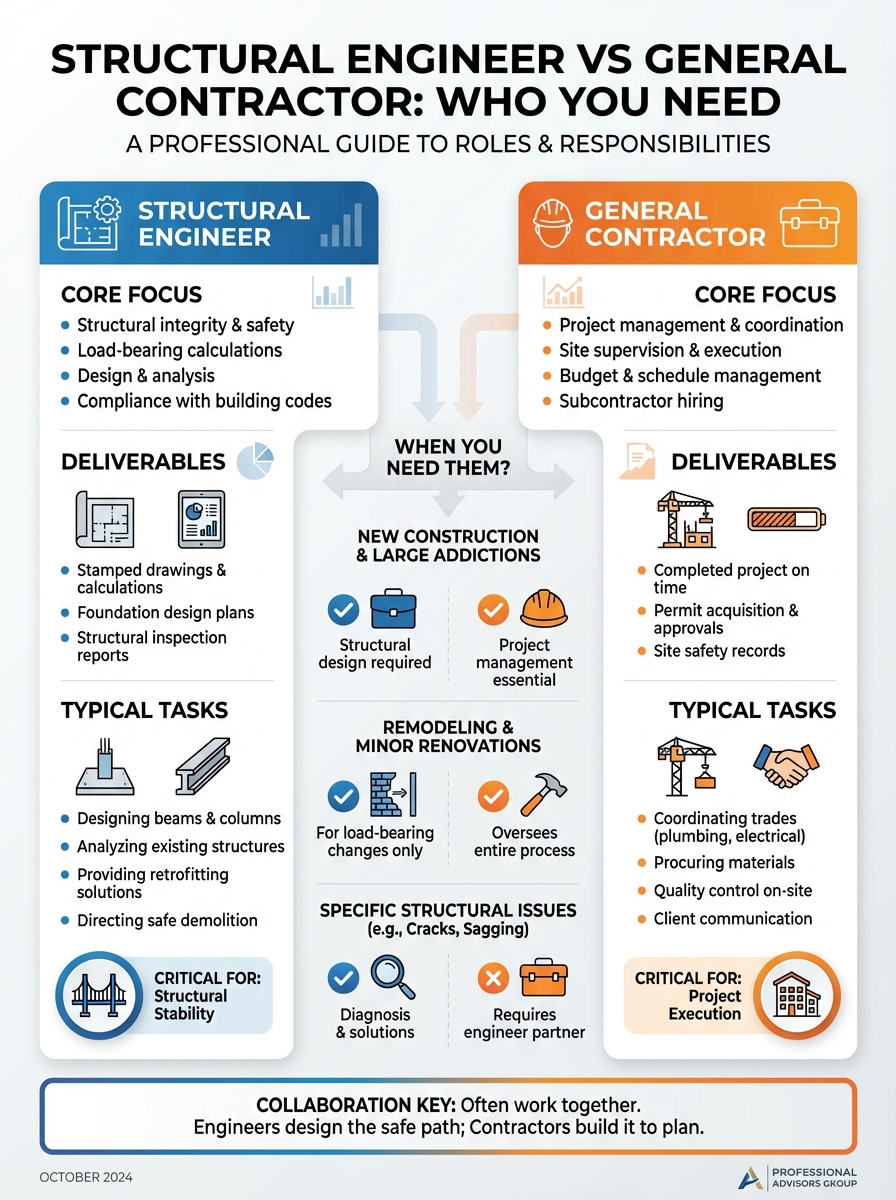
Think of structural engineers as the ultimate bodyguards for your home's safety and how long it'll last. They're the ones stopping disasters before they happen. Look — after over 20 years watching these guys work, I can tell you they're not sitting in some ivory tower. They're crawling through your crawlspace at 7 AM with a flashlight and a moisture meter. They're taking soil samples from your yard. One engineer I know in Austin spent four hours under a 1920s bungalow because the homeowner mentioned "just a little settling." Turned out the whole southeast corner was sitting on basically zero foundation.
These folks have specialized engineering degrees (usually structural or civil), professional engineering licenses (the PE exam has a roughly 70% fail rate), and they carry professional liability insurance that costs more per year than most people's car payments. They can tell you if that dream open-concept kitchen is going to make your upstairs floor feel like a trampoline or if your new sunroom means you need more robust footings.
It's science, not guesswork.
So what does a typical Tuesday look like for these folks?
**Load Calculation & Analysis**
They pull out their calculators and start figuring exact weight capacities. Dead loads first — that's everything permanently attached to your house. Roof, walls, tile, that built-in bookshelf you'll never move. Then live loads — people, furniture, snow accumulation if you're in Minnesota, that ridiculously heavy Peloton bike everybody bought in 2020.
Look — a structural engineer I worked with in Denver once calculated that a homeowner's planned rooftop deck would add 14,000 pounds during peak occupancy. The existing supports? Designed for maybe 6,000. That $3,200 engineering analysis saved them from a $90,000 catastrophe.
**Detailed Structural Planning**
They create drawings that show exactly how forces move through your home. Not sketches. Not "approximately here" diagrams. Engineered plans with load paths, precise beam dimensions, connection details, and material specifications down to the gauge of the steel brackets.
I've seen general contractors cry tears of joy when they open a well-done structural plan set. Everything's there. No guessing. No midnight calls asking "what did they mean by this?"
**Building Code Compliance**
Every jurisdiction has codes. Those codes change. Engineers track those changes like fantasy football stats. They know that your county adopted the 2021 IRC but with local amendments about wind loads and snow loading that differ from the state code. They know which inspector is a stickler about certain details and which one will give you flexibility if your approach is technically sound.
(Want to dig deeper? Check out our guide on [understanding building codes](/articles/understanding-building-codes)).
**Foundation Assessment & Design**
Your foundation is, well, foundational. They check if it can handle new or heavier loads. If not, they design fixes, reinforcements, or entirely new solutions.
Cracks are a clue. But not all cracks matter. I've seen homeowners panic over tiny hairline shrinkage cracks while completely missing a genuine structural failure happening behind their water heater. Engineers know the difference.
**Disaster Resilience Design**
Living in an earthquake zone? Hurricane alley? High-wind area? Engineers design upgrades specifically for those challenges. They don't mess around with Mother Nature.
(More on this: our [Guide to Earthquake-Resistant Homes](/article/guide-to-earthquake-resistant-homes) delves into seismic retrofitting.)
FEMA guidelines say engineer involvement is a must for *any* work affecting your main structural support systems. And I've seen the fallout. Once, in a small town outside of Nashville, a homeowner decided to DIY a foundation repair. No engineer. Huge mistake. It led to over $35,000 in damages, endless delays, and total chaos. A really painful lesson in why professional oversight isn't optional.
**When is a Structural Engineer Absolutely, Positively Essential?**
You're messing with a load-bearing wall. Period. Doesn't matter if it's "just a small opening" or "my contractor said it's probably fine." If that wall is holding up anything above it, you need calculations before you touch it.
I watched a project in Buckhead come to a complete halt — crew standing around for three days, $2,100 in labor costs and zero progress — because they'd opened up a wall without engineering approval. The city inspector red-tagged the job on the spot. Wouldn't even let them temporary-brace it until a PE signed off on the work.
Want a second story? A 400-square-foot addition? Turning your garage into living space? Those are major structural changes. Your existing foundation might not be designed for the additional load. Your wall framing might need reinforcement. Your soil bearing capacity might need testing.
Installing a 12-foot sliding glass door? That giant window wall you saw on Pinterest? Oversized openings create oversized engineering challenges. You're removing structural support and replacing it with... glass. Something substantial needs to pick up that load.
Got persistent settling, massive cracks, water leaking into your basement, or other major foundation worries? Engineer. Immediately. Foundation repairs done wrong don't just fail — they fail catastrophically and expensively.
Fire, flood, earthquake damage? Long-term structural fatigue? An engineer can assess the true damage and design a safe repair plan.
If you're in an area prone to natural disasters, bolstering your home to meet specific local codes often needs an engineer's touch.
Avoid the Costly Mistake: Engineers Don't Just Hand Over Drawings and Disappear
So here's where homeowners screw up constantly — they think once the engineer delivers those blueprints, that's it. Job done.
Wrong.
During demo, contractors find stuff. Rotted joists hiding behind drywall. Sketchy repairs from 1987 that were never permitted. Mystery beams that somebody cut halfway through decades ago. Without the engineer coming back for site visits at critical stages, your contractor's stuck making judgment calls in real-time. And those on-the-fly "fixes"? They might keep the project moving, but they can absolutely compromise your home's structural integrity down the road.
Budget for engineering site visits. Period. Especially after demo reveals what's actually behind your walls, before framing gets buttoned up, and definitely before drywall goes up. I've watched this save homeowners from $20,000+ repair bills more times than I can count. You're basically paying someone $800 to prevent a five-figure nightmare. That math works every single time.
BizzFactor Pro Tip: Upgrade Your Project with Smarter Insulation
Here's the thing: listen, when you're already tearing into walls for structural work, it's the *perfect* opportunity to upgrade your insulation. Consider ROCKWOOL Comfortbatt — it's made from stone wool (basically melted volcanic rock spun into fibers), and it offers seriously superior fire resistance compared to old-school fiberglass. It won't melt at crazy high temperatures. Plus, it's a champion at sound dampening and thermal performance. Super quiet. Super efficient. And get this: following FEMA's resilient building standards, ROCKWOOL shrugs off moisture and totally shuts down mold growth. That's a healthier indoor environment right there. Sure, it might cost a bit more upfront, but experienced contractors and home performance gurus will tell you it's a smart, long-term upgrade. Safety, comfort, energy savings? Absolutely worth it.
Industry Insight: Timing Your Professional Consultations
Look — here's something most guides won't tell you: for complex renovations, bring your general contractor into the conversation *before* you finalize all the detailed engineering work. I know that sounds backwards. But a contractor who's worked with certain engineers before knows their design styles — knows which ones tend to over-engineer solutions that'll blow your budget, and which ones design stuff that's actually buildable with standard materials and techniques.
This kind of pre-coordination leads to a smoother, faster, and more budget-friendly build. (Need to find qualified pros? Our [BizzFactor Contractor Directory](/contractor-directory) can help you out.)
What Are General Contractor Responsibilities? Orchestrating Your Home's Transformation
So yeah, general contractors. They're not just "the people who show up with a truck." They're running a small logistical army. Every day.
I watched a GC in Phoenix manage a whole-house gut job last year — he had eleven different trades cycling through that house in a single week. Plumbers Monday morning, electricians Monday afternoon (because plumbing rough-in has to happen first), HVAC guys Tuesday, spray foam insulation Wednesday, framing crew Thursday and Friday. One screw-up in that schedule and everybody's standing around billing hourly while making zero progress.
That's what separates the pros from the "my buddy does construction" guys.
Now, they're not swinging hammers all day (though the good ones absolutely *can*). They're texting the lumberyard because the LVL beams are backordered. They're on a call with the city inspector explaining why the original plans need a field modification. They're comparing three different bids for tile work because one seems sketchy-low and another seems like somebody added an extra zero.
**What makes a contractor actually worth hiring?**
The best contractors have a network. Not just "people they know" — actual specialists they've worked with repeatedly and trust.
Real plumbers who pull permits for every job. Who understand why venting matters and don't just connect pipes until water flows the right direction.
Electricians who've memorized the National Electrical Code. Who don't create junction boxes hidden behind drywall that future owners will discover only after something sparks.
HVAC techs who do Manual J load calculations instead of just looking at your old unit and saying "we'll put in another 3-ton system." (Spoiler: your house probably needs a 2.5-ton or a 3.5-ton, and getting it wrong costs you hundreds per year in energy bills.)
Insulation contractors who actually understand building science — who know where vapor barriers go in your climate zone and why air sealing matters more than R-value. Who've installed enough ROCKWOOL to know that you can't compress it and maintain performance.
Our team always bangs the drum about having detailed written estimates, checking licenses (don't skip this, ever!), making sure they're fully insured, and getting clear, realistic project timelines. Honestly, effective, open communication? That wipes out 90% of potential project squabbles. Trust me on this one.
**A Contractor's Key Coordination Tasks Include:**
- **Logistics & Procurement:** Imagine juggling dozens of deliveries and managing a bustling construction site. That's a contractor's daily grind. They ensure materials arrive on time and are stored properly. Big job.
- **Subcontractor Oversight:** Vetting, scheduling, supervising, and then quality-checking *all* the specialized trades. It's like herding cats, but with power tools.
- **Permitting & Inspections:** They handle all the paperwork for permit applications and coordinate those mandatory inspections with local authorities. Don't go rogue here. (Our guide on [navigating home renovation permits](/articles/navigating-home-renovation-permits) can demystify this for you.)
- **Project Management:** They track timelines minute-by-minute, keep budgets tight, update you on progress constantly, and hit all those important project milestones. That's what you pay them for.
- **Safety & Site Management:** Safety first, always. They enforce protocols, keep the job site tidy (which helps with safety, believe it or not), and ensure everyone plays by the local building code rules.
Real Case Study: The $18,000 Kitchen Nightmare (That Became Much More)
Greenwood neighborhood, Seattle. Nice 1960s ranch. Young couple wanted to open up their kitchen to the living room.
They hired a contractor through a Facebook recommendation. No engineer consult. The contractor looked at the beam between the two rooms and said it was "probably decorative" since it was wrapped in drywall and trim.
They removed it on a Wednesday.
By Friday, the homeowner noticed cracks forming in the ceiling drywall upstairs. By Monday, the cracks were big enough to fit a credit card into.
Turns out that "decorative" beam was carrying the entire load from the second floor. The house had been slowly sagging for five days.
So — emergency engineer site visit: $1,200.
Emergency structural repairs with steel beams and new supports: $24,000.
Repairing all the drywall damage throughout the house: $6,800.
Permit penalties for unpermitted structural work: $1,500.
Total bill: $33,500 to fix an $18,000 kitchen remodel.
That engineer consult they skipped at the beginning? Would've been $800.
In-Depth Look
Detailed illustration of key concepts

Visual Guide
Infographic illustration for this topic
Sources & References
- Understanding the Difference Between a Contractor and a Structural ...
- A Homeowners Guide: Recognizing the Need for a Structural Engineer
- Contractor vs. Engineer: Who to Hire for Home Renovation
- Should I Hire and Engineer or Contractor - Cozy Home Inspection
- Residential Structural Engineering Services — A Homeowner's Guide
- Building Codes, Standards, and Regulations: Frequently Asked ...
- Building Codes and Standards - 101 Guide | ROCKWOOL Blog
- [PDF] Building Codes Toolkit for Homeowners and Occupants - FEMA
- Navigating California Building Codes: Best Practices for Facilities ...
- Codes - DGS (ca.gov)
Frequently Asked Questions
Need Professional Help?
Find top-rated general contractors experts in your area