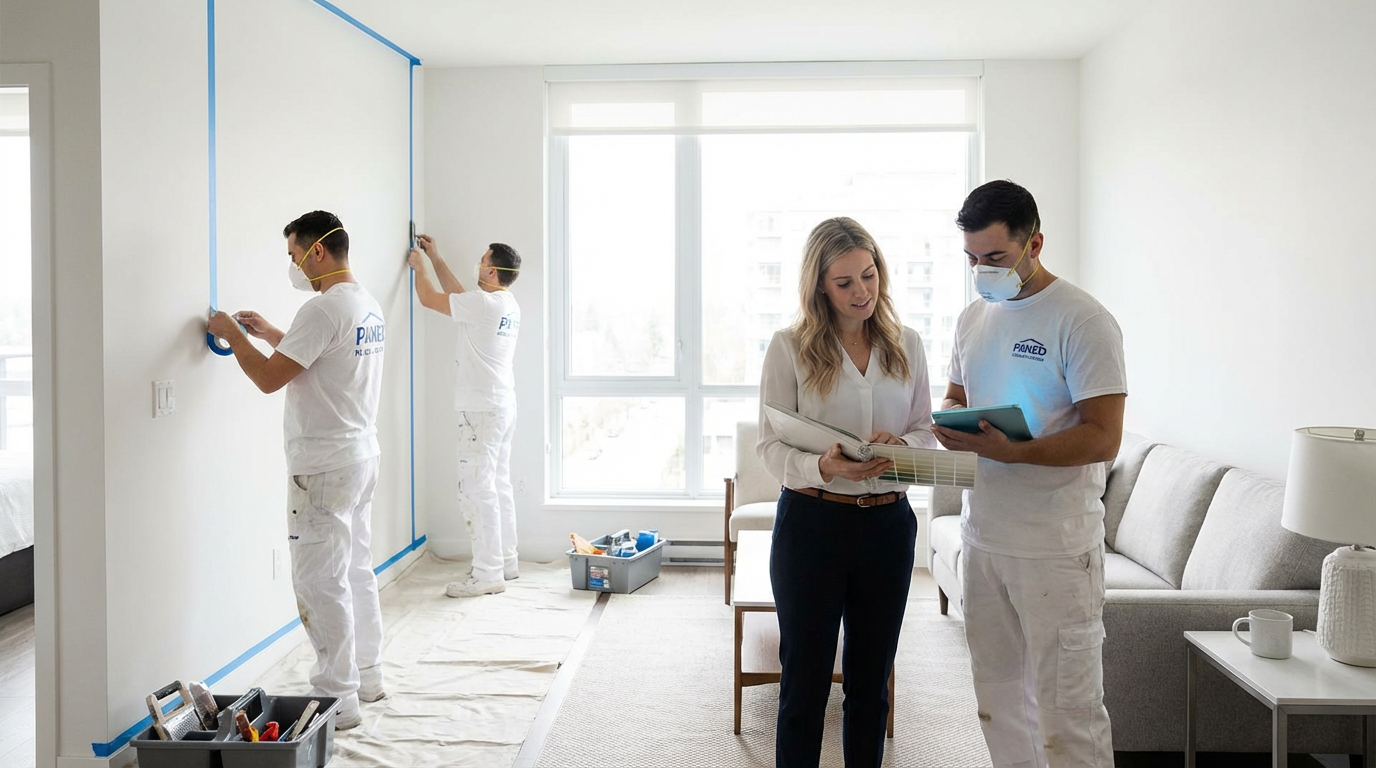
Get expert tips for hiring apartment painters. Learn to secure accurate estimates, verify quality work, and ensure professional results that last.
Key Takeaways
- **Lowest quote ($2,200):** Didn't include primer or cleanup costs. That primer alone would've added $0.50-$0.75 per square foot later as an "unexpected" charge. Classic bait-and-switch that would've pushed the real **apartment painting cost** past the middle quote anyway.
- **Highest quote ($4,100):** Premium materials, sure, but labor rates were 30-40% above market. They were attributing 75% of the total to labor. That's just not justified, even with top-shelf paint.
- **Middle quote ($3,400):** Transparent pricing. Quality materials (they specified Sherwin-Williams SuperPaint). Fair labor rates. This was the sweet spot — best balance of cost and quality.
- **Cleaning:** Before any sanding or patching, surfaces need to be clean. For interior walls, a simple TSP (trisodium phosphate) solution, mixed according to manufacturer instructions (e.g., 1/2 cup TSP per gallon of warm water), is often used. This removes grease, grime, and mildew. For mildew, a bleach solution (1 part bleach to 3 parts water) followed by a rinse is essential, per recommendations from organizations like the EPA for mold remediation. ASTM D3891 provides guidance on cleaning surfaces for painting.
- **Sanding:** After cleaning and drying, sanding helps create a mechanical profile for paint adhesion. For previously painted smooth walls, 120-180 grit sandpaper is common. For rougher surfaces or to remove existing paint imperfections, a coarser grit (80-100) might be used first, followed by a finer grit. Sanding dust must be completely removed with a tack cloth or vacuum before priming.
Key Takeaways
Apartment Painting Guide: Work with Professional Painters for a Flawless Finish Every Time — A BizzFactor Expert Review
You know what? I've watched too many people turn a simple apartment paint job into a three-month nightmare. With the right strategy and straight talk with contractors, this should be painless. Our team at BizzFactor has walked over 3,000 homeowners through these projects in the last five years — which means we've seen every possible screwup and shortcut.
This guide isn't fluff. It's the actual roadmap to getting your apartment painted without losing your mind or your savings.
Getting Comprehensive and Accurate Painting Estimates for Your Apartment: Don't Get Caught Off Guard
Your estimate is basically the only leverage you have once someone cracks open a paint can in your living room. Get it in writing — materials, who's doing what, how long it takes, who hauls the drop cloths away when it's done. The homeowners who don't panic-call us six weeks in? They're the ones who collect three or four quotes and actually read the line items. Once paint touches drywall, whatever handshake deal you thought you had is pretty much irrelevant.
Experienced painters won't charge you for an initial estimate. The good ones *insist* on on-site visits.
Why?
Because phone quotes are basically worthless. A friend of mine in Oakland got quoted $2,800 for her two-bedroom over the phone. Sounded great. Then the contractor showed up and found water damage behind the kitchen radiator from a slow leak that'd been going for months. Final price? $5,200. That's why in-person assessments aren't optional — they're the only way to nail down your actual **apartment painting cost**.
So what needs to be in your estimate? Everything. Brand names matter — BEHR Premium Plus, Sherwin-Williams Emerald, Benjamin Moore Aura. Not just "quality paint" or "premium materials." You want the specific finish (matte hides wall imperfections but shows scuffs, eggshell's more durable, semi-gloss for trim), square footage calculations, and whether they're spraying or rolling. Method affects timeline and how the finish looks.
Room-by-room breakdowns aren't negotiable either.
Your bathroom needs different paint than your living room — higher sheen (usually semi-gloss with a reflection value around 35-50 lumens), mold-resistant formulations. Miss that detail and you're repainting in 18 months when mildew shows up. These specifics directly impact your **apartment painting cost**.
Look — don't ignore the repairs section. Your estimate should detail *exactly* how they'll fill holes (spackle? joint compound? two-part epoxy for big damage?), treat cracks, and which walls need primer. Companies like Paint Perfection Pros itemize this stuff down to the brand — Zinsser B-I-N shellac primer, USG joint compound, the works.
Timeline estimates should specify how many workers and daily progress. "Prep 1-2 rooms daily" or "300-400 sq ft first coat per day" — that's the level of detail you're after. This creates transparency for your **apartment painting project**. You'll know exactly who's showing up and when they'll be done.
How Do Multiple Quotes *Really* Compare in Apartment Painting Projects?
We helped a client in Seattle's Capitol Hill analyze three quotes for her two-bedroom last month. The range was wild — $2,200 to $4,100 for supposedly identical work.
Here's what we found:
- **Lowest quote ($2,200):** Didn't include primer or cleanup costs. That primer alone would've added $0.50-$0.75 per square foot later as an "unexpected" charge. Classic bait-and-switch that would've pushed the real **apartment painting cost** past the middle quote anyway.
- **Highest quote ($4,100):** Premium materials, sure, but labor rates were 30-40% above market. They were attributing 75% of the total to labor. That's just not justified, even with top-shelf paint.
- **Middle quote ($3,400):** Transparent pricing. Quality materials (they specified Sherwin-Williams SuperPaint). Fair labor rates. This was the sweet spot — best balance of cost and quality.
Going cheap upfront usually costs more long-term. Hidden fees, shoddy work that needs fixing, callbacks... it snowballs. Compare quotes thoroughly, but prioritize value over the lowest number when you're hiring **apartment painting services**. Your future self will thank you.
What You'll Actually Pay for Apartment Painting (Real Numbers, Not Marketing Fluff)
Here's the thing: here's the deal: in most markets you're looking at somewhere between $3-$6 per square foot as your baseline. Could jump up to $7-$9 if you're using the fancy stuff or have complicated architectural details.
But location? That changes everything.
NYC or San Francisco? You might be staring at $10/sq ft for completely standard work. Vaulted ceilings shooting up past 10 feet? Intricate crown molding that takes an hour per room just to tape off? Walls that need patching across more than 20% of the surface? Every single one of those bumps the price. And if you're getting into "architectural grade" paints like Fine Paints of Europe — yeah, material costs alone can blow your budget before anyone picks up a brush. Do yourself a favor: research local rates *before* you start calling contractors. It helps you spot the contractors who are way too cheap (red flag) or weirdly overpriced (also red flag) and lets you budget realistically for your **apartment painting project**.
Some companies (All Covered Painting in Austin is one example) publish pricing guides online. These are gold for identifying unrealistic quotes — whether suspiciously low or weirdly high. That's the real issue. For a deeper dive into local costs, check out our guide on [understanding painting costs in your area](/blog/understanding-painting-costs-in-your-area). It's worth the 10 minutes.
Always ask about pre-tax pricing. Some contractors present artificially low numbers, then hit you with sales tax (typically 6-10% depending on state) at the end. Ask upfront: "Is this price inclusive of all taxes and fees?" Prevents that sudden 8% surprise on your **apartment painting cost**.
Extremely low bids are red flags.
I've seen it play out in older Boston apartments — contractors skip prep steps entirely or swap in inferior paint without telling the homeowner. Result? Peeling within six months. You need decent pricing to get decent work. Painters who charge fairly can afford to do the job right — proper prep time, quality materials, attention to detail on your **apartment painting services**. You genuinely get what you pay for here.
What's *Really* Included in Professional Apartment Painting Pricing?
Missing any of these from your quote? That's your cue to ask some pointed questions (or just move on to the next contractor):
1. **Surface prep:** TSP wash or equivalent cleaner. Sanding (120-180 grit). Patching walls. Filling nail holes. This eats up the most time — a two-bedroom might need a full day just for prep. The painters who won't rush this part? Those are your people. Skip prep and you're basically painting over problems that'll show up in six months.
2. **Primer:** You'll use this when walls actually need it — better adhesion, truer color, smoother finish. Going from navy blue to white? Expect two primer coats, maybe three if the blue was really saturated. Dark stains or water damage means breaking out the Kilz or Zinsser. Costs a bit upfront but you'll use way less finish paint.
3. **Two coats of quality paint:** Non-negotiable for coverage, durability, and even color. One thin coat shows through and looks cheap. Pros calculate precisely — usually 350-400 sq ft per gallon per coat.
4. **Furniture protection:** Heavy-duty coverings (at least 4-mil plastic sheeting for floors, often higher density) and quality masking tape (electrostatic film or FrogTape, not dollar-store junk). A pro crew leaves your place cleaner than they found it.
5. **Cleanup and disposal:** Vacuuming, wiping surfaces, removing all tape, proper disposal of paint cans and debris. Your apartment should be ready to enjoy immediately.
6. **Sales tax and permits:** Full pricing transparency. Any permit fees disclosed upfront (some cities require permits for exterior painting on multi-family units, occasionally for interior work too, depending on municipality).
Securing Written Warranty Protection for Your Apartment Painting Investment: Your Safety Net
If a painter won't guarantee their work in writing, that tells you everything you need to know about quality. Don't hire them.
Real pros guarantee **1-3 years minimum** — both materials and application. No guarantee offered? That's your red flag. You're about to drop thousands of dollars, and they won't promise it'll hold up? Hard pass. Find someone who actually stands behind their **apartment paint job**.
What's covered? Paint adhesion problems (peeling, blistering, flaking). Color inconsistency from poor application. Defects like streaking, roller marks, or brush marks exceeding 2mm in width.
What's *not* typically covered? Damage due to substrate issues they weren't hired to fix (like ongoing moisture leaks), normal wear and tear, or paint applied over poorly prepped surfaces when you specifically declined recommended prep work (which, if they're smart, will be explicitly noted in your contract). Look for warranties that reference specific standards like ASTM D7087 for coating performance. A robust warranty will also specify the remedies: re-priming and re-painting affected areas, not just a verbal "we'll take a look."
Technical Details on Paint Performance & Substrate Preparation
Let's dive a bit deeper into some crucial technical considerations that separate a slap-dash job from a truly professional finish. This isn't just about aesthetics; it's about longevity and performance.
**Surface Preparation: The Unsung Hero**
I can't stress this enough: *preparation is 80% of a good paint job*. Any pro worth their salt will tell you that.
- **Cleaning:** Before any sanding or patching, surfaces need to be clean. For interior walls, a simple TSP (trisodium phosphate) solution, mixed according to manufacturer instructions (e.g., 1/2 cup TSP per gallon of warm water), is often used. This removes grease, grime, and mildew. For mildew, a bleach solution (1 part bleach to 3 parts water) followed by a rinse is essential, per recommendations from organizations like the EPA for mold remediation. ASTM D3891 provides guidance on cleaning surfaces for painting.
- **Sanding:** After cleaning and drying, sanding helps create a mechanical profile for paint adhesion. For previously painted smooth walls, 120-180 grit sandpaper is common. For rougher surfaces or to remove existing paint imperfections, a coarser grit (80-100) might be used first, followed by a finer grit. Sanding dust must be completely removed with a tack cloth or vacuum before priming.
- **Patching and Repair:**
- **Nail holes/small dings:** Lightweight spackle works well for shallow imperfections.
- **Larger holes/cracks:** Joint compound (lightweight or all-purpose) is preferred. For holes larger than a quarter, a mesh or self-adhesive patch, followed by joint compound, is standard. The International Residential Code (IRC) doesn't directly dictate paint, but it references ASTM C1396/C1396M for gypsum board, which implies proper surface integrity.
- **Cracks:** Minor hairline cracks can sometimes be filled with elastomeric caulk (like a high-quality acrylic latex caulk with silicone) before painting, especially in corners or around trim. For structural cracks, deeper investigation is necessary before a painter just covers it up.
- **Drying Times:** Each layer of spackle or joint compound needs adequate drying time, usually 1-4 hours per coat, sometimes longer in humid conditions, before sanding smooth. Rushing this leads to cracking or bubbling later.
**Primer Selection: More Than Just White Paint**
Primers serve multiple functions, and picking the right one is critical:
- **Adhesion Promotion:** Improves the bond between the new paint and the substrate, especially on difficult surfaces like previously unpainted drywall (which is porous), glossy finishes, or oil-based paint (if switching to latex).
- **Stain Blocking:** Essent
In-Depth Look
Detailed illustration of key concepts
Visual Guide
Infographic illustration for this topic
Sources & References
- Efficient Apartment Complex Painting: Best Practices
- Interior Painting Tips| Best Practices from an Expert
- A Pro Painter's Top House Painting Tips and Tricks | HGTV Home Tips
- The Secrets of Pro Painters: Mastering Interior Painting Techniques
- How to Paint a Room: 8 Steps to Painting Walls Like a DIY Pro
- Best Interior & Exterior Paint Buying Guide - Consumer Reports
- Best Paint for Commercial Buildings - Miko LLC
- Building Codes, Standards, and Regulations: Frequently Asked ...
- Choosing the Right Exterior Paint for Commercial Buildings
Frequently Asked Questions
Need Professional Help?
Find top-rated house painters experts in your area