Expert bathroom painting guide covering moisture-resistant paints, professional prep techniques, mold prevention, and application methods for lasting results.
Key Takeaways
- Specialized moisture-resistant paints and primers are essential for bathroom environments
- Professional surface preparation includes mold remediation and comprehensive moisture assessment
- Proper ventilation and environmental controls during application ensure lasting results
BizzFactor Quick Guide
The BizzFactor Standard: Always use moisture-resistant paint formulations with anti-microbial primers in bathroom applications
Key Takeaways
The BizzFactor Standard
3 Non-Negotiable Requirements for Elite Workmanship
Licensed & Insured Professionals
Bathroom projects require proper licensing and comprehensive insurance coverage for water damage protection and mold remediation work.
Moisture-Resistant Material Specification
Premium bathroom-rated paints and primers designed specifically for high-humidity environments prevent premature failure and mold growth.
Written Performance Warranty
Minimum two-year warranty covering both materials and workmanship demonstrates contractor confidence in proper application methods.
Expert Bathroom Painting Guide: Moisture-Resistant Techniques & Best Practices
Painting a bathroom? It's not just slapping some color on the walls. Not even close. You're dealing with moisture, steam, and conditions that'll destroy standard paint in months. I'm talking premium moisture-resistant formulations — BEHR PRO, Benjamin Moore Aura Bath & Spa, that caliber. You need ventilation that actually works. Surface prep that includes legitimate mold remediation. And anti-microbial primers applied strategically.
This isn't a weekend project. It's a specialized operation.
Do it right and you'll protect your investment for years. Cut corners? You'll be repainting in six months, probably fighting mold too.
Why Bathroom Painting Demands Special Expertise — It's Not Just Another Room, Trust Me
Your bathroom wants to destroy paint. Seriously — constant moisture, wild temperature swings, steam that settles into every corner. Our specialists at BizzFactor see this daily. It's humid air meets drywall, and drywall loses unless you know what you're doing.
Hot showers, inadequate ventilation, and surface prep that homeowners skip entirely? That's the perfect storm for paint failure. We've walked into countless bathrooms where someone grabbed standard latex paint, skipped the priming, and ignored the moisture problems lurking underneath.
Those "cost-cutting" measures backfire spectacularly. Peeling within months. Bubbling that looks like your walls have a skin disease. And mold — black, toxic, property-value-destroying mold. Ever tried selling a house with visible mold? Buyers won't even schedule a second showing.
Here's what actually works: moisture-resistant coatings designed for humid environments. I mean real anti-microbial primers, not the stuff they market that way. Surface preparation that fixes problems instead of hiding them. CertaPro Painters® and Pearl Painters developed specific protocols for these spaces — protocols we've adapted because they've been field-tested in thousands of bathrooms.
Here's What Actually Makes Bathroom Paint Different
You know how bedroom paint just sits there looking pretty? Bathroom paint has to *fight*. The acrylic base is similar, sure, but then manufacturers pack in polymer resins and hydrophobic compounds — stuff that makes water bead up and roll off instead of soaking through. I watched a rep demo this once at a trade show. Regular paint vs. bathroom paint, both getting sprayed with water. The regular stuff darkened and started softening within minutes. The bathroom formula? Looked exactly the same.
Look — so what's happening at the molecular level? Those cross-linking additives create polymer chains during curing. Think of it like weaving — the tighter the weave, the less water sneaks through. That's your barrier right there. Water hits it, can't penetrate, rolls off. Works even when your teenager camps out in the shower for an hour.
Now, the anti-microbial stuff — usually zinc compounds or silver ions mixed directly into the paint. Silver ion tech disrupts microbial cell functions. Sounds like marketing BS (I thought so too initially), but there's legit testing behind this. **ASTM D3273** measures how paint holds up against mold in environmental chambers. **ASTM G21** tests synthetic materials against fungi. Good bathroom paints pass these because they're engineered specifically for wet environments, not because someone wrote clever ad copy.
Why Bleach Just Doesn't Cut It for Mold — A Critical Distinction
I've watched this play out maybe a hundred times. Homeowner spots mold, grabs the Clorox, scrubs everything down. Walks away feeling productive. Two months later? Mold's back, usually worse than before.
Bleach only kills surface mold on non-porous materials — tile, glass, that's it. On porous surfaces (drywall, wood trim, basically everything bathrooms are built from), bleach makes the mold *invisible*. The roots? Still growing. The spores? Totally fine, just waiting.
And here's the part that gets me: the water content in bleach actually feeds the colony deeper into the substrate. You're essentially watering your mold problem while making it harder to see. EPA-approved antimicrobial solutions (Concrobium Mold Control, RMR-86) actually penetrate porous materials and kill the colony at its roots. They denature fungal proteins, disrupt enzymatic activity — that's genuine remediation. Not cosmetic theater.
War Story: Turning Around a Mold-Damaged Bathroom in Silver Spring (That Almost Got Ripped Out!)
Here's the thing: a homeowner in Silver Spring contacted us about their master bathroom. Six months earlier, they'd painted it themselves using regular interior paint from Home Depot. Standard stuff, probably $28 a gallon.
The result? Catastrophic.
Mold was blooming behind the vanity. Paint peeling like old wallpaper around the shower. Dark humidity stains spreading across the ceiling. They thought they'd have to gut the entire room — we're talking a $15,000+ renovation they absolutely couldn't afford.
We scraped every bit of failing paint down to bare drywall in spots. Hit it with EPA-approved mold remediation solutions (following the dwell times on the label, which most people ignore). And we found something they didn't know existed: a leaky shower pan that'd been feeding moisture into the walls for months. That violated **IPC 417.5.2** on shower pan integrity, by the way.
Had to remove some tile, replace a section of damaged subfloor, install a new membrane with proper slope to the drain. Then we sealed everything with Benjamin Moore's Fresh Start Moisture Resistant Acrylic Primer (the K023 version — excellent stain blocking). Finished with two coats of BEHR PRO i300 Semi-Gloss, which has integrated antimicrobial properties.
The homeowner balked. "All that for a *bathroom*?"
Total for the extensive pre-paint work — subfloor repair, pan replacement, mold remediation, premium materials — came to around **$2,800**. Plus painting.
So we explained it: you can pay now to fix the root cause, or pay every six months when this keeps happening. And eventually pay $15K to rip it all out. Once they understood they were buying peace of mind instead of just paint, they signed off.
Now, six months later? Bathroom looks pristine. Zero mold. No peeling. Not even a hint of moisture damage. Sometimes the best sales pitch is just educating people on why shortcuts cost more in the long run. (Want another example of specialized techniques? Check out our article on [kitchen cabinet painting](/house-painters/kitchen-cabinet-painting) for how expertise applies to different spaces.)
Every room has quirks. Bathrooms just have *more* of them.
Picking the Right Paint for Your Bathroom — Color's the Easy Part
The shade you pick? That's like 10% of the decision. What really matters is whether that paint can handle getting blasted with steam twice a day, whether mold colonies can gain a foothold, whether you can scrub mystery gunk off the wall without taking the finish with it. Most paint folds under bathroom conditions.
BEHR Bathroom Paint, Benjamin Moore Aura Bath & Spa, Sherwin-Williams Duration Home — these aren't just expensive versions of regular paint with fancy labels. They're engineered differently. Higher resin content, hydrophobic additives, tighter molecular structures. When you search for the **best paint for bathrooms**, those brands dominate every list. There's a reason.
I talked to a rep from Benjamin Moore at a contractor expo last year. She explained that their Aura line has about 30% more acrylic resin than standard interior paint. That's what gives it the toughness bathrooms demand. Semi-gloss and satin finishes work better than flat because the molecular structure is tighter — literally less permeable. Water can't sneak through as easily. Flat paints absorb moisture like a sponge, basically rolling out the welcome mat for mold.
High-gloss finishes are crazy durable. But they highlight every imperfection. Under typical bathroom lighting, they look harsh. Not exactly spa-like.
Our crew recommends specific products based on bathroom size, ventilation quality, and usage patterns. A master bathroom with weak ventilation (like airflow below the **NEC 2020, Article 210.11(C)(3)** requirement of 50 CFM for smaller bathrooms) needs premium formulations. No exceptions. A rarely used powder room? Mid-grade moisture-resistant paint might work fine — *if* surface prep is exceptional.
You wouldn't use a bulldozer to plant petunias, right?
Deciphering Paint Sheen Levels for Bathrooms — Your Guide to the Right Glow
**Flat/Matte:** I tested this once in my half-bath. Don't ask why — young contractor hubris. Three months later, black spots blooming everywhere. Flat paint is porous, absorbs moisture, creates perfect mold habitat. ASTM D3450 washability ratings on flat finishes prove what I learned the expensive way.
**Eggshell:** Better, but that subtle texture still gives moisture places to hide. A powder room with decent ventilation and a window that actually opens? Maybe. Main bathroom with daily showers? You're gambling.
**Satin:** This is where bathrooms start making sense. Smooth enough to resist moisture penetration, subtle sheen that doesn't look institutional, cleans up easily. The tighter film structure makes it genuinely less porous. Manufacturers usually add mildewcides at this sheen level. Solid baseline choice for most bathrooms.
**Semi-Gloss:** My recommendation probably 70% of the time. Durable as hell, wipes clean without fuss, handles moisture beautifully. That increased resin content creates a harder, smoother surface that repels water instead of absorbing it. Perfect for bathrooms that get regular use.
**High-Gloss:** Moisture resistance? Unbeatable. But it shows every imperfection — dings, tape lines, uneven drywall compound you thought you'd fixed. Great for trim and doors where you want crisp definition. For walls? Only if your surface prep and finishing work is absolutely flawless (and let's be real, whose is?).
Professional Surface Preparation Protocols — This is Where the Magic Happens (Or Where Disasters Are Averted)
Here's what most DIYers miss: surface prep is 80% of the job. You can use $75-per-gallon paint, but if your walls aren't ready, it'll fail just as fast as the cheap stuff.
Here's the thing: here's the thing: we start every bathroom project with moisture readings. A Tramex ME5 Pro tells us if there's elevated moisture content lurking in the drywall or wood. That's the real issue. Anything above 15% means you've got an active problem that needs fixing *before* paint touches the wall. Last month in Bethesda, we found readings of 22% behind a vanity — turned out the supply line had been leaking for who knows how long.
Any discoloration gets tested. We use lab swabs to identify mold species and concentration levels. (Insurance companies care about this — document everything.) Cross-hatch adhesion tests per **ASTM D3359** tell us if existing paint is actually bonded or just hanging on by a prayer. You'd be shocked how often it's the latter.
Mold remediation strictly follows EPA guidelines using approved antimicrobial solutions. We specifically avoid bleach application on porous surfaces due to its ineffectiveness, as noted earlier. All loose or peeling paint gets removed through careful scraping and sanding.
Glossy surfaces get hit with 180-220 grit sandpaper to rough them up — creates microscopic peaks and valleys for the new primer to grab onto. Without that "tooth," even the best primer just sits on top instead of bonding. Nail holes? DAP DryDex Spackle with Microban works great (that antimicrobial additive matters in wet areas). Bigger gaps get epoxy-based fillers that won't absorb water.
Then we prime. Benjamin Moore's Fresh Start, Zinsser's Mold Killing Primer, KILZ Premium — depends on what we're covering. A bathroom that had minor mold issues? Mold-killing primer is non-negotiable.
DAP and 3M make excellent moisture-resistant fillers and caulks — crucial for preventing future water intrusion around tubs, showers, and sinks. We exclusively use elastomeric caulk products that stay flexible in high-humidity conditions
In-Depth Look
Detailed illustration of key concepts
Visual Guide
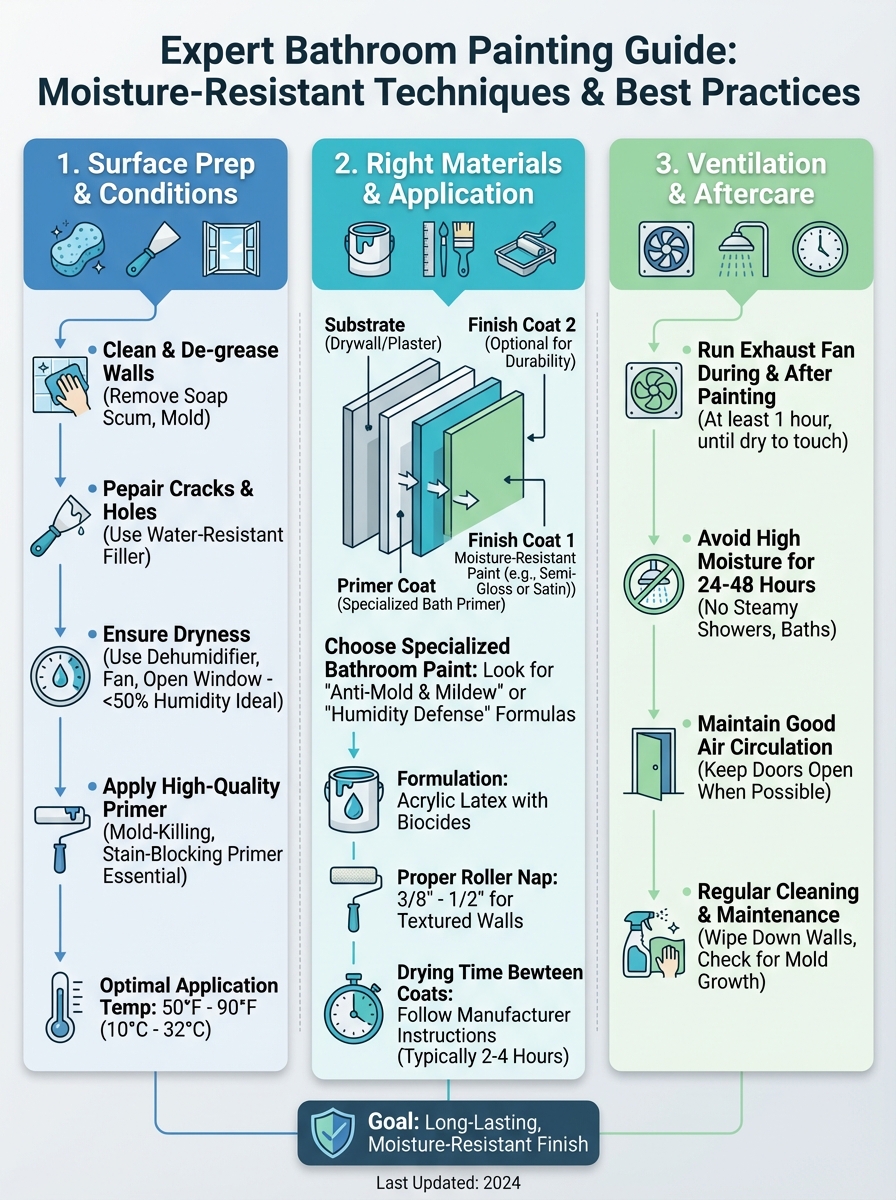
Infographic illustration for this topic
Sources & References
- How To Paint a Bathroom - This Old House
- What to Consider When Painting Your Bathroom - Pearl Painters
- A Pro Painter's Top House Painting Tips and Tricks | HGTV Home Tips
- How to Paint a Bathroom - Trusted House Painter
- Best Interior & Exterior Paint Buying Guide - Consumer Reports
- [PDF] South Carolina Residential Construction Standards - Anderson County
- Best Paint for Commercial Buildings - Miko LLC
- Building Codes, Standards, and Regulations: Frequently Asked ...
- Choosing the Right Exterior Paint for Commercial Buildings
Frequently Asked Questions
Need Professional Help?
Find top-rated house painters experts in your area