Complete guide to professional stairwell painting: safety protocols, material selection, cost factors & quality standards for multi-story buildings.
Key Takeaways
- Professional stairwell painting demands specialized equipment, safety protocols, and commercial-grade materials for durability.
- Proper surface preparation and premium paint selection ensure long-lasting results in high-traffic environments.
- Coordinated scheduling and phased approach minimize building disruption while maintaining emergency access routes.
BizzFactor Quick Guide
The BizzFactor Standard: Always use OSHA-compliant safety equipment and commercial-grade paints for stairwell projects
Key Takeaways
The BizzFactor Standard
3 Non-Negotiable Requirements for Elite Workmanship
OSHA-Compliant Safety Equipment
Professional contractors must use certified scaffolding systems and fall protection when working at elevated heights in stairwells.
Commercial-Grade Paint Systems
High-traffic stairwells require premium paints with enhanced durability ratings and soil resistance properties for long-term performance.
Comprehensive Surface Preparation
Proper cleaning, repair, and priming ensure optimal paint adhesion and prevent premature failure in demanding stairwell environments.
Stairwell Painting Guide: What Actually Works & What It'll Cost You
Stairwell painting? Different beast entirely.
You're not just slapping paint on a bedroom wall. We're talking about vertical spaces that get hammered daily — thousands of feet moving through, hands grabbing rails, shoulders bumping walls. The paint's gotta look sharp *and* survive serious punishment. For property managers and building owners, this is about protecting what you own and not having to redo the whole thing in eighteen months. Let me walk you through what actually works when pros tackle these jobs — and how to get it done without emptying your wallet.
Understanding Stairwell Painting: Yeah, It's Complicated
Think you can just grab a ladder and knock this out over the weekend?
Stop right there.
I've done maybe forty of these jobs, and every single one starts differently. You walk the site with your crew lead — no clipboard yet, just eyeballs and questions. Is this a straight shot, five floors with consistent landings? Or some weird split-level nightmare from the '70s where every turn is a different dimension? Can we even fit scaffolding through that door? Are people gonna be climbing these stairs at 8 AM Monday, or can we actually shut the thing down? A good contractor keeps disruption minimal and hits deadlines. That's table stakes.
Why are stairwells such a pain? First off, you're contorting around landings, reaching into corners that architects apparently designed as a personal challenge. Watched a crew in Midtown last month deal with a 35-foot ceiling. Their standard scaffolding? Not even close. They ended up renting this massive articulating lift that barely squeezed through the door — $800 for three days, but what else could they do?
Then there's the height thing, which genuinely messes with your workflow. Nobody's comfortable at the top of a 30-foot ladder. Your arms get tired. You start making sloppy choices.
And the paint itself — this needs to survive constant abuse. We're grabbing commercial-grade formulas from BEHR PRO and Sherwin-Williams. Not the stuff you'd use in your living room. These are built for constant traffic, washable, scuff-resistant. Matters way more than most people realize.
Get Ready: Planning Before the First Brush Hits the Wall
I've watched way too many contractors show up, eyeball the job from the landing, and start throwing out numbers.
Those guys? They're the ones calling you in three weeks asking for more money because "we didn't know about the water damage." The actual pros (yeah, crews like CertaPro and Arthur Cole come to mind, but honestly anyone who's been doing this for more than five years) — they show up with clipboards and actually *look* at stuff. Poking at bubbled paint. Checking if your ventilation is garbage. Measuring things. Proper ventilation isn't optional — paint needs to cure, and your people need to breathe air that won't make them dizzy. Want more on planning this stuff out? Our guide on [commercial painting project management](https://bizzfactor.com/commercial-painting-project-management-guide) goes deeper.
Lead paint testing for anything pre-1978? Yeah, you're doing that. Not because some inspector's gonna show up (though they might), but because lead poisoning lawsuits are expensive and terrible. Had a guy lose a $40K job in Brooklyn three years back because he skipped this step — building owner found out, fired him on the spot, hired someone else at a premium. That's the kind of stupid you can't afford.
We're also figuring out if your walls need serious surgery or just a good scrub and prime. Difference between a $6,000 job and a $12,000 job usually lives right here in the assessment phase.
Here's where it gets specific — and I mean *really* specific, the kind of thing that separates weekend warriors from people who've been doing this since the Clinton administration. You're standing there looking at walls that might be plaster from 1952, might be drywall from a 1987 renovation, might be some Frankenstein combo of both because the super "fixed" things over the years. Each one needs a different primer or you're wasting everyone's time.
Old plaster that's been painted a dozen times? Surface is slicker than you'd think. Regular primer just sits on top, never really grabs. You need something aggressive — KILZ Adhesion or Sherwin-Williams PrepRite ProBlock are the go-tos because they're basically engineered to bond with surfaces that don't want to be painted. Fresh drywall repairs (and there's always fresh drywall repairs in a stairwell)? Totally different problem. You hit raw drywall with regular paint and it sucks it up like a sponge, flashes darker than the rest of the wall, looks like garbage. PVA sealer fixes that, gives you an even base so your topcoat doesn't look patchy.
The Painting Contractors Association publishes spec sheets for this stuff. We keep physical copies in the truck — not because we're trying to impress anyone, but because when you're three floors up on scaffolding with six different surfaces staring at you, you need to know which primer goes where. Getting this wrong means you're back in two months fixing failures.
Essential Prep: Why Surface Preparation Makes or Breaks Everything
A contractor I know in Buckhead — guy named Marcus — told me he's watched more paint jobs fail from lazy prep than from anything else.
"Maybe seventy, eighty percent," he said. "And I'm being conservative."
Stairwells throw everything at you. Stress cracks because buildings shift — just how it goes. Holes where someone banged furniture coming up or down. Moisture problems because the space is basically sealed off with garbage airflow.
We're using DAP FastDry or 3M Patch Plus Primer for repairs — not the cheap spackling compound from the big box store. That stuff's fine for a nail pop in your kid's bedroom, but stairwells? Nah. You need compounds that'll flex when the building moves (and buildings *always* move — settling, temperature changes, that delivery truck that hits the loading dock too hard). Otherwise that perfect patch you did is gonna crack right back open in three months. Ask me how I know.
And washing these walls — man, you wouldn't believe the grime. Hand grease builds up on the walls. Cooking smells and oils drift up from lower floors and stick to everything. It's genuinely nasty once you start scrubbing. TSP cleaners (or the eco-friendly versions if your building's picky about chemicals) cut through all that contamination so the new paint can actually bond. Any peeling or flaking paint? Gets scraped, sanded, stripped down until you hit something solid. Then — only then — we prime before topcoats go on. Our [residential interior painting guide](https://bizzfactor.com/residential-interior-painting-guide) covers a lot of these same principles if you want to dive deeper.
Pick Your Materials: Why Cheap Paint Is a Terrible Investment
I'm gonna tell you something you probably don't want to hear.
That bargain paint you're eyeing? Terrible idea for a stairwell. Just terrible.
Look — on probably 90% of our commercial stairwell jobs, we're using BEHR Ultra or Sherwin-Williams ProClassic. Why those specifically? I've watched these formulas hold up while cheaper alternatives start looking ratty after eighteen months. The price difference isn't even that dramatic — maybe $55 a gallon versus $35. Seriously. Sounds like a lot until you realize you're repainting three years sooner with the cheap stuff. You're paying for the labor twice, the scaffolding rental twice, the building disruption twice. A property manager in Buckhead told me last year she spent $6,200 redoing a stairwell they'd painted with economy-grade paint only two years earlier. Could've been avoided entirely. (And no, we don't get kickbacks from paint companies — I just hate callbacks.)
Most stairwells are basically caves. Maybe there's one sad little window on a landing somewhere, throwing in some light around lunchtime. So we're usually pushing neutrals that'll bounce whatever light exists around instead of absorbing it — warm grays, soft taupes, anything that makes the space feel less like you're descending into a parking garage.
The finish debate? Here's how it actually plays out on job sites. Semi-gloss gives you maximum washability — someone's kid drags a sticky hand down your freshly painted wall, you can hit it with a wet rag and it's gone. But semi-gloss also shows *every* imperfection in your substrate and your roller technique. You better have prepped that wall perfectly. Satin's more forgiving, hides minor flaws, still cleans up reasonably well. We probably go satin on 70% of stairwell walls, semi-gloss on trim and handrails where people are actually grabbing with greasy fingers. Flat paint in a stairwell? Never. You can't clean it, and it'll look trashed in six months. Same logic we apply to [kitchen cabinet painting](https://bizzfactor.com/kitchen-cabinet-painting) — if people are touching it, it needs a finish that can handle it.
Safety First: Not Just a Slogan
You want to know what keeps me up at night on stairwell jobs?
It's not missing deadlines. It's someone falling.
OSHA says fall protection starts at six feet. Six feet. Every stairwell job hits that, usually by the second floor. And yeah, I've got crew members who've been painting since before I was born, think they're invincible, don't need to clip in. Doesn't matter how experienced you're. You're clipping into an approved anchor point if you're on that scaffolding, or you're finding a different job site. The scaffolding itself gets inspected before we load it — manufactured system with proper bracing, rated for the load, locked wheels, the whole deal. That's the real issue. I've walked off jobs where property owners wanted us to "just use some planks and ladders to save money." Not happening. My insurance company would murder me. More importantly? I'm not explaining to someone's wife why her husband fell three stories because we wanted to save $400 on a scaffold rental.
Respiratory stuff gets ignored constantly, which drives me crazy. "Oh, it's just paint fumes, crack a window." Except stairwells are basically sealed boxes with minimal airflow. Those VOCs build up *fast* — you'll be lightheaded in an hour if you're not careful. We're running ventilation fans, we've got respirators rated for organic vapors (not the paper dust masks from Home Depot, actual respirators), and if the building's HVAC can't handle the load, we're working shorter shifts. This Old House has been screaming about ventilation for decades. Fresh air circulation protects workers and building occupants. Period. Nobody needs to be dizzy halfway up a flight of stairs.
Here's the thing: electrical? Yeah, we're paranoid. Outlets get covered. Switches get taped off. Emergency lights can't get painted over (seems obvious, but I've seen it screwed up). Professional-grade drop cloths and plastic sheeting aren't just for keeping drips off the floor — they stop stairs from turning into a slip hazard. Paint on a stair tread is a lawsuit waiting to happen. For comprehensive safety measures, check our guide on [safety in painting services](https://bizzfactor.com/safety-in-painting-services).
Real Talk: A Chelsea Stairwell Nightmare That Actually Worked Out
So last year we took on a stairwell job in a 12-story residential building in Chelsea.
Maintenance had been deferred for almost a decade.
The existing paint was shredded at handrail contact points, scuff marks everywhere, and we discovered an undisclosed moisture issue behind an HVAC chase. Big problem. What followed required some serious improvisation — you're tearing out drywall mid-job, coordinating emergency moisture remediation, and still trying to stay somewhere near schedule. The building manager was losing his mind because tenants kept asking when they'd get their "nice" stairwell back. We had to keep one section open at all times for fire code reasons, which meant working in weird phases — floors three and four on Monday, skip to seven and eight Tuesday, back down for five and six Wednesday. Felt like painting Tetris.
We went with Sherwin-Williams ProClassic throughout — eggshell on walls, semi-gloss on all the trim. Not flashy, but bulletproof. Cleans up nice, takes abuse like you wouldn't believe, and the finish consistency holds up under different lighting conditions floor to floor.
Total project cost? $18,400.
About 30% over initial estimates due to the moisture remediation. But it's held up beautifully for over a year now with zero callbacks.
Quality Control: How We Make Sure It Actually Looks Good
So we're on-site constantly while this thing's happening. Not because we don't trust the crew (okay, sometimes because we don't trust the crew), but mainly because stairwells are quality control nightmares.
Lighting's the big one. What looks perfect under your work lights at 7 AM shows every roller stipple when afternoon sun comes through that seventh-floor window at a different angle. We catch this by walking the site at different times of day, which sounds obsessive until you've had a client call you back because "it looks streaky at 3 PM." That's the real issue. Coverage consistency between gallons matters too — paint batches can shift just enough in tint to drive you insane when you're trying to match across twelve floors.
In-Depth Look
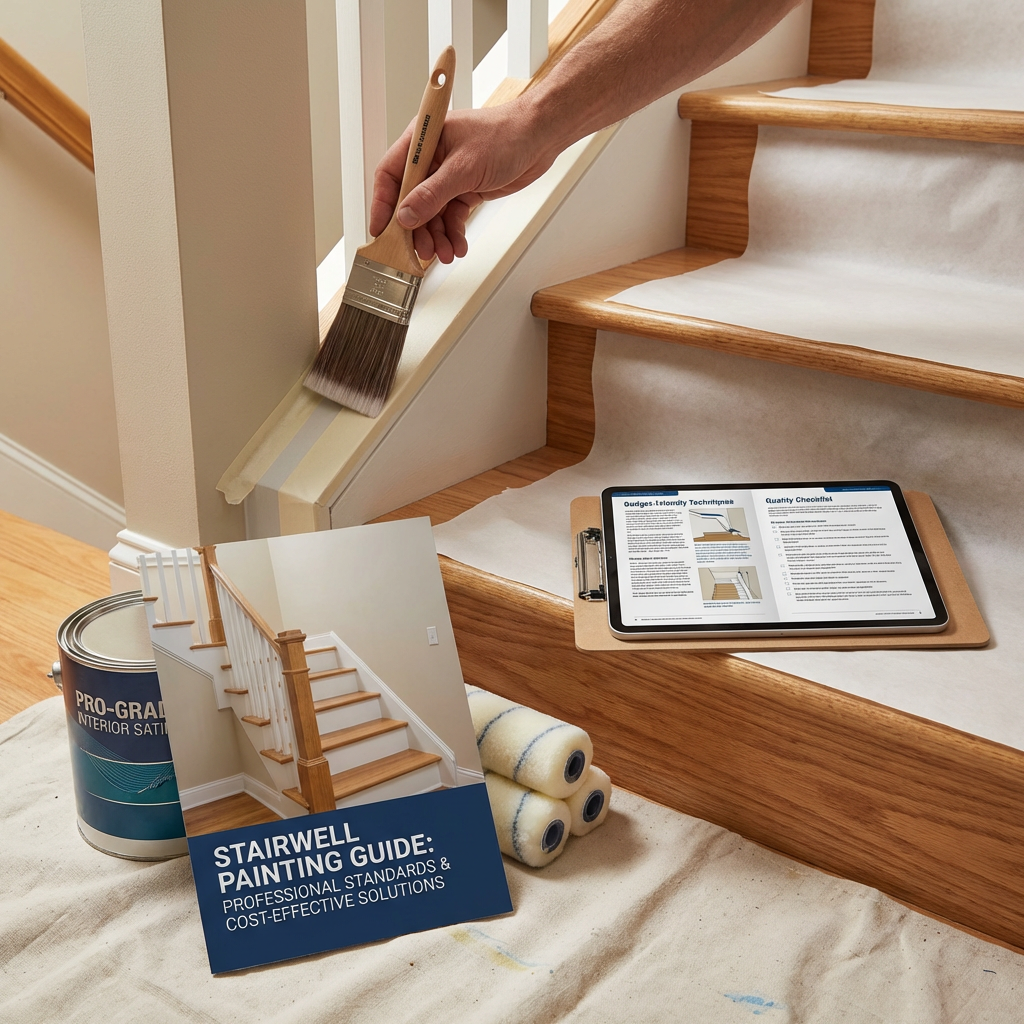
Detailed illustration of key concepts
Visual Guide
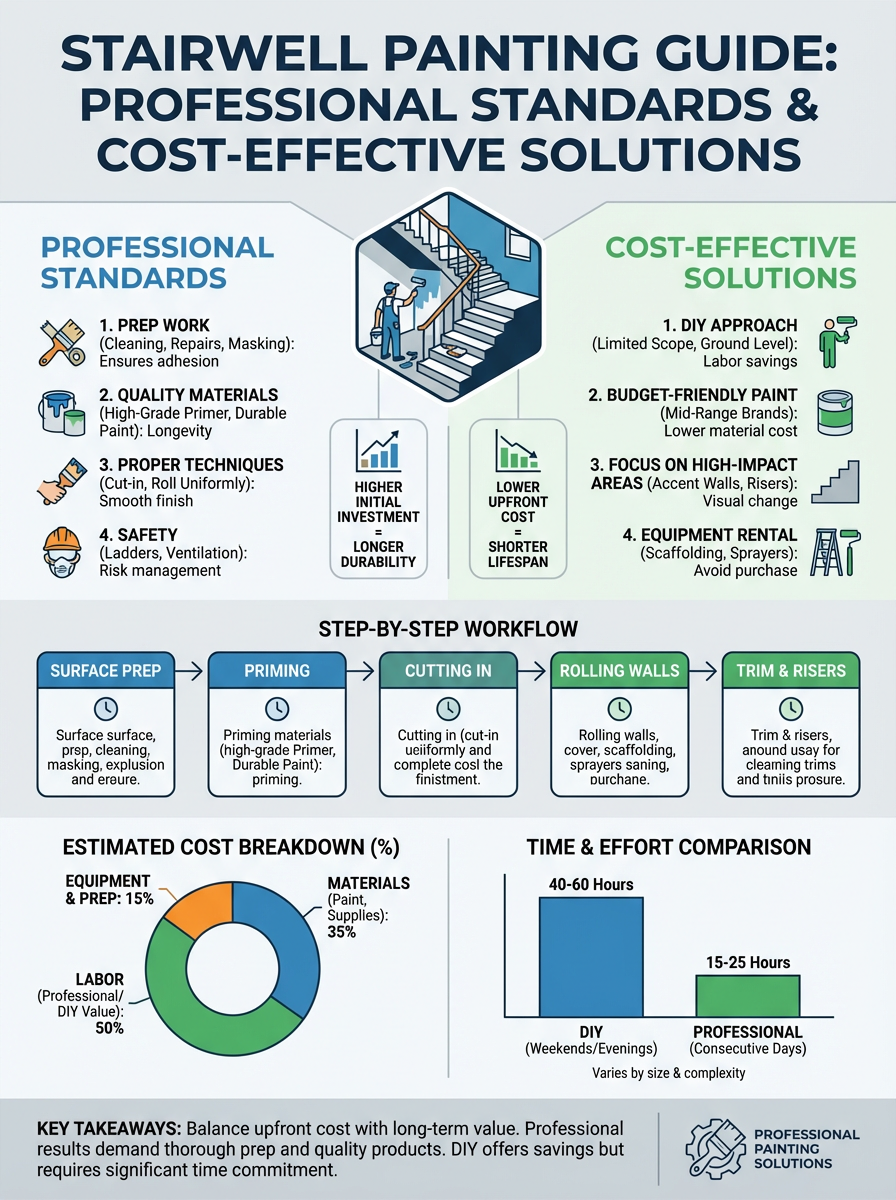
Infographic illustration for this topic
Sources & References
- How to paint a stairwell: expert advice for painting space
- Ultimate Guide to Stairwell Painting - Kennedy Coatings
- Frenchic Top Tips | How to Paint a Staircase - YouTube
- Staircase Spray Painting: Complete Guide And Free Quote
- Best Interior & Exterior Paint Buying Guide - Consumer Reports
- Best Paint for Commercial Buildings - Miko LLC
- Building Codes, Standards, and Regulations: Frequently Asked ...
- Best Industrial Painting Brands: A 2025 Comparison Guide
Frequently Asked Questions
Need Professional Help?
Find top-rated house painters experts in your area