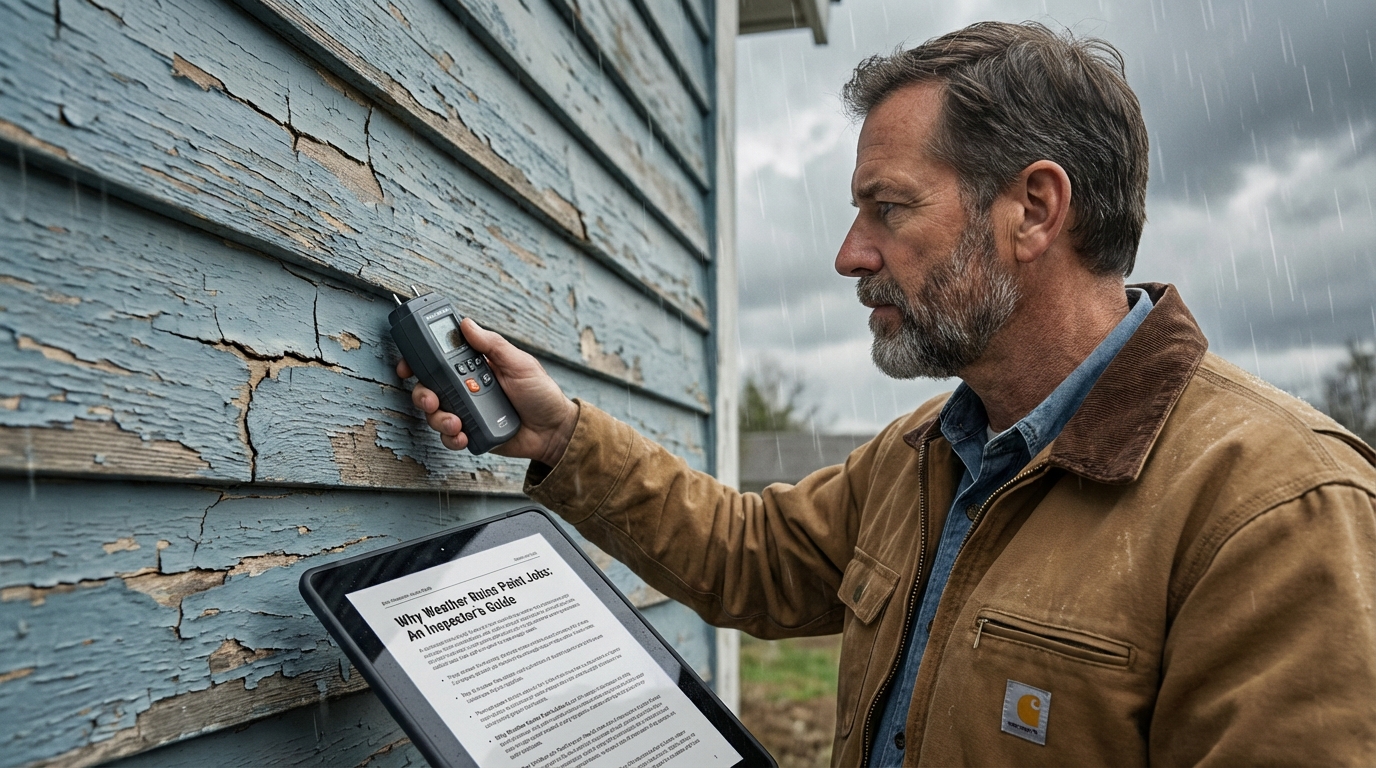
Our licensed inspectors reveal how heat, cold, and humidity ruin paint. Learn the perfect painting conditions and pro tips to prevent peeling, cracking, and costly repairs.
Key Takeaways
- **Too Hot:** Scorching temperatures, especially with direct sun beating down, make the paint's surface dry at warp speed. This 'flash drying' is a real problem. It leads to blistering, bubbling, and pathetic adhesion because the deeper paint layers don't get enough time to bond correctly to the substrate. I've walked residential properties in Scottsdale where south-facing stucco walls looked like a bad case of acne due to this very issue. The paint literally pushes itself off. That's a $4,200 repair bill on a 2,800 sq ft home. And here's the thing — this isn't just cosmetic. It's a structural failure of the paint system.
- **Too Cold:** Paint polymers won't cooperate in the cold. They get stiff, stay separate, refuse to link up into that protective film you need. The stuff might dry to the touch — feels fine when you run your hand over it after lunch — but a month later it's chipping off in your landscaper's hand. Because nothing bonded. The molecular chains stayed rigid, never fused, left you with what's basically very expensive colored dust stuck to your house. Think about trying to melt chocolate chips in a cold pan. Same energy. They just sit there, stubborn.
- **Poor Adhesion:** The paint can't establish a strong mechanical or chemical bond with the substrate because the polymer chains remain rigid and don't fuse adequately. This makes it incredibly vulnerable to chipping, flaking, and delamination. A light bump will ruin it. It's like trying to glue two cold surfaces together. Just won't stick.
- **Surfactant Leaching:** Ever seen ugly brown, glossy, or sticky streaks on a painted surface, especially after a dew or light rain? That's surfactant leaching. Water-soluble ingredients (surfactants) designed to keep the paint stable in the can are drawn out prematurely when the paint dries too slowly, leaving these indelible marks. It's truly unpleasant. They wash away eventually, but the underlying paint often lacks full durability. Its integrity is compromised. ASTM D714 and D772 are the relevant standards here.
- **Reduced Durability:** The finish remains soft, spongy, or chalky for an extended period. This dramatically shortens its lifespan and leads to premature chalking or fading when exposed to normal environmental wear-and-tear. It just can't take the abuse. The molecular structure never fully forms its intended protective lattice. It's a weak film.
Key Takeaways
Why Weather Ruins Paint Jobs: An Inspector's Definitive Guide to Exterior Longevity
After 20+ years inspecting homes, I can tell you this much — **weather isn't just a factor in paint failure. It's THE factor.** We see it constantly across Phoenix and beyond. Sure, plenty of things can mess up a good paint job (bad prep, cheap materials, sloppy contractors). But environmental attacks? Scorching heat, bone-chilling cold, relentless humidity, intense UV radiation, even plain old wind — these absolutely body-slam the longevity of your exterior finish.
Understanding these forces isn't just smart. It's non-negotiable for any homeowner trying to protect their investment and keep their property looking sharp. It really is.
Look — look — ever notice a paint job just *give up* way too soon? Peeling, cracking, blistering, fading — these aren't just aesthetic annoyances. Often, they're direct consequences of slapping paint on walls under the wrong conditions. This guide, forged from years of real-world inspections and countless contractor discussions, will pull back the curtain. We'll show you precisely why weather messes with paint adhesion, proper curing, and overall toughness, helping you sidestep those super costly mistakes and lock in a finish that actually lasts (we're talking years longer). Seriously — it matters. Big time.
The Temperature 'Goldilocks Zone': Preventing Premature Paint Failure
Most quality paints work between 50°F and 90°F. Period.
Stray outside that range and you're gambling with your money. The paint can't form the protective film you're paying for, and you end up with defects nobody wants to see.
Here's what actually happens when the molecules try to link up. Paint needs to cure at a specific pace — binders wrapping around pigment particles, polymers forming chains that'll flex with your siding for the next decade. Temperature controls that dance. Too hot or too cold? The whole system falls apart. I've literally watched a $3,800 Dunn-Edwards job in Tempe bubble up like burnt cheese because the crew ignored their own surface thermometer.
- **Too Hot:** Scorching temperatures, especially with direct sun beating down, make the paint's surface dry at warp speed. This 'flash drying' is a real problem. It leads to blistering, bubbling, and pathetic adhesion because the deeper paint layers don't get enough time to bond correctly to the substrate. I've walked residential properties in Scottsdale where south-facing stucco walls looked like a bad case of acne due to this very issue. The paint literally pushes itself off. That's a $4,200 repair bill on a 2,800 sq ft home. And here's the thing — this isn't just cosmetic. It's a structural failure of the paint system.
- **Too Cold:** Paint polymers won't cooperate in the cold. They get stiff, stay separate, refuse to link up into that protective film you need. The stuff might dry to the touch — feels fine when you run your hand over it after lunch — but a month later it's chipping off in your landscaper's hand. Because nothing bonded. The molecular chains stayed rigid, never fused, left you with what's basically very expensive colored dust stuck to your house. Think about trying to melt chocolate chips in a cold pan. Same energy. They just sit there, stubborn.
And look — it's not just the ambient air temperature that matters. The **surface temperature** of the material being painted is what really counts. A wall baking in the sun can be a good 20-30°F hotter than the air around it due to solar gain.
Here's the thing: here's the thing: professional chemists and engineers at companies like Sherwin-Williams (think their *SuperPaint Exterior Acrylic Latex*, designed with advanced cross-linking technology for enhanced durability, meeting ASTM D6904 and ASTM D7088 standards) and BEHR (like their *Premium Plus Exterior Paint & Primer*, often with ceramic microspheres for increased abrasion resistance) put these guidelines on their labels for a reason. They're critical. They aren't suggestions. Ignoring them? That's a surefire way to gut the integrity and lifespan of your entire paint project, turning a protective coating into a cosmetic nightmare. You literally throw money away.
The Peril of 'Flash Drying' in High Heat: A Technical Breakdown
Paint a house at 2 PM in July and you're begging for trouble.
What happens is the surface dries in minutes — way before the paint underneath has time to cure. You get this sealed crust trapping moisture and solvents below it. Those trapped elements need to escape eventually, so they force their way out. Creates bubbles. Blisters. Little craters that look like lunar terrain on your siding. I've seen entire elevations destroyed this way. It's not decorative anymore at that point — it's failed protection, straight up.
The volatile stuff (water in latex, solvents in oil-based formulas) evaporates from the top layer too fast. Scientifically, this creates a barrier that seals in everything underneath. As the trapped components try to escape later, they generate pressure. Visible bubbles, blisters, craters — all signs the mechanical bond with the substrate is toast. Compromised. Done.
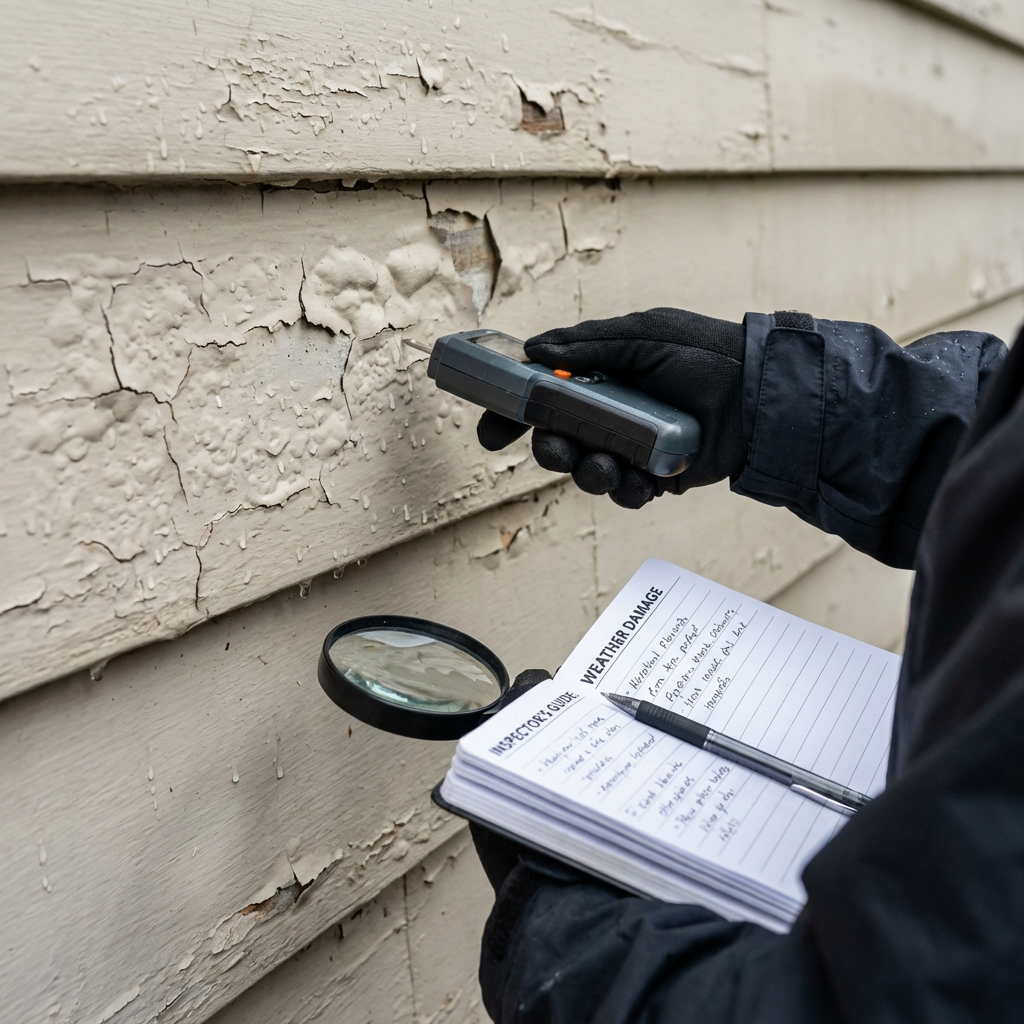
For a visual deep dive, check out examples of common [paint defects and their causes](/blog/common-paint-defects-and-their-causes). These images tell a clearer story than words ever could; they're like mugshots of bad paint jobs. They're not pretty.
Our crews in Anaheim, especially during those brutal summer heatwaves, frequently see flash drying on south and west-facing walls painted during peak midday. Fixing it? That's the painful part. We're talking extensive and costly stripping, heavy-duty sanding, and a complete do-over of the affected areas. All because someone rushed it.
Want to avoid that nightmare? Start with proper surface prep. See our guide on [Essential Prep Steps for a Flawless Exterior Paint Job](/blog/essential-prep-steps-for-a-flawless-exterior-paint-job). It's foundational. This isn't just about cleaning; it's about creating an optimal canvas for adhesion, free of contaminants and loose material. Precision matters.
Why Cold Weather Compromises Curing: The Molecular Struggle
Painting when temperatures drop below 50°F? You're asking for trouble. Below 40°F it's a total disaster waiting to happen.
Cold weather turns paint polymers into lazy teenagers. They won't move, won't link up, basically refuse to do their job. You touch it after four hours and think "great, it's dry" — but at the molecular level you've got nothing. No film. No protection. Just colored liquid that happened to stop being wet. Give it a month and it'll chip off if someone leans a ladder against it. I watched this exact scenario play out on a craftsman in Asheville last November. Benjamin Moore Aura, $89/gallon, peeling off in sheets by Christmas.
- **Poor Adhesion:** The paint can't establish a strong mechanical or chemical bond with the substrate because the polymer chains remain rigid and don't fuse adequately. This makes it incredibly vulnerable to chipping, flaking, and delamination. A light bump will ruin it. It's like trying to glue two cold surfaces together. Just won't stick.
- **Surfactant Leaching:** Ever seen ugly brown, glossy, or sticky streaks on a painted surface, especially after a dew or light rain? That's surfactant leaching. Water-soluble ingredients (surfactants) designed to keep the paint stable in the can are drawn out prematurely when the paint dries too slowly, leaving these indelible marks. It's truly unpleasant. They wash away eventually, but the underlying paint often lacks full durability. Its integrity is compromised. ASTM D714 and D772 are the relevant standards here.
- **Reduced Durability:** The finish remains soft, spongy, or chalky for an extended period. This dramatically shortens its lifespan and leads to premature chalking or fading when exposed to normal environmental wear-and-tear. It just can't take the abuse. The molecular structure never fully forms its intended protective lattice. It's a weak film.
I know Sherwin-Williams makes their *Resilience® Exterior Acrylic Latex* for low-temp application (they say down to 35°F). Special polymer tech, faster-evaporating co-solvents — yeah, it works better than standard latex in the cold. But every experienced painter I know still tells homeowners the same thing: stick to that 50-90°F range if you want the best results. That's the real issue. Chemistry doesn't lie, and ASTM D1640 backs this up with actual testing on drying, curing, and film integrity.
Don't chance it.
Humidity: The Invisible Threat to Paint Adhesion and Curing
Humidity doesn't announce itself, which is probably why it causes so many failed paint jobs.
You're out there with perfect 70°F weather, blue skies, thinking you've hit the jackpot. Meanwhile the air's at 88% relative humidity and your latex paint is basically trying to dry in a sauna. It can't shed moisture at the rate it needs to. Water stays trapped in the film. Drying takes three times longer than the can says. And during all that extended wet time, bad things happen:
- **Drips and Sags:** Paint stays wet and heavy for too long, losing its thixotropic properties. Gravity wins. It runs, accumulates, and creates unsightly 'tears' or 'curtains.' It's a hallmark of rushed or poorly timed application. That's a bad look.
- **Weak Bonding:** Extended drying times compromise the paint's ability to grab onto the surface. The adhesive forces that bond paint to substrate require specific drying rates to develop properly. This sets the stage for future blistering and overall film integrity issues. It won't hold. The bond is fragile.
- **Unfavorable Dew Point:** This is a big one. If the dew point (the temperature at which air becomes saturated with moisture and condensation occurs, measured by a psychrometer) is too close to the actual air temperature, moisture can condense *directly* onto the wet paint surface. That means haziness, dullness, or a total loss of adhesion. Imagine trying to paint in a steam room — bad idea. That's why our licensed painters meticulously monitor conditions with a hygrometer and dew point calculator *before* they even uncork a can, especially during early mornings or late evenings in places like Baton Rouge. Gotta be precise. Condensation introduces a barrier at the molecular level, preventing proper adhesion. It's science.
You want somewhere between 40% and 70% relative humidity. That's the sweet spot where paint can actually cure properly. Above 85%? You're basically gambling with several thousand dollars and hoping luck's on your side. (Spoiler: it won't be.)
For more insider information on paint chemistry and environmental factors, dive into our guide on [Understanding Paint Chemistry: What Homeowners Need to Know](/blog/understanding-paint-chemistry-what-homeowners-need-to-know). It explains the science behind the problem, breaking down topics like polymer composition and pigment dispersion. It's enlightening.
Wind and Sun: More Than Just a Pleasant Day — They're Adversaries
So — real talk — while a breezy, sunny day might seem perfect for an outdoor project, both direct sunlight and strong winds can actually wreck a fresh paint job. They accelerate surface drying and introduce unwanted debris.
These seemingly harmless factors often undermine even the best materials and application techniques. Don't be fooled.
- **Rapid Drying (Sun/Wind):** Both intense direct sun and strong, gusty winds cause the paint surface to dry too quickly. This is where you get those infuriating **lap marks** — areas where brush or roller strokes overlap but don't blend seamlessly because the leading edge has already skinned over. The paint is skimmed over before it can flow out, creating visible lines and inconsistencies. It's a dead giveaway of a rushed job. This uneven drying also creates internal film stress, reducing elasticity. It becomes brittle. ASTM D3964 addresses application properties.
- **Contamination (Wind):** Wind is a paint job's enemy. It's notorious for kicking up dust, pollen, fine particles, and debris that embed themselves in the wet paint film, creating a rough, gritty texture and compromising the smooth finish. I've seen $6,000 jobs in Mesa ruined by cottonwood seeds that looked like snow falling into fresh Benjamin Moore Regal Select. By the time anyone noticed, there were thousands of tiny fibers locked into the finish. Had to sand it all down and start over.
The fix? Paint in the shade when possible. Follow the sun around the house. Start on the east side in the afternoon, hit south walls late in the day. And if wind's gusting over 10-15 mph? Honestly, just reschedule. Your timeline matters less than doing it right the first time.
In-Depth Look
Detailed illustration of key concepts
Visual Guide
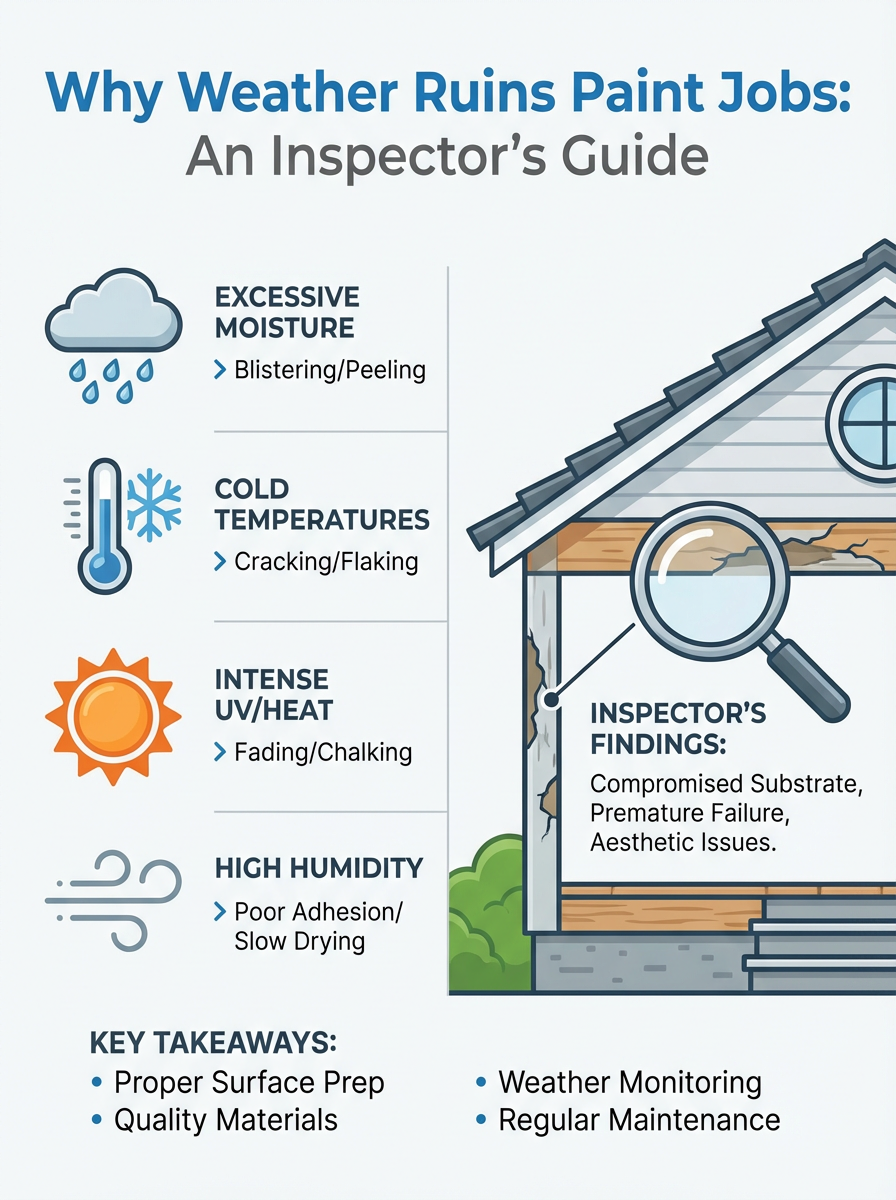
Infographic illustration for this topic
Sources & References
- Exterior House Painting Temperature Guide: 5 Tips for Perfect Results
- Best Outdoor Temperatures for Painting Your Home...and Other ...
- Common Exterior Painting Mistakes And How To Prevent Them
- How Weather Conditions Affect Exterior Painting Projects - ProPainters
- Painting Home Tips By Heritage Painting: Vancouver House Painters
- Best Interior & Exterior Paint Buying Guide - Consumer Reports
- Best Paint for Commercial Buildings - Miko LLC
- Building Codes, Standards, and Regulations: Frequently Asked ...
- Choosing the Right Exterior Paint for Commercial Buildings
Frequently Asked Questions
Need Professional Help?
Find top-rated house painters experts in your area