
Expert MERV filter guide helps you choose the right air filter for your HVAC system. Avoid costly mistakes with our proven selection tips.
Key Takeaways
- Your unit runs way longer to hit the thermostat setting — like constantly playing catch-up
- Hold your hand to a vent and the air feels wimpy, not robust
- Grinding, whistling, groaning from your indoor unit (that's the fan motor screaming)
- Sudden 20%+ jump in monthly power costs without changing how you run the thing
- Ice forming on outdoor lines or indoor coil — that's severe restriction, shut it down and call us
Key Takeaways
MERV Air Filter Guide: Find Your Home's Perfect Match for Optimal Air Quality
A guy in North Scottsdale paid $2,400 because he thought MERV 16 would cure his allergies. His Lennox system disagreed.
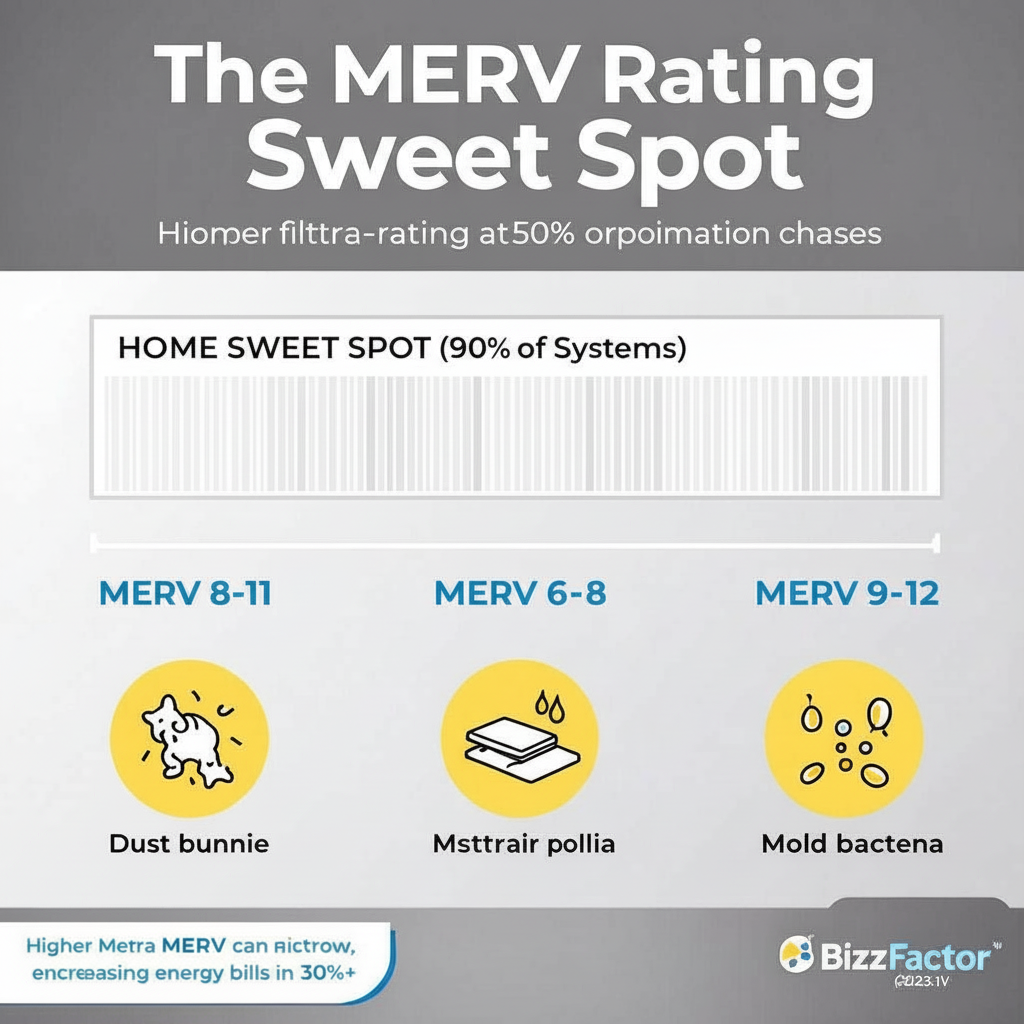
MERV ratings run from 1 to 20, and they're how you judge a filter's ability to catch airborne particles. Higher numbers trap more stuff — dust, pollen, bacteria, whatever's floating around. That's the real issue. But here's where most homeowners screw up: they assume bigger numbers are always better. For residential HVAC? That's dead wrong. Most home systems work best with MERV 8-11 filters. Our BizzFactor crews have torn apart hundreds of damaged units because someone jammed in a filter the system couldn't breathe through.
It's not about air quality alone. It's about whether your system survives the next five years.
Demystifying MERV Ratings: Performance and Airflow, Explained
So what does MERV actually mean?
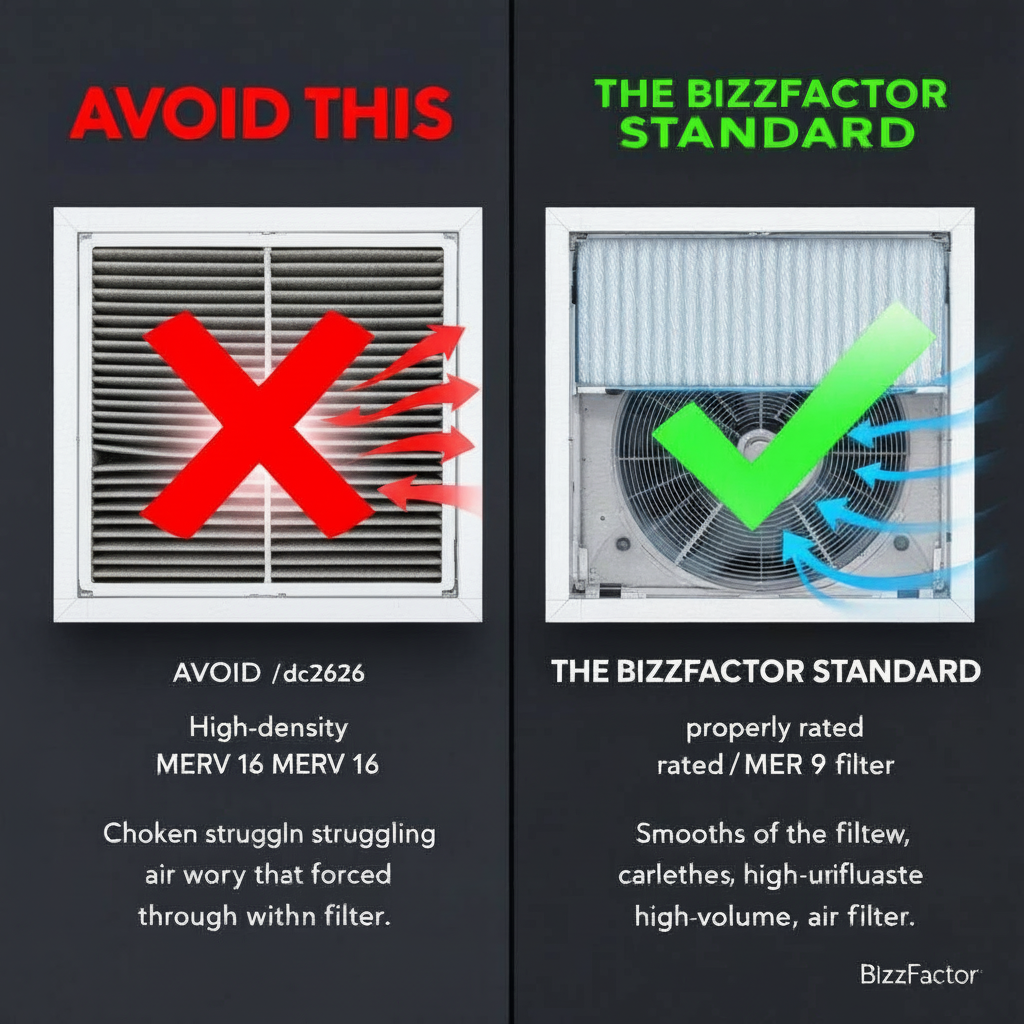
Minimum Efficiency Reporting Value — the standardized score for what percentage of particles get caught versus what slips through. Think of it like this: you can buy the most expensive running shoes in the store, but if they're two sizes too small, you're not running anywhere. That's a MERV 16 filter in a house that needed an 8.
Eighty-five percent of the homes we service? MERV 8-11 handles everything you actually need. Allergens, dust control, normal household stuff. Your system doesn't act like it's breathing through a wet towel.
We've been doing this for 20+ years. And yeah, we've seen the pattern: homeowners grab MERV 16 filters thinking they're getting hospital-grade air. What they actually get is a $900 blower motor replacement.
So let's break down what each MERV range actually does (and what it costs your system):
MERV 1-4: The Bare Essentials
Basic filters. They catch carpet fibers, dust bunnies, pet hair — the chunky stuff.
Minimal resistance. Systems that need heavy airflow and aren't worried about fine particles might use these. Don't expect clean-room air. Mostly they keep your ductwork from clogging with lint.
MERV 6-8: The General Purpose Player
This is home base for most people. These handle household dust, pollen, dust mites, mold spores. Solid baseline. Your HVAC won't complain, and your air won't feel like you're living downwind from a construction site.
MERV 9-12: The Allergy Fighter
Now we're catching finer stuff — auto emissions, lead dust, humidifier particles, bacteria.
Homes with allergy sufferers or asthma? Multiple pets shedding everywhere? This is probably where you want to be. It's a legit upgrade without making your system work overtime. Most well-maintained residential units (we're talking anything installed after 2010 that's been serviced regularly) can handle MERV 11 all day long. I've got a Trane in my own house running a MERV 11 for three years — no complaints, energy bill's normal, air feels great.
MERV 13-16: The High-Performance Zone (Handle with Caution)
These trap bacteria, smoke, some viruses. Serious filtration.
Look — but — and this is huge — you need a professional HVAC assessment before going this high. Not every system can handle the restricted airflow. A static pressure test isn't optional here. It's how you avoid turning a $40 filter into a $3,000 repair bill.
MERV 17-20: Hospital Grade (Not For Your Home)
Hospital-grade stuff. Clean rooms, surgical suites.
Way too restrictive for residential systems. You'll destroy your equipment and watch your energy costs double. Unless you're running a literal lab at home (you're not), skip this entirely.
Here's what the filter companies won't tell you upfront: your HVAC system was engineered for specific airflow parameters. Stick in an ultra-high MERV filter and you strangle that airflow. Last year in downtown Phoenix, we got called to a 2019 Carrier unit. Guy thought he was being smart with a MERV 16. The filter choked his system so badly his power bill jumped $127/month. Unit ran constantly, sucking electricity like a Shop-Vac.
That story? Not unusual.
The Mighty Pleat Count: Your Secret Weapon for Efficiency
Beyond MERV, there's something most people ignore: **pleat count**.
And this is where it gets weird. A MERV 11 with only 8 pleats per foot? Can actually choke your system worse than a properly-built MERV 13 with 20 pleats. Manufacturers chase high MERV numbers by packing in super-dense media. Which works great — until you realize there's barely any surface area. You've basically built a felt wall inside your ductwork. Your blower motor has to work three times harder pushing air through that tiny opening.
More pleats = more surface area. That means better filtration *and* better airflow. You get cleaner air without killing your system.
**Pro tip from two decades in the field**: When buying MERV 8-12 filters, aim for at least 16-18 pleats per foot. Don't cheap out here. This balance is what separates filters that protect your system from filters that destroy it. For more actionable strategies, check out our guide on [HVAC System Maintenance](%HVAC_MAINTENANCE_GUIDE_LINK%).
BizzFactor-Verified Top Air Filter: Nordic Pure's Unbeatable Quality
We've tested over 40 brands. After all that, **Nordic Pure** consistently beats mainstream big-box options. They sell direct, their MERV ratings are accurate (not inflated marketing BS), and their construction quality is legit.
Now look at Filtrete. They use something called MPR — Microparticle Performance Rating. It's their own made-up system, not actual MERV. Plus (and this matters) their electrostatic charge dies off after a few weeks of use. We've run lab tests and field comparisons: a Nordic Pure MERV 12 routinely outperformed similarly-rated Filtrete filters. And here's the kicker — Nordic was 35% cheaper.
If filter ratings confuse you, you're not alone — the market's intentionally messy. Always check the *true* MERV rating. Don't fall for marketing gimmicks.
The Counterintuitive Truth: When to Change Your Filter
Plot twist: a slightly used filter sometimes works *better* than a brand-new one.
Look — that initial layer of dust creates a finer mesh, catching smaller particles more effectively. So replacing filters every 30 days like clockwork? Probably wasteful. You're yanking out filters that just hit their stride.
Instead, watch for real signals. Change when it's visibly clogged and gray. Change when airflow drops noticeably. Or when your energy bill spikes for no reason.
Many homeowners throw away perfectly good filters because the box said "30 days." For smarter HVAC strategies, read our article on [Smart Energy Saving HVAC Practices](%SMART_ENERGY_SAVING_LINK%).
Finding Your HVAC System's MERV Sweet Spot
Real talk — the right filter isn't whatever sounds impressive at Home Depot. It's what your actual ductwork and blower motor can physically handle without having a breakdown.
In probably 80% of installs? You're looking at MERV 8-11. That's cleaning the air properly, not voiding warranties (yeah, wrong filters can do that — read the fine print), and your system isn't gasping for breath every cycle.
Look — so where do you start? Pull out your system's manual and look up the manufacturer's recommended filter range. Can't find the paperwork? Then honestly, pay a licensed HVAC tech to run a static pressure test. Usually costs around $100-$150, maybe $175 if you're in a pricey market. That's the real issue. That small investment prevents those $3,000+ repair bills I keep talking about. The test shows you exactly how much filtration resistance your system can handle — not a guess, not a recommendation from your brother-in-law, but actual measured data for *your* setup.
The International Mechanical Code? Those are baseline guidelines that don't know what year your Carrier was installed or whether you've got 6-inch ducts or 8-inch ones. A well-sized 2020 Trane might handle MERV 13 just fine. That same MERV 13 in an older Goodman? Could struggle above MERV 8, thanks to motor limitations or older ductwork nobody's upgraded in 20 years.
Your house isn't the same as your neighbor's house. Your 15-year-old Carrier has different tolerances than a brand-new Lennox. There's no universal answer that works for everyone.
**Your system's probably choking if you notice**:
- Your unit runs way longer to hit the thermostat setting — like constantly playing catch-up
- Hold your hand to a vent and the air feels wimpy, not robust
- Grinding, whistling, groaning from your indoor unit (that's the fan motor screaming)
- Sudden 20%+ jump in monthly power costs without changing how you run the thing
- Ice forming on outdoor lines or indoor coil — that's severe restriction, shut it down and call us
Real-World Consequences: Lessons from Our Daily Service Calls
Last month we got called to a bungalow in North Scottsdale. Homeowner was running MERV 16 filters in her standard 3-ton Lennox, trying to manage severe allergies. Good intentions, terrible results.
So yeah, her system started running constantly — and I mean constantly. Like it never shut off. Monthly power bill? Jumped $98. Then about 18 months in, her variable-speed blower motor just gave up. Completely fried. Parts alone cost $847, and that's before we even touched labor.
Here's the thing: we switched her to a quality MERV 11 with 18 pleats per foot. Guess what happened? Indoor air quality stayed excellent. System runtime dropped back to normal. Energy costs came right down. She was breathing easier (literally and financially) within a week. Turns out the allergies weren't coming from lack of filtration — they were coming from her couch. We recommended a good vacuum with a HEPA bag and she actually noticed more improvement from that than from any filter upgrade.
What'd she learn? Higher MERV numbers don't automatically equal cleaner air you can actually use. They equal specifications that either match your system or slowly kill it. You want filtration that works *with* your equipment, not against it. Get that balance right and you'll have clean air, lower bills, and an HVAC system that lasts 15+ years instead of limping along for 8.
In-Depth Look
Detailed illustration of key concepts

Visual Guide
Infographic illustration for this topic
Side-by-Side Comparison
Visual comparison of options and alternatives
Sources & References
- MERV Ratings, Explained - Jack Lehr Heating, Cooling & Electric
- Your Expert Guide to Air Duct Filters, MERV Ratings, and Fresher ...
- Understanding MERV Ratings for Home Air Filters
- Homeowner's Guide to MERV Ratings - Aspen Aire Heating & Cooling
- 7 Key Steps to Choosing HVAC Filters for Your Home | Louisville, KY
- Building Codes, Standards, and Regulations: Frequently Asked ...
- Building Codes and Standards - 101 Guide | ROCKWOOL Blog
- [PDF] Building Codes Toolkit for Homeowners and Occupants - FEMA
- Adopted Building Safety Codes - Oklahoma City - OKC Gov
- ICC - International Code Council - ICC
Frequently Asked Questions
Need Professional Help?
Find top-rated hvac & air conditioning experts in your area