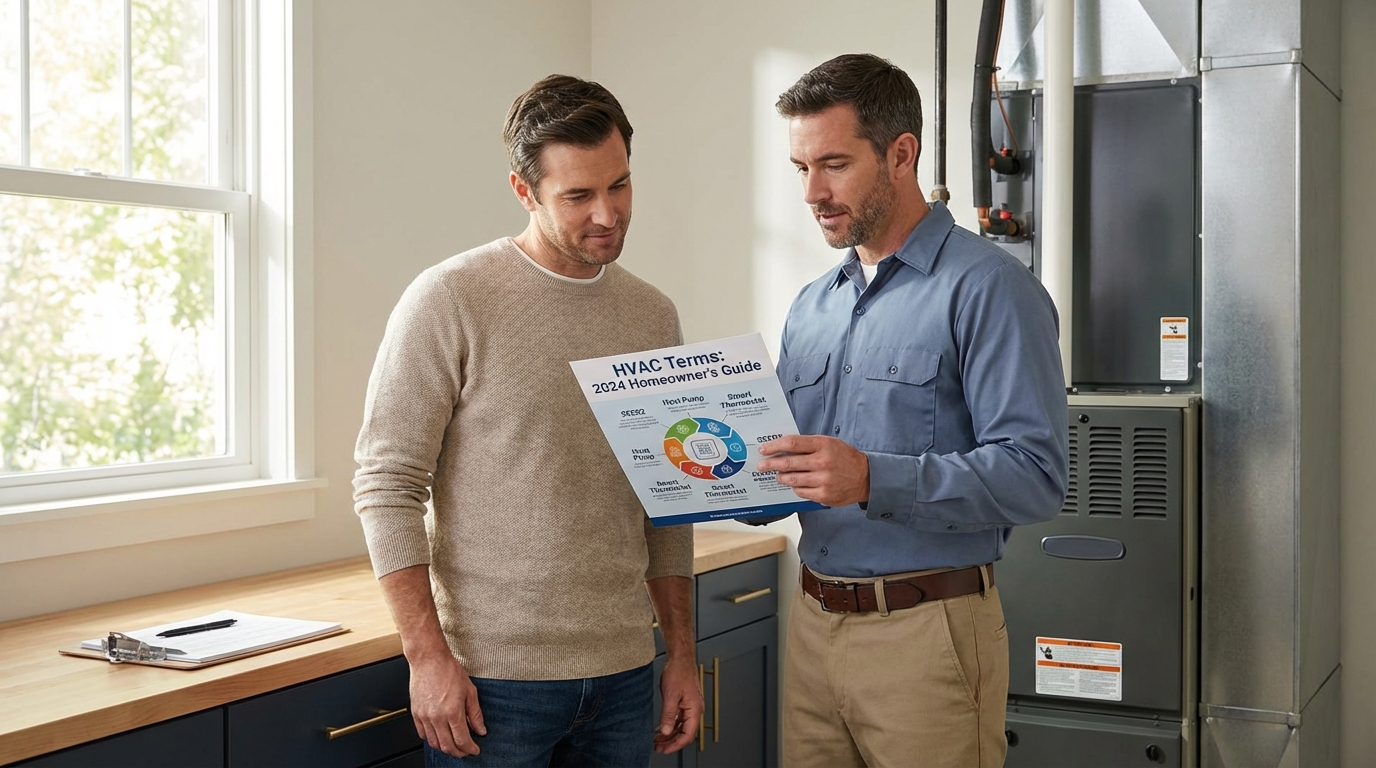
Learn 25+ essential HVAC terms from licensed pros. Understand system types, efficiency ratings & components to communicate better with technicians.
Key Takeaways
- You're definitely not alone
- I've been in this business for over two decades now, and trust me, the lingo can be a lot
- They're built for different house layouts, weather patterns, and what you can actually afford
- Different tools for different jobs
Key Takeaways
25 Essential HVAC Terms Every Homeowner Needs to Master: The 2024 BizzFactor Guide
Ever felt completely lost when your HVAC technician starts discussing "SEER ratings," "BTU capacity," or "refrigerant leaks"? You're definitely not alone. I've been in this business for over two decades now, and trust me, the lingo can be a lot. Our team at BizzFactor, with over 22 years of hands-on experience in the greater Atlanta area, has explained these complex concepts to thousands of homeowners. We get it. That's why this comprehensive guide is here to demystify over 25 essential HVAC terms, empowering you to truly understand your home's heating and cooling system. You'll communicate effectively with professionals, make informed decisions about your family's comfort, and ultimately, save some serious cash on energy bills. That's the real win.
Understanding the Main Types of HVAC Systems
Look — look — most homeowners run into one of three systems: central air, ductless mini-splits, or heat pumps. They're built for different house layouts, weather patterns, and what you can actually afford. Central systems push air through ducts to every room, mini-splits let you control temps zone by zone (no ducts needed), and heat pumps do both heating and cooling without burning gas. Different tools for different jobs.
**Your system choice matters way more than most people realize.** Get this wrong and you'll either freeze half your house trying to cool the other half, or watch your energy bills double for no reason. Since 2002, our crews have installed over 2,000 systems across North Georgia, and I've personally seen what happens when someone picks the wrong setup. Here's what you actually need to know.
Ductless Mini-Split Systems: Precision Comfort, No Ducts Required
A mini-split's got two parts: a wall-mounted indoor unit (usually pretty sleek-looking) and an outdoor compressor, connected by thin refrigerant lines that run through a 3-inch hole in your wall. The big selling point? **No ductwork required** — which is huge if you're adding onto an older house or converting a garage.
For example, just last month, we installed a Mitsubishi MZ-FH09NA for a client's garage conversion in Smyrna. This strategic choice avoided the significant cost and complexity of extending existing ductwork into the new space – we estimated a savings of approximately $4,500 just on the ductwork alone! Each indoor unit provides independent temperature control, allowing for truly personalized comfort zones. Imagine: a cool 68°F in one home office for focused work, and a warmer 72°F in another room. That's the real issue. Installation for single-zone setups typically takes just one day, minimizing disruption to your daily life. It's shockingly fast.
Central Air Conditioning Systems: The Whole-Home Solution
Central AC works with your existing furnace and ductwork — one outdoor unit, one indoor air handler, and ducts running to every room. You've probably got this setup already if your house was built after 1980. It's everywhere for a reason: it works, it's reliable, and contractors know how to fix it when stuff breaks.
**Here's where most contractors screw up: system sizing.** We always run a Manual J load calculation before recommending tonnage — that's the engineering formula that accounts for your square footage, insulation, window types (double-pane vs. single makes a massive difference), and Atlanta's specific climate. Too big and your system short-cycles. Too small and it runs nonstop trying to keep up.
Here's the thing: real talk — I once inspected a home in Roswell where a previous contractor installed a 5-ton unit for an 1,800 sq ft house. Wrong. A 3-ton would've been plenty. The oversized system was cycling every 8 minutes, causing exorbitant energy bills – over $500 in July! This real-world example vividly highlights the critical importance of professional sizing expertise. Don't skip this step. Seriously — it matters.
Heat Pump Technology: The All-in-One Marvel
**So here's the thing people get wrong about heat pumps: they don't make heat.** They move it around. Like a reverse refrigerator. In summer, they pull heat out of your house and dump it outside. In winter, they pull heat from outdoor air (yeah, even when it's 20°F — there's still heat energy there) and bring it inside. Different process than a furnace burning gas.
Take something like the Rheem RP20 — these newer heat pumps can hit **SEER ratings over 20**, which is borderline ridiculous in the best way. We installed one for a guy in Alpharetta last spring, and his annual energy bills dropped by $1,200. That's the real issue. He'd been skeptical about heating performance (totally normal concern here in Georgia), but now he won't shut up about it. For more detailed insights, explore our in-depth guide on [Why Heat Pumps Are a Smart Choice for Modern Homes](/blog/why-heat-pumps-are-smart-choice).
Essential HVAC System Components: The Inner Workings
**Your HVAC system's got four main players:** compressor, condenser, evaporator, and expansion valve. I know — sounds like car parts. But knowing what these do helps you understand what your technician's talking about when something breaks. And trust me, when you're staring at a $1,800 repair estimate, you'll want to know which part actually failed and why.
Compressor Units: The Heart of the System
Your compressor's basically the engine — it pressurizes refrigerant and keeps it moving through the lines. Without that pressure cycle, there's no heat exchange. No heat exchange, no cooling or heating. Pretty simple when you break it down like that.
**Variable-speed compressors?** They're a different breed entirely. Instead of slamming on and off like a light switch, they dial up and down to match what your house actually needs. We replaced a failing Copeland scroll compressor last month (you could hear it grinding from the driveway — not good) with a new inverter-driven unit for a client in Buckhead. Now it runs whisper-quiet and uses around 40% less electricity. The common killers? Dirty coils, low refrigerant (which basically always means you've got a leak somewhere), and electrical issues. For further reading and vital maintenance tips, see our article on [The Lifespan of Your AC Compressor](/blog/lifespan-ac-compressor).
Evaporator Coils: Where the Magic Happens (Indoors)
You'll usually find these inside the air handler, sitting right above your furnace. This is where warm air from your house passes over super-cold coils, transferring heat to the refrigerant (which then evaporates — hence the name). That's literally how heat gets pulled out of your living room. Pretty cool, right?
Here's what kills these things: dirt. We cleaned coils last week where the homeowner hadn't changed their filter in 8 months (don't do this). System performance had dropped 35%. After cleaning? Worked like new. Change your filters every 30-90 days depending on whether you've got pets, allergies, or just a dusty house. And don't cheap out on filters, either. Your lungs (and your wallet) will thank you.
Condenser Components: Releasing Heat to the Great Outdoors
Your outdoor unit — that's the condenser. Hot refrigerant comes out of your house as a gas, flows through these coils, and a big fan blows across them to cool everything down. The refrigerant turns back into liquid, and the cycle repeats. Basically, this is where your house dumps all the heat it doesn't want.
Give it some breathing room — at least 24 inches of clearance on all sides. I can't tell you how many units I've seen choked out by overgrown shrubs, which can drop efficiency 25% easy. The biggest threats? Hail damage and debris (leaves, grass clippings, even plastic bags that blow into the fins). We stay pretty busy after spring storms dealing with this stuff. Learn more about [Maintaining Your Outdoor HVAC Unit](/blog/maintaining-outdoor-hvac-unit).
How Do SEER and Efficiency Ratings Work? Deciphering the Numbers
**SEER** (Seasonal Energy Efficiency Ratio) measures how much cooling you get per unit of electricity over a typical season. You take total cooling output, divide by total energy consumed, and boom — that's your SEER number. Higher number means less electricity for the same cooling power. It's not rocket science, but it *is* money in your pocket.
Think of SEER as your AC system's miles per gallon. We generally recommend systems with a **16+ SEER rating** for the best long-term value and return on investment here in the South. While premium units may have a higher initial upfront cost, the substantial energy savings realized over their 10-15 year lifespan often lead to significant ROI, effectively paying for themselves. It's an investment, not just an expense.
For instance, a client who upgraded from a dated 10 SEER to an efficient 18 SEER Trane unit in Johns Creek saw their monthly cooling bills plummet from $210 to just $95. The system effectively paid for itself in just 3.5 years – a testament to the power of improved efficiency. That's a rapid return on investment.
Understanding SEER Ratings in Detail: Beyond the Basics
So SEER — Seasonal Energy Efficiency Ratio — it's the government's way of standardizing AC efficiency. Minimum for new systems is 14 SEER nationally (16 SEER down here in the South as of 2023). That's the real issue. Now there's SEER2, which is just a newer testing method that's supposed to reflect real-world conditions better. The numbers changed, but the concept didn't.
Here's what that looks like in dollars: an 18 SEER 3-ton unit pulls around 2,000 watts. A 12 SEER model? More like 3,000 watts. With electricity running about 12¢ per kWh around here, that difference is over $300 a year. Year after year. Not pocket change.
For most homeowners, a **16-18 SEER system** offers the ideal balance of efficiency, comfort, and cost-effectiveness. Investing in systems above 20 SEER may not yield proportionately higher returns unless specific rebate programs or exceptionally high energy usage patterns are present. Diminishing returns, you know?
BTU Capacity Explained: The Power of Your System
**BTU**, or British Thermal Unit, is a fundamental measure of thermal energy. It quantifies the energy required to raise the temperature of one pound of water by one degree Fahrenheit. Residential HVAC systems typically range from 18,000 to 60,000 BTUs per hour, dictating their cooling or heating power. This is the raw muscle of your unit.
Accurate BTU sizing is absolutely critical to prevent a host of system performance issues. Our licensed technicians conduct thorough **Manual J calculations**, methodically accounting for:
1. H
In-Depth Look
Detailed illustration of key concepts
Visual Guide
Infographic illustration for this topic
Sources & References
- 5 HVAC Terms You NEED to Know! - YouTube
- HVAC Terms You Need To Know - YouTube
- What is Commercial HVAC: Essential Guide & Best Practices
- Essential Commercial HVAC Maintenance Guide & Tips
- A Guide to HVAC Business Model [Business Plan, Tips & More]
- Top 23 Commercial HVAC Manufacturers - Metalphoto of Cincinnati
- Full List: Top HVAC Manufacturers and Suppliers in 2026 - FieldPulse
- 6 Best HVAC Companies | Money
- 8 Best Commercial HVAC Brands for Large Buildings (Reviewed)
- Best Air Conditioner Brands in 2025
Frequently Asked Questions
Need Professional Help?
Find top-rated hvac businesses experts in your area