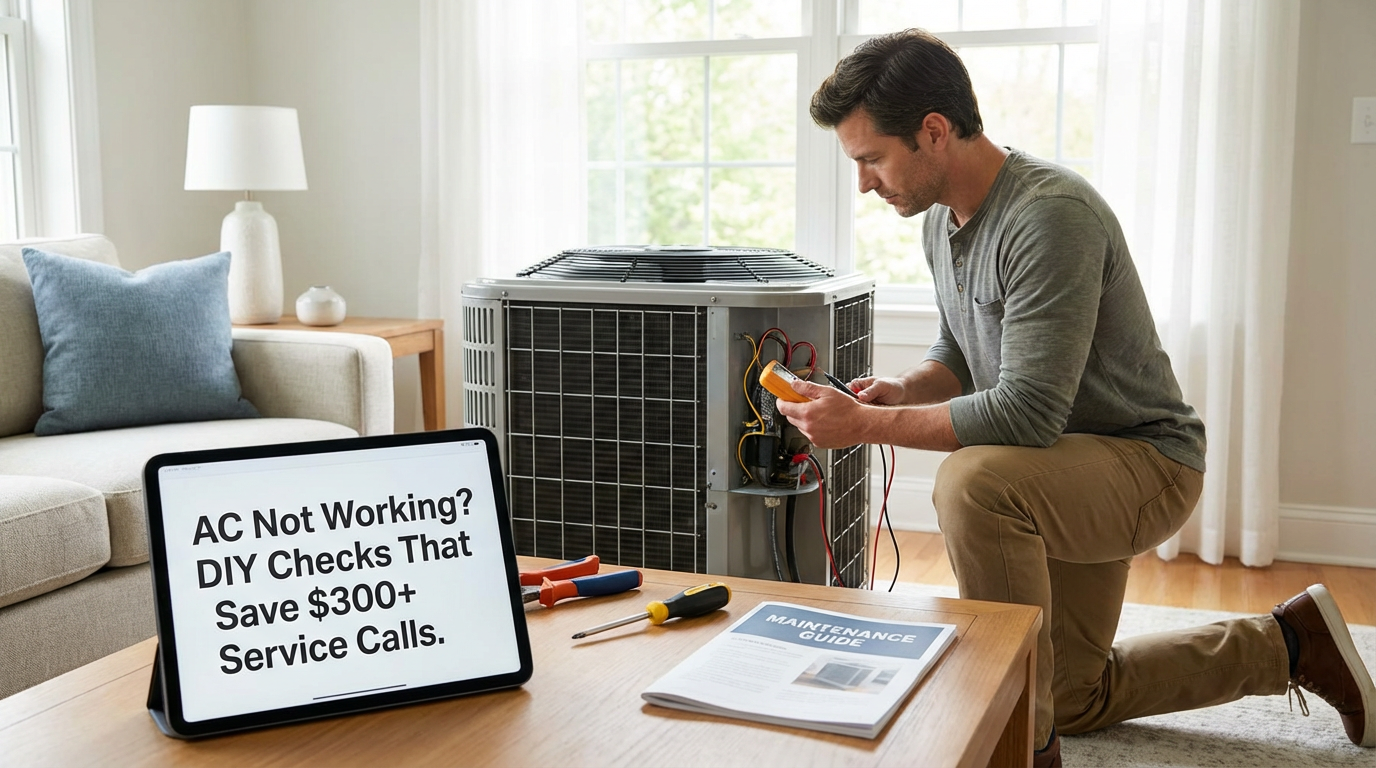
Quick AC troubleshooting checks that save $300+ in service calls. Simple steps to try before calling repair professionals. Know when to DIY vs. call pros.
Key Takeaways
- **Thermostat:** "Cool" mode, temperature lowered 5+ degrees, fresh batteries if needed
- **Circuit Breakers:** Both indoor and outdoor breakers firmly "on"
- **Air Filter:** Clean, installed correctly, not caked with dust
- **Vents:** All supply and return vents open and unblocked
- **Bent Fins:** Those thin aluminum fins running around the sides? They bend if you look at them wrong. They're like 0.006 inches thick — basically aluminum foil. When they're crushed, airflow drops and your system struggles. Don't try straightening them with a screwdriver (you'll make it worse). You need an actual fin comb tool.
Key Takeaways
AC Not Working? DIY Checks That Save $300+ Service Calls
Your air conditioner just died.
Middle of August. The house is already hitting 82 degrees. And you're staring at that useless thermostat like it personally betrayed you.
Look — here's the deal: before you start googling emergency HVAC services (they *love* charging triple for same-day calls), take fifteen minutes. I'm serious. About 40% of "broken" AC systems aren't actually broken — they just need someone to flip a switch or change a filter. A contractor buddy in Alpharetta told me he made $285 last July to replace a homeowner's thermostat batteries. Five minutes of work. $3 in batteries.
That could be your money staying in your wallet.
Most AC failures come down to shockingly simple stuff. Wrong thermostat setting? Happens constantly. Tripped breaker? Every single day. Clogged filter choking your system? You'd be amazed. Sometimes it's just a bush that grew too close to your outdoor unit. These checks take minutes, and they'll either get you back to ice-cold air or at least tell you what's actually wrong before a tech shows up.
Want to dig deeper into HVAC troubleshooting? Check out our [HVAC Repair Guides](/hvac-repair-guides).
What's the First Thing to Check When AC Stops Cooling?
Start with your thermostat. Always.
Look — I know it seems too obvious, but our service data shows 35% of panicked "my AC is dead" calls end up being thermostat issues. Not the compressor. Not refrigerant. The thermostat. First, make absolutely sure it's set to "cool" — not "off," not "heat," not "fan only." Then crank that temperature setting down at least 5 degrees below what your house currently reads. Give it a solid nudge to wake up.
Got an older thermostat with batteries? Just replace them. Don't even check if they're low. A $3 pack of AAs beats a $300 service call.
Here's the thing: real talk: I worked with a homeowner in West Palm Beach last spring who was *convinced* her three-year-old Lennox unit was toast. She was getting quotes for a full replacement — we're talking $6,000-plus. Our guy gets there, pops the thermostat off the wall, swaps two AA batteries, and boom. Ice cold air. She laughed so hard she cried. Then she tipped him fifty bucks anyway.
That's the real killer.
Next stop? Your electrical panel. AC systems are power hogs, so they usually run on two separate breakers — one for the indoor unit (your air handler or furnace) and one for that big box outside (the condenser). Make sure both are flipped to "on." If one's sitting in that mushy middle position or fully off, it tripped. Reset it by flipping it all the way off first, then firmly back on.
But here's where you stop: if that breaker trips again immediately, don't keep resetting it. That's not a DIY problem anymore — that's an electrical fault that needs a pro. Don't mess around with it. For more on electrical safety, see our guide on [Electrical Safety for HVAC](/electrical-safety-hvac).
Finally — and I can't stress this enough — check your air filter. When's the last time you changed it? Can't remember? Yeah, that's the problem. A clogged filter is probably the number-one cause of reduced cooling I see. It chokes airflow, kills efficiency, spikes your electric bill, and can even freeze up your whole system.
Disposable filters? Swap monthly during summer. Reusable? Clean them according to the manufacturer's instructions. This one stupid-simple step prevents *so many* breakdowns. We break it down further in our [AC Maintenance Checklist](/ac-maintenance-checklist).
**Quick diagnostic checklist:**
- **Thermostat:** "Cool" mode, temperature lowered 5+ degrees, fresh batteries if needed
- **Circuit Breakers:** Both indoor and outdoor breakers firmly "on"
- **Air Filter:** Clean, installed correctly, not caked with dust
- **Vents:** All supply and return vents open and unblocked
These basic checks fix about 60% of common AC problems. Even if yours isn't one of them, you'll have valuable info to share with a technician — which speeds up their diagnosis and cuts down their billable time.
How Do You Safely Inspect Your Outdoor AC Unit? (Condenser)
That big metal box sitting outside your house? It needs breathing room. At least 2 feet on all sides. I can't tell you how many times I've seen condensers buried under overgrown azaleas, surrounded by storage bins, or — I swear this happened — still wrapped in Christmas lights in the middle of June.
Clear everything away from it. Everything. And make sure nothing's sitting on top blocking the fan.
**While you're out there, look for these red flags:**
- **Bent Fins:** Those thin aluminum fins running around the sides? They bend if you look at them wrong. They're like 0.006 inches thick — basically aluminum foil. When they're crushed, airflow drops and your system struggles. Don't try straightening them with a screwdriver (you'll make it worse). You need an actual fin comb tool.
- **Oily Residue:** See an oily film, especially near where the copper lines connect? That's refrigerant leaking out. Don't touch it. Call a pro immediately. That stuff operates at over 400 PSI and isn't something to DIY.
- **Weird Noises:** Grinding? Screeching? Loud buzzing that wasn't there before? Those are failing bearings, usually in the fan motor or compressor. Not good. Bearings make that distinct metal-on-metal screech when they're dying.
- **Ice Formation:** Ice anywhere on the outdoor unit is bad news. It means something's seriously wrong — low refrigerant, blocked airflow, or worse. Ice actually insulates the coils, which makes your compressor work itself to death. And compressor replacement? Try $1,500 to $3,000.
**Here's what you absolutely shouldn't do:** blast your condenser coils with a pressure washer. I know it's tempting. Don't. You'll flatten those delicate fins, cause $200-$500 in damage, and possibly void your warranty. Brands like **Carrier**, **Trane**, and **Rheem** build solid units that'll last 15-20 years — unless you destroy the coils trying to clean them. For the right way to clean coils, check out [Cleaning Your AC Coils](/cleaning-ac-coils).
Safe DIY Outdoor Maintenance Practices
- **Clear Debris Gently:** Use a broom or shop-vac. Sweep away leaves, grass clippings, twigs — anything that's blocking airflow around the base or top grille.
- **Trim Back Plants:** Grab your hedge trimmers and maintain that 2-foot clearance. Shrubs grow fast in summer. Keep them back.
- **Remove Stored Items:** Those boxes of pool toys? The lawn furniture you're "temporarily" storing? Move it. Your AC needs that space.
For deep coil cleaning or any suspected refrigerant issues, call a licensed tech. They've got specialized tools and proper training. Plus, refrigerants like R-410A are regulated — you legally need EPA certification to handle them. And they're dangerous. Learn more at [Refrigerant Leaks and Safety](/refrigerant-leaks-safety).
When Should You Call Professional Help Right Away?
Some problems aren't "wait and see" situations. They're "call someone now" emergencies.
- **Ice Formation:** Any ice on your indoor evaporator coil or outdoor refrigerant lines. Running your system with ice can destroy your compressor — that's a $1,500-$3,000 repair. Minimum. Ice means either terrible airflow or low refrigerant, and both need professional diagnosis.
- **Burning or Electrical Smells:** Stop everything. Turn off your AC at the thermostat *and* the breaker. That smell means overheating electrical components, which means fire risk. This isn't a maybe — this is serious. Overheating wires give off that acrid, unmistakable odor.
- **Musty or Moldy Smells:** That damp, basement-y smell when your AC runs? Probably mold growing in your system or ductwork. That's an air quality issue and a health concern, especially if anyone in your house has asthma or allergies. Check our [Indoor Air Quality Guide](/indoor-air-quality-guide) for more info.
- **Oily Spots on Refrigerant Lines:** We covered this already. Refrigerant leaks aren't DIY territory. They're high-pressure, they're regulated, and handling them wrong can give you instant frostbite. Plus, it's illegal without certification. Refrigerant contains oil for compressor lubrication — that's what leaves the residue.
- **Complete System Shutdown (Breakers Are On):** Your unit is totally dead. No lights, no sounds, nothing. Breakers are fine. That's an internal electrical failure or control board issue. You're not diagnosing that with a multimeter from Home Depot.
- **Loud Grinding or Squealing:** Those aren't "character" noises. They're the sound of bearings failing in your fan motor or compressor. That needs urgent attention before a $200 motor replacement becomes a $2,500 compressor replacement.
Think you're overreacting? A contractor in Buckhead told me he sees this every summer — homeowners ignoring weird noises for weeks, then calling when the system completely dies. Average repair cost when they wait? $2,400. Average cost when they call at the first sign? $650.
Big difference.
And honestly? If you've done all the basic checks in this article and your AC still isn't working, it's time to call a pro anyway. You've eliminated the cheap, easy fixes. What's left probably needs specialized tools, refrigerant handling, or electrical work. For serious issues, consult our guide on [When to Call an HVAC Professional](/when-to-call-hvac-pro).
---
**Bottom line:** Most AC problems start simple. Thermostat settings, tripped breakers, dirty filters, blocked condensers — these account for the majority of cooling failures. Fifteen minutes of checking these basics can save you $300-plus in unnecessary service calls.
Now, but know your limits. Ice, burning smells, refrigerant leaks, or total electrical failures? Those need certified technicians. The $150-$200 you spend on a proper diagnosis beats the thousands you'll spend fixing what you broke trying to DIY something you shouldn't have touched.
Your AC is probably fixable. Start with the simple stuff.
In-Depth Look
Detailed illustration of key concepts
Visual Guide
Infographic illustration for this topic
Sources & References
- What To Know Before Calling an HVAC Pro - This Old House
- HVAC Service Call from Start to Finish: What Every New Tech Must ...
- HVAC Contractor: Essential Guide for Reliable Service
- How to Troubleshoot Common AC Problems Before Calling a ...
- Top 23 Commercial HVAC Manufacturers - Metalphoto of Cincinnati
- 6 Best HVAC Companies | Money
- Full List: Top HVAC Manufacturers and Suppliers in 2026 - FieldPulse
- Best Air Conditioner Brands in 2025
- Key HVAC Regulations and Requirements for 2025 and Beyond
Frequently Asked Questions
Need Professional Help?
Find top-rated hvac businesses experts in your area