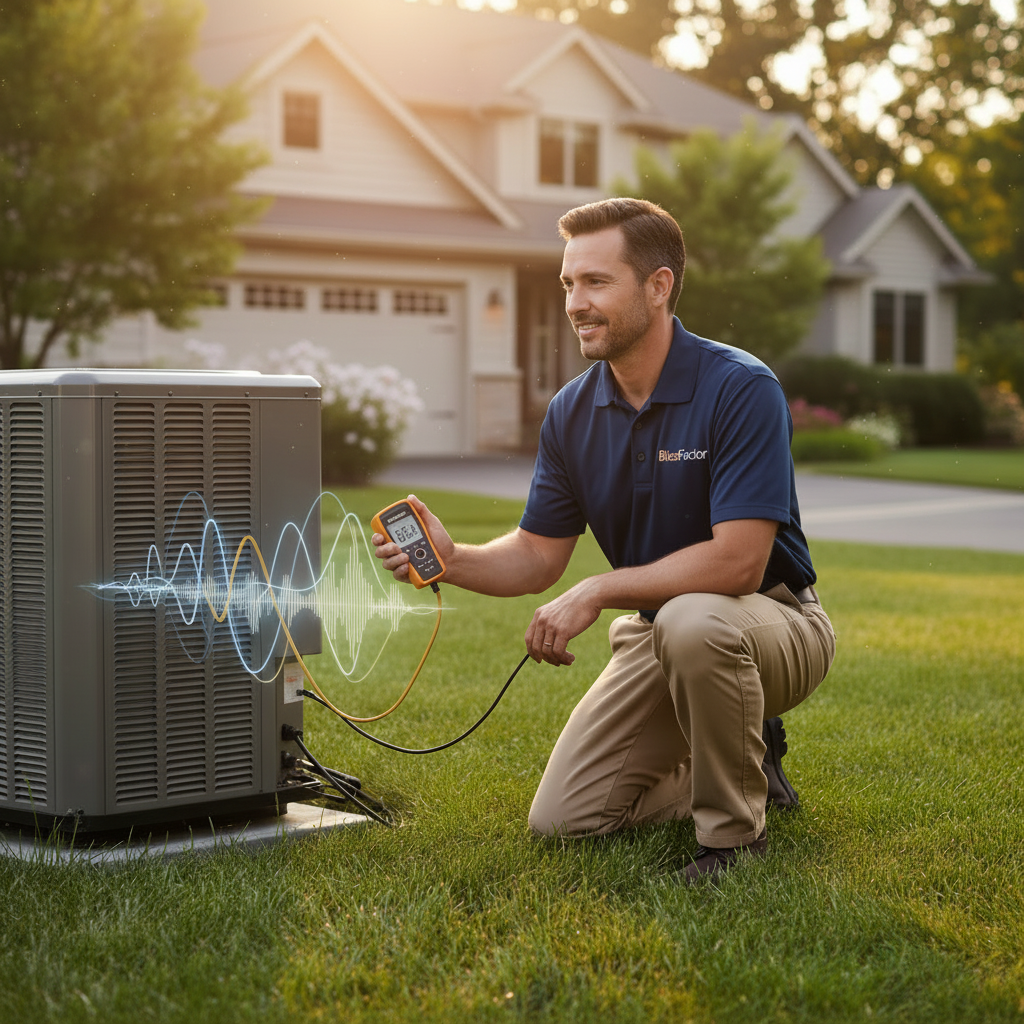
Stop noisy HVAC, refrigerators & computers with pro tips from certified technicians. Get quiet appliances with our proven repair methods.
Key Takeaways
- **HVAC systems** — mounting brackets vibrate loose over time, isolation pads get crusty and useless, condenser coils choke on cottonwood fluff and grass clippings. Fan's screaming because it's trying to push air through a solid mat of yard debris.
- **Refrigerators** sitting crooked because the floor's not level, or that little evaporator fan motor finally gave up. Sometimes it's both and you don't know which noise is which.
- **Computer fans** so packed with dust and Labrador undercoat you could make felt. Bearings sound like a coffee grinder because they're trying to spin through half an inch of compressed pet hair.
- Isolation pads that've been baking in the sun for eight years, now they're hard as hockey pucks. Every vibration transmits straight into your slab like a drumhead.
- Motor bearings in your washer making that grinding-squealing symphony that gets a little worse every week. Spoiler: it's not gonna spontaneously heal itself.
Key Takeaways
Stop Noisy Appliances: Pro HVAC & Home Repair Tips for a Quieter Home
Your refrigerator sounds like it's digesting gravel. The AC unit rattles the bedroom window at 2 AM. And that desktop computer? Jet engine.
These aren't just annoying — they're warning signs. Something's loose, worn out, or installed wrong. At BizzFactor, we connect homeowners with pros who've actually seen this stuff before. Not your nephew who "knows computers." We're talking certified techs with 20+ years diagnosing **HVAC noise reduction**, refrigerator failures, and cooling system problems. Their job is making your house quiet again.
Which, honestly, shouldn't be revolutionary. But here we're.
Unmasking the Culprits: What's Really Causing Your Appliance's Racket?
Most service calls we log? Same three problems keep showing up: something came loose, something wore out, or the original installer half-assed the job.
Not always. But often enough that it's basically the starting checklist.
The weird stuff — the truly bizarre failures that make techs scratch their heads — that's maybe 20% of calls. Everything else is preventable if you'd just done the maintenance card said to do. (Nobody reads those cards.)
Here's the usual suspects:
- **HVAC systems** — mounting brackets vibrate loose over time, isolation pads get crusty and useless, condenser coils choke on cottonwood fluff and grass clippings. Fan's screaming because it's trying to push air through a solid mat of yard debris.
- **Refrigerators** sitting crooked because the floor's not level, or that little evaporator fan motor finally gave up. Sometimes it's both and you don't know which noise is which.
- **Computer fans** so packed with dust and Labrador undercoat you could make felt. Bearings sound like a coffee grinder because they're trying to spin through half an inch of compressed pet hair.
- Isolation pads that've been baking in the sun for eight years, now they're hard as hockey pucks. Every vibration transmits straight into your slab like a drumhead.
- Motor bearings in your washer making that grinding-squealing symphony that gets a little worse every week. Spoiler: it's not gonna spontaneously heal itself.
Walk into Home Depot and every brand's got the same pitch about their "whisper-quiet technology" — variable-speed compressors, triple-layer insulation, advanced dampening systems.
Rheem's got it. Trane brags about it. Carrier charges you another $400 for it.
And yeah, it helps. New units genuinely are quieter than whatever your parents bought in 1987. But they don't stay quiet forever, because friction doesn't take a day off. Everything that moves eventually wears down. Better engineering just buys you more time before physics wins.
Last summer in Midtown Atlanta, neighbors actually started a petition against this one homeowner's AC unit. Called code enforcement and everything. The noise was that bad.
We show up expecting a dying compressor — maybe $2,800 repair, possibly full replacement territory.
Three loose bolts.
That's all it was. Twenty minutes with a socket wrench, zero parts needed, and suddenly everyone's best friends again. The homeowner couldn't believe something that disruptive came down to hardware you could fix with basic tools.
Deciphering That Annoying Hum: Beyond Surface-Level Issues, Deep Dive Edition
Think of your HVAC like a band where everyone's gotta stay in sync. Compressor's the drummer. Fan's the bass player. Refrigerant loops are doing rhythm guitar. When one piece starts struggling? The others try to compensate.
Everything gets louder.
Most DIY guides tell you to identify the noisy part and replace it. Cool. Except they skip the important question: *why* did it get noisy? If you don't answer that, you're just buying time until something else breaks.
We had this Goodman unit in Alpharetta — whole back wall of the house vibrating like a subwoofer. Homeowner figured the compressor was shot. Maybe $1,500 repair, best case scenario.
Our tech breaks out the vibration analyzer (not a screwdriver — an actual diagnostic tool). Compressor's fine. Fan motor's fine. But the isolation pads underneath? Cracked to hell and hard as ceramic tile from sitting in Georgia sun for eight years. Plus the fan blade was maybe 2mm out of alignment.
Replaced the pads, rebalanced the fan. 70% noise reduction, measured with a decibel meter.
Total cost was around $340.
This happens constantly. Homeowners laser-focus on the appliance itself — "this unit's a lemon, I'm writing a terrible review" — when the actual problem's in the mounting hardware, the ductwork, sometimes the concrete pad underneath.
Not sexy stuff. But that's where you find the solution.
Pro Tip: Always Check the Foundation First. Seriously.
You know what almost nobody talks about in those home improvement blog posts?
The concrete slab your AC sits on.
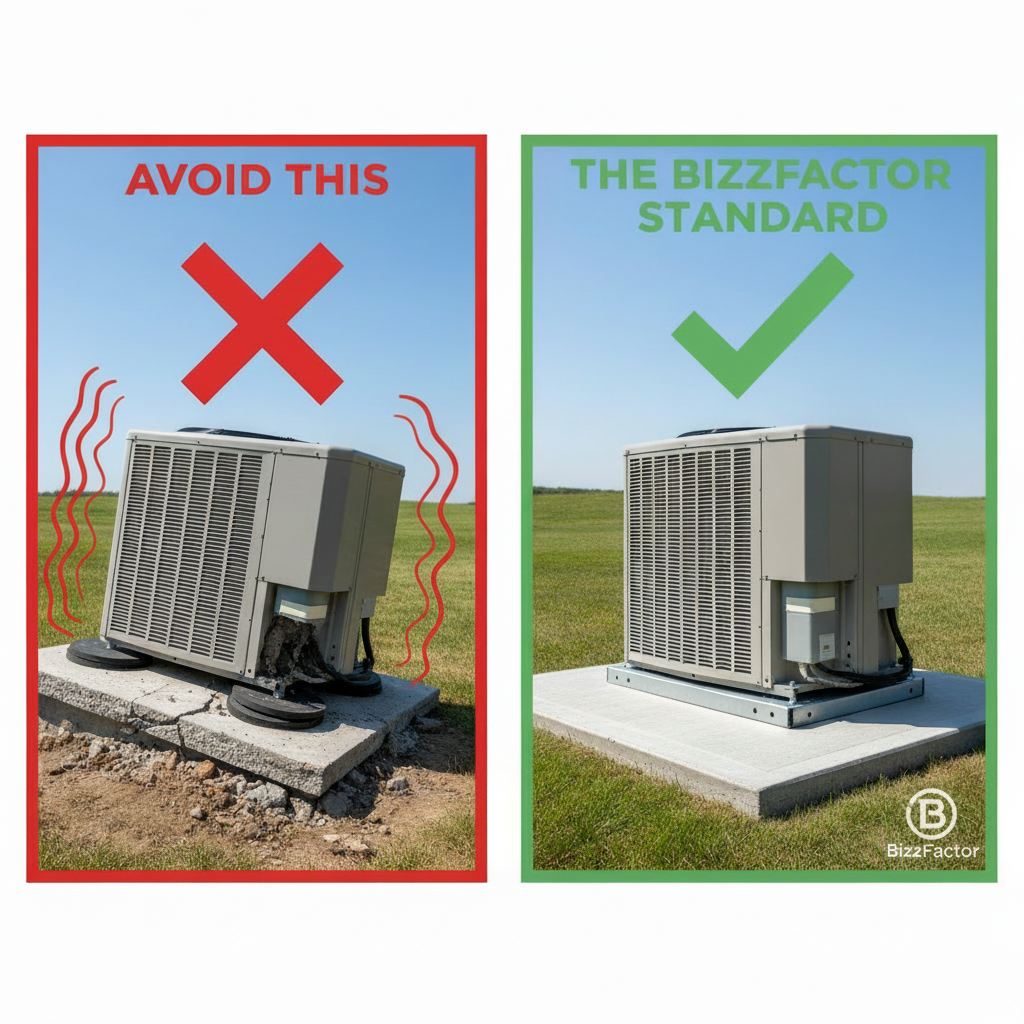
I've watched homeowners drop $200 on premium isolation pads, install them perfectly according to the manufacturer's specs, and the noise doesn't budge an inch. Because the pad underneath is cracked, tilted, or sinking on one corner. You can't isolate vibration from a foundation that's already moving.
Here's what you actually need:
- **At least 4 inches of concrete** — with rebar or fiber mesh reinforcement. This isn't a suggestion. Standard outdoor equipment specs call for this thickness because it resists frost heaving and stops the slab from cracking under constant load. Those thin DIY pads from the big box store? They'll crack within three years. Guaranteed.
- **Level within 1/8 inch across 10 feet** — our techs use laser levels because "eyeballing it" is how you end up with a compressor that struggles for the next decade. Mechanical codes push levelness for drainage and gravity-fed systems, but it also matters for compressor longevity. A tilted compressor works harder than it should.
- **6 inches bigger than the unit on all sides** — gives you support room so the edges don't settle weird over time. Prevents soil erosion from eating away at the pad's perimeter.
- **No cracks, no spalling, no settling** — if the concrete's compromised, you're building on quicksand. ASTM and ACI guidelines cover what's acceptable and what's not. Spalling means deeper problems.
When we find a foundation that's compromised, we don't patch it. We recommend starting over with a proper pour.
Costs more upfront? Absolutely. But it solves the problem for the next 20+ years instead of creating a recurring service call every summer. For detailed installation standards, check out [HVAC installation guidelines](https://www.bizzfactor.com/hvac-installation-guidelines) or ACCA Manual J and D specs.
Expert Strategies for Fixing Noisy HVAC Systems: The BizzFactor Method
Good techs don't wing it.
They test. They measure baseline readings with calibrated tools before touching anything. Then they fix the problem. Then they measure again to prove it actually worked.
No "sounds better to me" guesswork. Just verifiable data you can see on the screen.
Our techs show up with calibrated decibel meters, vibration analyzers, thermal cameras — not just a toolbox and good vibes. Outdoor condensing units get loud for dozens of reasons. Unbalanced fan blades. Panels that rattle in the wind. Compressors on their last legs. Mounting pads that disintegrated three years ago. Our job is figuring out which combination is causing *your* specific problem.
How We Actually Diagnose Noise Problems:
1. **Sound Level & Vibration Testing** — Type-1 decibel meters (IEC 61672-1 compliant if you care about the standards) and multi-axis vibration sensors give us baseline numbers. Not opinions. Numbers. Vibration sensors measure acceleration or velocity, which pinpoints imbalances or loose hardware fast.
2. **Full System Inspection** — fans, compressors, motors, electrical connections, refrigerant lines, ductwork, and the foundation underneath all get checked. We're hunting for stuff that's moving when it shouldn't be. Motor mounts that've loosened up. Fan blade pitch that's drifted out of spec. Refrigerant lines rattling against the house because the insulation came loose (easily fixable, surprisingly common). Access panels that aren't fully latched and buzz against the cabinet. It's tedious work. But that's how you find what everyone else missed.
Look — 3. **Targeted Repair** — we fix root causes with OEM parts, proper balancing, and acoustic dampening where it'll actually do something. Not just slapping foam everywhere and hoping. Replacing a compressor? We torque mounting bolts to manufacturer specs. Isolation materials are high-grade neoprene or rubber (ASTM D2000 rated for durability and vibration absorption). Because we want it to stay fixed.
Rheem's got some premium units with factory sound dampening that hit around 49-55 dB — genuinely quiet. Trane does too. Carrier charges extra for theirs.
But I've personally seen $4,500 Carrier systems sound like garbage trucks because the installer rushed the job. And I've seen properly installed mid-tier Goodman units you can barely hear running.
Here's the thing: the brand matters way less than who installs it and whether they follow ASHRAE residential noise standards (25-35 dB indoors, under 55 dB outdoors at the property line). We partner with contractors who hit those numbers because that's what makes a home actually livable. Not "quieter than it was" — measurably quiet by industry standards. For more on our contractor selection process, see our [HVAC contractor vetting process](https://www.bizzfactor.com/hvac-contractor-vetting). We often refer to ASHRAE Handbook—HVAC Systems and Equipment for best practices in sound and vibration control.
Addressing Indoor Air Handler Noise: The Hidden Threat
Air handlers hide in closets and attics where you mostly forget they exist.
Until they start making noise.
Blower motor bearings wear out gradually. Filters pack solid with dust and pet dander. Ductwork loosens up and starts vibrating against floor joists. That metallic flapping sound? Usually loose duct connections somewhere in the attic you haven't visited since you moved in.
Here's the thing: had a classical musician in Ansley Park — gorgeous old bungalow, hardwood floors, the whole deal — call us because his air handler sounded like a freight train. He was genuinely ready to spend $8,000 replacing the entire system just to make it stop.
Turned out to be a $12 air filter that hadn't been changed in probably two years.
Seriously.
The restricted airflow was choking the blower motor, making it scream trying to pull air through what was basically a felt blanket at that point. New filter, twenty minutes of labor, system runs silent again.
He saved thousands because we checked the obvious stuff first.
Dirty filters cause around 40% of HVAC efficiency problems according to EPA data. They absolutely contribute to noise, energy waste, and premature equipment failure. For maintenance schedules that actually work, check out our [HVAC maintenance checklist](https://www.bizzfactor.com/hvac-maintenance-checklist). Besides filters, we regularly check fan belt tension (if your system's got belts), lubricate bearings per manufacturer specs (usually NLGI Grade 2 lithium-based grease for motor bearings), and make sure all panels and access doors are fully sealed and latched. Ductwork noise? Often comes from inadequate hanging straps (SMACNA says every 4-6 feet) or loose branch connections. Flex duct should be stretched properly and secured tight to minimize airflow turbulence that creates whistling.
When is it Time to Call the Professionals? Know Your Limits.
Basic maintenance? Do it yourself.
Change filters every 90 days (or 30-60 if you have pets). Spray off condenser coils with a garden hose in spring. Replace thermostat batteries. Vacuum out return vents. All fair game.
But electrical work?
Don't. HVAC system
In-Depth Look
Detailed illustration of key concepts
Visual Guide
Infographic illustration for this topic
Side-by-Side Comparison
Visual comparison of options and alternatives
Sources & References
- Reducing HVAC Noise: Tips for a Quieter, More Peaceful Home
- Quiet Your HVAC System: Practical Noise Reduction Tips
- Soundproof Solutions and Sound-Deadening Ideas for Your Home
- How To Reduce HVAC Noise: Common Causes & Effective Solutions
- How to Reduce HVAC Noise: Effective Air Handler Noise Reduction ...
- 6 Best HVAC Companies | Money
- Top 23 Commercial HVAC Manufacturers - Metalphoto of Cincinnati
- 8 Best Commercial HVAC Brands for Large Buildings (Reviewed)
- Best Air Conditioner Brands in 2025
- California Title 24 HVAC Code of Regulations - Conduit Tech
Frequently Asked Questions
Need Professional Help?
Find top-rated hvac businesses experts in your area