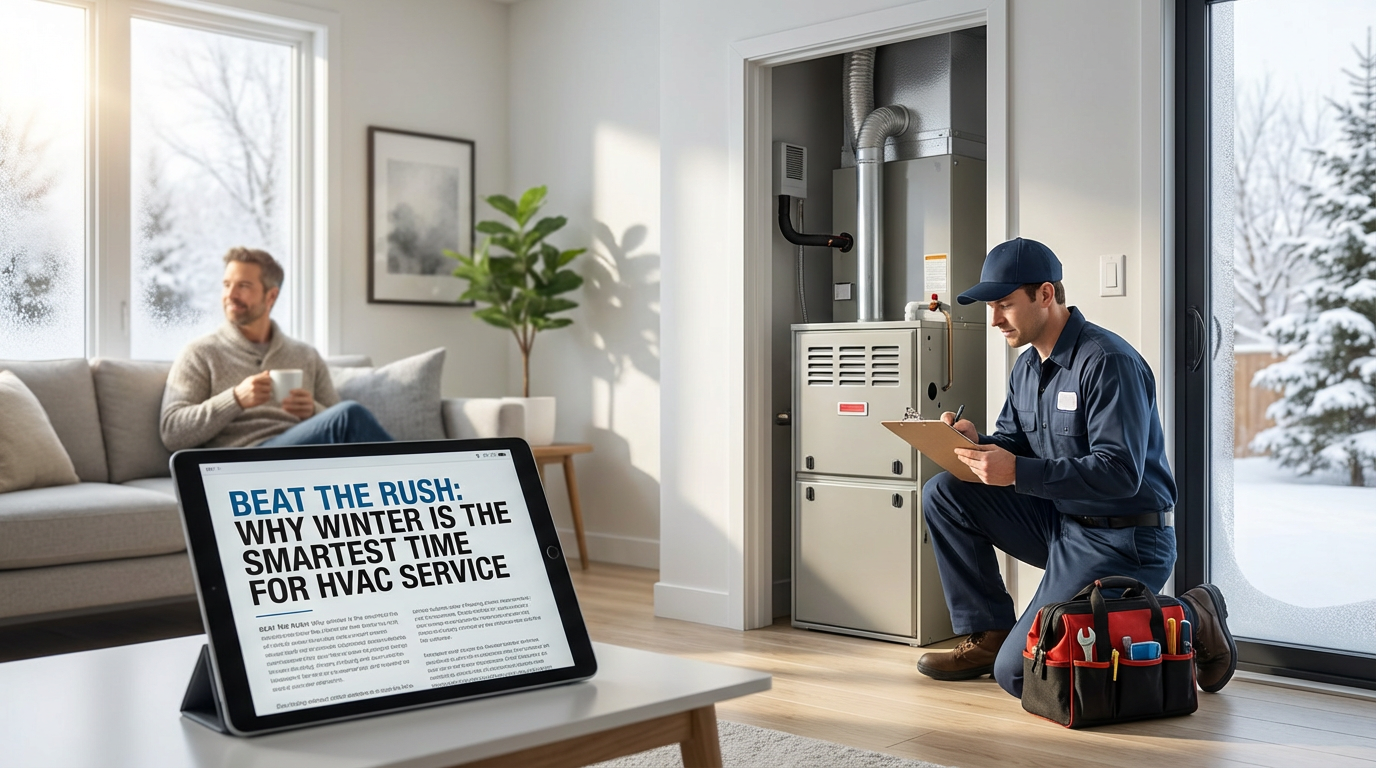
Discover the best time to call an HVAC technician. Our expert guide explains why scheduling service in the off-season saves you money, stress, and prevents summer breakdowns. Learn the secrets to proactive HVAC care.
Key Takeaways
- Book HVAC service during the off-season (fall/winter) to secure better pricing and availability.
- Proactive maintenance identifies and fixes small problems before they become costly summer emergencies.
- Waiting until summer often results in premium fees, long waits, and rushed repair work.
BizzFactor Quick Guide
The BizzFactor Standard: Always schedule HVAC maintenance during the off-season to avoid premium pricing and delays.
Key Takeaways
The BizzFactor Standard
3 Non-Negotiable Requirements for Elite Workmanship
NATE-Certified & Properly Insured
Technicians must hold North American Technician Excellence (NATE) certification, the industry gold standard, and carry full liability insurance to protect your property and their workers.
Transparent, Upfront Pricing
Elite pros provide a detailed, written estimate before any work begins. This quote should clearly break down parts and labor costs, eliminating the risk of hidden fees or surprises.
Provides a Written Labor & Parts Warranty
A confident professional always stands behind their work. They will provide a written warranty that covers both the replacement parts and the labor performed for a reasonable period.
Beat the Rush: Why Winter is the Smartest Time for HVAC Service & Maintenance
Want to know when you should actually get your HVAC system serviced? Fall or winter. That's it.
This isn't some industry secret. It's just common sense that most people ignore until they're sweating through their shirts in July. Think about it — better technician availability, lower prices, and you're not gambling on whether your AC dies during a 95-degree heatwave. Skip the panic calls when everyone else's system tanks. Way less stress.
Look — i've watched this play out hundreds of times. Off-season HVAC service saves homeowners serious money and a ton of headaches. Plus your system actually lasts longer. Your future self — the one chilling in a perfectly cool house next August — will thank you for handling this now. Don't get caught unprepared.
The Proactive Advantage: Why Off-Season HVAC Service Sets You Up for Success
Schedule HVAC service in November instead of July? Your technician actually has time to think.
Summer's chaos. Every AC company I know is running four weeks behind, techs are doing five emergency calls before lunch, and diagnostic work gets reduced to "swap the obvious broken part and run." Off-season appointments are different — that's when you get real diagnostics, actual preventative work, and a tech who isn't watching the clock because dispatch is blowing up their phone about six more emergencies stacked up that afternoon.
You don't wait for the first blizzard to throw snow tires on your car. You handle it in October when there's time to think straight, get it done right, and avoid the rush. Same exact logic applies to your HVAC system.
Most homeowners wait. They wait until the AC is wheezing its last breath on the first 90-degree day. Then it dies completely. Suddenly everyone needs service at once, which means you're waiting days and paying through the nose. Who wants that headache?
Being proactive flips the script. You're not managing a crisis — you're preventing one. A tech who isn't slammed can do a real **HVAC tune-up**, checking everything that matters. The capacitor that starts your motor. The fan motor itself. Refrigerant levels, measured down to the ounce (residential systems need it within +/- 2 oz of spec to run efficiently). No rushing. No cutting corners.
This separates savvy homeowners from the ones sweating it out in July, wondering why they didn't do something sooner. We recommend booking your [HVAC tune-up](/blog/preventative-hvac-maintenance-tips) now to dodge the summer rush. Small investment, huge payoff.
Peak Season Problems: The Downside of Waiting Until Summer for HVAC Repairs
Calling for HVAC repairs in July when it's 98 degrees outside? Almost always a mistake.
Here's what you're signing up for: waiting days (sometimes a full week), premium emergency rates around 1.5x to 2x normal pricing, and rushed service because even great companies like our partners `AC's Heating & Air` in Phoenix get absolutely buried during those scorching months. That's the reality of summer HVAC work.
When your AC dies mid-summer, you're joining a very long, very uncomfortable line. I've seen this movie before. Here's how it usually goes:
- **Emergency Fees:** Most companies tack on $150-$300 extra just for showing up same-day or after-hours. During heatwaves? That becomes standard. Ouch.
- **Extended Waits:** You might be sweating for several days instead of getting help today. Brutal.
- **Rushed Work:** An overbooked tech with ten other emergency calls stacked up? They'll fix the immediate symptom, miss the root cause, and you'll be calling again in three weeks. Ask me how I know.
- **Limited Options:** Need a full replacement? You're probably stuck with whatever's gathering dust in the warehouse — not the perfect `Rheem` or `Carrier` unit you actually wanted.
Waiting for a crisis puts you in the worst negotiating position possible. Costs more, quality suffers, and the stress isn't worth it. Check out our [preventative HVAC maintenance tips](/blog/preventative-hvac-maintenance-tips) or learn about [common HVAC issues](/blog/common-hvac-issues-and-solutions) you can dodge entirely by planning ahead.
Real-World Scenario: A Tale of Two Homeowners and HVAC Maintenance Preparedness
My team inspected two houses in the same Raleigh neighborhood last year. Perfect example of why timing matters.
Here's the thing: here's the thing: homeowner A? Their 5-year-old AC unit croaked during August when temps were pushing 100°F for days. They called frantically, got put on a waiting list because *everyone's* system was failing. That's the real issue. Two-day wait in that kind of heat is absolutely miserable — kids cranky, nobody sleeping, portable fans doing basically nothing.
When the tech finally showed up (emergency fee already stinging), they got devastating news: compressor seized. Replacement needed. And because three more calls were stacked up, the work got rushed. I heard about it in our office — they were pretty upset, and honestly, who could blame them?
Homeowner B played it differently.
October the previous year, we came out for preventative maintenance. Found the capacitor reading weak (30 microfarads instead of the required 35 MFD — classic early failure sign). Outdoor coil was caked with cottonwood and pollen, forcing the system to work overtime.
Replaced the capacitor. Cleaned the coil thoroughly. Under $200 total.
Sailed through summer. Zero issues. Didn't even notice the heatwave while their neighbor was melting.
One homeowner faced a massive expense during a brutal heatwave, lost sleep, dealt with a cranky family. The other made a small October investment and enjoyed complete peace of mind, uninterrupted comfort, probably lower energy bills from improved efficiency. *That's* why **winter is the best time for HVAC service**. Real example, real difference.
What Defines The BizzFactor Standard for Quality HVAC Service?
There's a tech who swaps the broken part and leaves. Then there's a tech who figures out *why* it broke.
We call the second approach **The BizzFactor Standard** — comprehensive system analysis, straight talk about costs, manufacturer-approved parts (zero sketchy aftermarket junk), and a focus on making your system last years instead of limping through summer. My team's playing the long game here. Building trust with homeowners, not chasing quick money.
A capacitor fails? Sure, replacing it takes five minutes. But here's what you actually need to know — *why'd it fail in the first place?* Is the outdoor unit suffocating because the coil's packed with cottonwood? Compressor pulling way too many amps and frying electrical components? That detective work is what separates a $45 fix from a $2,400 disaster six months later. I watched a guy in Buckhead learn this the expensive way.
Real diagnostic work isn't guessing. Here's what I'm talking about:
- **Static Pressure Test:** We're measuring airflow with a manometer — actual numbers, not vibes. Restrictive filters, closed vents, crushed ducts? You're losing 15-20% efficiency. That hits your bill every single month.
- **Refrigerant Charge Verification:** Digital gauges, superheat and subcooling calculations, electronic leak detection (sometimes UV dye). Most residential systems? Manufacturer spec is tight — within 2 oz. You're bleeding roughly 5-10% efficiency per pound that's missing, plus you're slow-cooking your compressor.
- **Electrical Component Inspection:** Capacitors tested with a multimeter (should read within 6% of rated MFD). We're checking contactors, relays, every wire connection — hunting for pitting, corrosion, arcing. A weak capacitor slowly murders your compressor motor. That's a $2,000+ repair you could've prevented with a $45 part.
- **Coil and Blower Cleaning:** Evaporator coil, condenser coil, blower fan — everything gets cleaned properly. A dirty evaporator alone? You're losing 30% efficiency. *Thirty percent.* That's your money getting burned in your backyard.
- **Drainage System Check:** Making sure condensate lines actually drain, checking for algae buildup, confirming the float switch works. Prevents water damage, mold nightmares, those fun emergency shutdowns when the pan overflows at 11 PM on a Saturday.
- **Thermostat Calibration:** Verifying accuracy against a known temperature source. Bad calibration wastes energy and creates those annoying hot-and-cold zones nobody can explain.
Take someone like `Salmon HVAC` up in Portland — they're using estimation software (probably `1build` or something similar) that breaks down every line item before any work starts. You know *exactly* what you're paying for. No "oh by the way" charges when the bill comes.
That's the difference between professional **HVAC preventative maintenance** and some guy trying to make a quick buck before moving to the next town. Visit our directory to find [trusted HVAC professionals near you](/hvac-businesses) who actually give a damn about quality work.
Why Proactive Winter Service is a No-Brainer for Homeowners
Now, now, what do you actually want from your HVAC system? Probably consistent comfort without thinking about it. Electric bills that don't make you gasp. Not wondering every summer if this is the year everything implodes spectacularly.
Here's the deal: winter service checks all three boxes. Your system's running at actual designed efficiency when July rolls around, and you're dodging those ridiculous emergency rates that make you question your life choices.
A contractor buddy in North Hills (solid operation, been doing this maybe 15 years) obsessively tracks this stuff. His numbers? Homeowners scheduling winter maintenance save around $340 versus emergency summer calls. That's *just* the service cost — doesn't even touch the energy savings from a system that's actually running efficiently instead of wheezing through the season at 60% capacity.
Here's what usually happens: people completely ignore their HVAC until something spectacularly breaks. Then they're genuinely shocked when the emergency repair bill comes back at $1,800 for a mid-July compressor replacement. I've probably seen this exact scenario a hundred times.
Preventative maintenance in winter? Usually $150-$250. And during that visit, a good tech catches small problems before they become wallet-destroying problems. A slightly worn belt costs $45 in November. Wait until it snaps during a June heatwave? Now you've probably got motor damage — suddenly you're looking at $600, maybe more if the tech finds additional issues. See how fast things spiral?
And honestly? There's something legitimately priceless about peace of mind. Knowing your system got thoroughly checked by a professional when they had actual time to do it right. No shortcuts. No rushing.
So you've got two paths: Schedule a tune-up during the slow season, probably save a few hundred bucks, and your system runs better all year. Or roll the dice, hope nothing major breaks during summer, and potentially end up like Homeowner A — sweating it out for days while your bank account takes a hit.
Which one sounds smarter?
In-Depth Look
Detailed illustration of key concepts

Visual Guide
Infographic illustration for this topic

Sources & References
- What To Know Before Calling an HVAC Pro - This Old House
- Complete Guide to HVAC Repair: Knowing When to Call the ...
- When To Call An HVAC Professional Vs DIY Repair Guide
- Why Now Is the Perfect Time to Service Your HVAC System
- HVAC Dispatching Tips: How to Make the Most of Service Calls
- Top 23 Commercial HVAC Manufacturers - Metalphoto of Cincinnati
- Full List: Top HVAC Manufacturers and Suppliers in 2026 - FieldPulse
- 8 Best Commercial HVAC Brands for Large Buildings (Reviewed)
- Key HVAC Regulations and Requirements for 2025 and Beyond
- The Best HVAC Brands Of 2026 - Mattioni Plumbing
Frequently Asked Questions
Need Professional Help?
Find top-rated hvac businesses experts in your area