
Our expert guide details the pros and cons of central air, ductless mini-splits, and window AC units to help you choose the most efficient system for your home.
Key Takeaways
- Match your AC type to your home's size; central air for whole-home, ductless for zoning.
- Always demand a professional Manual J load calculation to ensure your new system is sized correctly.
- Ductless mini-splits offer superior efficiency and room-by-room temperature control for long-term savings.
BizzFactor Quick Guide
The BizzFactor Standard: Always insist on a Manual J load calculation before any new central AC installation.
Key Takeaways
The BizzFactor Standard
3 Non-Negotiable Requirements for Elite Workmanship
Manual J Load Calculation
This is non-negotiable. It's the only way to scientifically determine the correct size for your AC unit, ensuring efficiency and comfort. Avoid any pro who just uses a rule of thumb.
Licensed & Insured
Verify the technician holds a current state HVAC license and carries both liability and workers' compensation insurance. This protects you from faulty work and job site accidents.
Provides a Written Warranty
An elite professional stands behind their work. You should receive a clear, written warranty covering both the equipment (manufacturer's) and the installation labor for at least one year.
Expert HVAC Guide: Choosing the Right Air Conditioner For Your Home
A guy in Buckhead just called me, sweating through his shirt in his own living room. Brand new $7,200 AC system installed three weeks ago. Still miserable.
You know what the problem was? Nobody asked the right questions before they sold him that unit. They just looked at his square footage, picked a system off the shelf, and cashed the check. That's not how this works.
Look — look — here's what actually matters when you're choosing an AC system: your home's size, sure — but also how it's built, where you live, whether you've got ductwork or not, and what you can actually afford to run every month (not just buy upfront). Central air conditioning? Ductless mini-splits? Those old-school window units rattling in your bedroom? Each one's got a job it's actually good at. The secret sauce? We weigh energy efficiency, the headache factor of installation, and how well a system can handle zoning.
Decoding Central Air Conditioning Systems for Whole-Home Comfort
So most contractors will tell you central air is the gold standard. The whole-home solution. And yeah — when it's done right, there's nothing better. You've got one thermostat controlling every room, conditioned air flowing through vents, consistent temperature everywhere.
But here's the catch.
A quality installation isn't just slapping a unit in place. It demands surgical precision in sizing, which usually means a **Manual J load calculation**. Skip this step and you're basically gambling with your comfort and money. An oversized unit? It'll cycle on and off constantly (short-cycling — memorize that term). An undersized one? It'll run 24/7, rack up insane electric bills, and die years early because it's always maxed out.
I watched this exact nightmare unfold in Oakhaven last summer. Beautiful home, brand new AC, family still sweltering because the installer eyeballed the tonnage instead of doing the math.
So the typical setup? You've got the outdoor unit — that's where the condenser and compressor live, doing the heavy lifting — and then there's the indoor air handler with its fan and coil that pushes air around. Pretty straightforward, but there's nuance here depending on your home's layout and your contractor's skill level. If you've got a sprawling two-story with teenagers blasting music in opposite wings, or that converted attic bedroom where grandma stays, central air makes sense because you need that consistent push of cool air everywhere at once.
Now, if you're shopping for a new system, you'll see brands like `Rheem` and `Carrier` advertising their SEER ratings (that's Seasonal Energy Efficiency Ratio — or the newer SEER2 ratings, which are even more accurate). The math on this is simple: pick a number in the high teens or low twenties, and you'll probably see your summer bills drop 20-30% compared to that dinosaur unit from 2005 — but it depends on how you use it, what your local rates are, and whether you're the type who cranks it to 68° or keeps it reasonable at 76°. `ENERGY STAR` certification? Look for it. These units get independently tested, so you're not just taking the manufacturer's word for efficiency claims.
Here's the thing: here's the thing: the initial investment for central AC can be hefty, though. And if one component fails? The whole house feels it. Plus, and this is a biggie, shoddy or leaky ductwork can steal over 30% of your conditioned air before it even reaches your toes. Seriously! So, to keep your system purring like a kitten, understanding the basics of [HVAC System Maintenance](/hvac-businesses/hvac-maintenance-tips) isn't just smart; it's essential.
The BizzFactor Standard: Central AC Installation Best Practices
Too many installers still eyeball unit size based solely on square footage. "Oh, you've got 2,000 square feet? Here's a 3-ton unit." That's lazy, and it'll cost you thousands over the system's lifetime.
The good contractors? The ones who've been doing this long enough to care about callbacks? They _insist_ on a **Manual J load calculation**. Companies like **AC's Heating & Air** in Glendale won't even give you a quote without one (I've seen their lead tech, Mike, literally walk off jobs when homeowners push back on it).
So what's that, exactly?
Think of it like this: there's software that basically interrogates your house about its cooling needs. The tech measures your insulation (R-values in the attic, walls, crawlspace), catalogs your windows (single-pane from 1987 or double-pane Low-E from last year?), figures out which direction each room faces (that west-facing family room is getting cooked every afternoon at 4pm), and plugs in your zip code's climate data — average July temps, humidity levels, how many 95-degree days you get. Punch all that in, and out pops a number: the exact BTUs your house needs. Not a guess. Actual engineering.
Just right.
This kind of precision work? It's what separates a system that'll run 15 years from one that dies at year 7 while draining your bank account the whole time. It means your compressor isn't cycling itself to death. It means you're not throwing money out the window every time that thing kicks on. And it means you can actually set your thermostat to 72° without wondering if you'll be able to afford groceries this month. Want to dive deeper into proper installation? Check out our guide on [HVAC Installation Best Practices](/hvac-businesses/hvac-businesses/hvac-installation-best-practices).
Understanding Airflow and Duct Design: Beyond Just the Unit
Your AC unit is basically your heart. Ductwork? That's every artery and vein in your house. And if those ducts are kinked, undersized, or leaking? Even a $10,000 unit's gonna struggle.
I've seen brand new systems fail miserably because nobody paid attention to what was already in the walls. You can have the most efficient compressor money can buy, but if your ducts are leaking 35% of that precious cooled air into your attic or crawlspace, you're essentially air conditioning your insulation. Static pressure matters. Airflow velocity matters. Register placement matters. An experienced technician knows that restrictive ductwork forces the blower motor to work harder, gobbling up electricity and shortening its lifespan.
Undersized return ducts are just as bad.
They create negative pressure and pull unconditioned air into your conditioned space. It's a lose-lose.
I saw this in a sprawling custom home in Calabasas last summer. The homeowner couldn't figure out why his brand-new 5-ton `Trane` unit — around $9,800 installed — couldn't cool his master bedroom. After days of troubleshooting the expensive unit itself, our BizzFactor pro found the culprit: one single, kinked flex duct supplying that massive bedroom, effectively turning it into a 6-inch straw trying to deliver water from a firehose.
A simple, careful redesign of that section of ductwork, and suddenly, crisp, cool air flowed.
It wasn't the AC unit; it's was the delivery system. Duct sealing with mastic (not just tape), and proper insulation are crucial steps that often get overlooked. Don't overlook them. Your bills will thank you.
The Flexibility and Efficiency of Ductless Mini-Split Systems
What about homes without ducts? Or that new addition? Or maybe you just can't agree with your spouse on a thermostat setting (one of you is always freezing, the other always sweating)?
Enter the **ductless mini-split system**.
I'll be honest — these things have saved more marriages than couples therapy. You've got an outdoor compressor hooked up to one or more indoor air handlers (usually sleek wall-mounted units, sometimes tucked in the ceiling). The magic? Each indoor head runs independently with its own thermostat. Want the bedroom at 68° while the living room stays at 74°? Done. No arguments. You're only cooling spaces you're actually using instead of pumping cold air into that guest room that hasn't seen a visitor since Thanksgiving 2022.
So yeah, the upfront cost hits different than central air. A single-zone setup? You're probably looking at $3,500–$4,200 installed if the outdoor unit doesn't have to go too far from the indoor head. Multi-zone gets pricier — I've seen three-zone systems run $8,000–$12,000 depending on how sadistic your home's layout is (like when the installer has to chase refrigerant lines through three floors and around chimneys). But here's the thing: I've watched a couple in Decatur cut their August electric bill from $380 to $195 after ditching their 20-year-old central system for a four-zone `Mitsubishi` setup.
And they're whisper-quiet. Most quality indoor units (think `Mitsubishi` or `Fujitsu`) operate around 19-25 dB — quieter than a library. For the really complex multi-zone setups, the pros often use advanced cost-estimating software, like **1build**, to nail down budgets for multiple units and those intricate refrigerant line routes.
Don't go guessing here. Find a qualified installer through our [Find an HVAC Pro](/hvac-businesses/find-an-hvac-pro) tool.
Case Study: Ductless Mini-Split Solves a Common Comfort Problem
Now, last month a woman from the Northwood neighborhood in Irvine called us. She had _the_ classic complaint: an upstairs that felt like a sauna, a downstairs that was practically arctic, and her central AC was running non-stop.
Total madness.
We sent one of our pros out, and here's what he found: a **15-year-old** `Rheem` unit, way oversized for the house. It was short-cycling like crazy (remember that term?) and doing a terrible job of dehumidifying. Plus, the existing ductwork? Totally out of whack – a maze of shoddy connections and pinched flex lines.
Instead of hitting her with a massive bill for a full system and ductwork overhaul, we suggested a multi-zone **ductless mini-split system** for the upstairs and a smaller, properly sized central unit for downstairs after duct repair.
Three weeks later? She called back to say her master bedroom finally felt comfortable for the first time in years.
Her July bill used to hit around $340. August came in at $220. That's $120 back in her pocket every month (over 35% less). Not because we sold her some miracle technology — just because we matched the right equipment to her actual problem instead of doing what was easiest for the installer. For more insights on optimizing your system, explore [Understanding AC Efficiency Ratings](/hvac-businesses/understanding-ac-efficiency-ratings).
When Do Window & Portable AC Units Make Sense?
Okay, so — window units and portable ACs. I'm not gonna pretend these are ideal solutions for most situations, but they're not completely useless either. Got a single bedroom that gets hot? Renting an apartment where you can't install central air? These can work in a pinch. They're cheap upfront (like $200-$400 for a decent window unit), and you can usually install them yourself without calling a pro.
Real talk, though — the downsides add up fast.
They're electricity hogs compared to modern split systems. A window unit pulling 1,200 watts to cool one bedroom? That's rough. They're also loud because the compressor's literally sitting right there in your window or on your floor — good luck sleeping through that rattling hum. Window units create security vulnerabilities (might as well hang a sign saying "easy entry here") and block your natural light. That's the real issue. Portables eat up floor space and need that ugly exhaust hose snaking out your window, which never seals right, so you're basically air conditioning your backyard too.
So yeah, they'll cool a room. But they're Band-Aids, not solutions.
If you're thinking long-term or trying to cool more than one small space, you're better off consulting our guide on [Understanding AC Efficiency Ratings](/hvac-businesses/understanding-ac-efficiency-ratings) and investing in something that'll actually save you money over time.
Key Considerations Before You Invest in a New AC System
A new air conditioner isn't buying a candy bar. It's a major, long-term investment. So, beyond picking a system type, you gotta think about these crucial factors to ensure you're not just comfortable today, but also saving money down the road.
- **Energy Efficiency Ratings (SEER, EER, SEER2):** This is your wallet's best friend. Higher ratings mean lower energy bills.
In-Depth Look
Detailed illustration of key concepts
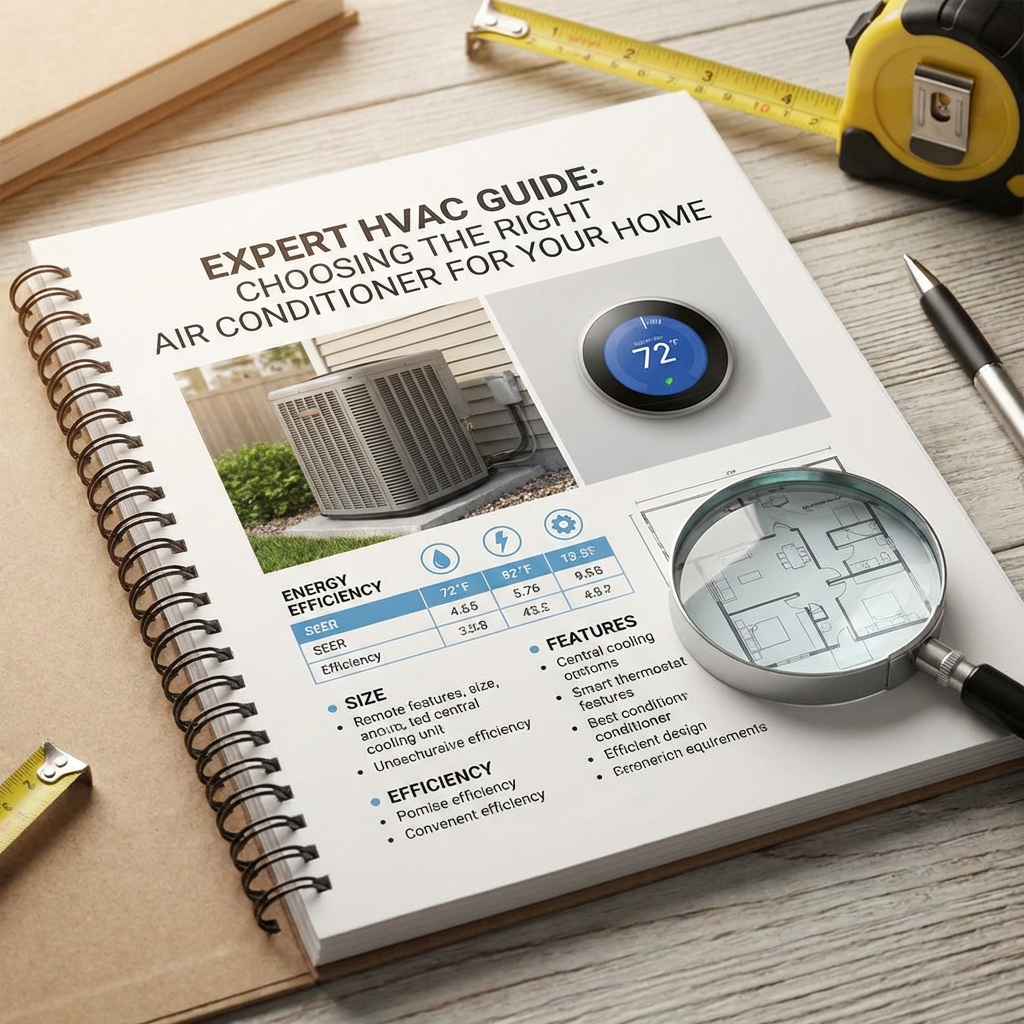
Visual Guide
Infographic illustration for this topic

Sources & References
- Best Central Air Conditioning Buying Guide - Consumer Reports
- 11 Types of Air Conditioners and How to Choose - The Spruce
- Handbook of Best Practices: Room Air Conditioner Installation for ...
- [PDF] Guide to Home Heating and Cooling
- [PDF] A Guide to Energy-Efficient Heating and Cooling
- Top 23 Commercial HVAC Manufacturers - Metalphoto of Cincinnati
- Full List: Top HVAC Manufacturers and Suppliers in 2026 - FieldPulse
- 6 Best HVAC Companies | Money
- Best Air Conditioner Brands in 2025
- Key HVAC Regulations and Requirements for 2025 and Beyond
Frequently Asked Questions
Need Professional Help?
Find top-rated hvac businesses experts in your area