
Learn your rights when HVAC technicians arrive late. Discover compensation options, legal remedies, and how to choose reliable contractors who respect your time.
Key Takeaways
- Delays exceeding 2-3 hours beyond scheduled appointments often qualify for monetary compensation
- Professional HVAC companies provide clear delay policies and proactive customer communication
- Documentation and systematic escalation maximize your chances of successful compensation claims
BizzFactor Quick Guide
The BizzFactor Standard: Always choose HVAC contractors who provide written scheduling commitments and published delay compensation policies
Key Takeaways
The BizzFactor Standard
3 Non-Negotiable Requirements for Elite Workmanship
Written Service Agreements
Professional contractors provide detailed work orders with specific appointment times and clear delay policies to protect customer rights.
Proactive Communication Systems
Elite HVAC companies maintain real-time scheduling updates and notify customers of delays at least 2 hours in advance.
Published Compensation Policies
Reputable contractors establish clear compensation frameworks for service delays, demonstrating respect for customer time and commitments.
HVAC Technician Delay Compensation: Your Rights and Legal Options Explained
A guy in Buckhead paid $2,400 last February because his furnace guy never showed. Two days of frozen pipes, ruined hardwood floors, emergency plumber at midnight rates. Could've avoided the whole thing if he'd known what he was entitled to when that tech went radio silent for six hours.
You're not just inconvenienced when an HVAC tech blows their appointment window — you've got actual legal rights. Most homeowners don't know this. Consumer protection laws, company policies, even the specific circumstances around the delay can all trigger compensation. And during extreme weather? Those rights get even stronger, because we're not talking about "annoying" anymore. We're talking property damage, safety risks, and real money walking out the door.
Understanding Your Rights When HVAC Technicians Are Late: The BizzFactor Standard
There's this two-hour rule most consumer protection regs use as a baseline. Traffic happens. Previous job runs long because the diagnostics went sideways (which, trust me, happens constantly). Minor truck issues. Reasonable stuff that eats up time.
So here's the math: tech schedules for noon, rolls up at 1:45 PM? Annoying, but probably within reason. Shows up at 4 PM and hasn't called once? That's four hours past your appointment — two hours past the grace period — and yeah, you've got a legitimate complaint now.
Emergency services flip this whole equation. Furnace dies when it's 12°F in Massachusetts? AC quits during a Phoenix July heat wave? I've personally seen inside temps hit 98°F within three hours of AC failure in Arizona homes. This isn't about comfort anymore. Frozen pipes will run you $8,000 to repair. Heatstroke in elderly parents is a real, immediate danger. Quantifiable risk.
Reputable companies featured on [BizzFactor's directory of top-rated HVAC services](/hvac-businesses) usually have internal policies that beat the legal minimums by a mile. That's The BizzFactor Standard — the difference between a professional operation and some guy with a van. Choosing a vetted contractor cuts your risk of this nightmare basically in half.
The Impact of Delays on Home Comfort, Safety, and Economic Loss
No-show techs create a cascade of problems. Fast.
Elderly couple in Phoenix, condenser fan motor dies in July. Appointment: 9 AM. By 2 PM — outside temp pushing 110°F, living room at 95°F — still nothing. No tech. No call. Radio silence.
That's not discomfort. That's a medical emergency developing in real time.
Heatstroke and dehydration don't wait around, especially when you're over 70 and your body can't regulate temperature like it used to. Same logic applies in reverse during a Minnesota winter. I knew a homeowner in St. Paul who ignored a broken furnace for two days because "the tech would get there soon." Pipes froze, burst, destroyed every hardwood floor in the house. $15,000 in repairs because of a delay.
There's this standard — ASHRAE 55 — that says humans stay comfortable between about 68-76°F. Your house doesn't legally have to hit that (it's not a rental code thing), but it's the benchmark everyone uses for "safe and livable." Drop below that range for too long with kids or elderly folks in the house? You're looking at respiratory flare-ups, cardiovascular stress, actual hypothermia risk.
The financial hits stack up separately. Lost wages from burning a vacation day (around $200-$300 for most people). Emergency childcare you didn't plan for. Stopgap space heaters from Home Depot. Spoiled food if your refrigerator's the problem. A homeowner in Dallas tracked $425 in out-of-pocket costs from one six-hour warranty appointment that never happened.
That's documented loss, not theoretical annoyance.
When HVAC Technician Delay Compensation Becomes Available
Here's the thing about that Dallas homeowner I just mentioned: he'd taken the whole day off work for a pre-scheduled Carrier warranty service. Arranged childcare ($150), postponed a client meeting. Six hours past the appointment window, still no tech. No call, no text, nothing. He was absolutely livid.
And he had every right to be, because his situation basically wrote the textbook on compensation eligibility.
Pre-scheduled appointment? Check. Not some emergency call where timing's inherently flexible — this was carved out on both calendars weeks ago.
Way past the grace period? Four hours beyond the two-hour buffer, when the company's own policy promised a three-hour maximum window. Check.
Demonstrable loss? Bank statement showing the childcare charge. Pay stub showing the PTO day ($250). Even his utility bill proving he'd run space heaters. Real costs, not vague "inconvenience." Check.
Zero communication? One text could've changed everything. Complete radio silence crosses the line from unprofessional to potential breach of contract. Check.
Platforms like [1build](https://www.1build.com) connect you with contractors who've got GPS tracking on their trucks and proactive text updates built into their workflow. Accountability baked into the business model.
Circumstances That Typically Qualify for Compensation
Look — scheduled maintenance, warranty calls, installation appointments where everyone circled this date weeks ago? These carry real weight. You both committed to the time. Nobody's surprised.
Emergency repairs get messier. A tech might legitimately get pulled from your "routine" tune-up to handle a carbon monoxide leak happening two blocks away. That's a valid reason to bail (though they should absolutely call you).
Look — what actually excuses delays? Real severe weather — blizzards shutting down highways, hurricanes, not some drizzle. Widespread outages hitting dozens of customers simultaneously. Genuine safety emergencies requiring immediate response. Force majeure stuff, usually spelled out in the service agreement you signed (though often in language designed to confuse).
Scheduled maintenance on a clear Tuesday in April? Tech's just running late because he overbooked? Different story entirely.
Check our guide on [understanding HVAC service agreements](/hvac-service-agreements) for which clauses actually protect you versus which ones just protect them.
Standard Compensation Amounts and Structures for HVAC Delays
What you'll actually get varies dramatically by location. Manhattan versus rural Kansas? Completely different math. Labor costs, local regs, company size, how badly they screwed up — it all matters.
Most professional outfits operate on a sliding scale. They know losing a customer forever costs more than cutting a check today.
**First tier (2-3 hours late):** Goodwill gestures, mostly. They'll credit your service call fee, knock maybe 10-15% off today's work, waive the diagnostic fee. That's usually $75-$150 (sometimes $250 if you've got a complicated geothermal setup). Translation: "We're sorry, please don't torch us on Google Reviews."
**Second tier (3+ hours, you've clearly lost part of your day):** Now we're in real money territory. $100-$300 cash compensation. Sometimes substantial credits like $500 toward your next service. This acknowledges you burned a vacation day, paid for childcare, whatever actual costs you ate.
**Third tier (Extreme delays, safety risks, property damage):** This is where it gets heavy. We're talking full refund of any fees, potential reimbursement for hotel stays (if your HVAC is truly out of commission and it's extreme temps), and even coverage for documented property damage. That Buckhead guy with the frozen pipes? He ended up getting the full cost of his emergency plumbing and hardwood repair covered, which was over $6,000, plus a full refund on the initial diagnostic fee. His argument centered on the "duty of care" – the company, by failing to show up for a pre-scheduled emergency repair on a freezing day, effectively became negligent. This negligence directly contributed to the pipe burst.
What to Look For in Your Service Agreement and Warranty
Read the service agreement. I know, I know — nobody wants to wade through eight pages of legal jargon at 9 PM when you're just trying to get your AC fixed. But buried in that fine print, you'll find clauses about appointment windows, communication protocols, sometimes even specific remedies for delays.
"Force majeure" is the term you're hunting for. Sounds fancy, but it basically means "act of God" — hurricane, tornado, freak ice storm, zombie apocalypse (okay, probably not that last one). These clauses say if something truly uncontrollable prevents them from arriving, they're not liable for delays.
Here's the key: routine traffic or a tech running behind on another job? That's not force majeure. That's poor scheduling.
Some higher-end HVAC companies offer specific "on-time guarantees" now, promising to waive the service fee or give you a certain dollar amount back if they're late. This is becoming more common as companies compete on customer service. Always ask your prospective contractor if they offer such a guarantee. Get it in writing.
Home warranties add a third layer of complication (because why keep things simple?). These agreements often have their *own* specific timelines for dispatching technicians and completing repairs — usually 24-48 hours for non-emergencies, 24 hours for emergencies. If the warranty company dispatches a contractor who then ghosts you, you might have a claim against the warranty provider itself for breach of their service timelines, as well as against the contractor. The burden of proof for the emergency status falls on you, the homeowner, to clearly communicate the urgency (e.g., "my furnace is dead and it's 10°F outside, with an elderly person in the home").
Real-World Anecdotes and Case Studies
Let's dive into a few more specific instances I've encountered, illustrating how these principles play out.
**Case 1: The Frigid Friday in Chicago's Lincoln Park**
Last January, a client in Lincoln Park, Chicago, had their furnace die on a Friday afternoon when temperatures were plunging to -5°F. They called their usual HVAC company, "Polar Bear Comfort," who promised a technician between 4 PM and 7 PM. That's the real issue. By 9 PM, no one had shown up, and despite multiple calls, they couldn't reach anyone. The indoor temperature was dropping rapidly, already below 50°F. The family, with two young children, booked a hotel room downtown for $350 for the night. They also called an emergency plumber over due to fears of frozen lines, costing them another $200 for a visit.
The next morning, the HVAC company finally called, apologizing for an "unexpected emergency" with another client which had diverted all available technicians. They offered a free diagnostic and 10% off the repair. My client was understandably furious.
**Outcome:** My client documented everything: the hotel receipt, the emergency plumber's invoice, call logs, and screenshots of weather reports. They contacted Polar Bear Comfort's management, not just customer service. Citing the immediate safety risk (children, extreme cold) and the breach of the promised service window with zero communication, they demanded full reimbursement for the hotel and plumber, plus a full credit for the repair. After some back and forth, Polar Bear Comfort, wanting to maintain their reputation in the affluent Lincoln Park area, agreed to pay the $550 in hotel/plumber costs and provided a $500 credit towards the new furnace installation they needed. This wasn't a binding legal decision, but an act of good faith to prevent negative reviews and potential small claims court action. The total compensation exceeded $1,000.
**Case 2: The Dallas Summer Swelter and the No-Show Installers**
A homeowner in Plano, Texas, had scheduled a full AC system replacement for a scorching Tuesday in July. Two technician
In-Depth Look
Detailed illustration of key concepts

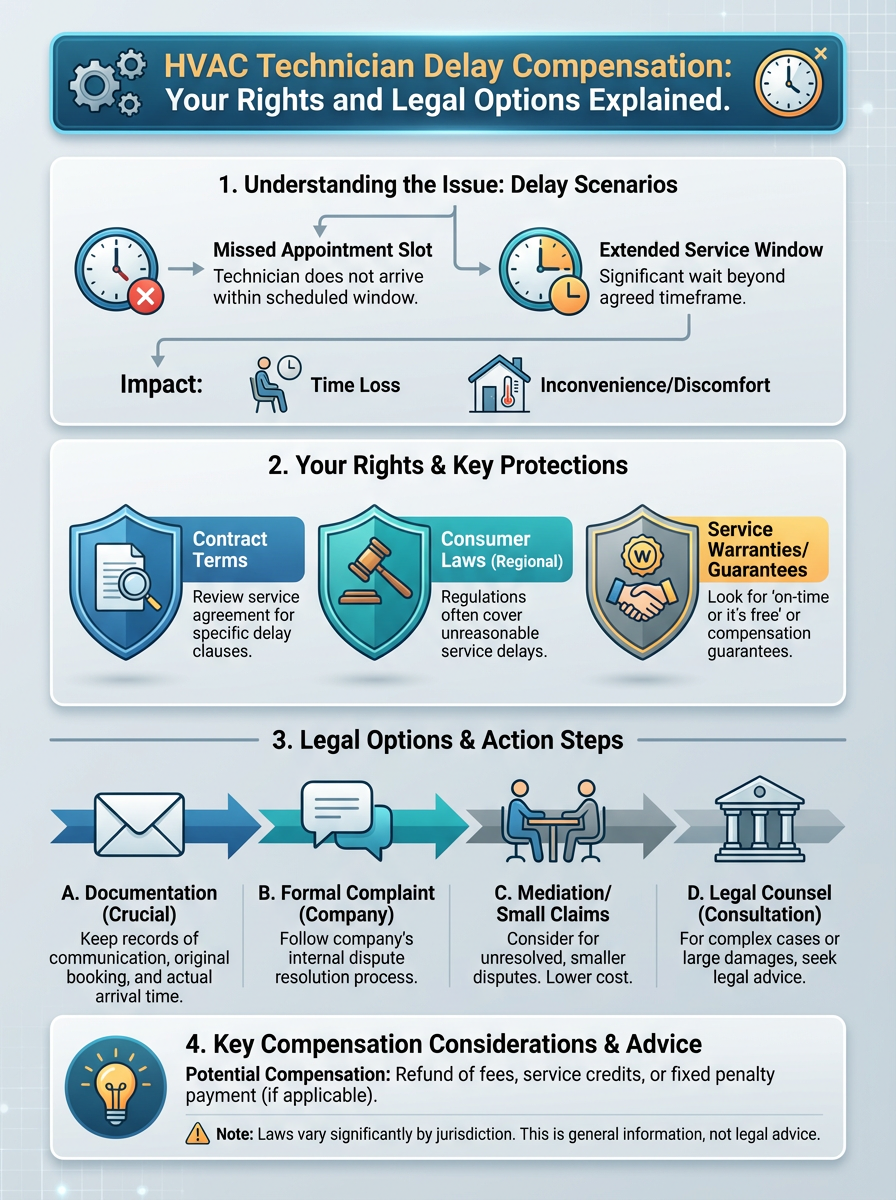
Visual Guide
Infographic illustration for this topic
Sources & References
- How Technician Compensation Affects Your HVAC Experience
- Tips for HVAC Contractors to Get Paid on Time
- The True Cost of Technician Turnover in HVAC - Applause
- Top HVAC Recruiting Strategies: 9 Best Practices in 2026
- Beat the HVAC Technician Shortage | Access Coins
- Top 23 Commercial HVAC Manufacturers - Metalphoto of Cincinnati
- Full List: Top HVAC Manufacturers and Suppliers in 2026 - FieldPulse
- 6 Best HVAC Companies | Money
- 8 Best Commercial HVAC Brands for Large Buildings (Reviewed)
- Best Air Conditioner Brands in 2025
Frequently Asked Questions
Need Professional Help?
Find top-rated hvac businesses experts in your area