
Professional mini-split AC refrigerant recharge guide. Learn costs, process, and why EPA-certified technicians matter for R410A systems. Expert HVAC advice.
Key Takeaways
- Mini-split refrigerant service requires EPA-certified technicians and specialized equipment for proper handling
- Professional leak detection and repair prevents recurring refrigerant loss and system damage
- Costs vary by system size, refrigerant type, and accessibility but include labor and materials
BizzFactor Quick Guide
The BizzFactor Standard: Always use EPA-certified technicians with proper recovery equipment for mini-split refrigerant service
Key Takeaways
The BizzFactor Standard
3 Non-Negotiable Requirements for Elite Workmanship
EPA Section 608 Certification Required
Technicians must hold valid EPA certification for legal refrigerant handling and environmental compliance during service calls.
Complete Leak Detection Before Recharge
Professional service includes electronic leak detection and pressure testing to identify all refrigerant escape points first.
Manufacturer-Specified Charging Procedures
Proper evacuation, moisture removal, and precise refrigerant quantities according to system specifications ensure optimal performance.
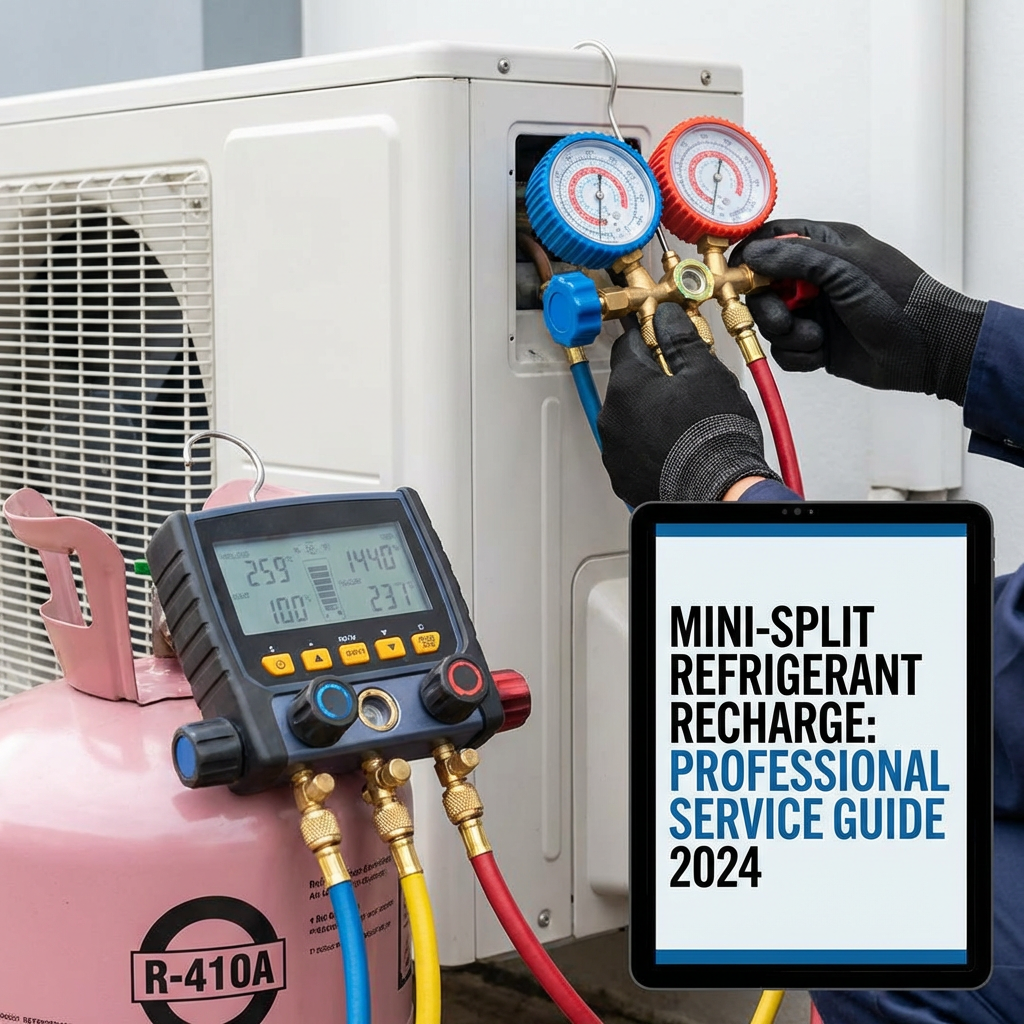
Mini-Split AC Refrigerant Recharge: Professional Service Guide 2024
A guy in Alpharetta watched three YouTube videos and figured he could recharge his mini-split himself. Saved the $400 service call. Three weeks later, his compressor seized. The replacement — including emergency weekend labor — ran him $2,800.
I've seen this exact scenario play out maybe a dozen times in the last two years. People treat refrigerant work like changing air filters. It's not. These systems operate on pressure tolerances measured in single PSI. The gauges alone cost more than most people's monthly car payment. And the EPA doesn't mess around — vent refrigerant to atmosphere and you're looking at fines that could buy a new car.
Look — look — when you call a professional HVAC tech for refrigerant work, you're not just paying for someone to hook up a hose. You're paying for years of training, thousands of dollars in equipment, and the knowledge that prevents catastrophic compressor failure. (That's the part nobody thinks about until it's too late.)
This guide breaks down why professional intervention isn't negotiable and what actually happens during a proper recharge. Spoiler: it's way more complicated than you think.
The Intricacies of Mini-Split Refrigerant Requirements: An Expert View
Mini-splits and central air? Totally different animals.
The refrigerant circuits work differently. Charging methods aren't remotely the same. And the pressures — completely different world. Most residential units installed after 2010 run R410A — probably 90% of what we service. Low-side pressures typically sit between 250-300 psi. High-side can push past 450 psi when it's 95 degrees outside and your compressor's working overtime to keep up.
Our team uses only EPA-approved refrigerants and follows manufacturer specs to the letter. Not because we're rule-followers by nature, but deviating even slightly can brick a $4,000 system. (Ask me how I know.)
Want to dive deeper into the science? You can learn more about different [types of refrigerants and their environmental impact](/blog/refrigerant-types-environmental-impact). So here's how this actually works. The refrigerant moves through your outdoor condenser, then into your indoor air handler, then back through the linesets. Round and round. Most people don't realize these systems come factory-charged for maybe 15, 20 feet of lineset — that's it. Your outdoor unit's mounted 35 feet from the indoor head?
You need more charge.
Here's the thing: here's the thing: installers skip this constantly. I've diagnosed probably fifty systems where nobody bothered adjusting the charge for longer linesets. Six months down the road, the compressor's running overtime, your electric bill's climbing, and you're wondering why your "energy-efficient" mini-split costs more than the old window unit ever did.
R410A vs. R32: Understanding the Pressures and Environmental Shift
R410A took over after R22 got phased out for environmental reasons. It's a hydrofluorocarbon blend that runs considerably hotter — discharge side pressures can hit 400-450 psi under normal conditions. Phoenix in summer? You'll see higher. Components need to handle burst pressures around 700 psi, which means one kinked line, one rushed flare connection, one sloppy braze joint creates a leak waiting to happen.
Precision beats enthusiasm every time.
R32's the new kid — difluoromethane technically, but everyone just says R32. Global warming potential's around 675 versus R410A's 2088. Makes a difference.
But R32 got an A2L flammability rating from ASHRAE. Mildly flammable. Which means different recovery equipment (the SAE J2843 certified stuff), different safety protocols, and honestly? Most techs around here still haven't been trained on it. The specialized tools alone run about two grand more than standard R410A equipment. Companies charging extra for R32 work aren't gouging you — they're covering real costs and serious liability exposure.
What's Coming Next: Ultra-Low GWP Refrigerants (And Why They Complicate Everything)
So R290 (which is basically propane) is starting to show up in smaller residential systems. Global warming potential of 3 — sounds like a home run until you remember you're putting a flammable gas in someone's living room. It's rated A3, highly flammable, which means you need leak detection systems, strict charge limits based on room volume, and safety protocols most residential guys don't even own the equipment for yet.
Then there's CO2 refrigerant (R744) with a GWP of literally 1.
Perfect, right? Except it runs at pressures over 1000 psi on the high side. We're talking completely redesigned compressors, heat exchangers built like pressure vessels, and training programs that barely exist outside of commercial applications.
I sat through manufacturer training in Dallas last year on R290 handling. Half the room — experienced techs with 15+ years — looked absolutely lost.
This isn't your grandfather's HVAC work anymore.
The Unavoidable Need for Refrigerant Service in Mini-Splits: It's Not a Consumable!
Real talk — the number of people who think refrigerant is like windshield washer fluid drives me absolutely nuts. Something you just pour in once a year during a tune-up.
That's not how this works.
Your refrigerant circulates in a sealed system. It doesn't evaporate. Doesn't degrade. Doesn't get "used up." If your unit's running low, you've got a leak somewhere — could be at flare connections that weren't torqued properly (should be 28-35 ft-lbs depending on size), could be microscopic pinholes in brazed joints, could be service valves that loosened from vibration over time. Salt air's brutal in coastal areas like Pensacola or Corpus Christi. Corrodes copper faster than you'd believe.
Now, now, I worked on a house in Savannah once, three blocks from the water. Beautiful historic home, terrible location for HVAC equipment. The outdoor unit's lineset connections had corroded through in just four years. Not the installer's fault — just environmental reality. We had to replace entire sections of lineset, re-braze everything with proper silver solder, pressure test to 300 psi with nitrogen, and recharge from scratch.
Cost the homeowner $1,400, but it beat replacing a $3,200 outdoor unit because the compressor had been running low on charge for months. (That's what happens when you ignore the problem — compressor runs hot, oil breaks down, bearings fail. Game over.)
Here's what a dying system looks like:
**Reduced cooling capacity?** Unit runs constantly but your house feels like a sauna? Air from the vents hits maybe 65-70°F when it should be pumping out 50-55°F? That temperature differential tells the whole story. Low charge means lousy heat exchange. You're paying to run a fan, not an air conditioner.
**Ice formation.** Frost on the indoor coil or suction line means low refrigerant dropped your evaporator coil below freezing temps. Moisture in the air just freezes on contact. Left alone, this damages the coil itself and you're looking at serious [AC repair](/services/ac-repair) bills. I've seen coils so trashed from ice buildup that we had to replace them entirely. That's $800-1,200 you didn't budget for.
**Unusual cycling patterns.** System kicks on for three minutes, shuts off, fires back up four minutes later? Short-cycling murders the compressor. Think stop-and-go traffic versus highway cruising. Eventually something breaks. Modern mini-splits throw error codes when this happens (check your remote display), but even without codes, that behavior screams low refrigerant.
**Hissing or bubbling noises?** You're hearing refrigerant escape under pressure. That hiss (sounds like a tire leak) or bubbling noise means there's a breach. Could be the liquid line, service valve, maybe inside the wall where you can't see it. Either way, you're losing charge. Every day you wait makes the repair more expensive.
**Your electric bill jumped 20-30% but you're not doing anything different?** A low-charge system works triple-time for mediocre results. Had a customer in Boca Raton whose bill went from $180 to $285 over three months. Slow leak had been draining refrigerant for half a year. By the time we showed up, the compressor was already showing early oil breakdown.
Ring any bells?
Don't wait on these. Seriously — what starts as a $400 repair turns into a $2,800 compressor replacement if you sit on it for six months hoping it'll just fix itself.
The Anatomy of a Leak: A Technician's Perspective — Real-World Scenarios
Last spring I got called to a Mitsubishi multi-zone in Scottsdale's Silverleaf community. $2M+ property. Master bedroom wouldn't cool but the other three zones worked fine.
Small oil stain around the service valve caught my eye during walkthrough. Refrigerant carries compressor oil with it, so where you find oil residue, there's usually a leak. Electronic detector confirmed it — slow leak at the valve stem, losing maybe 2-3 ounces a month.
We tightened the valve, swapped the core, pulled vacuum down to 250 microns (took around 45 minutes), then recharged to spec using a digital scale.
Cost them $385.
They'd waited another six months? Compressor failure would've run them $2,400-2,800 minimum. Catching it early saved thousands.
So — worst case I ever dealt with was a high-rise condo near Atlanta's Fox Theatre. Brand new Daikin system — maybe eighty days old — providing exactly zero cooling. That's the real issue. We spent four hours with electronic detectors, UV dye, nitrogen pressure testing at 300 psi, trying to track down the problem. Finally found it buried inside the drywall: microscopic crack in a flare connection.
Installer had rushed the flare job. You could actually see tool chatter marks on the copper tubing. That tiny imperfection took three months to bleed enough charge to kill the cooling.
We cut open the wall, re-flared the connection properly, patched drywall, vacuumed to 300 microns, recharged the system.
That repair ran $1,850 between wall work and labor.
Here's the thing: the homeowner was livid — not at us, at the original contractor who'd obviously rushed through the install. That's what happens when you chase the cheapest bid instead of the best one. You end up paying for it twice.
Professional Refrigerant Recharge Process Standards: No Shortcuts Allowed
Every legitimate service call starts with **leak detection**. Not optional. We use electronic detectors calibrated to find refrigerant concentrations as low as 0.1 oz/year (meeting SAE J1627 standards). For stubborn leaks, we pressure-test with nitrogen at 250-300 psi, sometimes adding UV dye that glows under blacklight. You have to find *every* leak before adding refrigerant, or you're just wasting everyone's time and money.
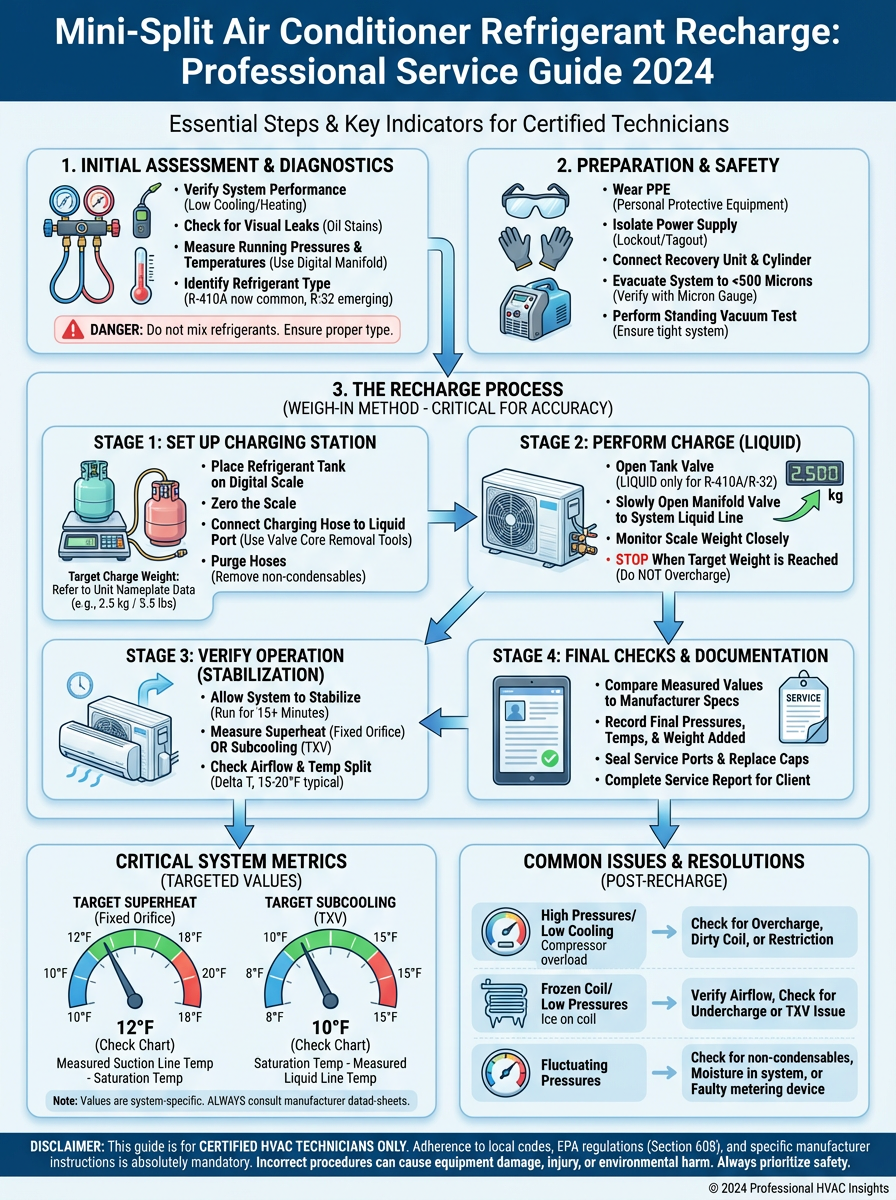
Our EPA-compliant recharge process follows these steps (skip any of them and you're asking for trouble):
Look — 1. **Refrigerant Recovery (Federal Law!):** Before any repair work, we recover whatever refrigerant remains in the system using certified recovery equipment. This isn't a suggestion — it's EPA-mandated under Section 608 of the Clean Air Act. Venting refrigerant to atmosphere carries fines up to $37,500 per day. Per day.
In-Depth Look
Detailed illustration of key concepts
Visual Guide
Infographic illustration for this topic
Sources & References
- Add Refrigerant to Mini-Split Air Conditioner Step-by-Step - YouTube
- How To Add R410A Refrigerant (Freon) in Mini Split Air Conditioner!
- Essential Steps to Refill Aircon Gas: A Professional's Guide
- How To Add Refrigerant to a Mini Split Air Conditioner - YouTube
- Top 23 Commercial HVAC Manufacturers - Metalphoto of Cincinnati
- 6 Best HVAC Companies | Money
- Full List: Top HVAC Manufacturers and Suppliers in 2026 - FieldPulse
- Best Air Conditioner Brands in 2025
- Key HVAC Regulations and Requirements for 2025 and Beyond
Frequently Asked Questions
Need Professional Help?
Find top-rated hvac businesses experts in your area