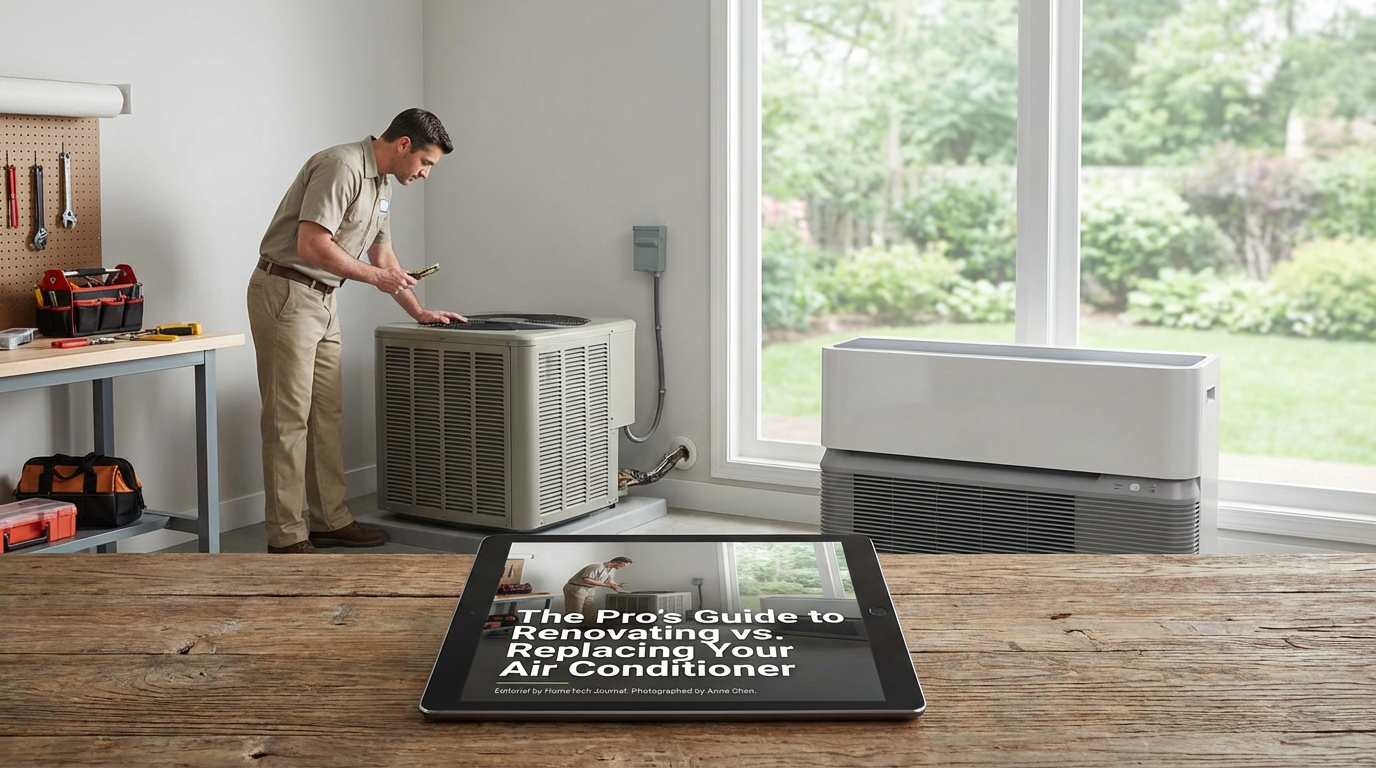
Considering a renovated or refurbished AC unit? Our expert guide breaks down the pros, cons, costs, and risks. Learn when to repair, replace, or buy refurbished.
Key Takeaways
- Refurbished ACs can be a budget-friendly option, but only if they are professionally certified and warrantied.
- Renovating your own high-quality older unit can be more cost-effective than buying a cheap replacement.
- Modern energy efficiency standards often make a new, high-SEER unit a better long-term investment.
BizzFactor Quick Guide
The BizzFactor Standard: Always get a written warranty and a full diagnostic report for any refurbished HVAC unit.
Key Takeaways
The BizzFactor Standard
3 Non-Negotiable Requirements for Elite Workmanship
Written Warranty for Parts & Labor
A reputable pro stands behind their work. A minimum 6-month warranty on a refurbished unit or a 1-year warranty on major repairs is non-negotiable. It's your primary protection.
Detailed Diagnostic & Renovation Report
You must receive a document detailing what was tested, what parts were replaced (with model numbers), and the final performance metrics like temperature drop and amperage draw.
Adherence to Modern Refrigerant Standards
The technician must be EPA 608 certified and handle refrigerants properly. They should inform you if the unit uses phased-out R-22 and explain the future service cost implications.
The Pro's Guide to Renovating vs. Replacing Your Air Conditioner
Last summer, a homeowner in Buckhead called me at 11 PM. His AC had died — again — and he'd already sunk $1,800 into repairs that year. "Should I just keep fixing this thing?" he asked. I hear this question almost every week.
Here's what it really boils down to: You need to know exactly how old your system is (and I mean *really* — when was it installed, not when you *think* it was installed). Then look at what this specific repair costs versus what you'd pay for a new install. And finally — be honest about how much you're bleeding on your power bill every month. That's the real issue. For a newer unit with a simple problem — blown capacitor, clogged drain line — a targeted repair usually makes sense. But for an old workhorse that keeps breaking? Replacement's probably your move. The difference between these two paths? One's a band-aid. The other's peace of mind.
Look — look — when your AC quits during a heat wave (who hasn't been there, sweating through their pajamas at 2 AM?), you need it fixed fast. That's when you'll see offers for "renovated" or "refurbished" units at tempting prices. But is that actually a smart play, or are you setting yourself up for expensive callbacks and a utility bill that makes you wince?
As nationwide expert [HVAC inspectors](https://bizzfactor.com/hvac-businesses), we've seen both brilliant renovation jobs and absolute disasters. Let's dig into what a renovated AC actually is, when it makes sense, and what quality standards you should demand.
What Exactly Is a "Renovated" or "Refurbished" Air Conditioner?
So what're you actually getting with a refurbished unit? It's basically a used AC that somebody's cleaned up, tested, and fixed enough to sell again. A decent tech will swap out the worn parts, flush the coils, check the pressures, and (hopefully) make sure everything runs without blowing a fuse. Sometimes they'll use original manufacturer parts. Sometimes they won't.
Think of it like buying a used car that's been through the shop.
An "as-is" used unit? That's Russian roulette with your cooling budget. You've got zero clue what's been abused, neglected, or jury-rigged inside that box. But a properly renovated air conditioner? Different story — assuming the tech knew what they were doing. They pull these units during full system replacements. Somebody's upgrading, and their old AC becomes inventory. Some older models — I once saw a 30-year-old `Trane` still running in a San Antonio garage — were built like tanks. Mechanical simplicity. No circuit boards to fry. But (and this is a big but) they're energy hogs compared to anything built after 2010, and good luck connecting them to your smartphone.
The renovation process can get weird. I've seen techs frankenstein these things — pull a fan motor from Unit A, grab a control board from Unit B, bolt 'em together and call it refurbished. Does it work? Maybe. For how long? Who knows. A real professional won't do that unless the parts are actually compatible — same voltage, same CFM ratings, same communication protocols if it's a newer system. Then they'll run it for hours under load to make sure it's not going to grenade itself the first time it hits 95 degrees outside. That's what separates the pros from the parts swappers. For insights into maintaining your system, explore our guides on [HVAC maintenance](https://bizzfactor.com/blog/hvac-maintenance-checklist).
The Financial Breakdown: When Does AC Renovation Make Sense?
So when does it actually pencil out to fix instead of replace?
Rule of thumb: if the repair's under half what a new system costs, you're probably okay. My crew uses what we call the "5,000 Rule" — take the age of your unit, multiply it by the repair quote. If that number's over $5,000, stop throwing money at it. Just stop.
A refurbished 2-ton window unit? Around $300, give or take. New one's $700-ish. You pocket $400 today. But here's what they don't tell you at the point of sale.
That 15-year-old refurbished `Goodman` is limping along at maybe a 10 SEER rating. Probably less. A new `Rheem` or `Carrier`? You're looking at 17 SEER minimum, no sweat. Some of those variable-speed jobs hit 21 SEER. What does that mean for your wallet? About $30-50 less per month on power in a normal-sized house. If you're in Phoenix or Houston? Even more. That's $360-600 annually. Over five years, you've basically paid for the price difference between refurbished and new — except now you're stuck with an old system that's worth nothing.
Good HVAC contractors use software like `1build` or `CoolFront` to run these numbers for your specific house. Not guesswork. Actual monthly projections based on your square footage, insulation, and local rates.
Real-World Scenario: A Refurbished Unit Fails Inspection in Phoenix
Our team inspected a rental property in Phoenix last fall. The landlord — trying to save a few bucks — had installed a "renovated" mini-split system. Price looked great on paper.
Problem? The tech who refurbished it used a control board from a completely different brand.
Here's the thing: here's the thing: the compressor short-cycled constantly. On and off, on and off, every few minutes. The tenant's power bill jumped 40%. Worse — the wiring was running hot enough to be a legitimate fire hazard. We red-tagged it immediately and told the landlord to replace it.
A proper refurbishment from a legit shop like `AC's Heating & Air` or `Fire & Ice` would've used OEM parts (or certified equivalents) and included a full diagnostic report. That's the difference between a professional job and a liability waiting to happen. For vetted local pros, check our [HVAC Business Directory](https://bizzfactor.com/hvac-businesses).
The Risks vs. Rewards of Buying Refurbished
You'll save upfront. Period. That's the entire appeal.
Refurbished units work perfectly fine for certain applications — a detached workshop, maybe a rental property where you're just trying to keep tenants from complaining, or a guest house you use twice a year. But let's talk about what you're signing up for. Lower efficiency (count on it). Shorter lifespan (bank on it). Parts that might not exist in three years when something breaks. And warranties that are basically decorative.
Here's what should keep you up at night before you buy:
**Your power bill will hate you.** Those old units? SEER 8-10 territory. Modern code requires minimum 14, and most decent systems hit 16-21 now. In any climate where you run AC more than three months a year, that gap costs you $40-60 extra every month. Maybe more. That's $480-720 annually just leaking out of your ducts. I had a customer in Decatur — he bought a refurbished 3-ton unit to save $800 upfront. His July electric bill went from $180 to $267. Every. Single. Month. Always — *always* — ask for the SEER rating before you commit. If they won't tell you? That tells you everything.
**The R-22 refrigerant disaster.** Tons of older units still run R-22 (old-timers call it Freon). EPA killed it starting in 2010 because it destroys the ozone layer. You can still service these dinosaurs, technically, but R-22 now costs $100-150 per pound versus $20-40 for R-410A. And good luck finding it — I know techs who've driven 90 miles to score a few pounds for a customer. Modern systems use R-410A or the newer R-32. Cheaper. Easier to find. Better for everyone. Check the nameplate on the outdoor unit. If it says R-22, you're looking at expensive service calls down the road. Guaranteed.
**Frankenstein monsters.** If the guy who refurbished your unit isn't NATE-certified (or doesn't care about doing it right), you could end up with mismatched components, wrong refrigerant pressures, incompatible control systems. I talked to a contractor with 40 years under his belt who told me, "A perfectly good used compressor can die in an hour if the pressures are off or the system wasn't evacuated properly." That's not theory. That's thermodynamics.
**Warranty? What warranty?** A new system usually comes with five to ten years on parts — sometimes even twelve on the compressor if you're buying quality. Refurbished? You might get a year if you're lucky. And it usually only covers whatever parts the seller actually swapped out — not the whole system. Not the labor. Not the stuff that fails three months later because it was already on borrowed time. Read every word of that warranty. Get it in writing. Every single time.
Is Renovating Your *Current* AC a Better Option?
If your current system's under 10-12 years old — and it's a real brand, not some off-brand junk from a big-box store — fixing what you've got beats gambling on somebody else's used equipment nine times out of ten.
Why? Your system's history is an open book. Did you change filters regularly or let it choke on dust for years? Has it been running in brutal 115-degree Texas summers, or mild 80-degree coastal weather? Was it installed correctly in the first place, or did some hack strap it in crooked and hope for the best? These questions have answers when it's your equipment.
Putting a new compressor or evaporator coil in your existing system might run $800-1,500. Not cheap. But usually less risky than dropping money on a refurbished unit with an unknown past and a warranty printed on toilet paper. A good tech can run diagnostics and tell you straight: "Your compressor's shot, but everything else is fine. $1,100 for a new compressor versus $4,500 for a whole new 3-ton system. What makes sense for your budget?"
The best contractors I know — and I mean the ones who've been doing this for 20+ years without cutting corners — they'll document everything. Every part number. Every diagnostic code. Efficiency projections based on *your* house, not some generic calculation. They'll sit down and walk you through the math: "Here's the repair cost. Here's replacement cost. Here's what you'll save monthly if you upgrade." No sales pitch — just numbers. That level of transparency? That's what we call **The BizzFactor Standard**. You can find pros who operate this way in our [HVAC Business Directory](https://bizzfactor.com/hvac-businesses).
In-Depth Look
Detailed illustration of key concepts
Visual Guide
Infographic illustration for this topic
Sources & References
- [PDF] HVAC: A Guide for Contractors to Share with Homeowners
- What To Know Before Calling an HVAC Pro - This Old House
- HVAC Employee Best Practices: Raising Standards in Heating ...
- 13 Top HVAC Business Management Tips to Follow For Success
- Top 23 Commercial HVAC Manufacturers - Metalphoto of Cincinnati
- Full List: Top HVAC Manufacturers and Suppliers in 2026 - FieldPulse
- 6 Best HVAC Companies | Money
- Best Air Conditioner Brands in 2025
- Key HVAC Regulations and Requirements for 2025 and Beyond
Frequently Asked Questions
Need Professional Help?
Find top-rated hvac businesses experts in your area