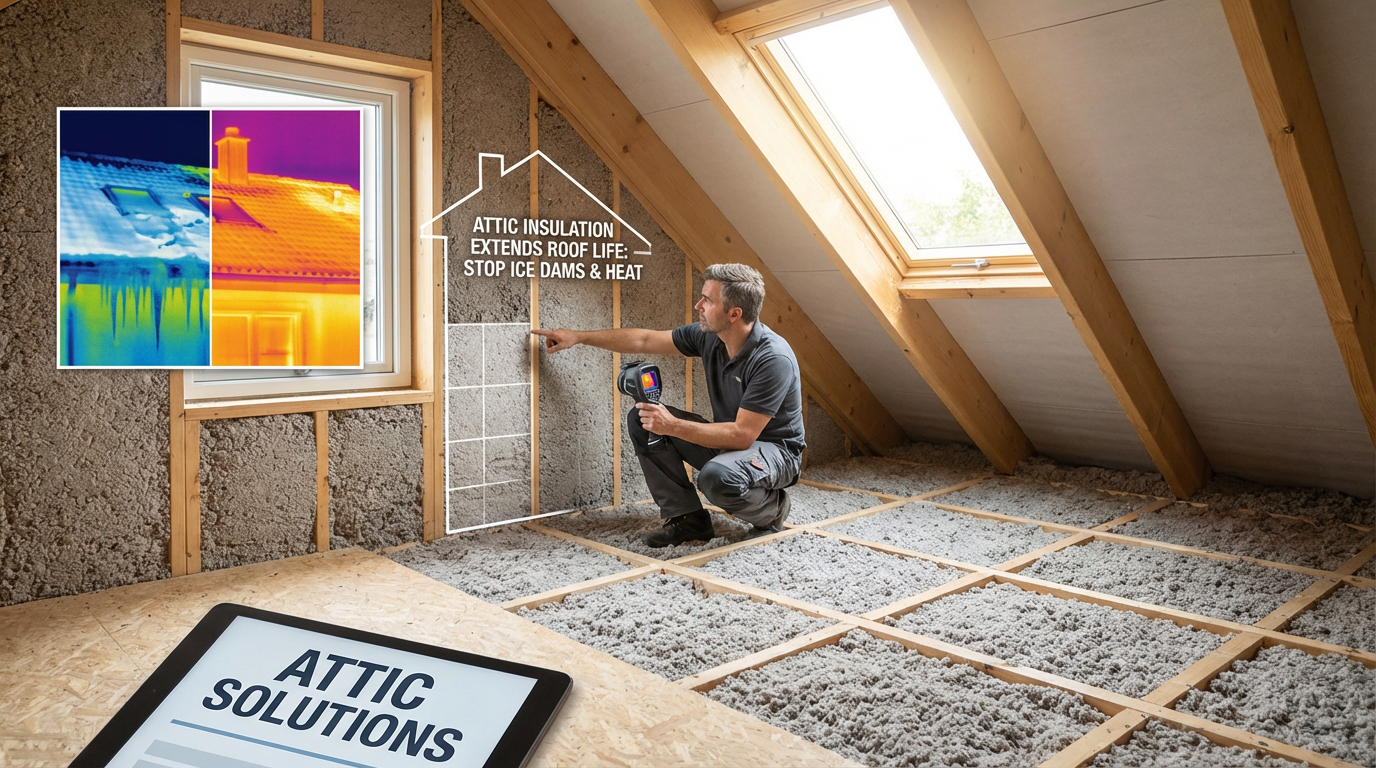
Learn how proper attic insulation prevents ice dams & heat damage to extend roof life. Expert installation tips & material recommendations from licensed pros.
Key Takeaways
- The roof was only 14 years old
- He thought attic insulation was just about staying cozy in January
- It's what stands between a roof that lasts three decades and one that dies at year 15 — cracked, warped, brittle as old newspaper
- I've seen this play out probably a hundred times now
Key Takeaways
Attic Insulation: Extend Roof Life, Prevent Ice Dams & Reduce Heat Buildup - The Ultimate Guide
A guy in Edina paid $18,000 for an emergency roof replacement last winter. The roof was only 14 years old. Know what killed it? He thought attic insulation was just about staying cozy in January. It's not. It's what stands between a roof that lasts three decades and one that dies at year 15 — cracked, warped, brittle as old newspaper. I've seen this play out probably a hundred times now. Your insulation is a thermal barrier preventing heat loss in winter, blocking heat gain in summer, and (here's the big one) stopping ice dams before they destroy your roof deck. For the full rundown on what's actually happening up there, check out our [attic services](/services/attic-services/) page.
Think of your attic insulation as the DMZ between your living space and whatever weather hell is happening outside. Without that buffer? Your roof gets hammered by constant temperature swings — expanding, contracting, cracking, warping. At BizzFactor, we install insulation that actually works, not just the minimum some code book says you can get away with.
Why Quality Attic Insulation is Your Roof's Ultimate Protector Against the Elements
Think about your roof like a person standing outside in a blizzard wearing a t-shirt. That's what happens when your attic isn't properly insulated — the temperature swings hammer your shingles 24/7.
So when your attic temp stays relatively stable — not bouncing from Arctic to Sahara and back — your shingles aren't doing gymnastics every day. Less stress. Less cracking. Less warping. I replaced a roof last spring where the homeowner had maybe R-19 insulation (basically a sweater when you need a parka). The shingles were fourteen years old and looked thirty. Brittle as potato chips.
Here's what you're looking at: most asphalt shingle roofs should last 20-30 years, depending on quality and climate. But I've pulled off roofs at year 12 that looked ancient — all because the attic underneath was basically a heat tunnel. Thin insulation can cut your roof's lifespan by a third, maybe half. I know because I'm the guy who gets called when homeowners can't figure out why their "15-year roof" is curling at year 8.
So here's the deal with what's happening in your attic. You've got your heated (or air-conditioned) living space downstairs, and you've got whatever Mother Nature's throwing at you up top. The insulation? That's your buffer zone. When we do inspections at BizzFactor, we see this pattern constantly — and I mean constantly: homes with thin or patchy attic insulation end up needing new roofs 8-12 years earlier than they should. You can read the DOE studies yourself if you're into that kind of thing, but here's the short version: decent attic insulation can cut your heating and cooling bills by anywhere from 10% to 50%. Yeah, that's a huge range, but it depends on how bad your current situation is. Point is, those aren't just energy savings — that's your HVAC system not running itself to death trying to compensate for what's basically a thermal sieve above your head.
Why does this happen?
You've got expansion happening when it heats up. Contraction when it cools down. Your shingles are basically doing calisthenics all day and night — bending, flexing, stretching. Eventually something's gotta give. I've pulled up shingles that looked like potato chips because they'd been through too many cycles. Good insulation keeps your attic somewhere around the ambient outdoor temperature (give or take), which means your roof deck isn't going from 20°F to 140°F and back again. Those extreme swings? That's what causes the real damage — premature granule loss, cracking along the mat, seal failure between shingle layers. Think about bending a paperclip. First time, no problem. Do it fifty times, it snaps. Your roof's doing that same dance, just over months instead of minutes. Check out our [roof maintenance guide](/blog/roof-maintenance-tips/) for more on protecting against environmental stress.
**Building codes tell you the bare minimum.**
Look — that's it. They're designed to prevent disasters, not create homes that actually perform well. The number you're looking at is R-value — how well something resists heat flow. Bigger number, better insulation. ENERGY STAR recommends R-38 to R-60 for most of the country, but that's painting with a pretty broad brush. Up in Minnesota or northern Wisconsin? You're probably closer to R-60, maybe higher. Texas or Georgia? R-38 to R-49 might do it.
But here's where it gets messy: every state — hell, sometimes every county — does their own interpretation. California's got Title 24 with its own special rules. Other places just kinda winged it over the years. (Check with your local building department before you assume anything.) At BizzFactor, we don't just hit the minimum and walk away. We spec for your actual climate, your roof type, your house — not some generic checkbox written for an entire region.
How Ice Dams Form (And Why Your Insulation's the Real Problem)
A client in Bloomington called me in February, panicked. Water was dripping through her dining room ceiling fixture during a cold snap. "My roof's only six years old!" she kept saying. Wasn't the roof. Never is.
Here's the chain of events that wrecks your house:
Heat's leaking into your attic. Could be through old recessed lights. Could be thin spots in the insulation. Could be that attic hatch you've been meaning to weatherstrip for three years. Doesn't really matter *how* — what matters is warm air rises (because physics) and camps out right under sections of your roof deck.
Snow's sitting up there on your roof. The warm spots underneath start melting it. Water trickles downward toward your gutters.
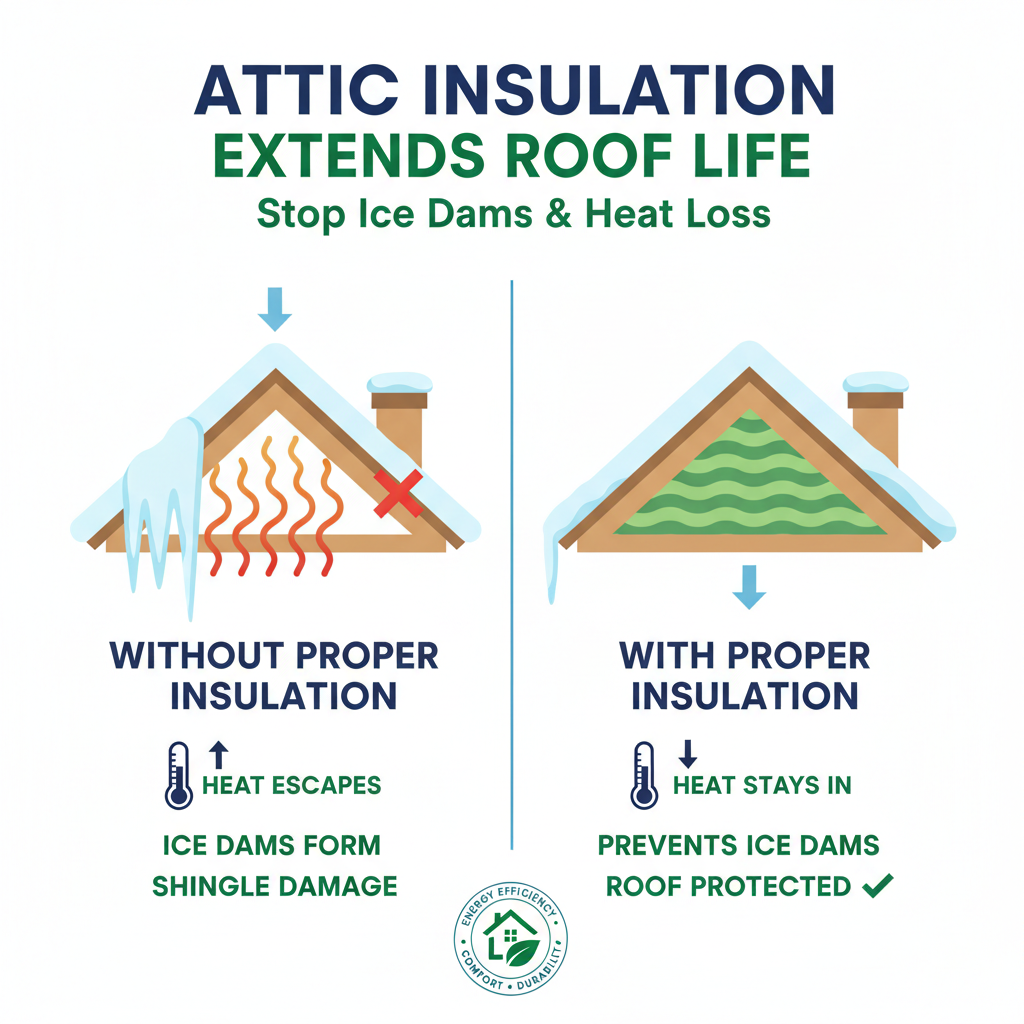
But your roof overhangs — the eaves that stick out past the walls — those don't have heated space below them. They stay cold. So when that meltwater hits the overhang, it freezes solid. Ice builds up. Creates a dam (hence the name).
More meltwater keeps flowing down from the warm sections. It's got nowhere to go now. Backs up behind the ice. Starts creeping sideways under your shingles.
Your underlayment wasn't designed to be a pond liner.
So the water finds the path of least resistance — nail holes, seams, tiny gaps — and starts working its way into your roof deck. Then your fascia. Then your walls. Then your ceilings. The woman in Bloomington? She had maybe 6 inches of old blown cellulose up there with bare spots you could see drywall through. Ice dams had been forming for three winters running, and she didn't notice until the damage got bad enough to leak inside. That's the real issue. We pulled out $4,200 worth of soaked insulation, replaced rotted fascia boards, and air-sealed 23 separate penetrations before re-insulating to R-50. Total bill was around $11,500. Could've prevented the whole thing for maybe $3,800 if she'd called two years earlier.
There's a 2022 study from Premier Group Roofs (yeah, I know, nobody reads roofing studies) showing that homes with proper insulation and air sealing had 85% fewer ice dam problems than under-insulated ones. But forget the data for a second — just drive around after a big snowstorm. See those houses with giant icicle curtains hanging off the gutters? Those are the ones hemorrhaging heat through their attics. For more on winterizing your home, check our [seasonal home care blog](/blog/seasonal-home-care/).
⚠️ Critical Mistake to Avoid: Overlooking Meticulous Air Sealing
Don't just pile on insulation and call it done.
That's the mistake I see constantly — homeowners (and even contractors who should know better) blow insulation right over attic floor penetrations like recessed lights, electrical chases, plumbing stacks, and HVAC connections. They think more insulation volume is always the answer.
Wrong.
**You need to seal air leaks first.**
If you don't, heated air just bypasses the insulation through convection. You get localized hot spots in the insulation layer and on the roof deck — and suddenly your R-50 performs like R-30 because half your conditioned air's floating straight through. Doesn't matter how thick you pile it. It's like trying to hold water in a sieve. Air leaks can account for up to 40% of a home's heat loss or gain, which is insane when you think about it.
So our crews go in with caulk guns and cans of Great Stuff. They're on their hands and knees, flashlights strapped to their heads, sealing every penetration they can find. Seriously. Low-expansion polyurethane around pipes and wiring (the high-expansion stuff will crack your drywall — ask me how I know). Fire-rated caulk around chimneys and flue chases, because you really don't want to get tagged on a code violation there. HVAC duct joints get mastic tape, not that cheap foil crap that peels off in eighteen months.
Takes forever. Boring as hell.
But I've done blower door tests before and after air sealing, and we've seen air leakage rates drop by 35-40%. That's the difference between insulation that actually works and insulation that's basically decorative. For a deep dive on this process, see our guide on [attic air sealing techniques](/blog/attic-air-sealing-techniques/).
BizzFactor's Professional Insulation Recommendation: The Superiority of Stone Wool
FEMA publishes baseline guidelines for building resilience. We've read 'em. But we typically push past those recommendations, especially with materials. Our default spec these days is **ROCKWOOL stone wool insulation** — and yeah, it costs more upfront than standard fiberglass, but it handles water, fire, and long-term durability in ways that pink fluffy stuff just doesn't.
**Fiberglass is everywhere.** Cheap. Easy to get. Every installer knows how to work with it. But ROCKWOOL solves problems fiberglass creates — especially in real-world conditions where things go wrong.
Here's the thing: water resistance is the big one. Stone wool is hydrophobic — water beads up and rolls off instead of soaking in. You can dunk a batt in a bucket, pull it out dripping, shake it off, let it dry overnight, and it's back to full R-value. But (and this is the weird part) it's also vapor permeable, so moisture that does get in can escape and dry out instead of festering inside the material. Last year we worked on a house in Maple Grove where a roof leak went unnoticed for probably three weeks. When we opened up the attic, the ROCKWOOL batts were damp but intact. No mold. No compression. No smell. If that'd been fiberglass, we'd have been pulling out soggy, moldy wads of pink garbage.
Fire resistance is legitimately nuts. Stone wool won't ignite until temps hit around 2,150°F — which is "your entire house is already ash" territory. It won't melt. Doesn't produce toxic smoke. I've watched fire test videos where they torch ROCKWOOL batts for ten straight minutes and they just... sit there. Glowing red, sure, but structurally solid.
In-Depth Look
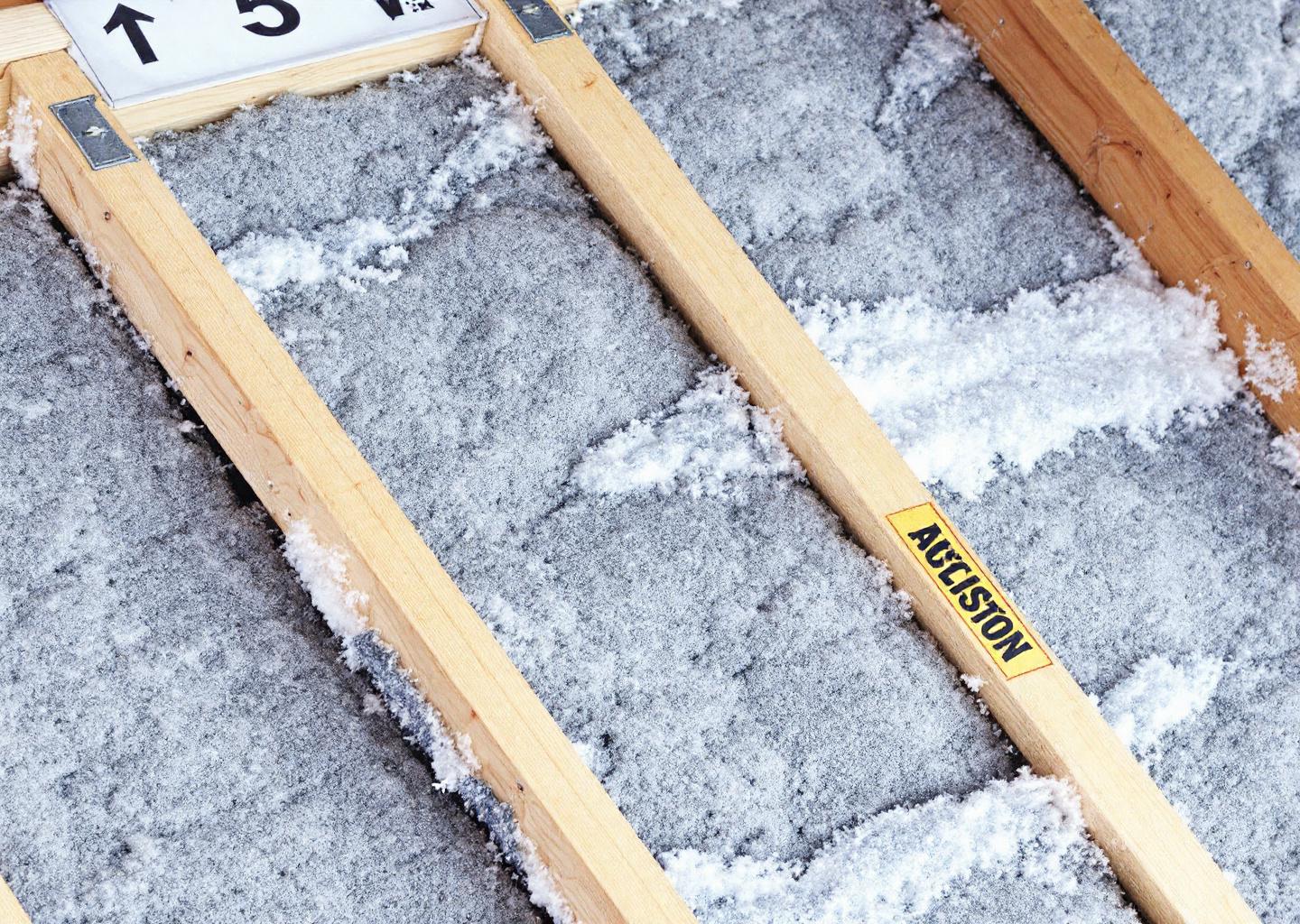
Detailed illustration of key concepts
Visual Guide
Infographic illustration for this topic
Sources & References
- How Proper Attic Insulation Prevents Ice Dams
- Attic Insulation And Roof Health: Key Strategies For Home ...
- The Homeowner's Guide to Attic Insulation - Mr. Roof
- Ice Dams & Roof Damage: Prevention Tactics Every Homeowner ...
- Preventing Ice Dams on Roofs: A Comprehensive Guide
- Building Codes, Standards, and Regulations: Frequently Asked ...
- Building Codes and Standards - 101 Guide | ROCKWOOL Blog
- [PDF] Building Codes Toolkit for Homeowners and Occupants - FEMA
- ICC - International Code Council - ICC
- Navigating California Building Codes: Best Practices for Facilities ...
Frequently Asked Questions
Need Professional Help?
Find top-rated insulation experts in your area