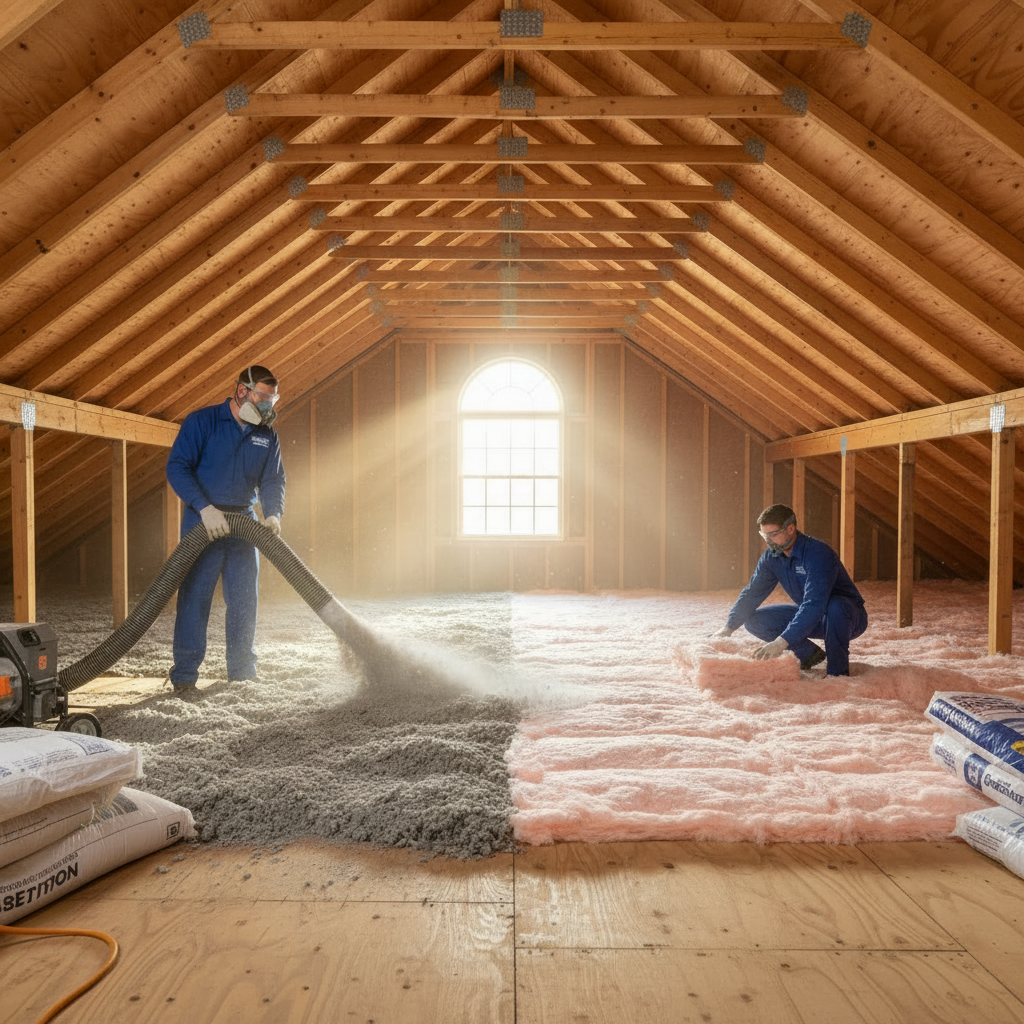
Cellulose vs. fiberglass insulation: Discover which material offers superior energy savings for your home. Compare density, cost, and eco-friendliness.
Key Takeaways
- **Moisture Non-Absorbent**: Glass doesn't soak up water. Big advantage in humid attics. The glass fibers themselves won't absorb moisture like a sponge. But here's where it gets tricky — the binders holding those fibers together? They don't love prolonged water exposure. And if fiberglass gets soaked, it holds that water *between* the fibers, which tanks its R-value until it dries out. Rule of thumb: fix any roof leaks before you even think about insulating.
- **Inherent Fire Safety**: Can't burn glass. Fiberglass is non-combustible and has a very high melting point, typically over 1,000°F (540°C). It usually provides excellent fire resistance, acting as a fire block in some applications as per building code requirements (e.g., International Residential Code, IRC R302.10 and R302.11 for draftstopping and fireblocking).
- **Lightweight and Versatile**: Easy to blow in, easy to work with. This is where it gets installed quickly, which translates to lower labor costs. It's also less dusty than cellulose during installation, which some installers prefer.
- **Material Depth Needed**: 16-18 inches to achieve R-49. This is specific to the loose-fill density, which can vary from manufacturer to manufacturer (e.g., Owens Corning ProPink L77 requires approximately 17-18 inches for R-49 over an open attic floor).
- **Cost Range**: $1.80 - $2.50 per sq ft for blown-in.
Key Takeaways
Cellulose vs. Fiberglass Insulation: Which Delivers Superior Energy Savings?
A homeowner in Marietta called me last month, furious. She'd paid $1,800 for fiberglass insulation two years ago, and her electric bill was still sky-high. Turned out the installer never sealed a single air gap first — just blew in the pink stuff and left. That's $1,800 down the drain.
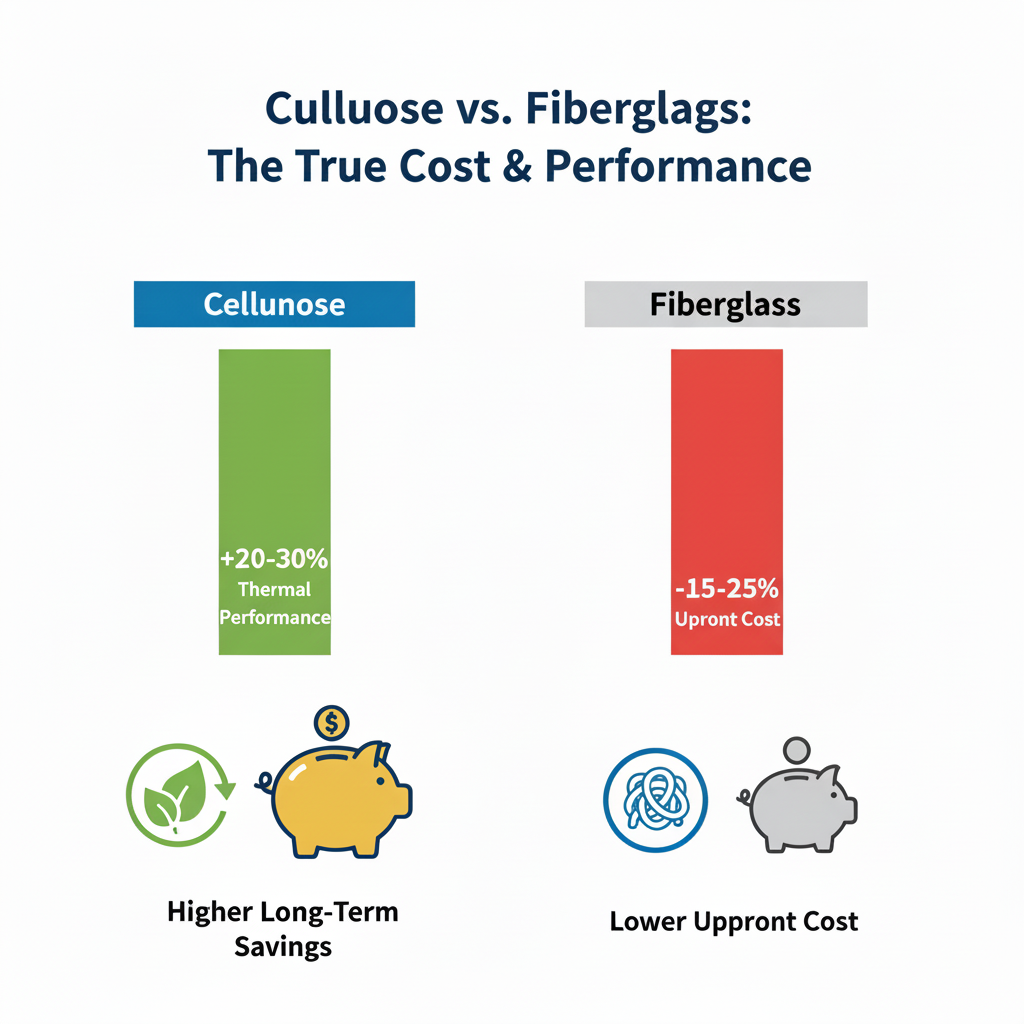
Here's what actually matters: cellulose typically cuts energy bills 20-30% more than fiberglass because it's denser and blocks air movement better. But (and this is huge) only if it's installed right. Our BizzFactor-certified techs usually push cellulose for clients chasing maximum efficiency, fiberglass for folks on a tight budget. Your call depends on what you're willing to spend now versus what you want to save over the next decade.
Understanding the Core Differences: Cellulose vs. Fiberglass
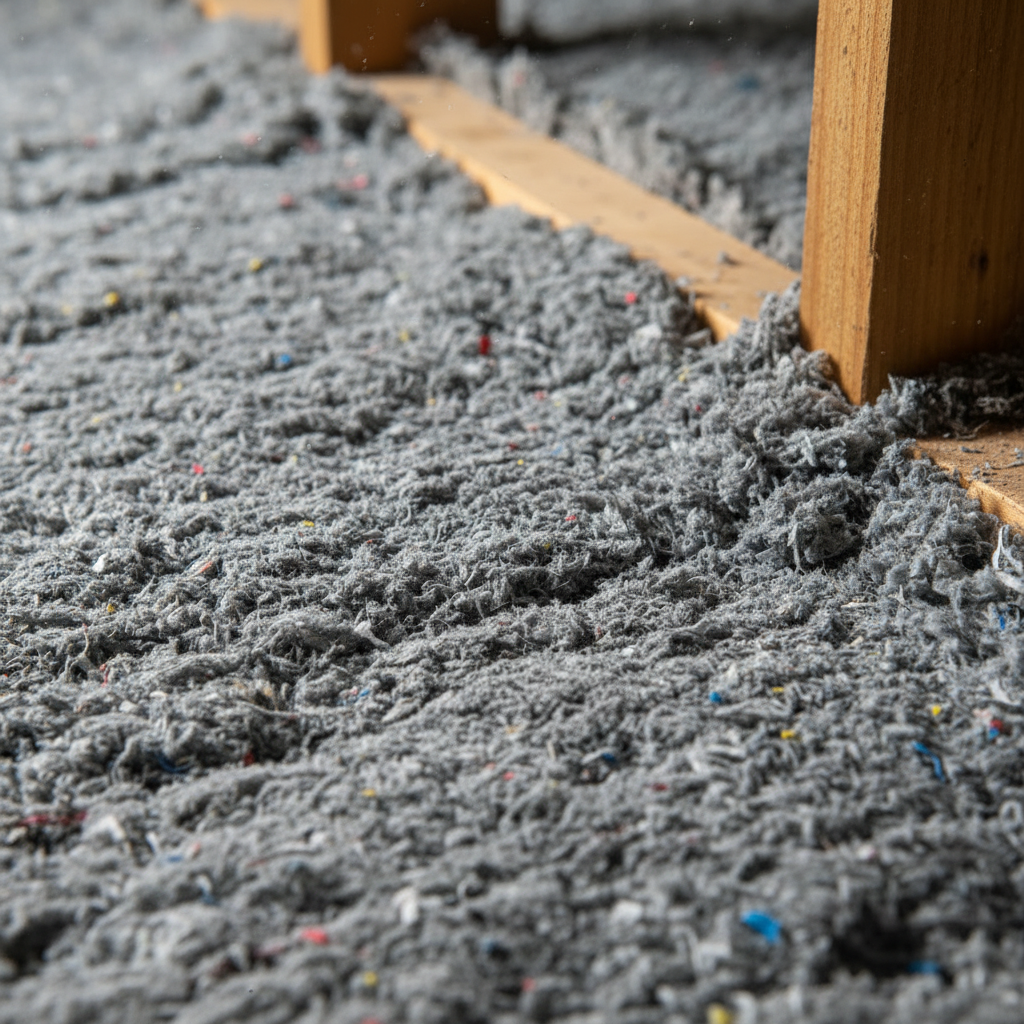
Cellulose packs way more material into the same space — that density advantage translates to 20-30% better thermal performance than fiberglass. Made mostly from recycled newspaper, it forms this tight blanket that stops air cold.
Fiberglass? Cheaper upfront, no question. But it's fluffier, lighter, and air slips right through the gaps between those glass fibers. That's where you lose money.
Here's an in-depth look at each material:
Cellulose Insulation: The High-Performing, Eco-Friendly Choice
You're basically blowing recycled newsprint into your attic. Sounds weird until you realize they treat it with borate minerals — naturally occurring stuff, totally non-toxic. Those borates pull triple duty:
1. **Exceptional Fire Resistance**: Cellulose consistently beats fiberglass in flame spread tests. Like, it's not even close. In fact, cellulose insulation, when properly treated with fire retardants like boric acid, is required to meet specific fire resistance standards. For instance, ASTM E84, also known as the "Steiner Tunnel Test," measures surface burning characteristics. Quality cellulose insulation commonly achieves a Flame Spread Index (FSI) of 25 or less and a Smoke Developed Index (SDI) of 50 or less, which are crucial for safety in residential and commercial buildings. The National Fire Protection Association (NFPA) also sets standards, like NFPA 286, which assesses fire growth. Trustworthy cellulose products are heavily tested.
2. **Natural Pest Deterrent**: Rodents hate borate. Won't nest in it. The borates act as a mild irritant and dessicant to insects and small mammals, making the environment unappealing. While not a pesticide – you can't just sprinkle it around to kill bugs – it certainly discourages them from nesting.
3. **Mold and Mildew Resistance**: Manages moisture better than you'd expect for a paper product, plus the borate keeps fungi at bay. The borate treatment inhibits fungal growth, and cellulose's hygroscopic nature means it can absorb and release moisture without losing its thermal properties or providing a breeding ground for mold, unlike some other materials that become compromised when wet.
We installed GreenFiber T.A.P.® cellulose in a 2,000 sq ft house in Roswell last winter. The owner's gas bill dropped 25% the next month. Why? Dense-pack installation — we blow it in at high pressure so it fills every crack, every corner, every weird little gap around a recessed light. Creates this airtight barrier. For more on why this works, check out our guide on [The Advantages of Cellulose Insulation](/blog/advantages-of-cellulose).
Look — look — think of dense-packed cellulose like a down parka for your house. Thick, windproof, zero air leaks. A key aspect of dense-pack is achieving the specified density, often between 3.0 to 3.5 pounds per cubic foot (pcf) in wall cavities and around 1.5 to 2.2 pcf in attics, depending on the desired R-value and manufacturer specifications. This density ensures that the insulation fills all voids and restricts convective airflow within the material itself.
Fiberglass Insulation: The Economical and Accessible Option
Loose-fill fiberglass (the pink Owens Corning stuff or yellow Johns Manville) costs less to install. That's the main selling point. After 20+ years doing this work, here's what it does well:
- **Moisture Non-Absorbent**: Glass doesn't soak up water. Big advantage in humid attics. The glass fibers themselves won't absorb moisture like a sponge. But here's where it gets tricky — the binders holding those fibers together? They don't love prolonged water exposure. And if fiberglass gets soaked, it holds that water *between* the fibers, which tanks its R-value until it dries out. Rule of thumb: fix any roof leaks before you even think about insulating.
- **Inherent Fire Safety**: Can't burn glass. Fiberglass is non-combustible and has a very high melting point, typically over 1,000°F (540°C). It usually provides excellent fire resistance, acting as a fire block in some applications as per building code requirements (e.g., International Residential Code, IRC R302.10 and R302.11 for draftstopping and fireblocking).
- **Lightweight and Versatile**: Easy to blow in, easy to work with. This is where it gets installed quickly, which translates to lower labor costs. It's also less dusty than cellulose during installation, which some installers prefer.
The problem? That lightweight quality means it moves. I've seen attic fans blow fiberglass completely off the eaves, leaving 3-4 feet of bare wood exposed. Your insulation literally migrates to the center of the attic while the edges — where you lose the most heat — sit there naked. This "wind-washing" or "convective looping" effect is a major issue. Modern building codes, like specific sections in the International Energy Conservation Code (IECC C402.2.1.1), often require airtight baffles (like attic insulation dams or chutes) extending past the top plate to prevent insulation from being displaced by ventilation air and to maintain clear airflow from the soffit to the attic vent. But many installers skimp on these vital components.
Longevity and Performance Over Time: Installation is Key
Here's the truth most contractors won't tell you: both materials will outlast your mortgage if — and this is critical — they're installed by someone who actually knows what they're doing. Cellulose settles over time. Fiberglass gets pushed around by air currents. The quality of installation matters 10x more than the material itself. Because even the best R-value won't perform if there are gaps or an incomplete thermal boundary. For context on why this happens, see our article on [Understanding Insulation R-Value](/blog/understanding-r-value). An R-value, by definition, is a measure of thermal resistance, but it's only accurate when the insulation is installed at the correct thickness and density and without thermal breaks or convective bypasses.
Understanding Cellulose Settling (and BizzFactor's Solution)
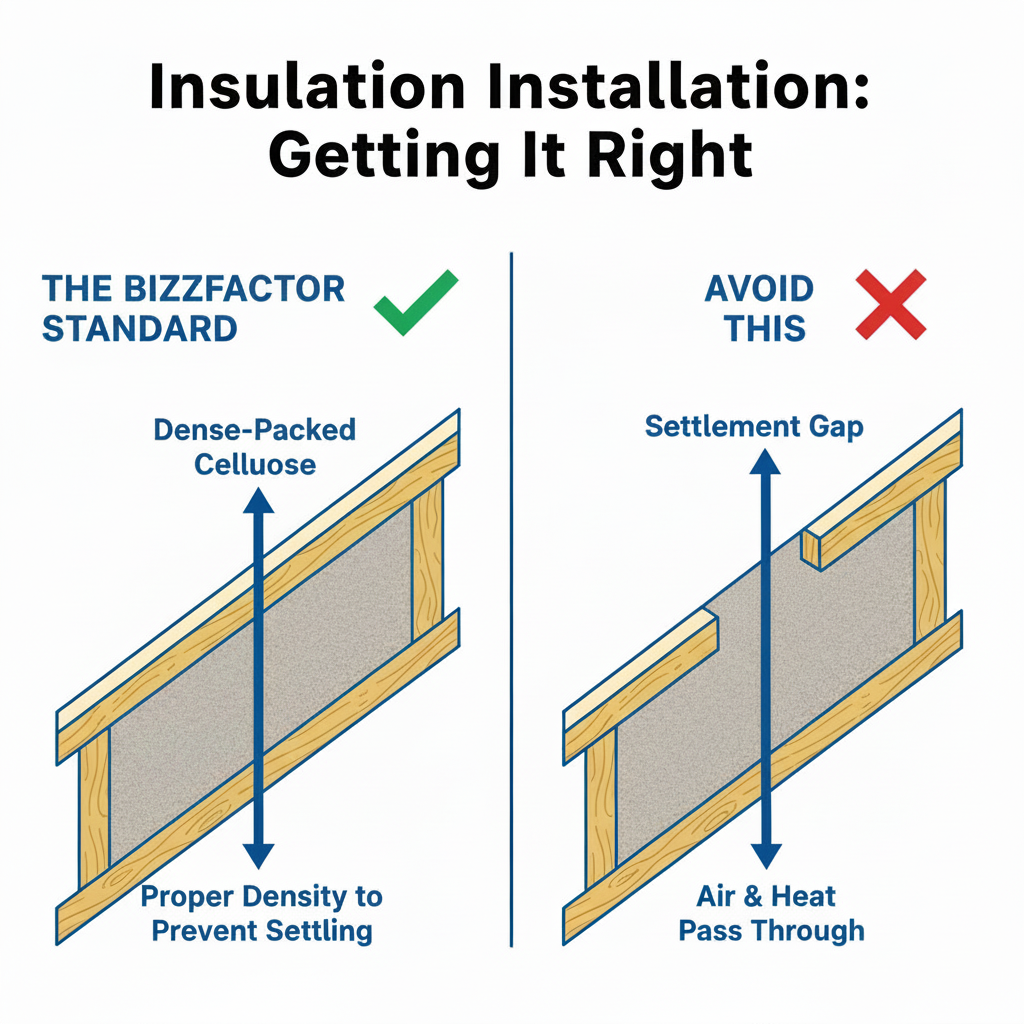
Here's the thing: cellulose compacts 10-15% in the first year. Every single time. That's just gravity doing its thing. Hack installers blow it in at the minimum spec and call it a day. Six months later your R-value's dropped below code and you're paying for it every month on your power bill.
We compensate for settling *before* we start the job. Dense-pack installation means we're calculating the exact density needed so that when the material settles, you still hit your target R-value. Think of it like packing a suitcase — you know your clothes will compress during the flight, so you pack strategically. That's the real issue. Specifically, we target an initial R-value that, after the expected settlement, will meet or exceed the specified R-value (e.g., R-38 or R-49 for attics). For example, if aiming for R-38, we might install to achieve R-42 initially with a density that allows for a 10% settlement without bringing the final R-value below the target. Manufacturers like GreenFiber provide specific installation charts detailing settled thickness vs. initial thickness. Result? Your R-value stays consistent for decades.
I inspected a house in Buckhead last year where the previous installer — not us — had done a garbage job. Cellulose had settled 30% (way more than normal), leaving huge gaps at the top of the walls. The homeowner's AC bills had doubled. We pulled it all out, reinstalled it properly, and her bills dropped 22% the next summer. That's the difference between doing it right and doing it fast. This particular issue highlights a failure to adhere to ASTM C739 standard practices for cellulose loose-fill thermal insulation, which outlines proper density requirements to account for settlement.
The Fiberglass "Gap" Phenomenon
Fiberglass doesn't settle — it migrates. Strong attic ventilation creates this "wind scouring" effect. The fiberglass literally gets pushed around by airflow. We've found homes where the entire perimeter of the attic was bare, all the insulation piled up in the middle like a snowdrift. This is especially prevalent in attics with unbalanced ventilation systems, where exhaust vents might overpower intake vents, creating strong negative pressure zones near eaves.
To prevent this, we install baffles religiously and blow slow. Rushing creates uneven coverage. Taking your time keeps it where it belongs. These baffles, often called attic insulation chutes (e.g., DuroVent or equivalent), are critical in maintaining the 1-inch clear air space between the roof sheathing and the insulation required by building codes (IRC R806.3) for proper ventilation and prevention of wind-washing. Without them, even the thickest insulation will be rendered ineffective around the critical perimeter. We also recommend using higher-density blown fiberglass products which are less prone to movement than the lighter "super-fluffy" varieties, even if they cost a little more.
Real-World Performance: A 15-Year Comparison
Two houses, same street in Sandy Springs. Both built in 2008, both around 2,400 square feet. One owner went with cellulose, the other chose fiberglass to save $400 upfront. Fifteen years later we got permission to run thermal imaging on both homes.
Now, the cellulose house? Nearly perfect coverage after all those years. Some settling, sure, but totally within normal range. The FLIR camera showed consistent temps across the entire attic floor — that's the sign of a proper thermal blanket with no air leaks.
The fiberglass house told a different story. Forty percent coverage loss near the vents. Cold spots lighting up everywhere on the thermal scan. Those dark blue and purple streaks along the eaves? That's your money leaking straight through the roof. The homeowner complained about cold floors every winter and a bedroom that never cooled down in summer. Classic symptoms of blown-around insulation.
The cellulose house used 18% less energy that winter. Over 15 years, that's thousands of dollars. And it's not just winter; the consistent barrier also significantly reduces heat gain in the summer, lowering AC bills.
Decoding the True Cost: Initial Investment vs. Long-Term Savings
Yeah, fiberglass runs 15-25% cheaper upfront. But cellulose pays for itself in 3-5 years through lower utility bills. The EPA says proper insulation can cut heating and cooling costs 15-30%. Our guide on [Maximizing Home Energy Savings](/blog/maximizing-home-energy-savings) breaks this down further.
Here's what R-49 insulation costs for a 1,000 sq ft attic (standard spec for Georgia, per IECC climate zone 3 recommendations):
**Fiberglass Installation:**
- **Material Depth Needed**: 16-18 inches to achieve R-49. This is specific to the loose-fill density, which can vary from manufacturer to manufacturer (e.g., Owens Corning ProPink L77 requires approximately 17-18 inches for R-49 over an open attic floor).
- **Cost Range**: $1.80 - $2.50 per sq ft for blown-in.
- **Pros**: Lower upfront cost.
- **Cons**: Higher long-term energy bills, air leakage issues, prone to movement and convective heat loss if not meticulously installed with proper air sealing and baffles.
**Cellulose Installation:**
- **Material Depth Needed**: 13-14 inches for settled R-49. This lower depth requirement is due to cellulose's inherent higher density and R-value per inch (typically R-3.7 t
In-Depth Look
Detailed illustration of key concepts
Visual Guide
Infographic illustration for this topic
Side-by-Side Comparison
Visual comparison of options and alternatives
Sources & References
- Fiberglass vs Cellulose Insulation: What's Better for Your Home?
- Cellulose vs Fiberglass Insulation: Cost, R‑Value, and Real‑World ...
- Blown in Attic Insulation: Cellulose vs Fiberglass
- Cellulose vs. Fiberglass Insulation | Comparative Analysis Guide
- Top Differences Between Cellulose and Fiberglass Insulation
- Building Codes, Standards, Regulations: FAQs
- Building Codes and Standards - 101 Guide | ROCKWOOL Blog
- [PDF] Building Codes Toolkit for Homeowners and Occupants - FEMA
- Navigating California Building Codes: Best Practices for Facilities ...
- ICC - International Code Council - ICC
Frequently Asked Questions
Need Professional Help?
Find top-rated insulation experts in your area