
Expert climate zone R-value guide. Our licensed pros explain insulation requirements by region, installation tips, and energy-saving strategies.
Key Takeaways
- It's foundational stuff
- The kind of thing that separates a comfortable house from one that bleeds money every month
- And here's what most people miss: your climate zone changes everything
- I've walked through hundreds of attics from Buffalo to Orlando
Key Takeaways
Maxing Out Your Comfort & Savings: Your Ultimate R-Value Guide by Climate Zone
Look — getting your home's R-value right isn't about pinching pennies. It's foundational stuff. The kind of thing that separates a comfortable house from one that bleeds money every month. And here's what most people miss: your climate zone changes everything.
I've walked through hundreds of attics from Buffalo to Orlando. The pattern's unmistakable. Up north, we're talking R-49 to R-60 in attics, sometimes more. Down south? R-30 to R-49 gets you there. Seems like a small difference on paper, but holy hell does it hammer your utility bills.
This isn't optional.
Dialing In: Climate Zones and Their Punch on Insulation
So why do climate zones matter at all? Because your house in Miami fights a completely different battle than one in Minneapolis. The DOE spent decades measuring actual temperature swings, humidity levels, heating loads — then mapped the country into eight distinct zones based on that data. Not arbitrary lines on a map. Real weather patterns your HVAC system has to deal with every single day.
Not suggestions. Requirements.
Zone 1 covers hot, humid spots like Florida and Hawaii. Down there, you're fighting heat gain and moisture. Crank the R-value too high without vapor control? You're creating condensation traps inside your walls. I've seen it wreck homes.
Zone 8? That's Alaska. Extreme cold. We're talking R-60 or beyond just to keep the heat from escaping. Most of the continental U.S. sits in Zones 3-6 — mixed climates where you're balancing heating and cooling. It's a dance.
Real talk: I once met a guy in suburban Cleveland (Zone 5) who was losing his mind over heating bills. His "new" insulation clocked in at R-19. That's a tropical climate R-value. In Cleveland. His HVAC system was running nonstop, ice dams were destroying his gutters, and moisture was creeping into the walls.
Absolutely brutal.
Look — look — to protect your home — and your sanity — you've gotta nail your region's specific needs. Building codes set minimums, but **Energy Star recommendations**? They consistently blow past those. A Zone 4 attic might legally squeak by with R-38. Energy Star pushes R-49 to R-60.
That's a massive difference.
Our team leans hard on **Rockwool stone wool**. Product comparisons bore people to death, so I'll keep it simple: I've pulled fiberglass batts out of homes where they'd compressed to half their original thickness after getting damp once. Rockwool? Still doing its job five years after a minor roof leak. And that 2150°F melting point basically gives you a firewall inside your walls — which has saved at least three homes I know of from electrical fires spreading. Want the full breakdown? Check out our guide on [Comparing Insulation Materials](/blog/comparing-insulation-materials).
The Silent Killer: Neglecting Air Sealing
You know what kills me? Watching someone drop eight, ten grand on premium insulation while air's pouring through gaps they can't even see.
Without **air sealing** first, you're basically lighting money on fire. An unsealed attic hatch bleeds as much conditioned air as leaving a window cracked all winter. I'm not exaggerating — we've measured it with blower door tests. Same with electrical boxes, plumbing penetrations, recessed lights. All those little holes add up to one giant hole in your thermal envelope.
That's energy flying out the roof.
**Air sealing these penetrations** happens before insulation goes in. Not negotiable. For the deep dive on why this matters so much, our article on [The Importance of Air Sealing Before Insulating](/blog/importance-of-air-sealing) breaks it down. We're talking about stopping convective heat transfer, which is way more powerful than conductive heat transfer (what insulation combats). Think of it this way: R-60 insulation is like a great winter coat, but air leaks are like leaving the zipper open. Doesn't matter how warm the coat is if cold air is blasting you.
Here's the thing: here's the thing: so where's all this air sneaking through? Top plates where your studs meet the ceiling. Plumbing stacks. Every electrical wire punching through drywall. Those old recessed lights (especially the non-IC rated ones — absolute energy vampires). Chimney chases. And yeah, that attic hatch you keep meaning to weatherstrip.
We seal these with expanding foam for bigger gaps — the single-component polyurethane stuff works great. Caulk handles the smaller cracks (silicone holds up better than acrylic latex in my experience, though both do the job). For larger openings? Specialized air sealing tapes or membranes.
Here's what separates pros from DIYers: we verify everything with a blower door test after sealing. Numbers don't lie. That test shows exactly where you're still losing air, and whether your building envelope is actually tight or just looks tight.
Our Go-To: Rockwool Stone Wool
I'm gonna level with you — there's probably fifteen different insulation products I could recommend. Each one's got some technical advantage on a spec sheet somewhere. But when I'm standing in someone's attic troubleshooting why their heating bills tripled, I keep seeing the same pattern.
Rockwool doesn't quit on you.
I've seen fiberglass get wet once and permanently lose 30-40% of its insulating power. Compresses into this sad, useless mat. Rockwool gets damp? Dries out, bounces back, keeps working. That hydrophobic property isn't marketing — it's the difference between a $1,200 insulation job and a $1,200 insulation job plus $3,800 in mold remediation two years later.
Yeah, it costs more upfront. But the long-term payoff in comfort and energy savings? That's the real killer.
It's built to last.
The density thing (around 1.7 pounds per cubic foot versus 0.5 for standard fiberglass) translates to real-world noise reduction. Your walls get maybe 5 to 10 decibels quieter. Kids practicing drums upstairs? Still loud, but not migraine-inducing. And the thermal performance edges out fiberglass too — you're getting slightly better R-value per inch at similar densities.
Now, that fire resistance isn't some marketing department's fever dream either. Flame spread index of zero. Smoke developed index of zero. I've literally held a torch to this stuff during demos. Glows a little. Doesn't catch fire. Try that with fiberglass and you get... well, melted plastic binders and a mess.
Moisture performance is where Rockwool really separates itself — absorbs less than 1% water by volume. So when you get a minor roof leak (and let's be honest, eventually everyone does), the insulation doesn't turn into a soggy, compressed mess. It dries out. Fiberglass? Once it gets wet, it loses R-value permanently. Gets moldy. Needs replacement.
That dimensional stability means no settling. No slumping. The R-value you install is the R-value you keep, year after year.
What Most Guides Miss: The Nuance of R-Values
Think higher R-values are always better? Not so fast. In mixed climate zones (Zones 3-5), **over-insulating without adequate ventilation** creates problems. Super-insulated attics without proper airflow get a colder roof deck. Know what that means?
Condensation. Mold. Disaster.
Now, now, a balanced R-49 system with smart airflow beats a poorly ventilated R-60 installation every single time. Houses need to breathe. Want to get this right? Our post on [Optimizing Attic Ventilation](/blog/optimizing-attic-ventilation) walks you through it.
Code calls for at least 1 square foot of net free vent area per 300 square feet of attic floor (sometimes 1/150 depending on conditions). Soffit vents pull air in, ridge vents push it out.
What happens when you skip this step? Your roof sheathing stays cold all winter. Warm, moist air from your living space (because no attic is 100% airtight, no matter how good your air sealing) hits that cold wood. Condensation forms. Within a year, you've got wood rot starting. Then mold colonies. I watched a remediation crew in Naperville pull out $18,000 worth of damaged sheathing and trusses — all because someone added R-60 insulation but blocked every soffit vent in the process.
Completely avoidable.
R-Value Requirements by U.S. Climate Zone: A Deep Dive
Up north, you're heating maybe five, six months straight — some years it feels like eight. The colder it gets, the harder your furnace works to replace heat bleeding through your building envelope. Down south? Totally different fight. You're trying to keep heat *out* while managing humidity that wants to turn everything into a science experiment.
Here's the breakdown.
Northern Climate Zones (Zones 6-8) — Where Winter Doesn't Quit
**Attic Insulation:** R-49 minimum, R-60 for Energy Star compliance.
Blown-in covers completely. No gaps, no excuses. But don't just call up some guy with a truck and a blower and let him go to town. You need proper fire-blocking around chimneys, recessed lights, any penetration. And the density matters — blown cellulose needs to hit around 3.5 pounds per cubic foot to reach roughly R-3.7 per inch without settling too much in year one.
I've crawled through attics where someone under-packed the cellulose to save material costs. Within eighteen months, it had settled 4-5 inches and lost about 30% of its R-value. Total waste.
**Wall Cavities:** 2x6 walls should hit R-20 to R-21 with batts. Got 2x4 walls? Dense-pack cellulose or foam gets you to R-13 to R-15.
Add exterior continuous insulation and you jump another R-5 to R-10. More importantly, you eliminate thermal bridging through the studs. Even with R-21 insulation stuffed in your wall cavity, those wood studs create thermal shortcuts — heat flows through them way faster than through insulation. Continuous insulation on the outside of the sheathing fixes that problem. We typically use rigid foam boards — XPS, EPS, or polyiso depending on the application.
I've measured wall assemblies before and after adding continuous insulation. The thermal imaging camera doesn't lie — those stud bays light up like a Christmas tree without it. With continuous insulation? Nearly uniform temperature across the whole wall.
**Basement Walls:** R-15 to R-19, doesn't matter if you go interior or exterior.
Most retrofits go interior. Two inches of XPS foam board stuck directly to the concrete — that's your R-10 base. Frame out a 2x4 wall maybe an inch off the foam, stuff those bays with R-13 fiberglass, finish with drywall. That foam layer does double duty — insulation plus vapor barrier. Stops warm indoor air from hitting cold concrete and condensing inside the assembly.
Skip that vapor control and you're growing science experiments within six months.
Exterior insulation works better in new construction. Rigid panels on the foundation perimeter, sometimes with waterproof coating. Brings your thermal boundary to the outside of the foundation instead of the inside.
**Crawl Spaces:** R-25 to R-30, and honestly? Encapsulation is the only way to go.
Full encapsulation means thick vapor barrier on the ground (10-mil minimum, we often go thicker), sealed tight to foundation walls insulated with R-10 to R-15 rigid foam. Don't forget the rim joist — spray foam or rigid foam plus batts gets it done. This brings your crawl space into the conditioned envelope instead of treating it like outside space.
A guy in Shaker Heights learned this the hard way. Spent $4,000 insulating his crawl space floor joists, left the foundation walls bare. Moisture from the ground saturated everything within two years. Had to rip it all out and start over with proper encapsulation. Cost him another $6,500.
Moderate Climate Zones (Zones 3-5) — The Balancing Act
**Attic Insulation:** R-30 to R-49 depending on where exactly you fall.
Zone 5? We're almost always pushing R-49. Zone 3? R-38 might be fine, though R-49 performs better. Energy Star usually recommends R-38 to R-60 for Zones 3 and 4, R-49 to R-60 for Zone 5. If you're adding to existing insulation, you can sometimes get away with hitting R-38 total.
**Wall Cavities:** R-13 to R-15 for standard 2x4 walls. 2x6 construction? Go R-19 or R-21.
Again, continuous exterior insulation boosts these numbers and kills thermal bridging. Even adding R-5 on the outside makes a noticeable difference in comfort.
**Basement Walls:** R-5 to R-15.
Even on the low end, just one inch of XPS foam (R-5) applied to concrete walls with furring strips and drywall dramatically improves comfort. I've b
In-Depth Look
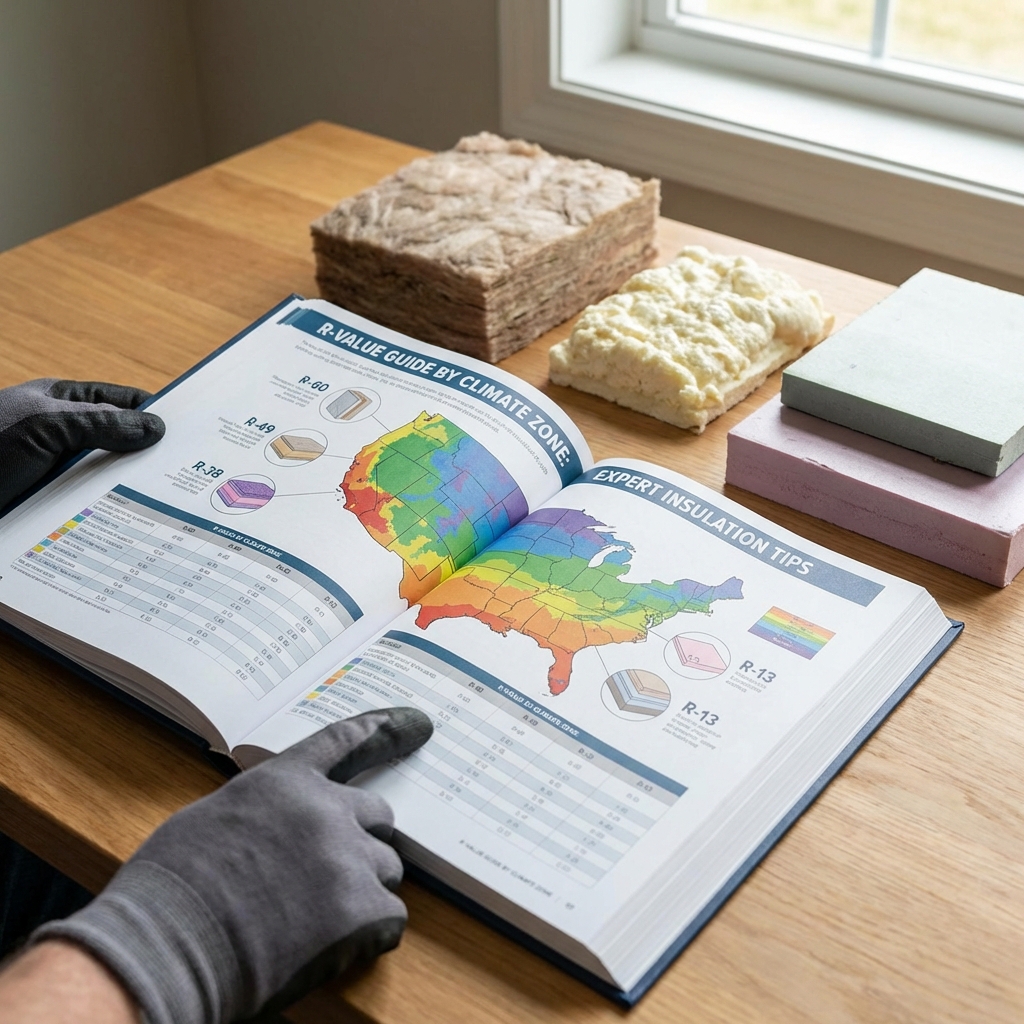
Detailed illustration of key concepts
Visual Guide
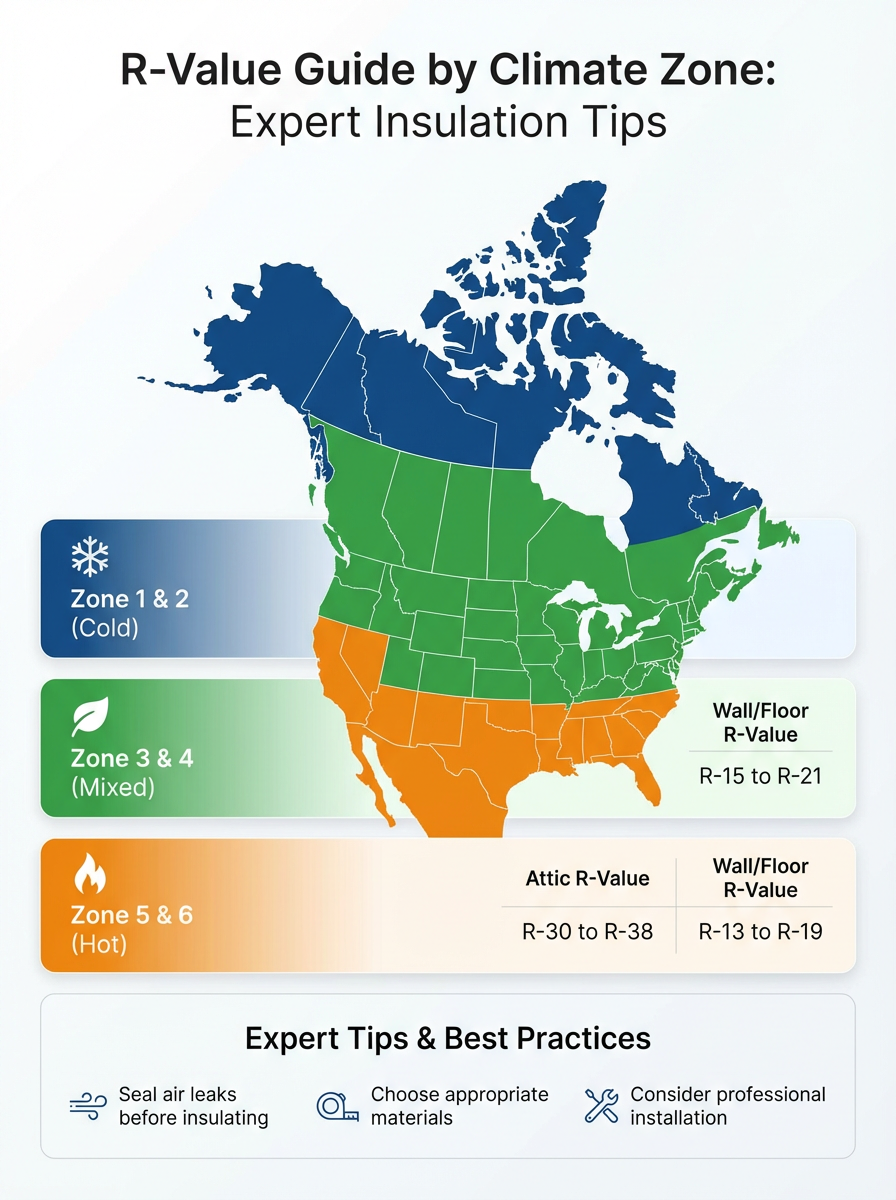
Infographic illustration for this topic
Sources & References
- Recommended Home Insulation R–Values - Energy Star
- Understanding Insulation and R-Value - This Old House
- Insulation | Department of Energy
- Understanding R-Values and Insulation | Focus on Energy
- Building Codes, Standards, and Regulations: Frequently Asked ...
- [PDF] Building Codes Toolkit for Homeowners and Occupants - FEMA
- Building Codes and Standards - 101 Guide | ROCKWOOL Blog
- 5 Reasons Building Codes Should Matter to You
- [PDF] Introduction to Model Codes
Frequently Asked Questions
Need Professional Help?
Find top-rated insulation experts in your area