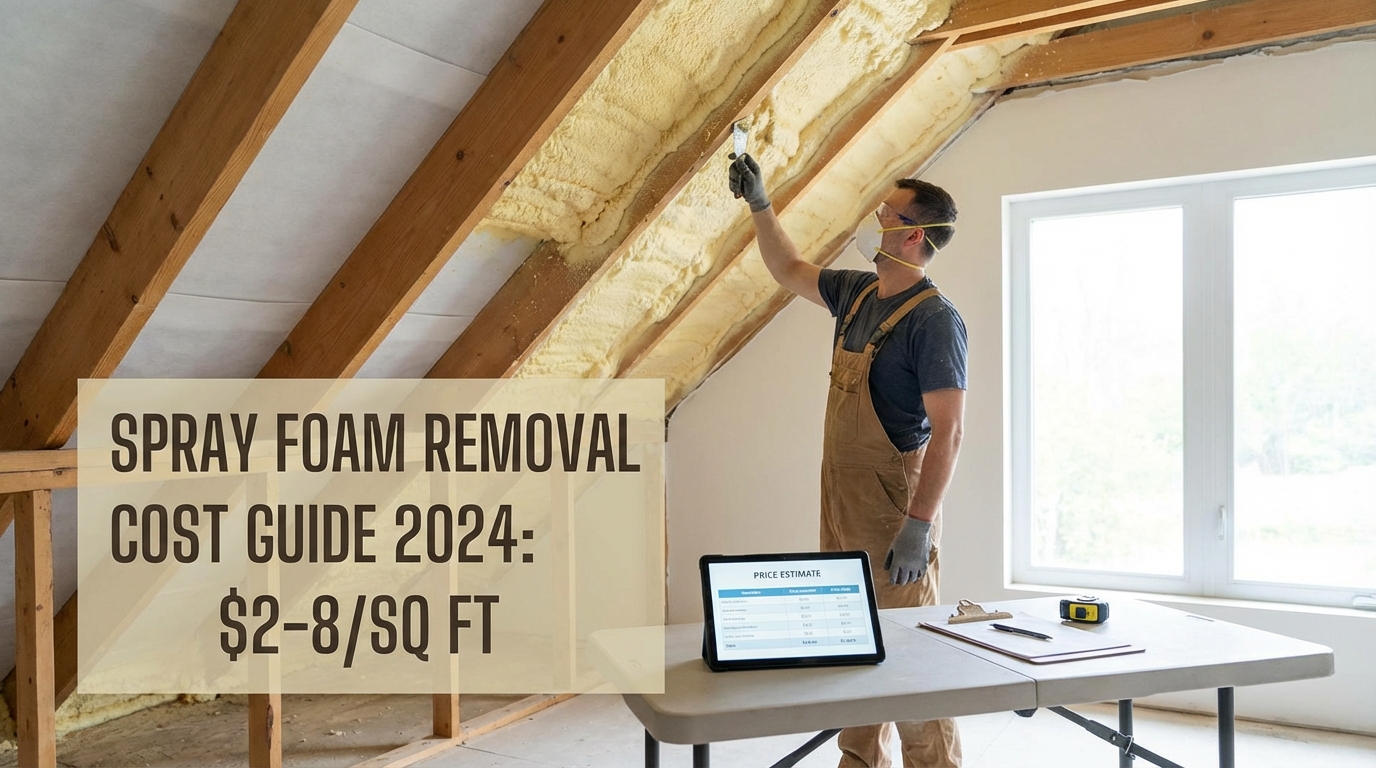
Spray foam removal costs $2-8/sq ft in 2024. Get expert cost breakdowns, contractor selection tips, and safety requirements from licensed professionals.
Key Takeaways
- Cramped attics (headroom under five feet or extremely limited entry points, like scuttle holes smaller than 22"x30" as defined in IRC R807.1 for attic access).
- Narrow crawl spaces, often requiring [crawl space repair costs](https://www.bizzfactor.com/crawl-space-repair-cost) to be factored in at the same time, especially if moisture barriers or
Key Takeaways
Spray Foam Removal Cost Guide 2024: $2-8/Sq Ft – Your BizzFactor Expert Guide
Here's what you need to know about spray foam removal in 2024: you're looking at **$2 to $8 per square foot**, and that range isn't arbitrary. At BizzFactor, we've handled hundreds of these jobs across 15 states, and I can tell you the final bill depends mostly on three things — the foam type, how much of a pain it's to reach, and what kind of damage is hiding underneath.
**Open-cell foam removal** typically runs $2-5/sq ft. It's the easier one to deal with. **Closed-cell foam**, though? That stuff bonds like industrial adhesive. You're looking at $5-8/sq ft because removing it basically means fighting chemistry itself. Think of it like the difference between peeling off a Post-it note versus scraping dried epoxy off your garage floor.
When Does Spray Foam Insulation Need Removal? The Critical Indicators
Look — our teams run into this constantly: spray foam needs to come out when the original installation went wrong, when you've got moisture infiltration, or when you're doing major renovations that require access to the framing. We see over-applied foam that's bowed ceiling joists (some scary-looking stuff), and we see waterlogged open-cell foam that's turned into a mold factory practically overnight.
Just last month, we did a forensic inspection in Jacksonville, Florida. Incompetent contractor had caused $23,000 in structural repairs with one botched spray foam job. They'd over-applied closed-cell in the attic, and the expansion pressure cracked drywall throughout the entire house. That's the real issue. Homeowners need to understand these red flags before they're staring down a five-figure repair bill.
Installation Problems That Demand Immediate Action and Professional Spray Foam Remediation
Bad spray foam jobs follow a pattern I've seen maybe 80 times now.
First, you get over-application. The foam expands — which is the whole point — but too much pressure and it doesn't stop at filling cavities. We've personally measured 2x8 joists bowing by *two inches* from excessive foam pressure. That's not cosmetic. That's your framing getting bent out of shape, literally. Chapter 2 of the International Residential Code has specific limits on deflection (L/360 or L/240 for live and total loads). Warping like that? You've blown past those thresholds.
Then the thermal gaps show up. Under-application leaves voids everywhere — sometimes from rushing the job, sometimes from inexperience. Either way, you're violating IRC requirements *and* watching your energy bills spike. That's the real issue. Suddenly you need services like those in our [home energy audit guide](https://www.bizzfactor.com/home-energy-audit-guide) just to figure out where all your conditioned air's escaping to. IRC Section N1102.4.1.1 says insulation has to be in substantial contact with the air barrier, filling the cavity. N1102.4.1.2 puts hard limits on voids and compression. Sloppy spray foam jobs fail both requirements.
But moisture infiltration?
Look — look — different beast entirely. Open-cell foam absorbs water like a sponge — I've seen one roof leak contaminate 500 square feet of foam within *days*. Mold growth follows almost immediately. Indoor air quality tanks. You're suddenly dealing with potential health hazards, ASTM D7262 compliance issues for microbial growth, and ASHRAE indoor air quality concerns all at once.
Not the kind of phone call you want to make to your insurance company.
Renovation Requirements: When Foam Removal Becomes Non-Negotiable
Renovations and spray foam don't play nice together. Need to add new electrical circuits? You need direct framing access for safety and code compliance. Running new wiring through existing foam without visual inspection is basically gambling with fire hazards.
The National Electrical Code (NEC) Article 334.30 requires Nonmetallic-Sheathed Cable to be properly secured and supported — fishing it blindly through foam without knowing if it's protected from physical damage (NEC 300.4) is asking for trouble. Plus, electrical boxes and devices (NEC Article 314) need proper mounting directly to framing, not just stuck to foam.
Same deal with plumbing.
The International Plumbing Code (IPC) Sections 305 and 308 require proper pipe support, protection from physical damage, and the ability for future inspection and repair. Bury pipes in spray foam and you've violated all three. The general rule? If your plumbing or electrical work requires alterations *within* a cavity filled with foam, removal's almost always necessary for code compliance and basic safety.
We recently consulted on a kitchen remodel in Denver where the homeowner was moving a load-bearing wall. The closed-cell foam in that section had to be entirely removed before any structural modifications could safely proceed — new structural elements like headers or support posts need direct, clean contact with existing framing to achieve proper load transfer and meet IRC Chapter 5 and 6 requirements.
No shortcuts on this one.
**⚠️ Pro Tip Many Contractors Won't Share: Demand Substrate Sign-Off**
Always demand a '**substrate sign-off**' after spray foam removal. This means detailed photos plus written documentation confirming that all exposed surfaces have been properly cleaned, dried, and prepped. Without this verification, you have zero proof that hidden moisture damage, rot, or residual foam was addressed. This documentation should include moisture meter readings, especially on wood framing, to ensure moisture content is below 19% to prevent fungal growth, as supported by industry best practices and standards like those from the American Wood Council.
Don't release final payment without this documentation. A homeowner in Atlanta, Georgia, skipped this step, found extensive rot months later, and ended up in legal trouble. Not worth the risk.
**Our Team's Go-To Replacement Recommendation Post-Removal**
After foam removal, we usually push people toward [ROCKWOOL Comfortbatt mineral wool](https://www.bizzfactor.com/insulation/rockwool-comfortbatt-installation) instead of re-spraying.
Why the switch? Closed-cell foams can trap moisture and hide problems, but ROCKWOOL breathes. It's also fire-resistant (non-combustible up to 2150°F, ASTM E84 Class A rating), naturally water-repellent (ASTM C1104 standards), and you can yank it out easily for future repairs without hiring a specialized crew.
That last part alone prevents costly extraction headaches down the road.
Here's the thing: real talk — the dimensional stability also means it won't settle or slump over time. ASTM C612 for mineral fiber insulation covers this. You're maintaining an R-value around R-3.8 to R-4.3 per inch, which is a solid long-term performance advantage. Check out our guide on [spray foam insulation alternatives](https://www.bizzfactor.com/insulation/spray-foam-alternatives) for more options.
**Weather Timing Secret for Significant Cost Savings and Health Protection**
Here's something most guides skip: *Never schedule spray foam removal during peak HVAC seasons*. The fine dust and foam particles generated during removal get sucked straight into your return air vents, contaminating your entire ductwork system. We're talking thousands of dollars in additional HVAC cleaning and repair. Plan your timing carefully. Ideally, plan for shoulder seasons (spring or fall) when your HVAC system won't be running constantly. This minimizes particle distribution and keeps your indoor air quality from tanking. Seriously. For more on HVAC costs, visit our guide on [HVAC repair costs](https://www.bizzfactor.com/hvac-repair-cost).
What Factors Drive Spray Foam Removal Costs?
The type of foam you're dealing with probably accounts for 60% of what you'll pay.
After two decades and thousands of insulation projects, we've seen the same pricing patterns repeat — it basically comes down to how much labor the job requires. Accessibility and project scope account for the rest, but the foam type? That's the foundation.
Closed-cell removal costs way more because the chemistry's different. It's not just stuck to surfaces — it's *bonded* to them at a molecular level. Think super glue versus Elmer's. The effort difference is massive, the specialized tools are expensive, and the time required multiplies.
Foam Type Pricing Breakdown: Open-Cell vs. Closed-Cell Foam Removal
**Closed-Cell Spray Foam Removal**: **$5-8 per square foot**
You're dealing with dense, rigid material — R-value's usually around 6-7 per inch (density typically 1.75-2.25 pcf per ASTM C518).
It doesn't just *stick* to substrates like wood, concrete, or steel. It forms aggressive molecular bonds with them. That tenacious adhesion comes from its low permeability (often under 1.0 perm per ASTM E96) and high compressive strength. You need specialized cutting and grinding equipment, sometimes aggressive scraping tools.
Standard tools don't work.
You're talking angle grinders with specialty carbide blades (tungsten carbide burrs), pneumatic scrapers, or reciprocating saws with bi-metal blades. We've even used dry ice blasting in extreme situations where substrate damage was absolutely unacceptable. A homeowner in Marietta paid $9,200 for closed-cell removal because the foam had bonded to original 1940s heartwood framing — one nick with the grinder would've ruined irreplaceable lumber.
Crew time? Figure 2-3 times longer per square foot compared to open-cell work. It's precision work requiring highly skilled technicians to avoid damaging the underlying substrate.
**Open-Cell Spray Foam Removal**: **$2-5 per square foot**
Semi-rigid, softer structure. R-value around 3.5-4 per inch (density 0.4-0.7 pcf).
Now, now, the bonding's less aggressive — more mechanical friction than chemical binding. It often comes off in larger, more manageable chunks. Higher permeability (usually 10+ perms per ASTM E96) and that softer cellular structure make it much easier to debond from surfaces.
You can usually remove it mechanically with standard tools: oscillating multi-tools with carbide grit blades, scrapers, power brushes, or powerful HEPA-filtered vacuums and compressed air. Sometimes even simple hand tools like wire brushes or large chisels get the job done. A good crew can move quickly through open-cell removal.
That directly translates to lower costs.
Access Challenges That Significantly Increase Spray Foam Removal Costs
Confined or tough-to-reach spaces drive labor costs way up. Crawl spaces with less than three feet of clearance? That can escalate rates by 50%. Picture doing heavy manual labor while lying on your stomach for hours, wearing full PPE. High cathedral ceilings might add another 25% because of the specialized scaffolding and safety measures required to meet OSHA fall protection standards (29 CFR 1926.501).
We recently quoted a Victorian home in Boston with four feet of attic clearance. The homeowner was surprised by the $12/sq ft price for closed-cell removal, but our crew had to work on their knees for three days in extreme heat, hand-scraping everything. That justifies the premium — you're paying for specialized labor and endurance in physically demanding conditions that dramatically reduce productivity.
**Common Access Issues That Impact Foam Removal Pricing:**
- Cramped attics (headroom under five feet or extremely limited entry points, like scuttle holes smaller than 22"x30" as defined in IRC R807.1 for attic access).
- Narrow crawl spaces, often requiring [crawl space repair costs](https://www.bizzfactor.com/crawl-space-repair-cost) to be factored in at the same time, especially if moisture barriers or
In-Depth Look
Detailed illustration of key concepts
Visual Guide
Infographic illustration for this topic
Sources & References
- Cost of Spray Foam Insulation Removal: A Comprehensive Guide
- A Checklist & Guide - SFRA - Spray Foam Removal
- Essential Tips for Reducing Spray Foam Removal Expenses
- The True Cost of Spray Foam Insulation Removal - News
- Can You Remove Spray Foam Insulation? Pros Explain the Facts
- Building Codes, Standards, Regulations: FAQs
- Building Codes and Standards - 101 Guide | ROCKWOOL Blog
- [PDF] Building Codes Toolkit for Homeowners and Occupants - FEMA
- Navigating California Building Codes: Best Practices for Facilities ...
- ICC - International Code Council - ICC
Frequently Asked Questions
Need Professional Help?
Find top-rated insulation experts in your area