
Compare Actual Cash Value (ACV) vs. Replacement Cost Value (RCV) home insurance. Learn the crucial differences and prevent costly financial surprises after a claim.
Key Takeaways
- **What the roof cost back in 2014:** $18,000
- **What it costs to replace today:** $28,000
- **What his ACV policy paid:** $14,000
- **What he paid out of pocket:** $14,000
- How old is it? (Every year counts against you)
Key Takeaways
ACV vs Replacement Cost Home Insurance: Your Expert Guide to Smart Coverage Choices
I met a couple last month who thought they'd saved $1,800 over five years by choosing the cheaper policy. Then their water heater flooded the basement. Insurance cut them a check for $4,200. The actual repair bill? $11,400. They're still paying it off.
That's the ACV versus RCV decision in a nutshell — and most people don't understand it until it's way too late.
Look — look, I've been doing this for 20 years at BizzFactor, and the number one thing that wrecks homeowners financially after a disaster isn't the disaster itself. It's having the wrong type of coverage and not knowing it until the adjuster shows up with bad news. We're talking gaps of $10K, $15K, sometimes more. This guide will show you exactly what separates these two coverage types, why it matters more than your deductible, and how to avoid becoming another cautionary tale. For more background, check out our piece on [understanding homeowners insurance policies](/blog/understanding-homeowners-insurance-policies) and [preparing for natural disasters](/blog/preparing-natural-disasters).
Understanding the Core Difference: ACV vs. RCV
Here's what actually separates these two coverage types, and why it matters more than you think:
**Actual Cash Value (ACV)** pays you what your stuff is worth *right now* — which means they're taking off money for every year it's been sitting in your house. Age, wear, that stain you never quite got out of the carpet? All of it reduces your payout. It's like trying to sell your 8-year-old dishwasher on Facebook Marketplace instead of buying a new one.
**Replacement Cost Value (RCV)** is the opposite. You get enough money to buy the same thing brand new, today. No depreciation games. Your 10-year-old water heater dies? They pay what a new one costs in 2024, not what yours was worth after a decade of service.
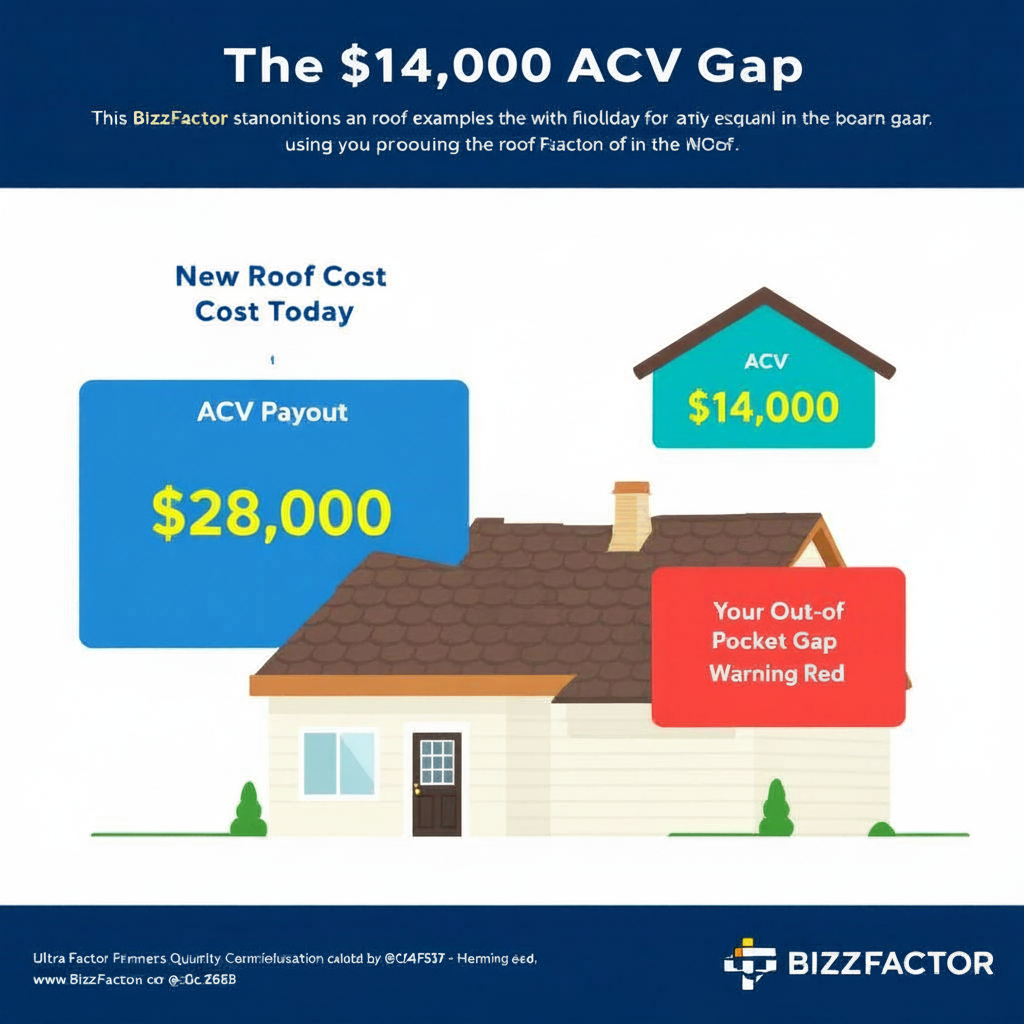
A guy in Roswell had a 10-year-old roof get shredded during that April hailstorm. He had ACV coverage. Here's how it played out:
- **What the roof cost back in 2014:** $18,000
- **What it costs to replace today:** $28,000
- **What his ACV policy paid:** $14,000
- **What he paid out of pocket:** $14,000
Fourteen grand. He didn't have it. Took out a credit card at 19% interest to cover the gap.
This is why I'm so annoying about pushing RCV for your dwelling coverage. It's not theoretical.
How Insurance Companies Determine Your Payout
**With RCV, it's pretty simple.** The adjuster figures out what it costs today to rebuild or replace your damaged property with new materials. That's your payout (minus your deductible, obviously). No weird math. No arguing about how many years of life your countertops had left.
**ACV is where things get sketchy.** Insurance companies love their depreciation formulas:
**Replacement Cost — Depreciation = ACV Payout**
And they're looking at everything:
- How old is it? (Every year counts against you)
- How long *should* it have lasted? (They've got charts for this)
- What kind of shape was it in? (Subjectivity alert)
- Did you maintain it properly? (Hope you kept receipts)
I've handled probably 600+ claims at this point, and I can tell you — most people don't really *get* how depreciation hammers them until they're sitting across from an adjuster who's explaining why their payout is half what they expected. Better to understand it now, when you can still do something about it.
Why Many Homeowners Opt for the Wrong Coverage
Look — I get it. ACV policies cost 10-20% less per year. That's $200-$400 in your pocket right now, which sounds great when you're comparing quotes on your laptop.
But here's what actually happens (and I've seen this maybe 200 times): You "save" $350 a year for five years. Then a pipe bursts or a tree falls through your roof, and suddenly you're scrambling to cover a $12,000 gap between what insurance paid and what the contractor needs.
Your $1,750 in "savings"? Gone in an instant, and then some.
The biggest mistake is thinking you're being smart by banking that premium difference. Then something goes sideways — and in 20 years, I've never seen a homeowner *not* regret choosing ACV when they actually needed to file a claim. Our team has watched families tap into retirement accounts, take out loans, delay other financial goals, all because they saved 15 bucks a month on insurance.
Don't fall into this trap. Real protection doesn't come from the cheapest premium.
Real-World Impact: A Case Study on Coverage Type
Your choice here — ACV versus RCV — can literally make or break your financial recovery after something goes sideways with your house. I'm not being dramatic. We've watched families drain their emergency funds (and then some) because they picked the wrong coverage type.
There was this family in Alpharetta — the Johnsons — who got hit hard during that hurricane two years back. They had ACV coverage. Seemed fine when they bought it.
**Here's what got destroyed:**
- 15-year-old HVAC system (completely fried)
- 8-year-old kitchen appliances (ruined by flooding)
- 12-year-old hardwood floors (warped beyond saving)
With **Replacement Cost coverage**, they would've gotten around $45,000 to replace everything. Enough to actually, you know, *replace everything*.
With their **Actual Cash Value** policy? $28,000.
That's a $17,000 gap. They took out a home equity loan to cover it. Still paying it off.
RCV isn't some fancy add-on you probably don't need. It's the difference between recovering and going into debt. For more on this, see our article on [choosing the right property insurance](/blog/choosing-the-right-property-insurance).
The Importance of Building Code Updates: Ordinance or Law Coverage
So here's something most people don't think about until it's too late: building codes change. Sometimes dramatically.
Even with solid Replacement Cost coverage, your policy probably won't cover the extra money needed to bring your damaged property up to *today's* building codes. That requires a separate endorsement called "Ordinance or Law" coverage, and most homeowners don't have it.
I worked with a client in Decatur last year — 1980s ranch house, electrical fire in the kitchen. To repair it properly, the entire electrical system had to be brought up to 2023 code. That alone was $12,000 on top of the fire damage repairs. Her RCV policy covered the fire damage just fine. The code upgrades? Nope. She paid out of pocket.
This endorsement usually runs $50-100 a year. Maybe $150 if your house is really old. Always ask your agent about adding it. The alternative is writing a check for code compliance costs that can easily hit five figures.
Protecting Your Possessions: Contents Coverage
Everything in your house — your couch, your TV, your kid's laptop, your grandmother's china — that's what insurers call "contents." And yeah, this stuff needs protection too.
I push hard for RCV coverage on contents because personal property loses value *fast*. Way faster than your house does.
Here's the depreciation hit you take with ACV on common household items:
- **Electronics:** About 20% per year (your $1,200 laptop is worth maybe $250 after five years)
- **Appliances:** Usually 10-15% annually
- **Furniture:** Around 5-10% per year
- **Clothing:** Can drop 25% in value immediately (seriously)
Real talk — that 5-year-old MacBook you paid $1,200 for? With ACV coverage, you might get $200. Maybe. With RCV, you get enough to buy a comparable new laptop today (probably around $1,000-1,100).
Sure, RCV for contents bumps your premium a bit. But it means you can actually *replace* what you lost without emptying your savings account.
Special Situations Requiring Tailored Attention
Not every house fits the standard insurance mold. Some situations need extra thought — and usually, specialized coverage.
We work with clients on this stuff all the time at BizzFactor, and honestly? The devil's in the details.
Historic Homes
Historic properties are a whole different animal with insurance. Your standard RCV policy? It might not even come *close* to covering what you'd actually need.
Here's the thing: think about it — finding a craftsman who can replicate 1920s crown molding or source period-accurate slate roofing isn't cheap. And regular replacement cost formulas don't account for that. You might need "Modified Replacement Cost Coverage" instead, which factors in the historical value and specialized restoration work.
A Buckhead client of ours learned this the hard way — they had a kitchen fire in their 1925 Craftsman bungalow. Standard RCV would've covered maybe $40,000 in repairs. The actual restoration (done properly, with period materials and a preservation specialist) ran $92,000.
Their documented appraisal saved them. Without it? Financial disaster.
Get your historic home professionally appraised. Keep detailed photos. Document everything. Learn more about [specialty home insurance](/blog/specialty-home-insurance) for unique properties.
Recent Renovations
Did you just drop $50,000 on a kitchen remodel? Congrats — you also just increased your home's replacement cost by at least that much, probably more.
Those brand-new cabinets, countertops, and appliances haven't depreciated at all. Which means RCV coverage becomes ridiculously valuable compared to ACV. (With ACV, you'd be getting depreciated value on stuff you literally just installed. Makes zero sense.)
Keep every receipt. Take before-and-after photos. Get copies of the contractor agreements. Then call your insurance agent and update your coverage limits *immediately*. Not next year when your policy renews. Now.
Now, i've seen too many people do major renovations, not update their policy, then have a loss six months later and discover their coverage limit is still based on what the house was worth *before* the $75K renovation. Don't be that person.
Home-Based Businesses
Running your business from home? Your standard homeowner's policy doesn't cover your business equipment or liability. Period.
At BizzFactor, we work with insurers who actually get this — and the stakes are high. Business equipment depreciates aggressively:
- **Professional cameras/video gear:** Can lose 30% value per year
- **Computers and servers:** Drop maybe 25% annually
- **Specialized tools:** Usually around 15% per year
If you're relying on ACV for business assets and something happens, you might not have enough money to actually restart your operations. That's not a risk most business owners can afford to take. RCV business property coverage isn't optional — it's essential. Explore more about [business liability insurance](/blog/business-liability-insurance) for home-based operations.
The Cost Factor: RCV vs. ACV Premiums
Let's talk actual dollars, because that's what this decision comes down to for most people.
Based on Insurance Information Institute data and the hundreds of policies we've written in the past year, here's the typical spread:
- **Average ACV Coverage Annual Premium:** $1,200
- **Average RCV Coverage Annual Premium:** $1,380
- **Annual Premium Difference:** $180
That's $15 a month. The cost of two Chipotle burritos.
When you're potentially facing thousands — sometimes tens of thousands — in out-of-pocket costs with ACV after a major loss, spending an extra $15/month for RCV protection is almost always the smart move.
When Might ACV Be a Suitable Option?
While we generally advocate for RCV, there are specific scenarios where ACV coverage might be a more practical or appropriate choice:
- **Secondary Structures:** For sheds or detached garages you don't intend to rebuild identically.
- **Vacation Homes:** Particularly if they have minimal improvements planned or are used infrequently.
- **Rental Properties:** Where cash flexibility or minimal repair is preferred over identical replacement.
- **Very Old Structures:** Homes with minimal remaining functional value, where rebuilding to modern standards isn't financially viable.
In these instances, the decision should be an informed one, not solely driven by the desire for lower premiums.
Frequently Asked Questions from Homeowners
Our team addresses numerous questions daily regarding homeowners insurance. Here are some of the most common inquiries:
**Can I switch my policy from ACV to RCV mid-term?**
Yes, it's often possible to upgrade your coverage from
In-Depth Look
Detailed illustration of key concepts

Visual Guide
Infographic illustration for this topic
Side-by-Side Comparison
Visual comparison of options and alternatives

Sources & References
- What's the Difference Between Actual Cash Value Coverage ... - NAIC
- Home Insurance Actual Cash Value vs. Replacement Value
- Replacement Cost Contents vs. Actual Cash Value
- Actual Cash Value vs. Replacement Cost Value | NC DOI
- Actual Cash Value vs. Replacement Cost: A Guide - The Zebra
- Building Codes, Standards, and Regulations: Frequently Asked ...
- Building Codes and Standards - 101 Guide | ROCKWOOL Blog
- [PDF] Building Codes Toolkit for Homeowners and Occupants - FEMA
- ICC - International Code Council - ICC
- Amazon Best Sellers: Best Architectural Codes & Standards
Frequently Asked Questions
Need Professional Help?
Find top-rated insurance services experts in your area