
Protect your family from debt with life insurance. Learn how debt protection life insurance can eliminate mortgages, car loans, and credit card debt.
Key Takeaways
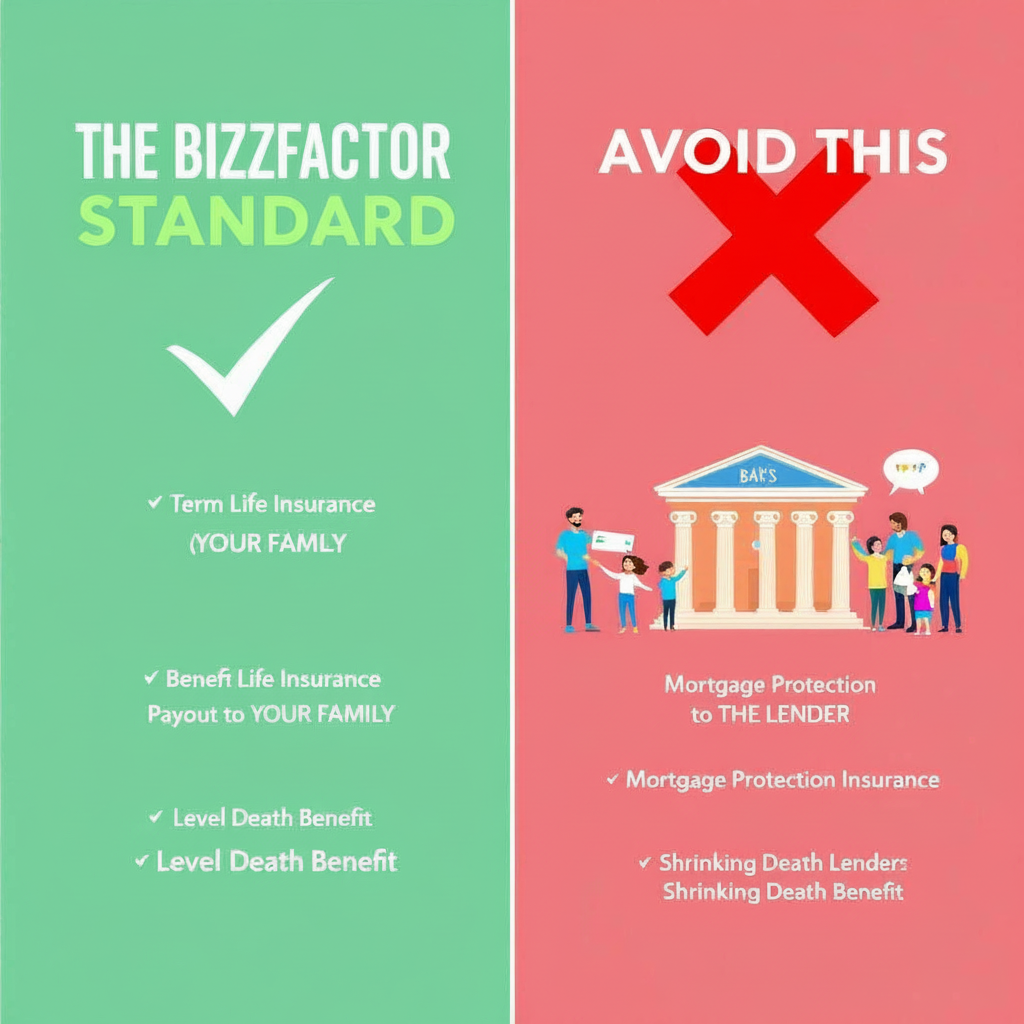
- **Shrinking payout:** Every month you pay down your mortgage, the death benefit drops. But guess what doesn't drop? Your premium.
- **Backwards pricing:** You're literally paying the same (or more) for less coverage as time goes on.
- **Wrong beneficiary:** The check goes straight to the bank, not your spouse. Zero flexibility.
- **Trapped:** Can't adjust it when your financial situation changes (and it will).
- $320,000 mortgage balance
Key Takeaways
Life Insurance for Debt Protection: A 2024 Guide to Safeguarding Your Family's Future
Here's something most financial advisors won't tell you upfront: debt protection is probably more important than income replacement for your family. Sounds backwards, right? At BizzFactor, we've worked with enough grieving families to know — wiping out a $280,000 mortgage beats replacing a full salary when your spouse is trying to rebuild their life.
Why Homeowners Urgently Need Debt Protection Life Insurance
Look — look — so here's what debt protection life insurance actually does: it pays off your mortgage, credit cards, car loans — all of it — after you die. Keeps your family in the house. Prevents foreclosure. The peace of mind part isn't marketing fluff when you've seen what happens without it.
After working with families for twenty years, I've noticed something weird. Most people obsess over income replacement ("I need 10 times my salary!") but completely miss the obvious play. Your family doesn't need your full paycheck forever — they need the debts gone. Think about it. No mortgage payment? That's $2,400 a month they don't need to earn. The math gets pretty simple once you actually run it.
Consider a recent case: Sarah had a $280,000 mortgage and earned $75,000 annually. Standard advice suggested $750,000 in coverage (10 times her income). We ran the numbers differently. What'd she actually need? $350,000 to clear the mortgage, another $50,000 for credit cards and the car loan. Total: $400,000.
That's it.
This approach saved her $200 monthly in [life insurance premiums](https://bizzfactor.com/insurance-services/life-insurance-cost-guide) while giving her family better protection for their specific situation.
Optimal Coverage Types for Debt Protection
You've got peak debt years — usually your 30s and 40s when the mortgage is high, the car payments are stacking up, maybe you've got a HELOC from that kitchen renovation. [Term life insurance](https://bizzfactor.com/insurance-services/term-life-insurance-guide) covers exactly those years without bleeding you dry on premiums. We're talking 80% cheaper than whole life for the same death benefit your family needs to clear the debts.
Most families go with 20 or 30-year terms, which (not coincidentally) matches how long you'll be paying off that house.
Here's the thing: so yeah, for debt protection? We usually go with term life. Whole life builds cash value, sure — you can borrow against it, potentially useful if you're already maxing out retirement accounts and need more tax-advantaged space. But you'll pay 5 to 10 times more for that privilege. I've watched a lawyer in Vinings pay $680/month for whole life when a $450,000 term policy would've cost him $85/month. Same death benefit. Different premium. That $595 difference invested over 20 years? Around $380,000 at 7% returns.
The exceptions exist — high earners who've hit their 401(k) and IRA limits, estate planning situations where you need guaranteed cash for estate taxes. But we're talking maybe 1 in 20 families.
The Pitfalls of Mortgage Protection Insurance (MPI)
Real talk — those mortgage protection policies your lender pushes? Terrible deal. Here's why they're garbage:
- **Shrinking payout:** Every month you pay down your mortgage, the death benefit drops. But guess what doesn't drop? Your premium.
- **Backwards pricing:** You're literally paying the same (or more) for less coverage as time goes on.
- **Wrong beneficiary:** The check goes straight to the bank, not your spouse. Zero flexibility.
- **Trapped:** Can't adjust it when your financial situation changes (and it will).
I've watched families throw away thousands on MPI when a regular term policy would've cost less and done more. Don't be that person.
BizzFactor's Pro Strategy for Comprehensive Debt Protection
Look — debt protection isn't just about the mortgage. A guy in Buckhead learned this the hard way when his wife passed and he found out she had $35,000 in credit cards he didn't know about. Here's what actually works:
Now, now, 1. **Term Life Policy:** Cover your total debts, then add 25% on top for the stuff that always comes up (funeral costs averaged $9,400 last year in Georgia, just for reference).
2. **Umbrella Liability Insurance:** Because getting sued can create new debts faster than you can say "slip and fall on your sidewalk."
3. **Emergency Fund:** Six months of expenses sitting in a boring savings account. Your family needs cash they can touch immediately, not investment accounts they have to liquidate.
Stack these three together and your family won't just survive — they'll have breathing room to figure out what's next without panicking about losing the house.
A Real Client Success Story: The Johnson Family
Last year, the Johnson family faced an unexpected tragedy when Mark passed away. He left behind:
- $320,000 mortgage balance
- $28,000 credit card debt
- $15,000 auto loan
- $35,000 home equity line of credit
**Total debt: $398,000**
Fortunately, Mark's $450,000 term life policy enabled his wife, Lisa, to eliminate every single debt immediately. She retained their family home and had a $52,000 surplus for emergencies. Seriously. Six months later, Lisa shared, "I can't imagine navigating this without the right coverage. The peace of mind is truly invaluable." Without this essential protection, she would have faced foreclosure within months—a distressing scenario we've witnessed too frequently.
How to Calculate Your Actual Coverage Needs
Ready? Grab a calculator and your latest statements. Add up:
**Primary Debts:**
1. Mortgage balance
2. Home equity loans or lines of credit (HELOCs)
3. Credit card balances
4. Auto loans
5. Student loans
6. Any relevant business debts
Now multiply that total by 1.25 to add your buffer.
So if you've got $300,000 in total debt, you're looking at $375,000 in coverage. No fancy formulas, no financial advisor jargon. Just basic math that might save your family's home.
The Importance of Working with Licensed Professionals
Last month, Georgia updated its replacement regulations — most agents I know had no idea until clients started asking questions. That's the problem with this industry. Rules shift constantly (state insurance departments change requirements, carriers revise underwriting guidelines, tax laws get tweaked), and if your agent isn't paying attention, you're getting outdated advice. [Understanding how life insurance works](https://bizzfactor.com/insurance-services/how-life-insurance-works) means staying current, not just passing a test once in 2019.
I met a widow in Marietta whose husband bought coverage from his college roommate who'd just gotten licensed. Guy meant well, probably. Policy had exclusions nobody explained. Two-year contestability period became a nightmare. She waited 11 months for a payout that should've taken two weeks.
What to look for in an agent we'd actually recommend:
- Current state insurance license (sounds obvious, but you'd be surprised)
- At least 5 years actually doing this work
- Works with multiple carriers — not trapped selling one company's products
- Real client reviews you can verify
- Upfront about how they get paid
Red flags? Anyone who only pushes expensive whole life for debt protection. Or those "free consultation" offers that turn into high-pressure sales pitches with fees buried in the fine print.
Essential Policy Features That Enhance Debt Protection
Term policies look identical until you read the fine print. Then you notice one company charges 40% less but won't let you convert to permanent coverage without a new medical exam. Another one includes living benefits riders at no extra cost. The differences stack up fast:
- **Convertibility:** Switch to permanent coverage later without another medical exam. Matt from Decatur developed Type 2 diabetes at 43 — would've been uninsurable for new coverage, but his convertibility option let him shift to whole life when he sold his business and needed permanent protection. Paid the same health rating he qualified for at 35.
- **Accelerated Death Benefit (Living Benefits Rider):** Get diagnosed with a terminal illness? You can access part of your death benefit early. One client in Sandy Springs pulled $150,000 from his $400,000 policy to cover experimental cancer treatment. His wife still got $250,000 to clear their debts after he passed.
- **Waiver of Premium:** Become totally disabled? Premiums get waived, coverage continues. Matters because disability hits younger than death does — way more 40-year-olds get disabled than die.
I've seen families save tens of thousands with these riders. Worth shopping around for.
Tax Benefits and Strategic Estate Planning with Life Insurance
Death benefits aren't taxable income. Your beneficiary gets the full amount — IRS doesn't touch it. So that $400,000 policy? Family receives $400,000 to clear debts. No withholding, no 1099, no surprise tax bill next April.
So — estate taxes only matter if you're worth over $13.61 million as an individual (doubled for married couples, so $27.22 million). Most families won't hit that. But if you're close — or if you own a business that might push you over — you'll want an estate attorney, not just an insurance agent. Irrevocable life insurance trusts, generation-skipping strategies, all that complex stuff that keeps probate lawyers employed.
What matters way more for regular families? [Beneficiary designations](https://bizzfactor.com/insurance-services/how-beneficiary-works-life-insurance) that actually work. Properly named beneficiaries skip probate entirely. We're talking 72 hours from death certificate to check in hand. I've seen it happen. But I've also watched families wait 8 months because Dad never updated his beneficiary after his divorce and the ex-wife fought the new wife in court. Review your beneficiaries every year. Divorce happens. Kids are born. People die. Update the damn forms.
Integrating Debt Protection with Other Financial Tools
Debt protection can't work alone — it needs backup. You absolutely need an emergency fund sitting in a boring savings account. Three to six months of expenses, cash you can grab today. That's for the immediate stuff your family faces before insurance kicks in (funeral costs, travel, taking time off work to grieve and handle paperwork). Life insurance clears the debts. Emergency fund handles the chaos.
Major home projects mess with your coverage needs too. Had a client spend $40,000 on foundation repairs last year. We bumped her policy because her home's value (and replacement cost) went up. Same deal with building code changes — costs more to rebuild now than when you bought the place, which means your old coverage amount might be way off.
Avoid These Common Mistakes in Debt Protection Planning
We've worked with thousands of families over the years. Same mistakes keep popping up, and they're brutal when they hit:
- **Underestimating Needs:** Guy figures he needs $200K because that's roughly his income. Doesn't account for his $280K mortgage plus $40K in other debt. Family loses the house within 8 months. Seen it happen.
- **Choosing the Cheapest Option Blindly:** Bottom-tier carrier saves you $15/month until they fight the claim for 18 months. Stick with AM Best A- rated companies or better.
- **Ignoring Inflation:** $300K in coverage today? In 15 years that's worth maybe $200K in purchasing power. Review it every 3 years minimum.
- **Neglecting Policy Reviews:** Birth, divorce, remarriage, new mortgage — life changes and your policy needs to keep up. We do annual check-ins with clients specifically because people forget this stuff.
Each of these screwups can cost your family their home. Not trying to scare you — just stating what we've watched happen when people skip the basics.
When to Review Your Life Insurance Coverage
Life's significant milestones are prime opportunities to review your life insurance. Schedule updates after:
- Refinancing your mortgage or taking out a HELOC
- Making major home improvements
- Significant changes in overall debt (e.g., paying off large loans, taking on new ones)
- Marriage, divorce, or the birth/adoption of children
- Substantial income increases or decreases
Our team provides annual reviews for all clients, proactively identifying and addressing potential coverage gaps before they become critical issues.
Making an Informed Decision for Your Family's Security
Debt protection life insurance does one thing really well: it keeps your family in their home by wiping out the debts that'd otherwise bury them. Start by adding up everything you owe. Then multiply by 1.25 for your buffer. Shop term policies from carriers with solid ratings (AM Best A- or higher).
Work with a licensed agent who gets debt protection strategy. Not someone pushing expensive permanent life insurance as the answer to every question.
Look — your family's home isn't just an asset on a spreadsheet — it's where they feel safe. The right coverage keeps it theirs, no matter what happens to you. We can't predict tragedies, but we can prepare for them. That preparation? That's what actually protects your family when everything else falls apart.
In-Depth Look
Detailed illustration of key concepts

Visual Guide
Infographic illustration for this topic

Side-by-Side Comparison
Visual comparison of options and alternatives
Sources & References
- Your Guide to the Life Insurance Checklist
- Comprehensive Guide to Life Insurance Options in 2026
- How to Use Life Insurance for Debt Protection
- Your Guide to Home Insurance in 2024: Top 7 Trends & Strategies
- How to buy life insurance: A step-by-step guide - Guardian Life
- Building Codes, Standards, and Regulations: Frequently Asked ...
- [PDF] Building Codes Toolkit for Homeowners and Occupants - FEMA
- Building Codes and Standards - 101 Guide | ROCKWOOL Blog
- Building Codes - BIAW
- ICC - International Code Council - ICC
Frequently Asked Questions
Need Professional Help?
Find top-rated insurance services experts in your area