
Compare group vs individual life insurance for home service pros. Expert advice on coverage, costs, and protection strategies from licensed professionals.
Key Takeaways
- **Restrictive Coverage Limits:** Caps on group policies often hover around $500,000, and more frequently, it's far less. That amount? Probably not enough for comprehensive family needs, especially if you've got a mortgage, young kids, or college aspirations. A house in Des Moines isn't cheap. Neither is college.
- **Job-Dependent:** This is a major Achilles' heel. Coverage is inextricably linked to your employment status. Leave your employer – whether by choice, layoff, or dismissal – and the policy typically vanishes faster than a forgotten tool at a job site. Pouf. Gone.
- **Zero Portability:** You can't take it with you. Period. Switch companies, launch that dream plumbing business, or go independent contractor? That group policy stays behind. It's a deal-breaker for ambitious tradespeople.
- **Minimal Customization Options:** Forget tailoring. Options to fit specific individual or unique family needs, such as adding riders for critical illness, disability income, or long-term care – crucial for physically demanding work – are usually severely restricted or non-existent. One-size-fits-all, and you know how well that works in real life.
- **Way Higher Coverage Limits:** We're talking $100K to $10 million+, depending on what your family actually needs (not what some HR department decided was "enough").
Key Takeaways
Group vs. Individual Life Insurance: The Definitive Guide for Home Service Professionals
A 42-year-old HVAC tech in Alpharetta just called me. His company's restructuring. Group policy? Gone in 30 days. Family of four, $380K mortgage, zero backup plan.
This happens three times a month in my office.
Look — look — for the backbone of our communities – HVAC techs, master plumbers, electricians, and roofers – the daily grind isn't just a job. It's a physically demanding calling with real hazards. With over two decades in the contractor insurance space, I've seen a pattern: employer-provided group coverage gives you a baseline safety net, but individual policies? That's your real armor for protecting your family long-term. It's not 'if' something happens — it's 'when,' and whether you're ready for it.
Don't gamble with your family's future. Seriously.
Unpacking Group Life Insurance: The Baseline for Tradespeople
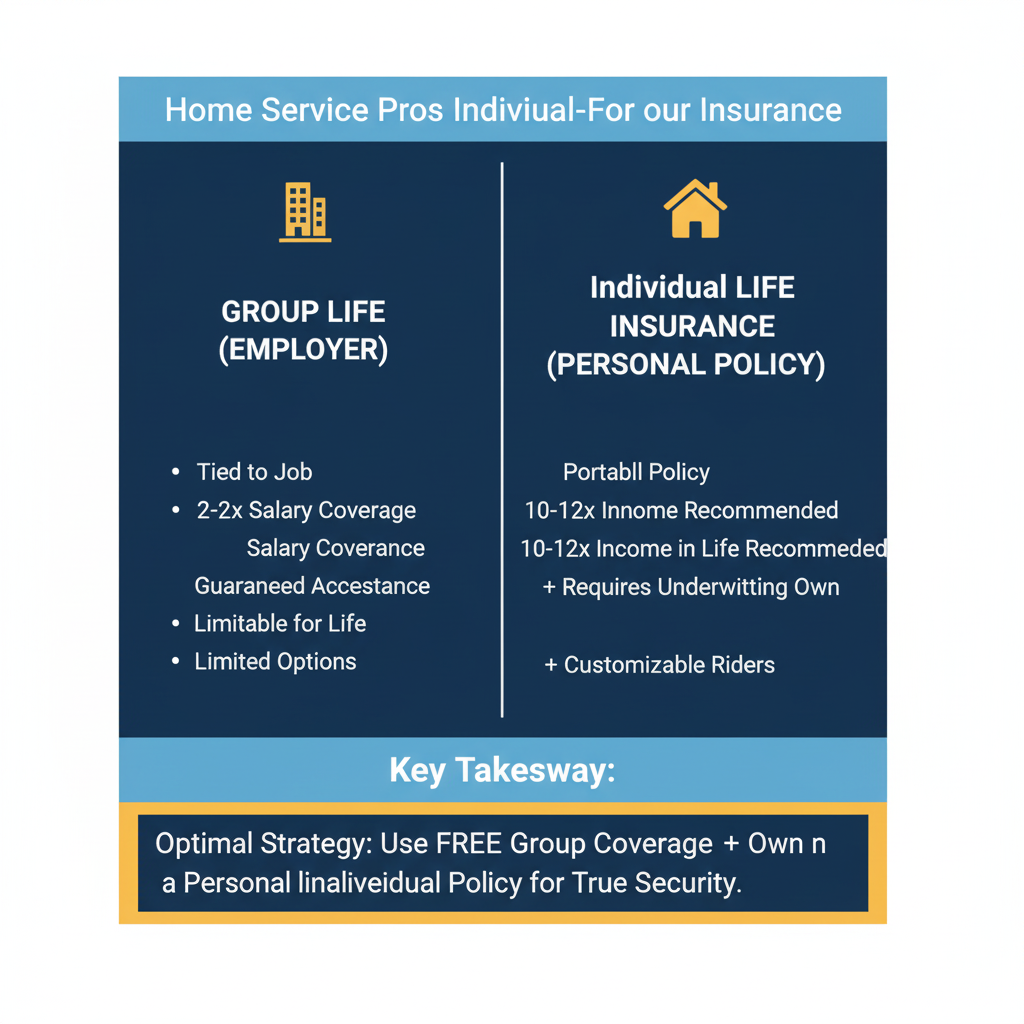
Most employer-sponsored group life insurance works like this: your company picks up part (or all) of the cost, you usually get automatic acceptance up to a certain amount regardless of health issues, and coverage typically runs 1-2x your annual salary. Pretty straightforward.
You'll find this in probably 70% of benefit packages at midsized home service outfits. Your employer often shoulders a substantial portion, or even the entirety, of the premium. This makes it an undeniably attractive, low-cost (sometimes free!) entry point for many individuals venturing into skilled trades. Instant gratification. Easy to enroll. Seems great, right?
But here's the kicker.
While it looks good because of the price tag, group coverage has some serious blind spots that tradespeople can't afford to ignore:
- **Restrictive Coverage Limits:** Caps on group policies often hover around $500,000, and more frequently, it's far less. That amount? Probably not enough for comprehensive family needs, especially if you've got a mortgage, young kids, or college aspirations. A house in Des Moines isn't cheap. Neither is college.
- **Job-Dependent:** This is a major Achilles' heel. Coverage is inextricably linked to your employment status. Leave your employer – whether by choice, layoff, or dismissal – and the policy typically vanishes faster than a forgotten tool at a job site. Pouf. Gone.
- **Zero Portability:** You can't take it with you. Period. Switch companies, launch that dream plumbing business, or go independent contractor? That group policy stays behind. It's a deal-breaker for ambitious tradespeople.
- **Minimal Customization Options:** Forget tailoring. Options to fit specific individual or unique family needs, such as adding riders for critical illness, disability income, or long-term care – crucial for physically demanding work – are usually severely restricted or non-existent. One-size-fits-all, and you know how well that works in real life.
Here's the thing: here's the thing: i once worked with an incredibly skilled, 50-year-old master electrician in Omaha who, after two decades with a large contracting firm, was suddenly laid off during a company restructuring. His group policy, which had provided a modest $200,000, evaporated overnight. Fortunately, years earlier, he'd had the foresight to secure individual coverage. His family's financial security remained intact through that incredibly stressful, unexpected transition. That's a war story with a happy ending, but it could have been catastrophic.
**So, how does group life insurance actually work?**
Look — employers negotiate rates based on what the entire workforce looks like, risk-wise. Young healthy guys on the crew? They're unknowingly subsidizing the premiums for the 58-year-old with diabetes. And you — the individual paying in — almost never get to adjust your coverage amount or tack on specific riders. It's rigid. That's its nature.
Group Life: A Closer Look at the Fine Print
It's not just about what group life offers, but what it *doesn't*. For instance, many group policies, especially those provided through trade associations, might have clauses tied to active employment or specific work hours. Get injured and can't work for six months? Even if you're technically still employed, some group coverages might lapse.
Always scrutinize the 'active work' clause. It's a real gotcha.
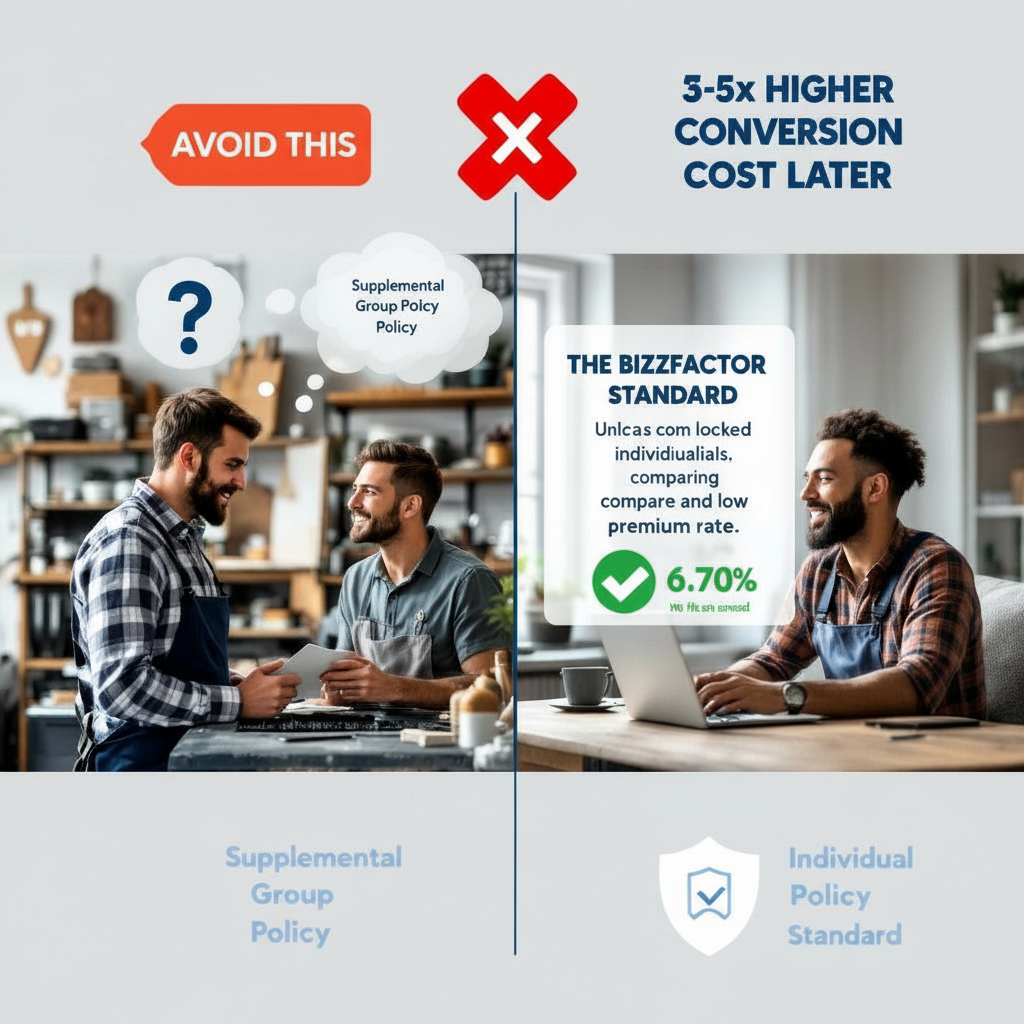
⚠️ Critical Warning: The 'Conversion Trap' in Supplemental Group Policies
Real talk — be exceptionally wary of relying exclusively on supplemental group policies, even if their initial 'cost' seems incredibly appealing. We see pros fall into this trap constantly: they believe these policies can be easily converted into more affordable individual plans later on.
This is a mirage.
Conversion rates for these specialized group policies can run **3-5 times more expensive** than simply securing an independent policy when you're healthy. You're not getting a discount — you're pre-paying for a significantly inferior and more expensive deal down the road. **Our recommendation: Build robust, independent individual coverage as your primary foundation. Treat any employer-provided group coverage as a valuable bonus layer.** It's icing, not the cake.
BizzFactor's Expert Recommendation for Tradespeople
Here's the deal: group coverage is like wearing generic work gloves. Better than nothing, sure. But is it enough for high-risk environments? Not usually.
For real security, individual coverage is essential (and I mean actually essential, not marketing-speak essential). Ideally, work with specialists who understand the unique dangers tradespeople face. Many general insurers won't cut it. Reputable providers like Haven Life, PolicyGenius, or dedicated independent brokers who specialize in high-risk occupations can offer tailored policies.
For a deeper dive into the specific considerations, don't miss our comprehensive guide on [life insurance for contractors](https://bizzfactor.com/articles/life-insurance-for-contractors). It's required reading.
What Far Too Many Guides Simply Overlook: Living Benefits
Instead of obsessing over death benefits, focus on what happens if you're injured but alive. You're a roofer — 34 years old — and you take a fall. Shattered pelvis, six-month recovery, maybe permanent limitations. You need cash *now* to keep the lights on. Not a payout to your widow someday.
Think about it.
If you're flat on your back after a fall from a roof — alive, but unable to work for 18 months — you need money *now*. Not when you're dead. Good individual policies let you tap 50-90% of your death benefit early if you're diagnosed with a terminal illness, suffer a catastrophic injury, or face a career-ending disability. A roofer in Marietta used this after a spinal cord injury in 2019 — pulled $340,000 from his $500K policy while still alive. Paid off medical bills, kept his mortgage current, sent his daughter to Georgia Tech.
That's what living benefits do. It's not about dying; it's about *living* through a crisis. That's the real killer — unexpected medical bills.
Individual Life Insurance: Comprehensive, Flexible, and *Yours*

Here's what you own with an individual policy: coverage that goes where you go. No employer controls it. You switch jobs? Covered. Start your own business? Covered. Get fired? Still covered.
Period.
You're buying a policy in *your* name — not your employer's group master policy where you're just a certificate holder (fancy term for "you don't actually own this"). A plumber I worked with in Seattle launched "Pipes & Pros Plumbing" in 2021. His old boss's group plan? Cancelled the day he gave notice. His $750K individual Northwestern Mutual policy? Didn't even blink. Kept right on protecting his family.
So what do you actually get?
- **Way Higher Coverage Limits:** We're talking $100K to $10 million+, depending on what your family actually needs (not what some HR department decided was "enough").
- **Your Premium Stays Put:** Lock in your rate when you're 32 and healthy. It won't budge when you're 48 with high blood pressure.
- **You're the Boss:** Pick your own beneficiaries. Change the terms. Adjust payment schedules. Zero corporate interference.
- **Build It Your Way:** Tack on disability riders, critical illness coverage, accidental death stuff — whatever fits your actual work risks.
- **Cash Value Option:** Some permanent policies let you build tax-deferred cash. Borrow against it or pull it out later. It's like a financial Swiss Army knife.
The biggest advantage? Control and stability. You dictate the coverage amount, policy type, and features. No employer can cancel it or change terms on a whim.
Here's the thing: yeah, initial costs might look higher than a "free" group policy (which isn't really free, let's be honest). But you're not just buying insurance — you're investing in genuine, long-term financial protection for your family. That's a huge difference.
Cost Deep Dive: Group vs. Individual Premiums
Group insurance usually costs you less upfront (or nothing) because your employer kicks in money. But individual policies? They're almost always the better long-term deal. Why? Locked-in rates. Guaranteed insurability even if your health tanks. Way more coverage flexibility as your life changes.
Sure, at first glance, group looks cheaper. Your boss pays half (or all) of it, right? But here's what they don't tell you: you're paying into a giant insurance averaging pool. Young, healthy 28-year-old electrician? You're subsidizing the 57-year-old dispatcher with a heart condition. That's just math.
Individual premiums work totally differently. The insurance company looks at *you* — just you — and prices accordingly:
- Your precise age and current, documented health status.
- The specific occupational risks inextricably linked to your trade (e.g., the dangers of roofing, the electrical dangers of high-voltage work).
- Your lifestyle choices – whether you smoke, engage in hazardous hobbies like competitive skydiving, or have a clean bill of health.
- The chosen coverage amount and the specific policy type ([term vs. whole life insurance](https://bizzfactor.com/articles/term-vs-whole-life-insurance)), which dramatically impacts cost.
So yeah, individual coverage might cost more out-of-pocket initially. But here's the trade: your rates are typically **locked-in for the term
In-Depth Look
Detailed illustration of key concepts

Visual Guide
Infographic illustration for this topic
Side-by-Side Comparison
Visual comparison of options and alternatives
Sources & References
- Group vs. Individual Life Insurance: What Are Your Options?
- Individual Benefits Insurance vs. Voluntary Benefits Insurance
- Should I Get Life Insurance Through My Employer?
- The Ultimate Guide to a Good Benefit Plan for Employees - Mployer
- Group vs. Individual Benefits Plans: What Works Best for Your Team?
- Building Codes, Standards, and Regulations: Frequently Asked ...
- [PDF] Building Codes Toolkit for Homeowners and Occupants - FEMA
- Building Codes and Standards - 101 Guide | ROCKWOOL Blog
- Florida Product Approval (FL#) - Florida Building Code Online
- [PDF] Introduction to Model Codes
Frequently Asked Questions
Need Professional Help?
Find top-rated insurance services experts in your area