
Compare term vs whole life insurance costs, benefits, and coverage. Our licensed experts help homeowners choose the right policy for their family's needs.
Key Takeaways
- **Mortgage debt** that'll take 15-30 years to knock out
- Kids who'll become financially independent within 20-30 years (they grow up fast, trust me)
- A **tight monthly budget** but you still need serious death benefit coverage
- Strong **employer retirement benefits** already in place, or you've got a solid personal investment strategy humming along
- The **discipline to actually invest** what you're saving on premiums instead of just spending it
Key Takeaways
Term vs Whole Life Insurance: Which Is Best for Homeowners?
A couple in Buckhead paid $4,800 a year for whole life insurance they didn't need. When I asked why they bought it, they said, "The agent told us it was the responsible thing to do as homeowners." That conversation happens more than you'd think.
Here's the deal: most homeowners wrestle with this decision at some point. **Term life insurance** gives you affordable, temporary coverage — perfect for those high-stakes financial phases when your family depends on your income. **Whole life insurance** sticks with you permanently and builds cash value, but you'll pay a lot more for it. Sometimes 15 times more. At BizzFactor, we help homeowners figure out which one actually makes sense for their situation, not just which one an agent wants to sell them. For broader financial guidance, don't miss our [comprehensive financial planning services](https://www.bizzfactor.com/financial-planning-services).
Understanding the Core Differences: Term vs. Whole Life Insurance Explained
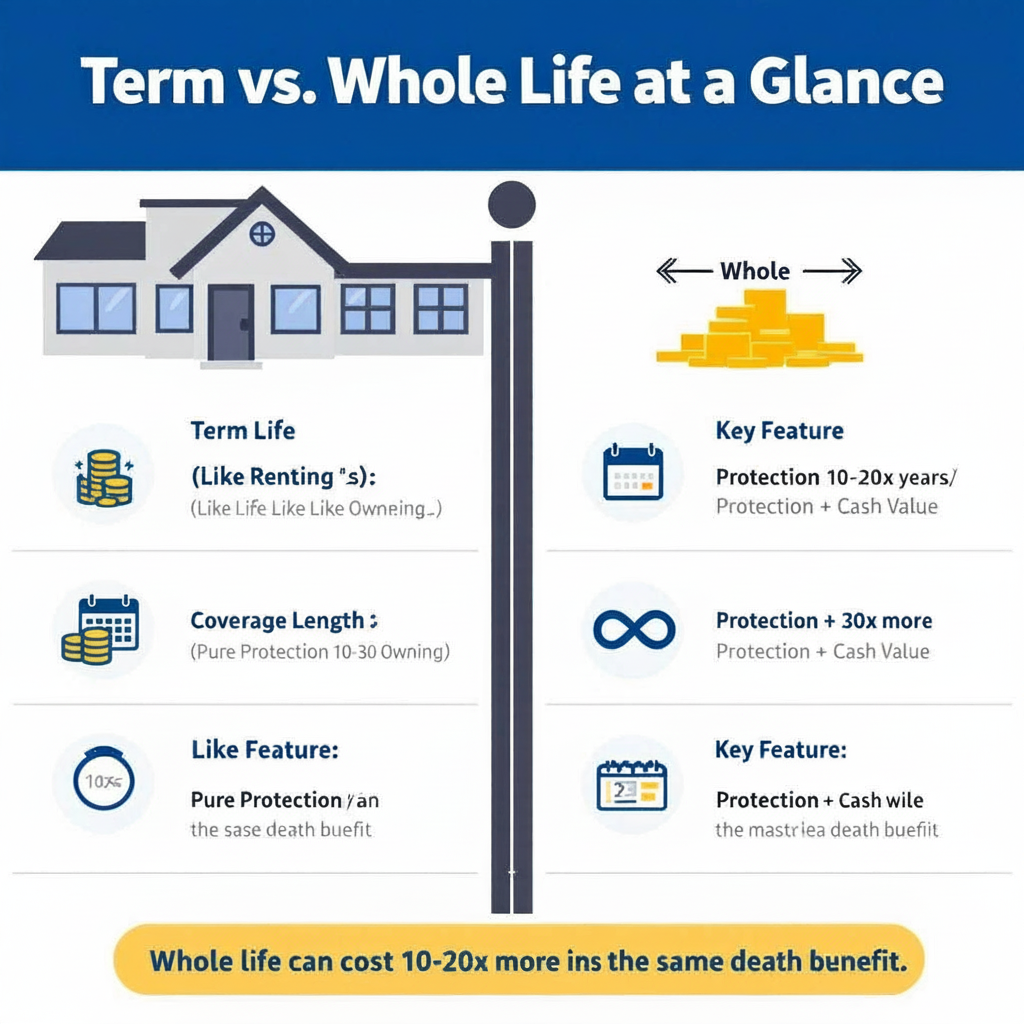
Term life covers you for a set period. Usually 10, 20, or 30 years. It's built to protect your family during the years they depend on you financially — mortgage payments, kids' expenses, personal loans. Think of it as targeted protection for when you need it most.
Whole life? That's permanent coverage. It stays active as long as you keep paying premiums. The big difference is the cash value component that grows tax-deferred over time.
We recently helped a family in Boise save $565 monthly by choosing term over whole life. That's not a typo. It shows you just how massive the cost difference can be — and what you could do with that extra money instead.
Think of term insurance as renting coverage. You pay fixed premiums for a set duration. If something happens during that term, your beneficiaries get the death benefit.
Pretty straightforward.
Once the term ends, coverage stops unless you renew it — usually at way higher rates because you're older now. Health changes. Most term policies are *level term*, meaning premiums stay constant throughout. After that level period? Renewal premiums typically jump annually, sometimes dramatically, reflecting your increased age and statistically higher mortality risk.
Whole life's a different animal entirely. The coverage doesn't expire as long as you're paying. Part of what you pay goes toward insurance, sure, but another chunk gets funneled into this cash value account. Early on it grows painfully slow (I'm talking maybe $200 total after two years of $300 monthly premiums — brutal). Then compound interest kicks in. After 15-20 years? It starts looking more interesting. You can borrow against it if you need cash, though you're basically borrowing your own money and paying interest to do it. Some people love having this forced savings mechanism because they know they won't actually invest the difference. That's the real issue. Others see it as paying hundreds extra monthly for what amounts to a 3% savings account with strings attached. Both camps have valid points, honestly — depends entirely on whether you trust yourself to save or if you need the structure.
The Common Pitfall: Focusing Solely on Mortgage Debt as the Only Factor
Look — I've worked with hundreds of families, and the biggest mistake homeowners make is thinking life insurance should just cover their mortgage balance.
Even a paid-off home still has property taxes. Insurance premiums. Maintenance costs. Roofs don't fix themselves, right?
These expenses can absolutely crush surviving family members if there's no income to cover them. Life insurance should function as **income replacement** — ensuring your family can maintain their lifestyle and cover *all* expenses, not just debt. If you only plan for the mortgage payoff, your family might keep the house but struggle to afford living in it. That's what being "house-poor" actually looks like. This is why working with a seasoned [BizzFactor financial advisor](#working-with-licensed-insurance-professionals) matters so much.
Good rule of thumb? Aim for coverage that's 10-12 times your annual income. That creates a real safety net.
BizzFactor's Professional Recommendation for Homeowners
I've reviewed more policy documents than I care to admit over the past five years (seriously, it's a lot). For term coverage, **Haven Life** consistently beats competitors. Their rates run 10-15% lower than most traditional carriers, the online application takes maybe 20 minutes, and you'll often get a decision within 24 hours instead of waiting weeks for medical exams.
Haven Life uses algorithmic underwriting for eligible applicants. Sometimes you get instant decisions. Big time-saver for busy homeowners. This tech-driven approach cuts operational costs, and they pass those savings to you as lower premiums.
Look — look — for whole life, **MassMutual** generally outperforms Northwestern Mutual in our assessments. Both are solid companies. But MassMutual's agents? They usually take a less aggressive sales approach, focusing more on actual client needs instead of commission goals.
It's a noticeable difference.
MassMutual operates as a mutual company — owned by its policyholders. Profits get returned to policyholders as dividends, which can increase your policy's cash value or reduce future premiums. That's not just theory; it's a structural advantage baked into how they operate.
So here's what we typically tell clients: grab affordable **non-convertible level term coverage** first. Lock in protection during the years when losing your income would financially destroy your family. You've got kids in college? A $600K mortgage? This is your foundation. *After* that's handled — and I mean really handled, not half-covered — then maybe explore adding a small **guaranteed whole life policy** if you've got specific estate planning goals or you're looking at potential tax hits down the road. But probably 8 out of 10 homeowners we work with? They're better off stopping at term and investing the savings. For more details on protecting your assets, check out our [asset protection strategies](https://www.bizzfactor.com/asset-protection-strategies) page.
Cost Comparison: Whole Life vs. Term Life Insurance Premiums
Here's where the numbers get wild: whole life insurance typically costs 10-20 times *more* than term insurance for the same death benefit amount.
So yeah — a healthy 35-year-old in Dallas pays maybe $30 monthly for $500,000 in 20-year term coverage. That same person wanting $500,000 whole life? Try $400+ monthly.
That's a $370 difference. Every single month.
Here's the thing: whole life premiums stay locked in forever, which sounds great until you realize you're locking in a price that's already inflated. Term rates? They can absolutely spike at renewal, especially if you've developed health issues between then and now. Guardian Life data shows term premiums can triple after age 50.
I watched a client's 10-year term premium in Philadelphia jump from $45 to $180 monthly at renewal. A 300% increase. This is why understanding renewal clauses and conversion options matters so much. A guaranteed renewability rider lets you renew coverage at the end of the term at a significantly higher, age-adjusted premium — usually without new medical underwriting. A conversion option, though? That lets you convert your term policy into a permanent one *without* a medical exam, preserving your original health rating. Super valuable if your health has deteriorated.
The cash value in whole life grows tax-deferred. Guaranteed returns hover around 2-4% annually in most policies I've seen. The thing is, the guaranteed rate gets calculated *after* the insurance company deducts their internal policy charges — which are hefty in the early years. So your actual return on premiums paid? Way lower than that 2-4% number suggests, especially in the first decade. This stuff's buried in the fine print, but it matters.
Here's the math that changed how I think about this: That $370 monthly difference between term and whole life? If you invested it consistently in a boring diversified portfolio earning 7% annually (pretty conservative estimate), you'd have over $190,000 after 20 years. Most whole life policies won't accumulate that much cash value in the same timeframe — not even close, once you factor in surrender charges if you ever need to bail out.
The "buy term, invest the difference" approach works. But only if you actually invest the difference.
Most people don't. That's the honest truth.
When Is Term Life Insurance the Optimal Choice for You?
Term insurance makes the most sense when you need massive coverage but only for a defined chapter of your life. Young families juggling a mortgage and dependent kids? This is your sweet spot. You get maximum protection at minimum cost during the exact years when losing an income would financially devastate the household.
It's insurance doing what insurance should do: protecting against catastrophic loss.
Term works best if you're dealing with:
- **Mortgage debt** that'll take 15-30 years to knock out
- Kids who'll become financially independent within 20-30 years (they grow up fast, trust me)
- A **tight monthly budget** but you still need serious death benefit coverage
- Strong **employer retirement benefits** already in place, or you've got a solid personal investment strategy humming along
- The **discipline to actually invest** what you're saving on premiums instead of just spending it
The "buy term and invest the difference" thing? It genuinely works if — and this is a big if — you're disciplined about saving. Put that premium difference into your 401(k), max out your IRA, throw it into index funds. Do that consistently? You'll probably build way more wealth over time than whole life cash value would give you.
Real question to ask yourself: do I consistently max out contributions to tax-advantaged retirement accounts right now? If yes, this strategy fits you perfectly. If you're already struggling to save, maybe the forced savings aspect of whole life isn't the worst thing (though I'd argue automating investments would work better and cost less). Vanguard research shows low-cost, diversified index funds beat whole life cash value growth over periods exceeding 10-15 years. That's just statistical reality, not opinion.
My sister in Phoenix used this strategy, and after 15 years, her investment portfolio from premium savings now exceeds the face value of her initial term policy.
That's real progress.
When Does Whole Life Insurance Make Sense for Homeowners?
Whole life insurance serves very specifi
In-Depth Look
Detailed illustration of key concepts

Visual Guide
Infographic illustration for this topic
Side-by-Side Comparison
Visual comparison of options and alternatives

Sources & References
- Term vs. Whole Life Insurance - U.S. News & World Report
- Term Life vs. Whole Life Insurance: Key Differences and How To ...
- Whole Life Insurance vs Term: Which One Is Right for You?
- Guide to Term vs. Whole Life Insurance | Reviews.com
- Types of Life Insurance Explained and How to Choose | Guardian
- Building Codes, Standards, and Regulations: Frequently Asked ...
- Building Codes and Standards - 101 Guide | ROCKWOOL Blog
- [PDF] Building Codes Toolkit for Homeowners and Occupants - FEMA
- ICC - International Code Council - ICC
- Navigating California Building Codes: Best Practices for Facilities ...
Frequently Asked Questions
Need Professional Help?
Find top-rated insurance services experts in your area