
Discover 2025 junk removal costs: average $133-$372. Learn how volume, item types, and accessibility impact pricing with a professional guide.
Key Takeaways
- **Volume of Junk**: This is typically the biggest cost driver, directly correlating with the space your items occupy in a removal truck.
- **Type of Junk**: Certain items require special handling or disposal, leading to additional fees.
- **Accessibility**: Ease of access to the items can impact labor time and, consequently, the final cost.
- **Electronics (E-waste)**: TVs, computers, and other electronics must go to certified e-waste facilities, incurring fees of **$25-$50 per item**.
- **Appliances**: Old fridges and freezers? They're a pain. Refrigerant recovery is legally required before you can dump them — EPA doesn't mess around on this one — so tack on **$50-$100** extra. A washing machine's simpler, usually no surcharge. But that old fridge from 1997 sitting in your garage? Yeah, that's gonna cost you.
Key Takeaways
Junk Removal Costs 2025: A Professional Pricing Guide
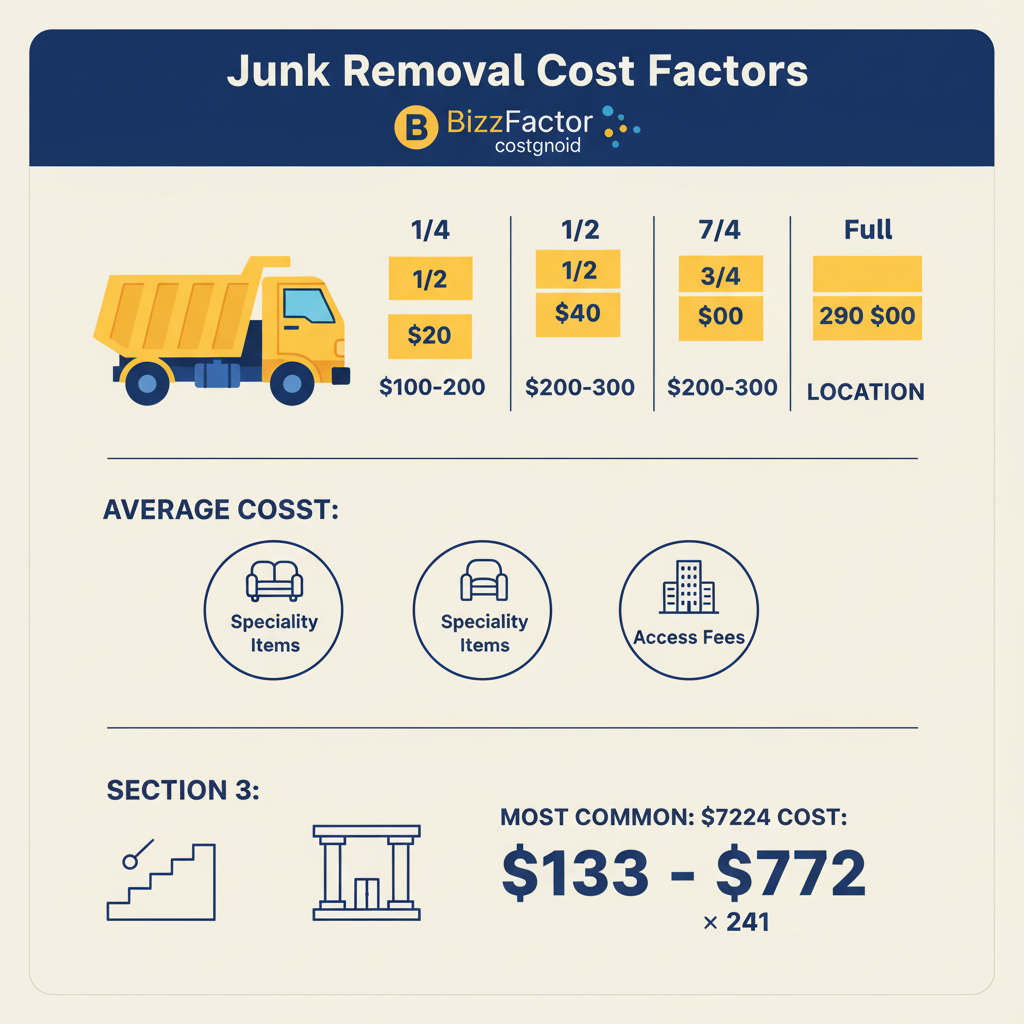
Facing a cluttered space and need items hauled away? The average cost for professional junk removal typically ranges from **$133 to $372**, with most homeowners spending around **$241**. However, the actual price can vary significantly based on the volume and type of items you need to dispose of, along with other factors specific to your situation.
Key Factors Influencing Junk Removal Costs
Here's what actually determines the price — and I mean this from running thousands of jobs where homeowners called back shocked their $200 estimate turned into $500:
- **Volume of Junk**: This is typically the biggest cost driver, directly correlating with the space your items occupy in a removal truck.
- **Type of Junk**: Certain items require special handling or disposal, leading to additional fees.
- **Accessibility**: Ease of access to the items can impact labor time and, consequently, the final cost.
How Much Does Junk Removal Cost by Volume?
So here's how pricing usually works: companies charge based on truck space. You're basically renting a portion of their hauling capacity.
A quarter load? That's **$100-$200**. Perfect for one big item — maybe a couch or a broken dishwasher.
Half the truck runs **$200-$300**. You could clear out a bedroom, probably a small home office too.
Three-quarters? You're looking at **$300-$400**. I've done garage cleanouts for this price dozens of times.
Full truck load hits **$400-$600** (sometimes more if you're in a pricey metro area). Whole-house cleanouts, construction debris from a bathroom reno, estate situations where everything's gotta go.
Look — consider a client who initially requested removal for "just mom's living room." This seemingly small task evolved into requiring three full trucks at $485 each, as the volume of items was far greater than anticipated. Always assess your junk accurately to avoid surprises.
What Items Cost More to Remove?
Okay, here's where it gets expensive. Certain stuff can't just get tossed in a landfill — environmental regulations and safety concerns mean extra processing fees:
- **Electronics (E-waste)**: TVs, computers, and other electronics must go to certified e-waste facilities, incurring fees of **$25-$50 per item**.
- **Appliances**: Old fridges and freezers? They're a pain. Refrigerant recovery is legally required before you can dump them — EPA doesn't mess around on this one — so tack on **$50-$100** extra. A washing machine's simpler, usually no surcharge. But that old fridge from 1997 sitting in your garage? Yeah, that's gonna cost you.
- **Hazardous Materials**: Paint, chemicals, motor oil, and old batteries need special handling and disposal methods.
- **Construction Debris**: Heavy materials like concrete, asphalt, and drywall are often priced separately due to their weight and specific recycling requirements.
Many consumers are unaware that a common household item like an old refrigerator can't simply be tossed into a standard dumpster.
How Do Access Issues Affect Pricing?
How hard is it to actually get your stuff from where it's sitting to the truck? That question determines a big chunk of your labor costs:
- **Stairs**: Expect an additional **$50-$100** for items located upstairs or in a basement.
- **Long Carrying Distances**: If the truck can't park close to the removal site, an extra **$25-$75** may be added.
- **Difficult Access**: Narrow doorways, tight hallways, or items requiring disassembly will incur additional labor charges.
For example, a third-floor apartment cleanout quoted at $300 ended up costing $475 due to the three flights of stairs involved. Always discuss potential access fees during the quoting process.
Real Pricing Example: Comprehensive Estate Cleanout

Let's walk through a recent 2,500-square-foot estate cleanout. The homeowner initially believed it would be a straightforward job—"just get rid of everything."
The costs broke down like this:
- **Initial Estimate**: Two full truck loads at $485 each.
- **Unforeseen Items**: Discovery of an old refrigerator, several paint cans, and various electronics. That's where things got complicated.
- **Special Disposal Fees**: An additional **$175** for hazardous materials and e-waste.
- **Final Total**: **$1,145**.
Good companies won't hit you with surprise fees after the work's done. They'll call you when they find something unexpected — "Hey, we found paint cans and an old fridge. That's gonna add about $175. Want us to take them or leave them?" That's how it should work.
Understanding Service Types: Full-Service vs. Basic Hauling
So what're you actually paying for? There's basically two ways this plays out:
- **Full-Service Removal**: The crew does it all — sorting through your mess, carrying everything out (even that dusty armoire stuck in the corner), loading the truck, hauling it off, and sweeping up afterward. You point and watch. Costs about **20-30% more**, but honestly? Worth every penny if you've got a bad back or zero patience for this stuff.
- **Basic Hauling**: You're the crew. You sort everything, drag it all to your driveway or garage (hopefully the ground floor), and they just load and drive away. Cheaper, sure — but you're doing the heavy lifting. Literally.
I had a guy in Sandy Springs try to save $80 by doing basic hauling on a basement cleanout. Threw his back out moving an old water heater up two flights. Ended up paying a chiropractor $400. Do the math.
Specialty Item Removal Costs
Some stuff just costs more. Period. The reasons vary — weight, hazmat processing, specialized recycling — but you'll pay extra for these.
Appliance Removal Costs
Fridges? Man, they're the worst. Federal law says you can't just dump refrigerants into the atmosphere (ozone layer and all that), so a certified tech has to recover the coolant first. That's your **$50-$100** surcharge right there. Washing machines are way easier — usually no extra fee. HVAC units, though? Central air systems can run **$200-$400** because you're dealing with both refrigerant and a bunch of heavy metal components that need proper recycling.
Electronics and E-Waste Pricing
Here's the weird part about electronics pricing — it's all over the map. That old TV from 2008? Probably **$25-$50** to haul off because there's basically no resale value and e-waste recycling ain't cheap. But your desktop computer (even if it's ancient)? Some companies might take it for free. Why? Recyclers can pull gold, copper, and other metals from motherboards and hard drives. I've even seen services pay a few bucks for bulk computer equipment.
Here's the thing: now, don't assume every company does this. State laws vary wildly on e-waste — California charges you, Texas doesn't care as much, and Connecticut basically requires certified destruction for certain devices. Professional haulers know these rules (or they should), which keeps you from getting slapped with fines down the road.
Geographic Factors Affecting Junk Removal Prices
Real talk — your zip code matters. A lot.
Urban areas cost more than rural ones, usually by a significant margin. I'm talking **30-50% higher** in places like Atlanta or Boston compared to small towns an hour outside city limits. Why? Dump fees are steeper in metro areas. Labor costs more (crew's gotta afford rent somewhere). Traffic eats time, and time is money. Insurance runs higher. It all adds up.
Coastal cities? Premium rates across the board. Miami, San Diego, Seattle — you're paying top dollar. Inland towns in Georgia or upstate New York? Usually cheaper.
But here's the twist: if you're way out in the sticks — like an hour from the nearest licensed disposal facility — some companies will hit you with travel surcharges that erase any savings. I quoted a job once near a tiny mountain town. Customer loved the low base rate until I mentioned the $75 trip fee. Yeah, not so thrilled after that.
How to Get Accurate Junk Removal Quotes
Want an actual number instead of a wild guess? Professional services need to either see your stuff in person or get detailed photos. Companies that quote over the phone based on your vague description ("I've got some junk in the garage") are setting you up for sticker shock. Reputable services will:
- **Conduct On-Site Inspections**: For larger jobs, an in-person visit ensures all factors are considered.
- **Request Detailed Photos**: For smaller jobs, clear photos can help with an initial estimate.
- **Provide Written Estimates**: A comprehensive written quote should detail all costs, including labor, disposal fees, and any specialty item handling, preventing unexpected charges.
When Does Professional Junk Removal Make Sense?
Sure, you could rent a U-Haul and do it yourself. Seems cheaper, right?
But factor in the rental fee (**$50-$100** for a truck, probably more on weekends), gas (**$30-$50** depending on mileage), dump fees at the landfill (**$40-$80** per load in most places), and — oh yeah — your entire Saturday. Plus the risk of throwing your back out or breaking something valuable on the way down the stairs.
Professionals finish most jobs in 2-4 hours. You're done before lunch. They handle disposal regulations (trust me, there's more rules than you think), they've got the equipment to move heavy stuff safely, and if they damage something, their insurance covers it. That peace of mind's worth something.
Essential Questions to Ask Your Junk Removal Provider
Don't just hire the first company that answers the phone. Ask these questions — and if they dodge any of them, move on:
1. **"So what's actually in the price you quoted me?"** Make them spell it out: labor, dump fees, taxes, gas surcharges (some companies sneak those in). Get it in writing.
2. **"What if my stuff's upstairs? Or way in the back of the yard?"** Stair fees and long-carry charges can add $50-$100 real quick.
3. **"How do you deal with old paint cans? Or my busted fridge?"** If they shrug or say "we just toss it all in the truck," that's a red flag. Hazmat and e-waste have rules.
4. **"You got insurance? Can I see the certificate?"** Don't take their word. If they drop your grandma's dresser through the drywall, you want them covered.
5. **"Got any recent customers I can call?"** Good companies hand over references without blinking. Sketchy ones make excuses.
A buddy in Marietta hired a "junk guy" off Craigslist who quoted $150. No insurance, no license. Dude backed his truck into the garage door ($800 damage) and vanished. You get what you pay for.
Saving Money on Junk Removal
Strategic preparation can help reduce your overall costs:
- **Consolidate Items**: Gather all junk in one easily accessible location, ideally on the ground floor or near the entrance.
- **Sort Recyclables**: Separate items that can be recycled (e.g., cardboard, paper, certain plastics). Some companies offer discounts for pre-sorted recyclables.
- **Donate Usable Items**: If items are in good condition, consider donating them to charities. Some junk removal companies partner with donation centers for *[furniture removal](https://www.bizzfactor.com/services/furniture-removal)* or *[appliance disposal](https://www.bizzfactor.com/services/appliance-disposal)*.
Our Professional Recommendation
For general household junk, most reputable haulers will suffice. However, for specialized items like construction debris, electronics, or hazardous waste, opt for companies with specific certifications and expertise in those areas. Companies with solid environmental compliance track records offer peace of mind — you're not risking fines for improper disposal, and you're not contributing to illegal dumping (which, yeah, still happens).
Making the Right Investment Decision
Look, hiring pros isn't just about avoiding a sweaty Saturday. It's about knowing your stuff gets handled right — recycled where it can be, disposed of legally where it can't, and not dumped in some ditch off Highway 85 (yeah, that happens with fly-by-night operators).
Now, good junk removal companies follow environmental regs, carry proper insurance, and won't leave you with a surprise bill that's double the estimate. That's not marketing fluff — that's the baseline you should expect.
Our team? We're fully licensed, insured, and we'll tell you upfront if something's gonna cost extra. No surprises, no shortcuts. That's just how you do business if you want repeat customers instead of one-star Yelp reviews.
The Bottom Line on Junk Removal Costs
For typical home projects, budget approximately **$200-$400**. For projects involving specialty items or extensive volumes, anticipate an additional **20-30%** or more. Always insist on written estimates that detail all potential fees. Investing in professional junk removal isn't just about convenience; it's about making sure the job is done right, the first time. For more information on specific services, explore our guides on *[ho
In-Depth Look
Detailed illustration of key concepts

Visual Guide
Infographic illustration for this topic
Side-by-Side Comparison
Visual comparison of options and alternatives
Sources & References
- How Much Does Junk Removal Cost? - LoadUp
- Understanding Junk Hauling Costs: What You Need to Know
- How Much Does Junk Removal Cost? [2025 Data] - HomeAdvisor
- Junk Removal Pricing For Beginners - YouTube
- How Much Does Junk Removal Cost? - Extra Space Storage
- Building Codes, Standards, and Regulations: Frequently Asked ...
- Florida Product Approval (FL#) - Florida Building Code Online
- Building Codes and Standards - 101 Guide | ROCKWOOL Blog
- [PDF] Building Codes Toolkit for Homeowners and Occupants - FEMA
- ICC - International Code Council - ICC
Frequently Asked Questions
Need Professional Help?
Find top-rated junk removal experts in your area